
In this post, you will discover the most recommended tourist attractions in Busan and the surrounding area.
At the end, you will find a map with all the places marked.
Find your ideal hotel at the best price in Busan with Agoda:

*It helps us maintain the blog
01. Haedong Yonggungsa Temple (해동용궁사)
Haedong Yonggungsa Temple is a Buddhist temple located in Gijang-gun. Its motto is ‘At least one of your wishes will be granted through your sincere prayers.’
Legend has it that it was founded by the great monk Naong (1320–1376), who was King Gongmin’s advisor. While practising asceticism at Bunhwang Temple in Gyeongju, the nation was hit hard by a drought that killed crops and caused famine among the people.

One day, a sea god appeared in Naong’s dream and said that if they built a temple on the edge of Bongrae Mountain and prayed there, all these hardships would disappear.
After that dream, Naong visited the area where Haedong Yonggung Temple now stands and saw that there was a mountain in front and the sea behind, which means that if they pray in the morning, they receive an answer in the afternoon.
There he built a temple called Bomun and named the mountain Bongrae. The word “Bongrae” means something mysterious and pure to which hermits with great understanding descend. The word “Bomun” means the absolute and unlimited power of the Great Goddess Buddha of mercy, called Gwanseumbosal in Korean.

It was destroyed during the Japanese invasion and rebuilt by the monk Ungang, from Tongdo Temple, in the 1930s.
It is one of the few temples in South Korea located by the sea and is very popular with tourists. It is truly wonderful to visit this haven of peace.
How to get there: Bus lines 100, 139, 181, 1001.
Opening hours: 4.30pm to 7pm.
Price: free.
ESSENTIAL VISIT
02. Jagalchi market (자갈치시장)
Jagalchi is the largest fish market in South Korea. Here you can find many stalls selling fresh fish, some of which are truly rare.
You can buy fish at the stalls and have it cooked right there so you can eat it on the go.
Most of the stalls are run by women known as Jagalchi Ajumma. ‘Ajumma’ means married or middle-aged woman in Korean.

How to get there: Jagalchi Station on Line 1 // Bus stop Jagalchi Station, BIFF Square on lines 8, 9, 11, 26, 70, 87, 103, 134, 171, 1000, 1003 and 1004.
Opening hours: every day from 5 a.m. to 9 p.m.
Price: free.
ESSENTIAL VISIT
03. BIFF square
Busan is South Korea’s film mecca. Since 1996, the Busan International Film Festival (BIFF) has been held here. This is one of the most important film festivals in Asia.
One of the events held during the festival is the printing of the hands of famous film celebrities. Here we can find the handprints of many personalities from the world of cinema, including some Spaniards.
Since it began, the area has become filled with shops, cinemas and food stalls.
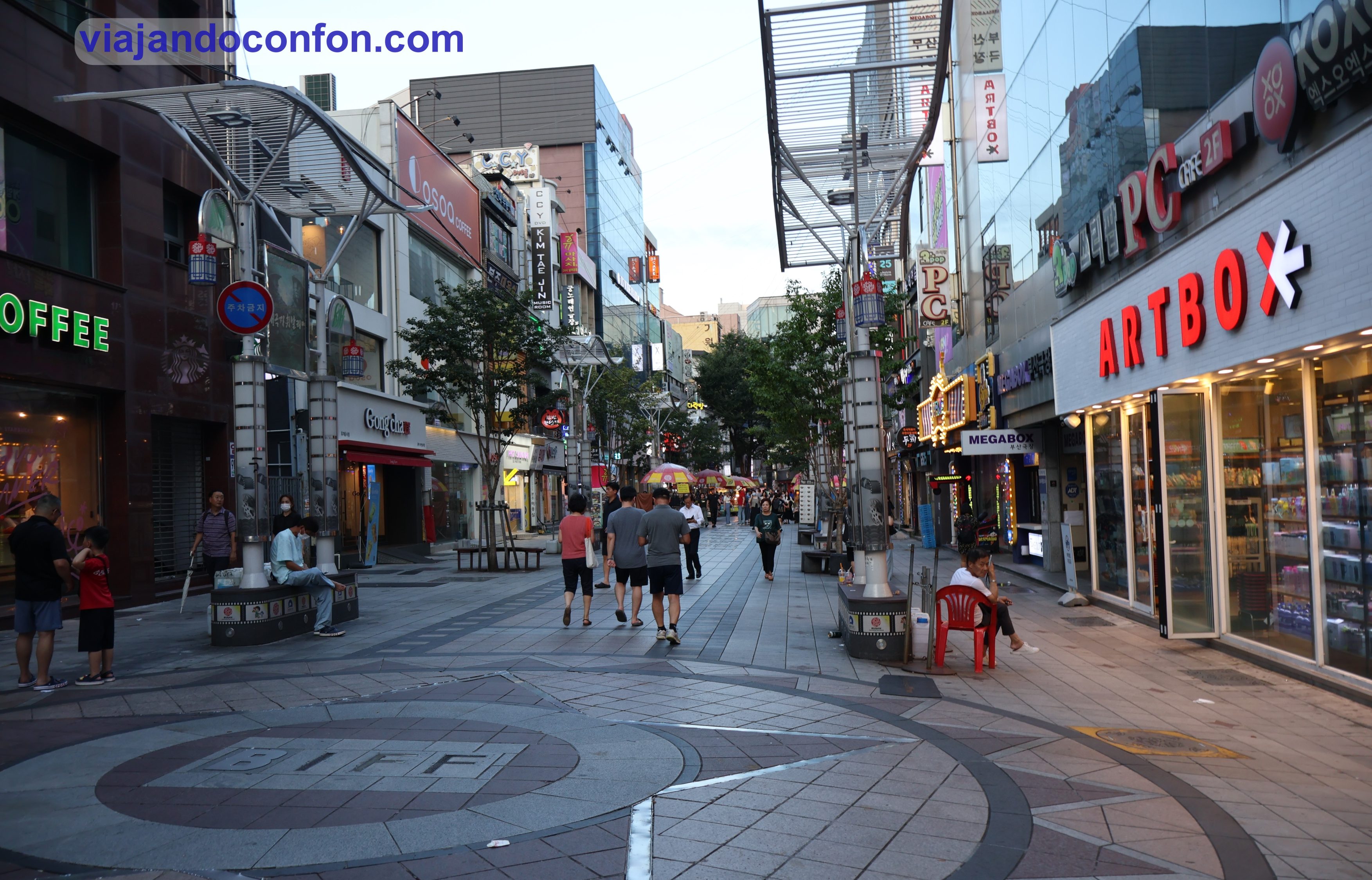

How to get there: Jagalchi Station on Line 1 // Bus stop Jagalchi Station, BIFF Square on lines 8, 9, 11, 26, 70, 87, 103, 134, 171, 1000, 1003 and 1004.
ESSENTIAL VISIT
04. Busan Tower – Diamond Tower (다이아몬드타워)
The tower was built in Yongdusan Park between 1972 and 1973. It was known as Busan Tower from its inauguration until 2021, when it was renovated and renamed Diamond Tower (다이아몬드 타워).
At 120 metres high, it offers spectacular views of Busan.

How to get there: Bus stop Jungang-dong Community Service Centre (중앙동주민센터) line 508.
Opening hours: every day from 10 a.m. to 10 p.m.
05. Beomeosa Temple (범어사)
Beomeosa Temple is a temple located on Geumjeongsan Mountain and is the headquarters of the 14th Diocese of the Jogye Order of Korean Buddhism.
It was founded by Master Uisang in the 18th year of King Munmu of Silla (678) as one of the Hwaeomsipchal temples in Haedong. Beomeosa Temple was established to realise the ideal world of the Avatamsaka Sutra on earth, a clean, pure and beautiful life filled with mutual help, understanding and happiness.
It is located on the outskirts of the city, nestled in a truly beautiful wooded setting, and it is a delight to walk around it.
Take a tour of the temple with us and find more information and photos of the temple in our travel diary.
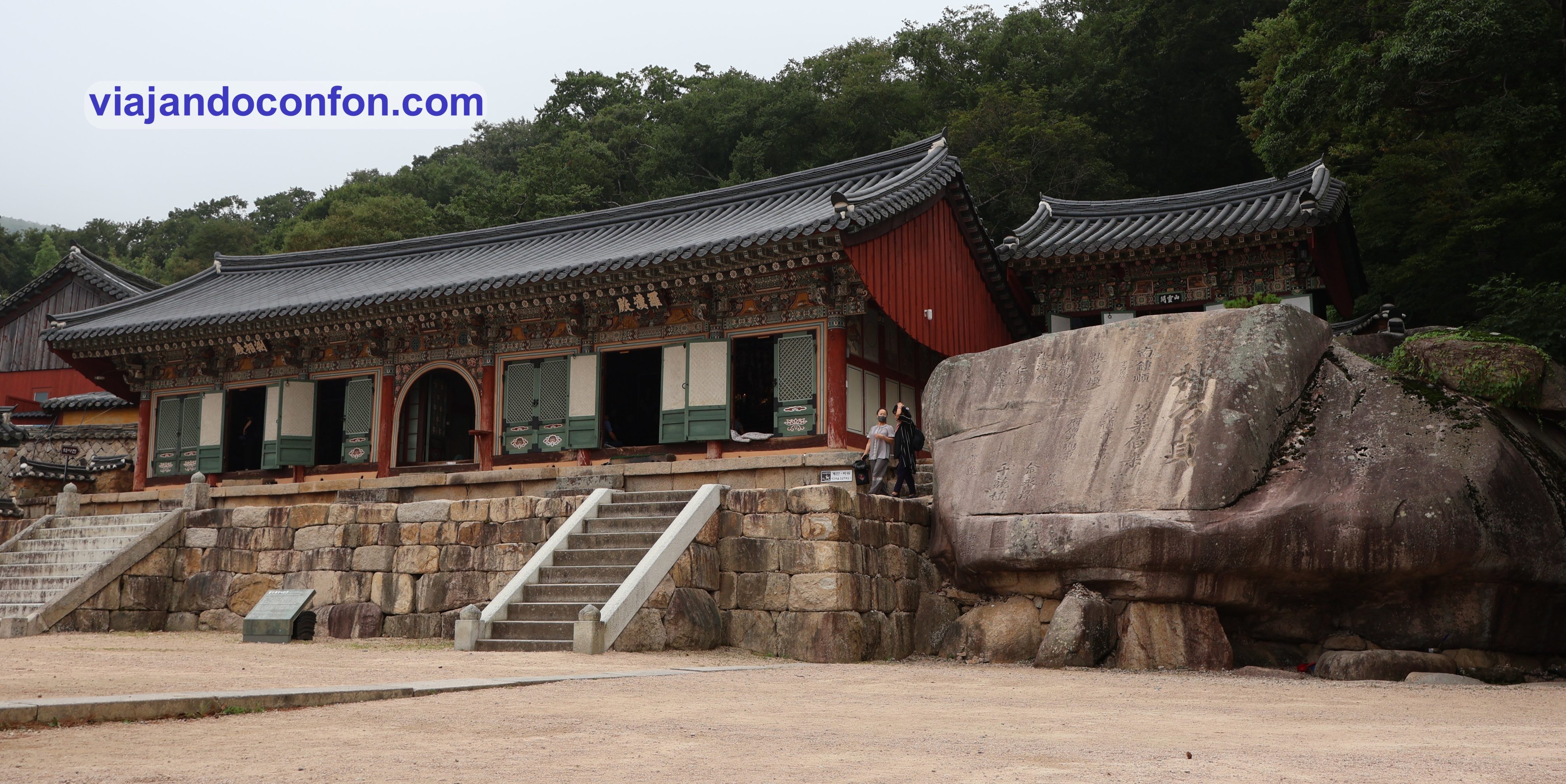
How to get there: Take metro line 1 to Beomeosa Station. Exit through Exit 5 and take the diagonal street behind you. After a couple of minutes, you will see the well-marked bus stop for the temple. From there, take bus no. 90, which goes directly to the temple. T-Money is valid.
Opening hours: every day from 8am to 5.30pm.
Price: free.
ESSENTIAL VISIT
06. Seokbulsa Temple (대한불교조계종 석불사)
It is a modern temple. It was founded by the monk Jo Il-hyeon in 1930 during the Japanese colonial period, when he was the head priest.
It is a small temple, but what is truly spectacular are the impressive sculptures of 16 Arhats and 29 Buddha statues carved into the rock wall.
The path is quite winding with a fairly steep slope in the last 500 metres. But I have to say it’s totally worth it. Anyway, I climbed it and I’m not exactly in the best shape. That said, you do need to wear comfortable shoes.
Find more information and photos about Seokbulsa Temple in our travel diary.
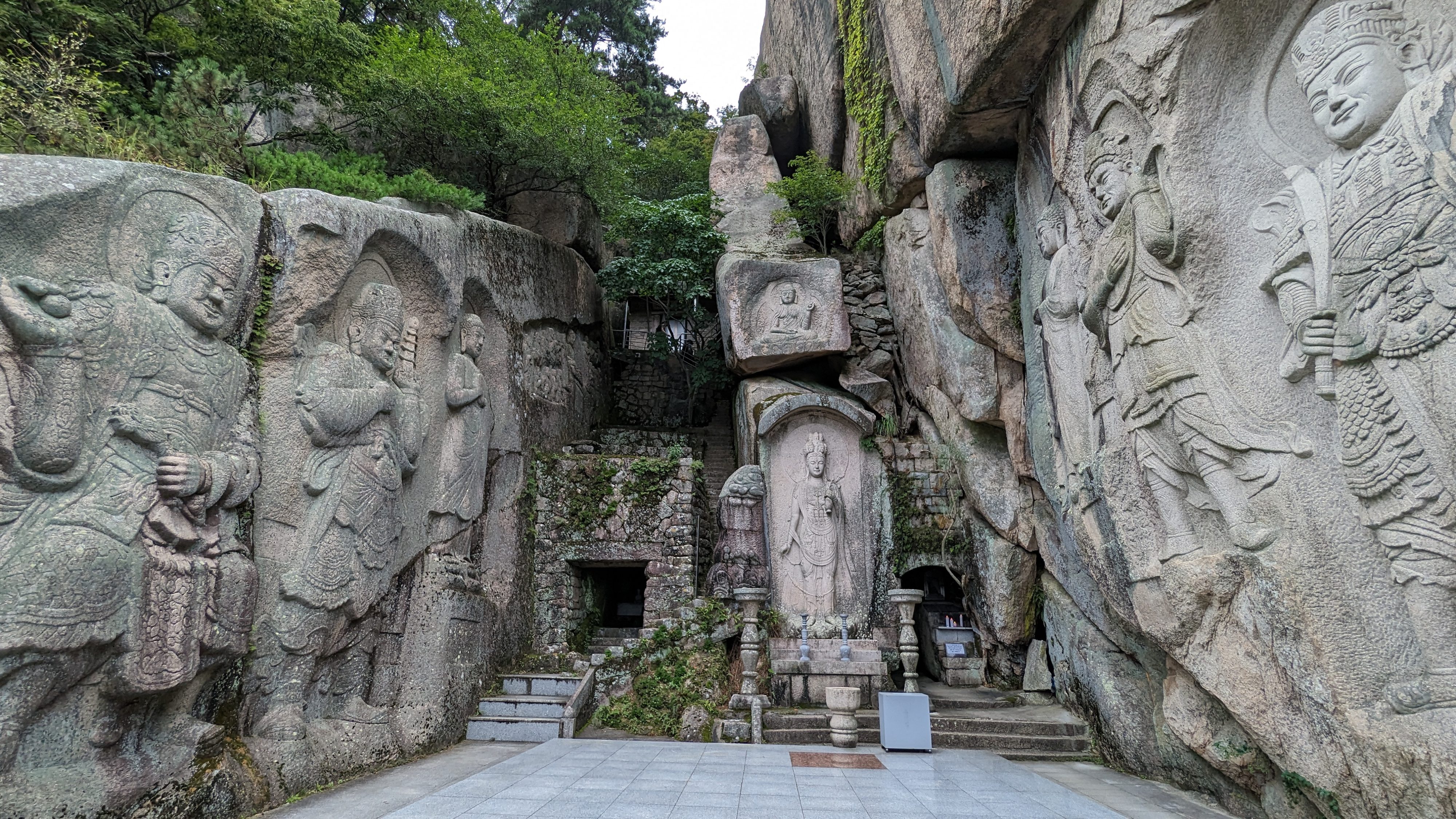
How to get there: Take metro line 3 to Mandeog station. Exit through exit 2 and turn onto Gumandeok-ro street. After about 10 minutes, you will reach a fork in the road, which is a slope called Mandeokgogae-gil. It is just past a small pedestrian bridge that crosses the road above your head.
The total distance from the station is about 2 km.

Hours: 7:00 to 16:30.
Price: free.
ESSENTIAL VISIT
07. Haeundae Traditional Market (해운대 전통시장)
The market stretches along several streets. Here you will find a multitude of food stalls, especially selling unusual fish. It is the perfect place to eat fresh fish that has just arrived at the port of Busan, the most important in South Korea.

How to get there: It is located very close to Haeundae Beach. Haeundae subway station, line 2.
Opening hours: Every day from 9:00 a.m. to 10:00 p.m.
Enjoy a wonderful guided tour of Busan with Civitatis:

*It helps us maintain the blog
08. Haeundae Beach (해운대해수욕장)
Haeundae is considered the best beach in Busan and is extremely popular in summer. It is a 1.5 km long beach with golden sand that attracts over 10 million tourists a year.
Numerous cultural events are held here, such as concerts, sand sculpture festivals, and much more.

How to get there: It is located very close to Haeundae Beach. Haeundae subway station, line 2.
09. Gunam-ro Street
This is the street that leads to Haeundae Beach. It is full of places to eat and shops. We also found it very interesting that there were many tarot card readers. Any time is a good time to have your fortune told…

How to get there: It is located very close to Haeundae Beach. Haeundae subway station, line 2.
10. Oryukdo Skywalk (오륙도 스카이워크)
Opened in 2012, this is a glass walkway from which you can see the Oryukdo Islands. These islands form an archipelago of five small rocky islands and are considered some of the most beautiful in South Korea.
Access to the skywalk is free, and you are given a shoe cover. Next to it is an information office, a convenience store, and a café where you can enjoy a drink while taking in the beautiful scenery.

How to get there: Buses 24, 27, and 131. Oryukdo Skywalk Bus Stop.
Opening hours: Every day from 9:00 a.m. to 6:00 p.m.
Price: Free.
HIGHLY RECOMMENDED VISIT
Follow us on social media:
11. Tongdosa Temple (조계종 통도사)
Tongdosa (Salvation of the world through mastery of truth) is a main temple of the Jogye Order of Korean Buddhism and is located on the southern part of Mount Chiseosan.
It is not actually located in Busan, but in the city of Yangsan, north of Busan.
Together with Haeinsa Temple and Songgwangsa Temple, it forms the Three Jewels and represents Gautama Buddha. Tongdosa is famous because there are no outdoor statues of Buddha in the temple, as Tongdosa preserves the ‘true shrines of Buddha’.

Tongdosa was founded in 646 by the monk Jajang-yulsa after returning from China. The temple prospered during the Later Silla and Goryeo periods (918-1392), when Buddhism was the state religion. During the Joseon Era, it managed to maintain its importance.
It is said that at its peak in the 15th century, it had hundreds of buildings and thousands of monks. Only the Mahavira Hall (the main Dharma worship hall) survived the Japanese invasion of the 16th century.
Interestingly, Beopdeung, the temple’s candle, has never been extinguished in over 1,300 years.
On Sundays, the temple monks provide free vegan meals.

How to get there: Take metro line 1 to the final stop, Nopo Dong. From there, cross over to Busan Central Bus Terminal and take the bus to Tongdosa Sinpyeong Terminal.

The ticket price is 1,950₩ (€1.37) and it takes about 40 minutes to reach Tongdosa Station. You can pay with T-Money.
Opening hours: every day from 8:30 a.m. to 5:30 p.m.
ESSENTIAL VISIT
12. Gamcheon Culture Village (감천문화마을)
This is a residential area of Busan, an intricate maze of charming narrow streets. Until the 1980s, it was an underdeveloped village with a low income level. Then it was decided to redecorate houses and streets with a new look through various projects. Starting with an art project called Dreaming Machu Picchu of Busan.
Today, we can find colourful houses, numerous murals and sculptures throughout the neighbourhood. It is a lovely place to stroll on a summer afternoon.
13. Gwangalli Beach (광안리 해수욕장)
It is the most popular beach in Busan after Haeundae. Along its 1.4 km length, there are many restaurants and cafés.
From here, we can see the Gwangan Bridge in all its splendour, which is illuminated at night with different colours depending on the season.
More than a million people also gather here every October for the famous Busan International Fireworks Festival.
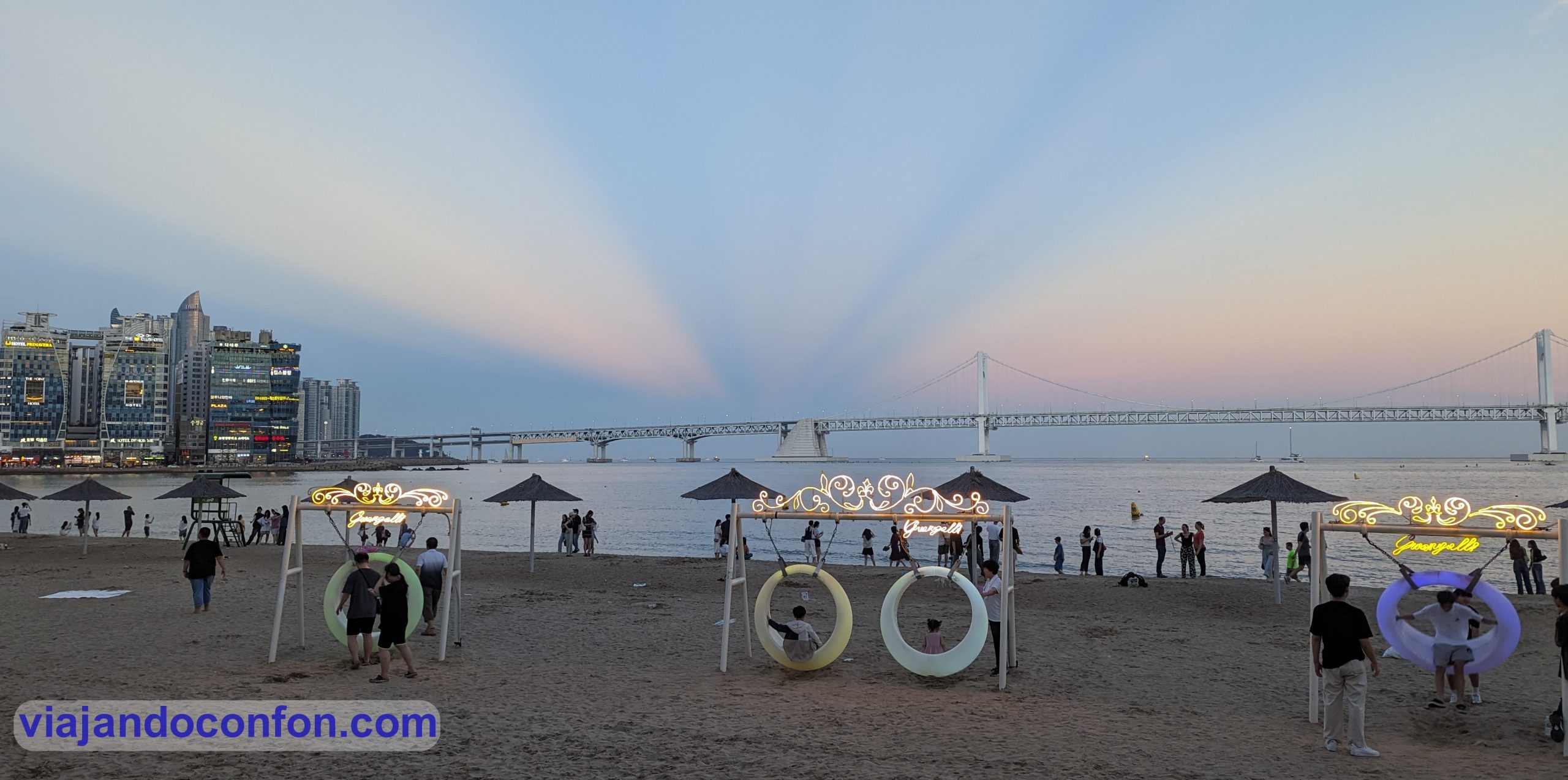
How to get there: Take metro line 2 to Gwangan Station, exit 5.
14. Trevi Fountain at Lotte Department Store Centum City
Lotte Department Store Centum City is a shopping centre belonging to the Japanese chain Lotte. But it’s not just any shopping centre. In the basement, where the underground station is located, there is a ‘replica’ of Rome’s Trevi Fountain.
It’s an interesting sight if you have time, but it really is a fountain that looks like it’s made of corkboard.

How to get there: Take metro line 2 to Centrum City station.
Price: Free.
15. Haeinsa Temple and the Korean Tripitaka (해인사 성보박물관)
Haeinsa Temple is not actually in Busan, but near the city of Daegu. However, it is a good day trip from Busan.
The temple was founded in 802, supposedly by the monks Suneung and Ijeong. Upon returning from a trip to China, they cured King Aejang’s wife of her illness. In gratitude for Buddha’s mercy, the king ordered the construction of the temple.

The Korean Tripitaka (조계종 해인사) is the oldest and most complete intact version of the Buddhist canon in Chinese script, with no known errors or misprints.
It is carved on 81,350 wooden blocks, with 52,389,400 characters organised into 1,514 titles and 6,791 volumes. It is housed in four buildings called Janggyeong Panjeon, the Korean Tripitaka repository, which are arranged in a rectangular layout.
The Tripitaka is not accessible, but the walls of the pavilions are latticed, and the tablets can be seen from outside.

How to get there: To reach the temple, take the KTX train to Dongdaegu Station. From there, take metro line 1 to Seobu Station.
Seobu Bus Station is located here. Purchase a ticket at the ticket office (cash only) for 8,100₩ (€5.66) per trip. The journey takes approximately 90 minutes.
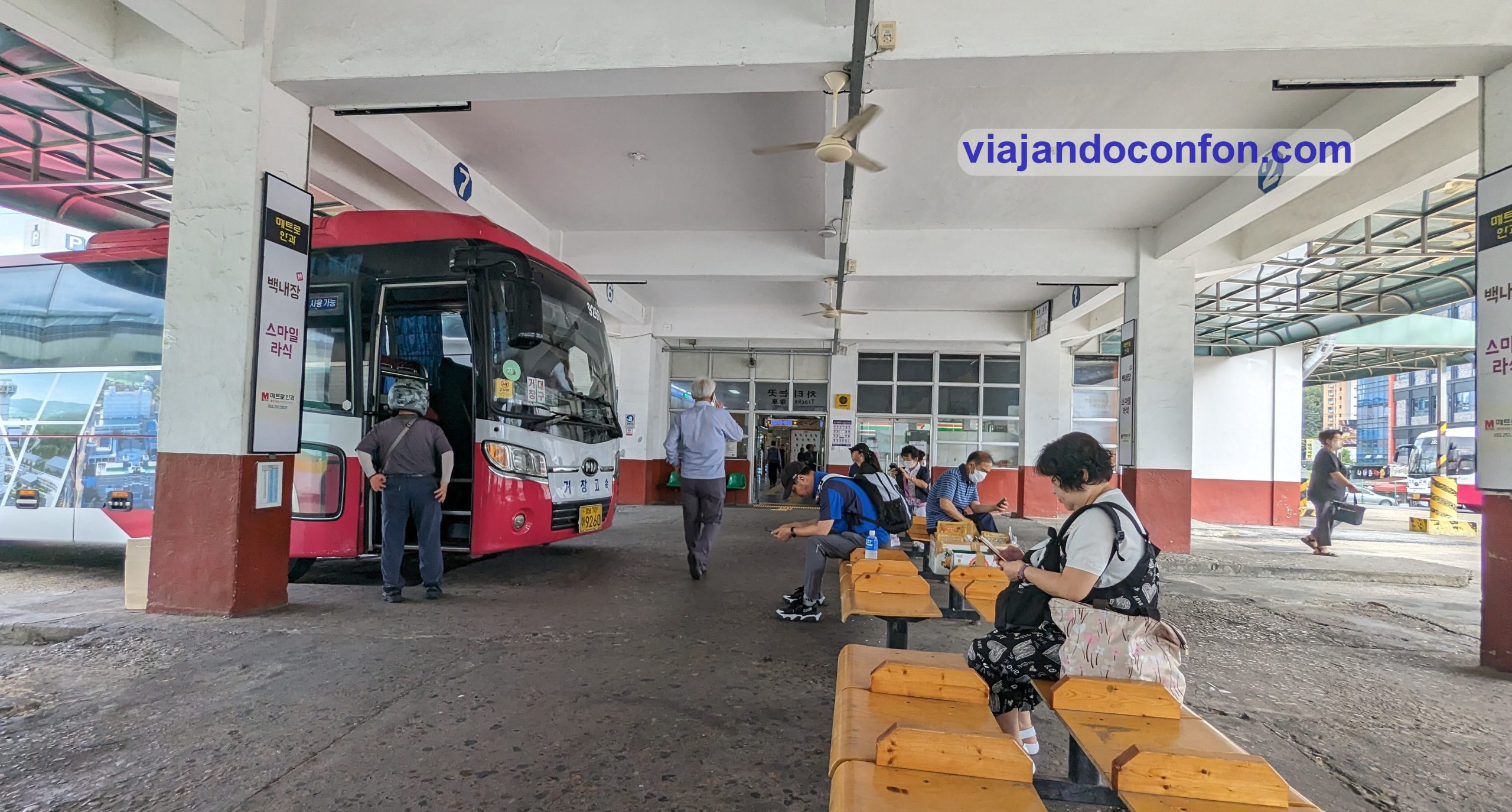
For the return journey, we must wait at the bus stop where we got off the bus until a car passes by, from which a young man gets out to sell us the ticket (cash only). A couple of minutes later, the bus arrives and we get on it to return to Daegu.
ESSENTIAL VISIT
Find the best activities and tours in Busan with Civitatis:
*It helps us maintain the blog
Here is a map with the locations marked: