As always, we recommend traveling with good health insurance. IATI is a specialist in travel insurance and, for being our reader, you have a 5% discount.
Pasea por el barrio Harbour Front admirando las bonitas vistas hacia el lago Ontario y sentarte a tomar algo relajadamente en alguna terraza o banco.
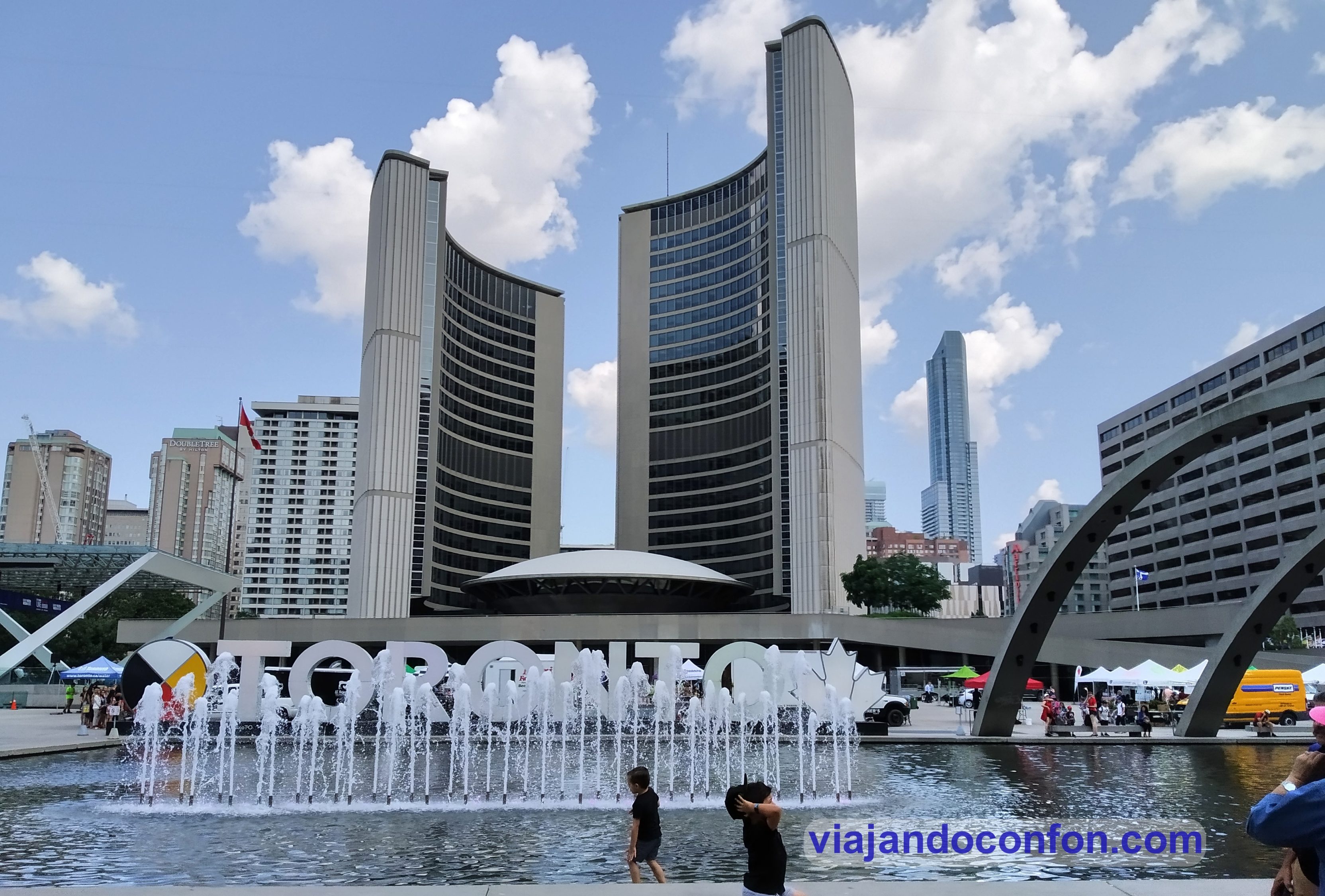
02. Visitar los ayuntamientos (viejo y nuevo) en la Plaza Nathan Phillips
Fue inaugurada en 1965, junto al nuevo ayuntamiento y es la plaza central de Toronto. Lleva el nombre del que fue alcalde de la ciudad entre 1955 y 1962.
La plaza es escenario de conciertos, exhibiciones de arte, un mercado de agricultores semanal, el festival de luces de invierno y otros eventos públicos, incluidas manifestaciones.
Durante los meses de invierno, el espejo de agua se convierte en una pista de hielo para patinar sobre hielo.
El nuevo y moderno ayuntamiento ha sido escenario de algunas películas como la segunda parte de Resident Evil.
Old City Hall (Antiguo Ayuntamiento) fue la sede del Ayuntamiento de Toronto desde 1899 hasta 1966.
Estuvo a punto de ser demolido a finales de los 60 para construir un complejo comercial y una serie de rascacielos (progreso lo llaman). Gracias a las protestas de los ciudadanos, se cambió de idea y se conservó el edificio.
Old City Hall fue designado Sitio Histórico Nacional en 1984 y actualmente es el Palacio de Justicia de Ontario.
Cómo llegar: metro: Queen Station línea 1.
03. Disfrutar de un día de ocio familiar en Toronto Islands
Son un conjunto de 15 pequeñas islas en el lago Ontario.
Las islas albergan el parque de la isla de Toronto, el aeropuerto de la ciudad de Toronto Billy Bishop, varios clubes de yates privados, un puerto deportivo público, el parque de atracciones Centreville, un vecindario residencial abierto todo el año y varias playas públicas.
Cientos de familias se dan cita los fines de semana para dsfrutar de las diferentes actividades que ofrecen las islas. es el parque temático del dominguero.
Como curosidad, es la comunidad urbana libre de automóviles más grande de América del Norte.
El viaje ya merece la pena sólo para contemplar el espectacular skyline de Toronto desde la isla central.
Cómo llegar: se puede llegar tomando un transbordador desde Jack Layton Ferry TerminalWeb de. Éstos funcionan durante todo el año.
El precio de ida y vuelta es 9.11$ (6.25€) para los adultos. Mayores de 65 y jóvenes de 15 a 19: 5.86$ (4€). Menores de 14: 4.29$ (3€).
04. Disfrutar de la gastronomía local en St. Lawrence Market
St. Lawrence Market es el principal mercado público de la ciudad y en la planta alta hay muchos sitios de comida en la que te ponen comida para llevar.
Te puedes comer sentado en unas mesas que hay en la terraza.
En la planta baja encontrarás muchos puestos de productos frescos. Si te apetece cocinar… este es tu sitio de compras.
05. Viajar en el tiempo por Distillery District
Distillery District, una antigua destilería de whisky (la más grande del mundo en 1860). Hoy ha sido reconvertida en una zona turística en las que hay tiendecitas, cafeterías y sitios para tomar algo. Diría yo que es demasiado hipster para mi gusto pero está muy bien para dar un paseo.
Si te interesa saber más de Distillery District, puedes contratar un fabuloso tour en Segwaypor el distrito:
*Nos ayuda a mantener el blog
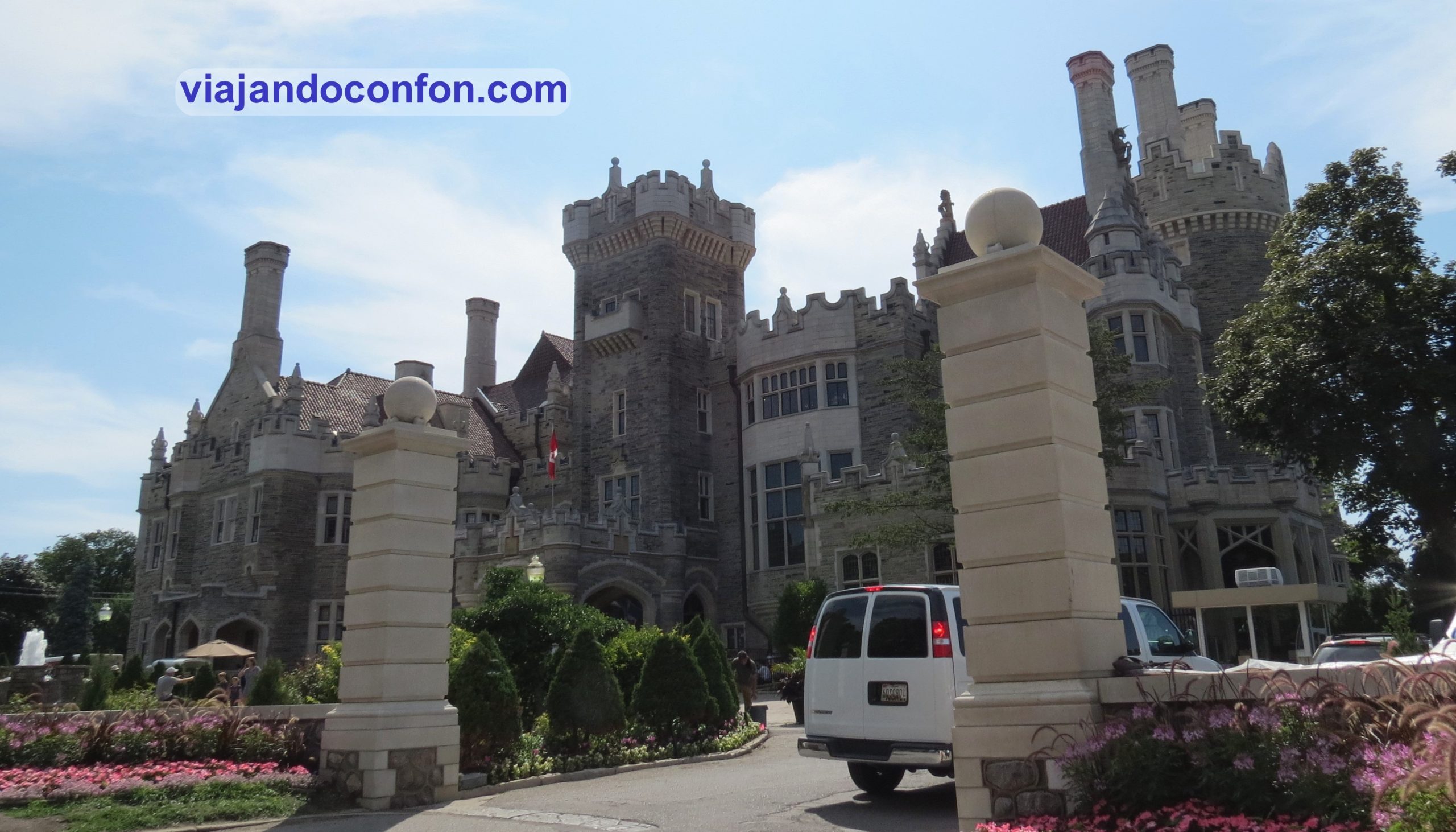
06. Admirar la bonita arquitectura de Casa Loma
Es una mansión y jardín de estilo neogótico en el centro de Toronto. Fue construida entre 1911 y 1914 por arquitecto E. J. Lennox, como residencia para el financiero Sir Henry Pellatt.
En 1924 la ciudad de Toronto embarga Casa Loma debido a las deudas e impuestos impagados. Henry Pellatt se arruina tras la expropiación de sus compañías eléctricas y el declive de sus negocios inmobiliarios. Fue a causa de la Primera Guerra Mundial. Tras esto, la casa quedó abandonada durante años.
En 1937 es arrendada por el Club Kiwanis de West Toronto. Más tarde, el Club Kiwanis de Casa Loma (KCCL), que comenzó a explotar turísticamente el castillo. Éstos administran la casa hasta el año 2011.
Debido a su carácter arquitectónico único en Toronto, Casa Loma ha sido un lugar popular para rodar películas y televisión. También es un lugar popular para las ceremonias de bodas.
Cómo llegar: Metro Dupont Línea 1.
07. Hacer un picnic en Queen’s Park
Queen’s Park es un parque urbano en el centro de la ciudad inaugurado en 1860 por el Príncipe Eduardo de Gales. Es nombrado así en honor a la Reina Victoria.
El parque es el sitio del Edificio Legislativo de Ontario, que alberga la Asamblea Legislativa de Ontario.
El edificio de la Asamblea Legislativa de Ontario empezó a construirse en el año 1886 según el diseño del arquitecto Richard A. Waite y se inauguró en 1893. Aunque se han realizado numerosas ampliaciones, las últimas en 1968 y 1969.
Cómo llegar: Metro Museum, al norte del parque y metro Queen’s Park al sur. Ambas línea 1.
Tranvía College St at Queen’s Park – Queen’s Park Station, línea 506.
08. Admirar las espectaculares vistas desde la CN Tower
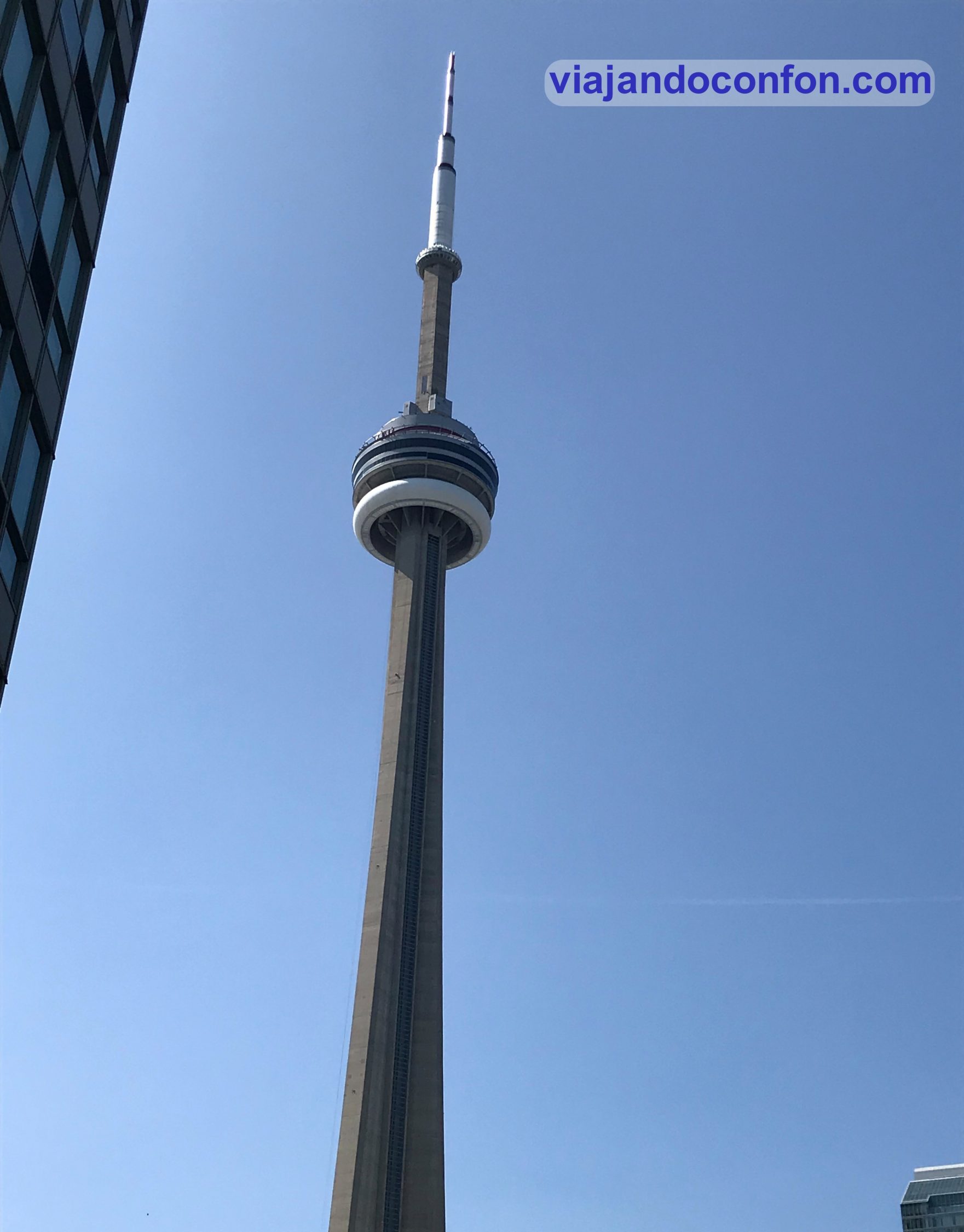
La CN Tower es una torre de comunicaciones y observación de 553 metros de altura. Se construyó entre 1973 y 1976. Su nombre “CN” originalmente se refería a Canadian National, la compañía ferroviaria que construyó la torre.
Hoy en día se puede subir para admirar las increíbles vistas de la ciudad y para comer en su restaurante, de 360º que va girando lentamente para disfrutar de todo Toronto. También hay diversas actividades como paseo por el exterior en lo alto de la torre (que miedo).
Que vamos a decir de las vistas desde la CN Tower… Son sencillamente espectaculares y el atardecer es una pasada.
También puedes comer allí. La comida está muy buena. Es cocina en plan moderna pero no se pasa hambre. Se puede elegir un menú o pedir de carta, pero esta última opción es carísima. Lo bueno es que incluye la entrada a la torre.
Se extiende a lo largo de las calles Dundas Street West y Spadina Avenue. El barrio empezó a desarrollarse en el siglo XIX siendo hoy uno de los mayores barrios chinos en América del Norte.
Los concurridos mercados y tiendas asiáticas al aire libre de Spadina Avenue venden frutas y verduras frescas, hierbas medicinales y recuerdos.
Fue donde nosotros compramos los nuestros desde galletas a camisetas.
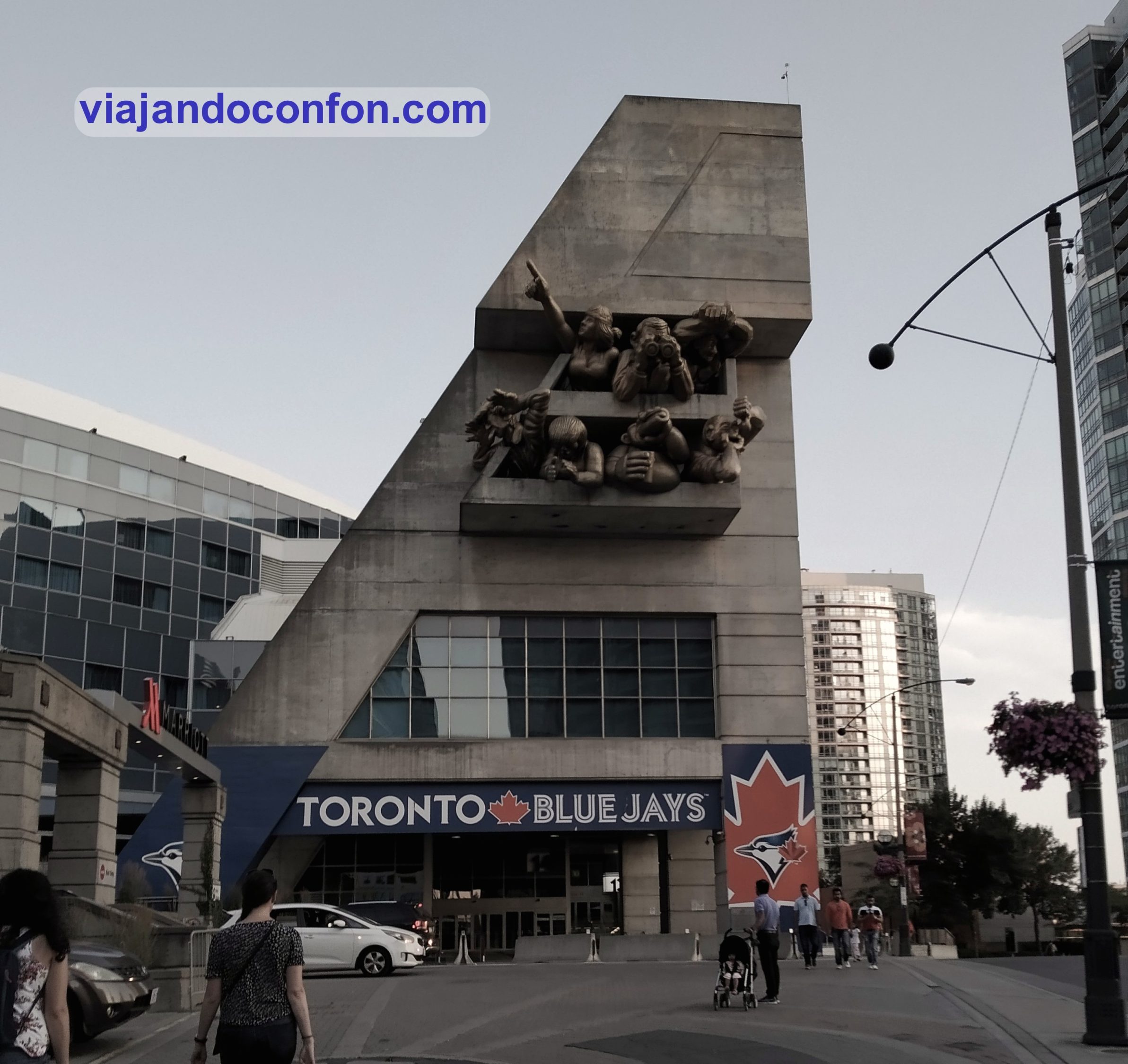
10. Acudir a un partido de baseball de los Toronto Blue Jays
Compiten en la División Este de la Liga Americana (AL) de las Grandes Ligas de Béisbol (MLB) y juegan sus partidos como locales en el Rogers Centre.
El equipo se llama Blue Jays es el nombre original en referencia al ave que lleva el mismo nombre, Cyanocitta cristata, (llamado también arrendajo azul, azulejo o urraca azul).
Son toda una institución en Ontario.
Descubre las mejores actividades y tours en Toronto con Civitatis:
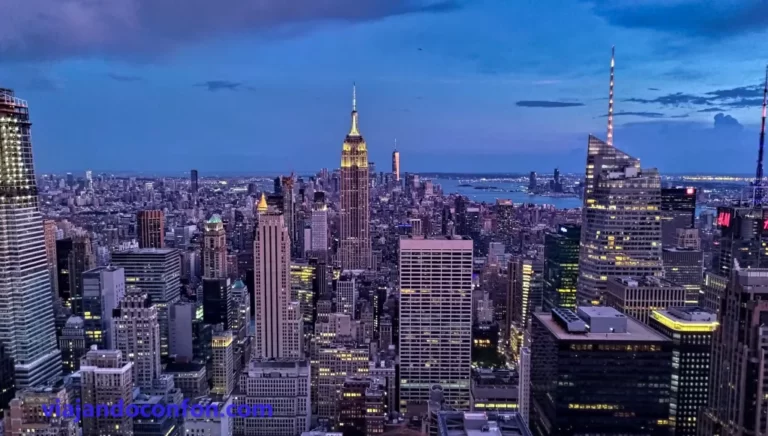
New York City, the Big Apple, is the most popular city in the United States and perhaps the entire world. With about 8 million inhabitants (about 20 million in its metropolitan area), it is also the most populous city in the country. New York has been described as the cultural and financial capital of the world.
It is made up of five districts (boroughs) that, at the same time, are counties: Manhattan, Brooklyn, Queens, Bronx and Staten Island. Since 1898 they have been consolidated as a unique city.
NYC is also the most multicultural city in the world. More than 3 million people born outside the US live here and nearly 800 different languages are spoken.
Find the best activities and tours in New York with Civitatis.
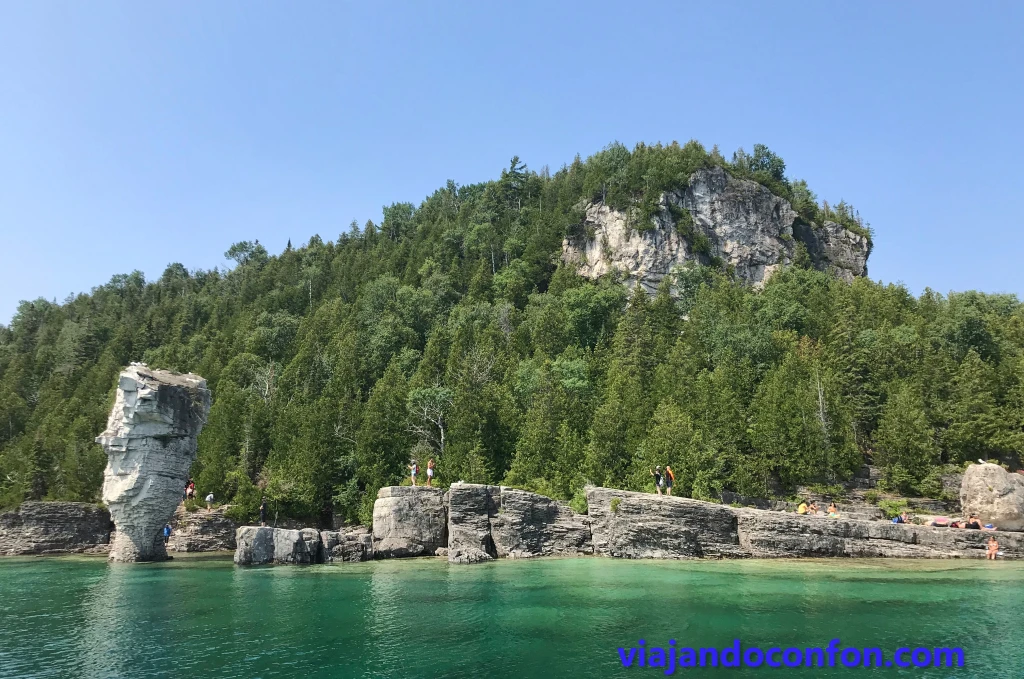
Thousand islands are a North American archipelago made up of 1,864 islands located in the North. They are located along 80 miles of the St. Lawrence River. They stretch for 80 miles on the border between Ontario (Canada) and New York (USA).
To be considered one of the thousand islands, emergent land within the riverbed must be at least one square foot (0.093 m2) of land above water level year-round and support at least two living trees.
The islands range in size from over 40 square miles (100 km2) to smaller islands occupied by a single residence or uninhabited rock outcroppings.
History of Thousand Islands
Before the arrival of the Europeans, this region was inhabited by the Iroquois community and the Ojibwa people. Back then it was known as Manitouana or the “Garden of the Great Spirit.”
Battles took place in this area during the 1812 war against the British. Many sites bear witness to those battles, such as Fort Wellington in Prescott and the garrison on Chimney Island in Ontario.
In the late 19th and early 20th centuries it became an important summer resort for distinguished families in the United States. Mostly wealthy people from New York, Chicago or Cleveland. Several luxury hotels were built and excursions between the islands were offered by steamboats.
A little later, both wealthy and middle-class American and Canadian families began to build summer residences on the islands.
Discover the best activities and tours in Toronto with Civitatis.
Visiting Thousand Islands
Among all the islands there are several that are noteworthy. These are:
Heart Island (USA): on it we find Bold Castle, a large masonry castle built at the beginning of the 20th century. It was commissioned to be built by George C. Boldt, owner of the luxurious Waldorf Astoria hotel as a token of love for his wife, Louise.
During its construction, in 1904 Luoise died and George C. Boldt ordered to stop the works. Without his beloved, the fairytale castle ceases to make sense. He never sets foot on the island again.
In 1977, the Thousand Islands Bridge Authority acquired ownership of the island and restored the remains of the castle, deteriorated after 73 years of neglect.
Hub Island (E.E.U.U): another of the islands that caught our attention. Maybe the most. Also called Just Room Enough Island.
It is the smallest inhabited island of all. Purchased by the Sizeland family in the 1950s, the island has a house, a tree, shrubbery, and a small beach. When we visited it, the water level was so high that there was no beach or land.
Due to the small size of the island, in 2010 the Washington Post declared, “One false step and you’re swimming.”
Wolfe Island (Canada): It is the largest island of all and is at the entrance of the river in Lake Ontario.
The island was part of the traditional hunting lands of the Tyendinaga Mohawk people and the island’s original name is Kawehnóhkwes tsi kawè:note. In 2021, the Municipality of the Frontenac Islands officially voted to accept the name Kawehnóhkwes tsi kawè:note. He added it to signs welcoming visitors to Wolfe Island.
The French called it Grande île (Big Island). In a proclamation by Lieutenant Governor of Upper Canada John Graves Simcoe on July 16, 1792, the island was renamed Grand Island to Wolfe Island, after British General James Wolfe.
Deer Island (USA): The island is located near Boldt Castle and can be seen up close from several Canadian and American tour boats that operate in the local waterways. The island’s land is heavily overgrown, with a small cabin on the southern corner of the island.
It is wholly owned by the Russell Trust Association and is used as a Skull and Bones retreat.
Scorpion Island
Grenadier Island (Canada): The island is named after the British Grenadier Guards regiment.
During the Seven Years’ War (1756-1763), Captain Francois Pouchot of the French Navy visited Grenadier Island.
The island remained under native control until United Empire loyalists arrived in the early 19th century. During the War of 1812, Grenadier Island housed a lookout post. By 1818, several farms had been established.
Since the early 1870s, Grenadier Island has become a popular summer retreat.
Longue Vue Island (USA.): It is the only artificial island in the region.
The original owner of the house was Hudson Rose, a lumber merchant from New York City. The island was originally named Rossette after Rose.
The house was purchased in the mid-1920s by Temple Berdan and sat vacant from 1932 to 1939. Lewis Dollinger purchased the house from the Berdan estate. It was later owned by the Dollinger Corporation and, after tax laws were changed in the 1970s, was owned by Dollinger Corporation founder Lewis Dollinger’s son, F. Leslie Dollinger for many years. It was sold in 1994 to Arizona businessman Al Wareing, who is the current owner.
Basswood Island
How to get
We can visit the Thousand Islands through cruises that pass through the islands.
If you are on the Canadian side, you can take the cruises from the cities of Kingston, Gananoque or Rockport. We did it from Gananoque.
If you are on the US side, you can take the cruises from Clayton or Alexandria Bay.
Find the best activities and tours in New York with Civitatis.
Discover everything about the world through ourtravel diaries.
Documentation and visas Since January 12, 2009, it is necessary to fill out the following online form at least 72 hours before arriving in the United States. The form must be filled out for all persons traveling, including children. If you have doubts, you can consult the official website for travel to the United States. https://travel.state.gov/content/travel.html
Security NYC is a relatively safe city but it is recommended not to walk at night in the neighborhoods of Harlem and Randall’s Island in Manhattan; the Bronx, especially the southern neighborhoods such as Mott Haven and Port Morris; East New York and Brownsville in Brooklyn. Also, in general, at night, remote areas of Manhattan and parks, including Central Park, should be avoided.
And as we always say, have common sense like being careful with pickpockets in areas with a lot of people.
Healthcare Healthcare in the US is totally private and very, VERY EXPENSIVE. It is essential to travel with medical insurance because any minimum consultation can cost you between $300 and $500.
As always, we recommend taking out good insurance for what may happen. Here we leave you IATI, specialized in travel that, also if you are a reader of our blog, you will have a 5% discount.
Electricity In the United States the voltage is from 110 to 120 volts and at 60 Hz and the plugs are flat pins of type A / B.
If you want to see cool photos of our trip to New York, visit our instagram.
2. How to get to New York
Note on the website of the Ministry of Foreign Affairs of Spain:
Visitors traveling by plane to the US / or from the US should be aware that both airlines and American authorities are increasingly sensitive to any incident that may occur on board the plane. by hot-tempered or violent passengers, most of the time applying the “zero tolerance” rule. Whether it is a question of refusing to obey any instructions, acts of violence or jokes, passengers are exposed to criminal consequences with such behaviors.
It happens with some frequency that if a traveler’s name and date of birth are similar to one of the people who appear in the US database of someone with a history, the Immigration officer may consider it necessary, before authorizing their entry into the country, carry out other verifications and detain the traveler for one, two or three hours until it is verified that it is not the person sought. It is recommended to exercise extreme caution when renting an apartment in New York online, due to the increasing number of scams that have occurred in this field recently.
John Fitzgerald Kennedy Airport (JFK) is the main airport in New York and with some 50 million passengers a year, it is one of the main airports in air traffic worldwide.
Shuttle service
It is the most comfortable option since it takes you to the door of the hotel, although it is not the cheapest, but it is worth it after many hours of travel. In the following link you have the best option:
Airtrain + subway
JFK AirTrain is the cheapest, fastest and easiest way to get around JFK Airport. The system connects all passenger terminals with airport parking garages, the hotel shuttle pickup area, the rental car center, and the New York public transportation network at the Jamaica and Howard Beach stations. At these stations we can continue the trip to the city center with the metro.
The AirTrain is free to move between terminals, but to travel to/from Jamaica and Howard Beach stations, the fare is $8.50 (plus $1 for the physical card) if you will then take the subway, and you can only pay via the MetroCard.
There are three AirTrain lines. We have the AirTrain JFK Gold, which is a circular line that runs only between the terminal stations.
There is also the AirTrain JFK Red line, which is the one that goes from the airport to the Jamaica station. And the AirTrain JFK Green line that goes to the Howard Beach station.
Once we get off the train, we find the machines where we must purchase our metrocard and load it to pay the $8.50 if we decide to transfer on the subway.
The money will be deducted from our metrocard when we insert it into the turnstiles.
As we mentioned before, the metro lines are independent from the AirTrain so you have to pay for the ticket separately. The fee is $2.75.
Taxi
It is a more comfortable option than the AirTrain+subway, but more expensive. The fare to/from Manhattan is $52 but for peak hours (4:00 p.m. to 8:00 p.m. on weekdays, except holidays) they charge a surcharge of $4.50 which would cost us $56.50.
2. LaGuardia Airport
Located in the borough of Queens, it is the closest airport to Manhattan, just 10 km away.
Shuttle service. It is undoubtedly the most comfortable option since it leaves you at the door of the hotel, although it is not the cheapest, but it is worth it after many hours of travel. In the following link I leave you the best option:
Bus New York City Metropolitan Transportation Authority (MTA) buses provide service between LaGuardia Airport, Manhattan, Queens, and beyond with connections to the subway, Long Island Rail Road, and Metro-North Railroad.
The price is $2.90 and you have to buy them through the Metrocard.
For LaGuardia Link Q70 SBS (Select Bus Service) and M60 SBS bus service, passengers must pay their fare with a MetroCard or exact change at curbside machines before boarding. Keep your paper ticket to travel.
Travelers leaving or going to Terminal A can take the Q47 bus, connecting to the 7, E, F, M, R subway lines at 74 St/Roosevelt Ave or the M60 SBS to Manhattan.
The MTA offers regular Q47, Q48, Q70 SBS, Q72 and M60 SBS service between LaGuardia Airport, Manhattan, Queens and beyond with a subway connection.
Taxi This option is more comfortable but more expensive than the bus. Taxis from LaGuardia do not have a fixed rate like from JFK and are metered. The price from LaGuardia to Manhattan is between $35 and $50 including tolls and gratuity, depending on the destination.
At the start of the race, the meter must show $3.00 and there are several supplements:
$1.00 for peak hours for trips from 4:00 p.m. to 8:00 p.m. from Monday to Friday.
$0.50 for trips from 8:00 p.m. to 6:00 a.m. every day.
There is a $0.50 New York state tax added to travel within New York, but not for travel to New Jersey.
Beginning April 5, 2023, a PANYNJ $1.75 airport access fee will be applied per trip for pickups only.
3. Newark LibertyAirport
With similar traffic to JFK airport, it is the second largest airport in New York. It is located in the town of Newark in New Jersey about 25 km from Manhattan.
Shuttle service
It is undoubtedly the most comfortable option since it leaves you at the door of the hotel, although it is not the cheapest, but it is worth it after many hours of travel. In the following link I leave you the best option:
AirTrain + Subway AirTrain is an easier and cheaper way to get to/from and around Newark Liberty Airport. It operates 24 hours at day, 365 days at year and provides easy connections to the NJ Transit station and the rail lines that run on the Northeast Corridor and North Jersey Shore Line.
AirTrain is free for travel at the airport and makes frequent stops around the airport, including airline terminals, parking garages, hotel transportation areas, and car rental facilities.
The price of the train from the airport station to New York Penn Station is $15.25 and the journey takes 26 minutes. To buy the ticket you must go to one of the machines at the AirTrain station and there buy the AirTrain ticket Newark + train to Penn Station.
More information on the official NJ Transit website.
Newark Airport Shuttle It is a transfer system that connects Newark Liberty Airport with three specific points in Manhattan: Grand Central, Bryant Park and W 42nd St & Port Authority Terminal.
The price is $17 per person and it runs from 4 a.m. to 1:15 p.m.
Taxi The most expensive option. The fare to Manhattan, depending on the final destination, is between $50 and $70 and tolls are not included. They are closed rates and it is illegal for the taxi driver to try to charge you by meter.
During peak hours on weekdays, in the morning (from 6:00 to 9:00) and in the afternoon (from 4:00 to 7:00 p.m.). On weekends (Saturday and Sunday from 12:00 to 8:00 p.m.), there is a supplement of $5 for all points in New York State, except Staten Island.
Paying with a bank card has an additional cost of $5.50.
Find your ideal hotel with the best prices in New York with Agoda.
3. Public Transportin New York City
1. Subway
Opened in 1904, with more than 1,000 km of tracks and almost 500 stops, the NYC subway is one of the largest in the world.
The subway in NYC is dirty, very dirty. You will see kangaroo-like rats roaming the stations leisurely. In addition, in summer, except in some seasons with air conditioning, it is very hot and very humid. It’s awful.
The metro consists of 26 lines named with numbers and letters. The truth is that it is a pain to use.
The price of a single ticket is $2.90 and must be paid through the MetroCard.
The metro works 24 hours a day, although at night, not all the entrances are open and, in general, you will not find operators at the stations.
2. Bus
Getting around NYC by bus is comfortable and simple but very slow compared to the subway.
Bus lines are named with a number and a letter. The letter indicates the district where it operates: Manhattan (M), Brooklyn (B), Queens (Q), Bronx (Bx) and Staten Island (S).
The prices are the same as those of the metro and they work 24 hours a day. After 10 at night, for security reasons, you can ask the driver to leave you at an exact point even if it is not an official stop.
To pay, it is best to do so with the MetroCard, which also allows you to transfer between the bus and the metro for 120 minutes. If you want to pay the driver in cash, you have to pay with the exact amount in coins. If you want a ticket with a transfer, you must notify the driver, but it is only valid to make them between different buses. It is not valid for the subway.
This is the ideal route for the elderly and people with disabilities since the metro is not adapted in almost any of its stations.
Tickets for public transport
Apart from the single ticket for $2.90, there are several different tickets.
MetroCard. This is a magnetic cardboard card that is valid for both the bus and subway (it is mandatory for subway) and there are two modes: Pay-Per-Ride or Unlimited Ride MetroCard.
Pay-Per-Ride: This card is rechargeable and the cost of each single ticket is $2.90, it can be shared among several people and it allows transfers between the metro and buses for 120 minutes. When recharging more than $5.50 you get an 11% bonus.
Unlimited Ride MetroCard: The unlimited card is the best option if you are going to use public transport a lot.
The price for 7 days is $32 and is profitable by making more than 12 trips.
The price for 30 days is $121 and is profitable by making more than 44 trips.
We can buy the card at a cost of $1 in subway machines, tourist offices and many souvenir and general item stores.
OMNY OMNY (One Metro New York) is a new payment system for NYC transportation, valid for fare payment and ticketing on subways, buses, paratransit and commuter rail, which will be implemented between 2019 and 2023. To pay, simply tap your card or device with the OMNY app on the digital reader and the screen will instantly confirm if the tap was successful, sending you on your way quickly and easily.
Payment methods. Smart devices such as smartphones and smartwatches, contactless bank cards and the OMNY card itself will be valid.
3. Taxi
Taxis in NYC are not excessively expensive, but they are compared to other forms of transport. The good thing is that it is the best option to move around at night, as it is the safest.
These are the prices (2019):
Flag drop: $2.50.
$1.56 per kilometer.
$0.50 for each minute of waiting.
City tax: 0.50$.
Night supplement (from 8:00 p.m. to 6:00 a.m.): $0.50.
Peak hour supplement (daily from 4:00 p.m. to 8:00 p.m.): $1.
The normal thing is to leave between 10 and 15% tip although it is not mandatory. At a minimum we should round up to the next dollar.
4. Bike
We can also move by bicycle through the Citibike application. With more than 20,000 bikes and more than 1,300 stations between New York and Jersey City, it is the largest company in the entire country.
To use the bikes we must register in the application and then choose between several modalities:
Single ride: For $3.50 we can use the bike for 30 minutes.
Day pass: For $15 we can use the bike for 30-minute trips, but for 24 hours.
Annual Membership: For $15 (billing in advance the full annual payment of $179) per month we can use the bike for 45 minutes.
The first thing you should do is download the app and sign up. Look for the nearest station in the app and unlock the bike through the code that comes to you. Use the bike and return it to a station. When the green light comes on, it means that it is locked and ready.
If like us and many people, you choose to stay in New Jersey (much cheaper), we explain how to go from one to another.
The simplest and fastest is to use the PATH. There are two lines:
Trains connecting Newark and Hoboken (NJ) with the World Trade Center Transportation Hub.
Trains that connect Hoboken and Journal Square (NJ) with 33rd street in Manhattan.
At the World Trade Center terminal you can connect with subway lines 2, 3, A, C and E.
You have two types of card. The MetroCard, the same one with which we move around NYC, with which the price of a single ticket is $2.75. Although the PATH only allows the use of the MetroCard Pay-Per-Ride modality and not the Unlimited Ride MetroCard.
The other is the SmartLink Card, which is the best option if we are going to travel a lot between the two cities. With this you have two options:
SmartLink 7-day-pass-unlimited, with unlimited rides at the following prices:
The only direct way to get from Manhattan to Staten Island by public transportation is by the Staten Island Ferry.
It is a passenger route operated by the New York City Department of Transportation. The ferry operates 24 hours a day, 7 days a week, with boats leaving every 15 to 20 minutes during peak hours and every 30 minutes during peak hours. Since 1997 the ferry is free.
The ferry departs from the Whitehall Terminal, next to the South Ferry Station, line 1.
For tourists like us, it is another attraction and you will be able to see it if you get on it, since it passes very close to the Statue of Liberty, although only to contemplate it from the boat because it does not stop at Liberty Island.
The New York Explorer Pass card offers free access to 3, 4, 5, 7 or 10 of the city’s top attractions. Design your own itinerary and you will save up to 50%.
The New York Explorer Pass card allows one access to each attraction and is valid for 60 days from the time of activation.
PRICE
ADULTS
CHILDREN
New York Explorer Pass 2 attractions
$69
$48
New York Explorer Pass 3 attractions
$87
$67
New York Explorer Pass 4 attractions
$117
$84
New York Explorer Pass 5 attractions
$140
$107
New York Explorer Pass 6 attractions
$159
$124
New York Explorer Pass 7 attractions
$178
$139
New York Explorer Pass 10 attractions
$229
$175
The price varies based on the chosen date. / Children 3 between 12 years old.
We bought the card for 3 attractions and we got a lot of use out of it. Just between the Empire State Building and the Top of the Rock it would have cost us $90.
The New York Pass card allows free access to more than 100 New York attractions, including the Empire State Building, the ferry to the Statue of Liberty, the 9/11 Museum.
The pass is only activated when you visit your first attraction. And it is only valid for the consecutive days following the first day of use.
PRICE
ADULTS
CHILDREN
1 DAY
$129
$99
2 DAYS
$174
$144
3 DAYS
$199
$154
4 DAYS
$229
$164
5 DAYS
$259
$179
6 DAYS
$279
$189
7 DAYS
$299
$199
10 DAYS
$399
$224
Children 3 between 12 years old.
The NYC Sightseeing Pass is a fairly affordable and easy to use flexible discount pass to New York. You only pay for the pass, you don’t need to pay anything else when you access the attractions.
With it you can choose the number of attractions and guided tours that you want to include in your Sightseeing Flex Pass. You can purchase the Sightseeing Flex Pass for 2, 3, 4, 5, 7, 10 or 12 attractions and you have 60 days to visit the attractions of your choice. You can choose from more than 100 attractions.
Attractions
2
3
4
5
6
7
10
12
Adults
$67
$89
$112
$130
$164
$184
$234
$264
Children
$46
$63
$81
$107
$155
$174
$224
$262
Children 3 between 12 years old.
You can buy your pass online. You receive a voucher with a QR code that is the pass. You can teach it directly from your mobile or print it.
At Civitatis you can find a multitude of activities and tours in New York.
Discover everything about the world through our travel diaries.
We are going to know the history of New York in a brief and entertaining way.
The first settlers in the area were the Lenape, an Algonquian people, who ranged from Virginia to the Rocky Mountains and north to Hudson Bay.
Starting in the 16th century, the first Europeans began to explore the area, with the Florentine navigator and explorer Giovanni da Verrazzano, in the service of King Francis I of France, who was looking for a route to Asia.
In 1624, 30 families of settlers sent by the Dutch West India Company settled on Nutten Island (now Governors Island), which they called New Amsterdam.
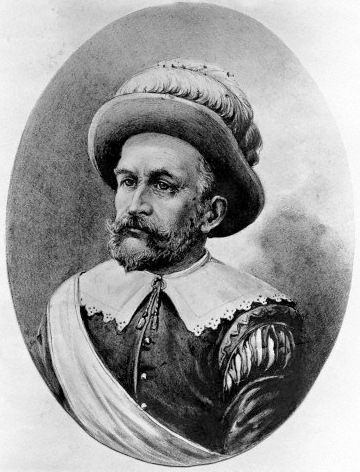
Peter Minuit.
In 1626, the governor of New Amsterdam, Peter Minuit, buys the island of Manhattan from the natives for 60 guilders (about $1,000 in today’s dollars) in trade goods, such as cloth or tools.
In 1664 the British took New Amsterdam from the Dutch and changed its name to New York, in honor of the Duke of York.
Over the next century, New York City’s population grew and diversified with the arrival of English, Dutch, French, and German immigrants, as well as servants and slaves from Africa.
The city prospers thanks to the trade in flour, furs, tobacco and wood and in 1760, the population grew from just 300 inhabitants in 1630 to 18,000 surpassing Boston as the second most populous city in the American colonies. 50 years later it already exceeded 200,000 inhabitants, becoming the most populous city in the northern hemisphere.
Between 1760 and 1770, an anti-British activity arose that exploded in 1765 after the approval by the British parliament of the Stamp Act, which involved a direct and specific tax for the thirteen colonies of British America that required that the majority of materials printed in the colonies will be published on stamped paper produced in London, stamped with an embossed revenue stamp. This law was intended to help pay for troops stationed in North America after the British victory in the Seven Years’ War and to control the growing freedom of the press in the colonies.
In August 1776, despite the efforts of George Washington’s Continental Army in Brooklyn and Harlem Heights, New York City falls to the British and serves as a British military base until 1783.
The city quickly recovers from the war and becomes one of the most important ports in the country in 1810.
But the real economic explosion would come with the opening of the Erie Canal in 1825, a 363-mile canal from Lake Erie to the Hudson River, which facilitated the transport of goods. This made NYC the true business capital of the Country.
The growth of the city required new infrastructure improvements. In 1811 the Commissioners’ Plan, considered the most important document in the development of New York City, established an orderly grid of streets and avenues for the undeveloped portions of Manhattan north of Houston Street.
In 1842, the Croton Distributing Reservoir was opened, a reservoir and aqueduct that provided drinking water to the growing population of the city. And in 1845 the city established its first municipal agency: the New York City Police Department.
With increased immigration during the 1840s and 1850s, they settled in different ethnic neighborhoods, started businesses, joined unions and political organizations, and built churches and social clubs.
During the first half of the 20th century, with the construction of interstate highways and suburbs, it encouraged wealthy people to leave the city, which combined with deindustrialization and other economic changes to shrink the tax base and decrease public services.
With the immigration and nationality law approved in 1965 or the Hart-Celler Act (Immigration and Nationality Act of 1965), the national quotas imposed by the National Origins Formula, in force in the United States since the Immigration Law of 1921, are abolished. With it, an annual maximum limit of 300,000 immigrant visas is established, it makes it possible for immigrants from Asia, Africa, the Caribbean and Latin America to reach the United States, many of them to NYC revitalizing many neighborhoods.
On September 11, 2011, NYC suffered the largest terrorist attack in the history of the United States, when a group of terrorists crashed two hijacked planes into the two tallest buildings in the city: the twin towers of the World Trade Center. Buildings were destroyed and nearly 3,000 people were killed.
Nonetheless. the city remains an important financial and tourist capital with more than 40 million visitors a year.
Find the best activities and tours in New York with Civitatis.
Discover everything about the world through our travel diaries.
This year it’s time for a new adventure: discovering the American continent. First stop: New York City (NYC).
July 18
We left Malaga on a direct flight with Delta around 8 in the morning. You arrive several hours early at the airport for boarding, go through extensive checks as a very friendly “conversation” with a company employee at the check-in counter, who writes down everything you say and asks several more serious questions such as whether you’ve been at all times with your suitcase and such.
We passed the passport control, and while waiting, a company worker approaches one of my companions and tells her that she has been randomly selected for a pre-boarding control and that she should accompany her. The rest we ship by conventional methods.
The plane was quite comfortable, seats relatively spacious, the crew very friendly and the food quite decent. From time to time they passed by offering you something to drink, an ice cream and things like that. Onboard entertainment quite good. The trip becomes very pleasant (considering that more than half I do it sleeping).
We arrived at JFK airport around 10:30. From what I had been told, the festival begins, the heaviness of going through the heavy controls of US airports. Nothing is further from reality. Luckily there were almost no queues at the controls, at the post: photo, fingerprints and passport. All very fast. We went out to get the luggage. Now yes, you will see the records, the questions, etc… well, again I fail. The suitcases were waiting for us, we pick them up and go directly to the terminal… is that it? That easy? Marvelous. It has been easier to enter the US than to leave Spain.
Remember to always travel with insurance. With IATI you have a 5% discount for being our reader.
So direct to the subway to go to the accommodation; an apartment in Jersey City since in New York it was very expensive and we were 6 people. After more than an hour of subway and transfer with the PATH we finally arrived. We left the suitcases and went out throwing mistos to eat that already the desire to eat was important at that time.
If you prefer to arrive more comfortably and quickly, you can do so by hiring a transfer. Here is a link to one that works great:
First acquaintance with American greasy junk food: a hamburger at a restaurant called Leftbank Burger next to the apartment.
Very good and dripping, with a strange breading that turned out to be breaded macaroni and cheese… well, like a macaroni croquette. Accompanied by ice water to mitigate the embarrassment it made. In New York they always give you cold water when you enter a restaurant.
Already with a happy stomach, we headed to Manhattan to see what’s going on there. First stop… 33rd Street st. We take a leisurely stroll around the Empire State Building, walk part of 5th Avenue to the Flatiron Building.
The Flatiron Building, originally called the Fuller Building, is a 22-story, 87-meter-high triangular building located at 175 Fifth Avenue. Designed by Daniel Burnham and Frederick Dinkelberg, it was one of the tallest buildings in the city after its completion in 1902, and one of only two “skyscrapers” north of 14th Street, the other being Metropolitan Life.
Flatiron Building
We retrace our steps to enter Macy’s to rest in the air-conditioned shoe store and see the wooden escalators.
Macy’s which was originally called R. H. Macy & Co. is an American department store chain founded in 1858 by Rowland Hussey Macy.
After resting a bit in the cool, we took a walk to the very crowded and oppressive Times Square.
Times Square is a major commercial intersection, tourist destination, and entertainment center at the intersection of Broadway and Seventh Avenue in Midtown Manhattan. Characterized by numerous billboards and giant neon signs, it stretches from West 42nd to 47th Streets.
The truth is that it is impressive. I think it shocked me more than the first time I visited Shibuya in Tokyo. Both because of the publicity and because of the number of people who were there.
From here we went for a walk around the neighborhood until we reached Madison Square Garden. Colloquially known as The Garden, it is a multi-use indoor arena located between 7th and 8th Avenues from 31st to 33rd Streets, it is situated atop Pennsylvania Station. The arena is used for professional ice hockey and basketball, as well as boxing, concerts, ice shows, circuses, professional wrestling, and other forms of sports and entertainment.
After a hard day, we decided to go back to Jersey to buy something for dinner and have breakfast the next day at a supermarket.
July 19
We woke up very early startled by the apartment’s fire alarm due to some toast burning in the toaster. The lack of habit of having these types of alarms. Well… early and well alert for the day of walking that was upon us.
Today it was time to indulge myself and freak out a bit, so we put the direct to the building that acts as headquarters in the ghostbusters movie (the original). I had read that there was nothing but we found out that it is a small fire station.
For the very geeks, this one is located at 10 North Moore Street.
From here we went to Chelsea Market, an old meat processing factory converted into a grocery store, very hipster in my opinion. As it was chilly we got some iced teas and some homemade sweets in a bakery called Sarabeth’s.
After gaining strength, we left the building to go through the Higline elevated park. An elevated linear park of 2.33 km, which runs along some old abandoned New York Central Railroad tracks. It was designed between James Corner Field Operations, Diller Scofidio + Renfro and Piet Oudolf and opened in June 2009. It’s a pretty cool place with lots of shade to walk around in the heat.
Higline elevated park.
At the end of the park, a strange construction called The Vessel awaited us, which is a kind of viewpoint, built with the design of the British Thomas Heatherwick; and opened in March 2019. The structure is honeycomb-shaped and has 16 stories and with 154 flights of stairs, 2,500 steps and 80 landings for visitors to climb (closed from 2021).
Just opposite we find Hudson Yards, a huge shopping center that also served us to rest a bit in the cool… or cold because in NY I think they put the air conditioners at 10ºc. How cold it is everywhere.
Refreshed, we took a (long) walk along 5th avenue to the Trump tower. The tower is a 58-storey, 202-meter-high skyscraper located at 721-725 Fifth Avenue. It is a multipurpose building in which former President Donald Trump and some of his relatives also live.
We continue walking and stop to eat at a nearby place, at fresh & co. a franchise of salads and organic food that is quite good and not expensive.
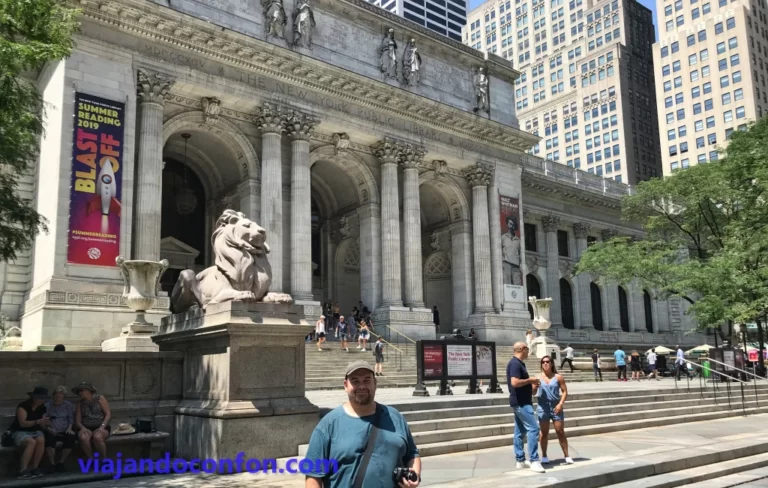
Full of energy, we headed to the New York Public Library, the second largest library in the United States and one of the largest in the world, containing more than 53 million items. And as a good geek, it is the scene of the first scene of the ghostbusters.
The building is quite spectacular both inside and out. It is quite a long visit even though you can only see part of the building. That yes, it is necessary to respect because in spite of being tourist it is still a library and some rooms are visited in which there are people consulting and studying, although not everyone is civilized.
New York Public Library
Already when closing the library we took another walk to Saint Patrick’s Cathedral. It is a neo-gothic cathedral, seat of the archbishop of the Roman Catholic Archdiocese of New York, built between 1858 and 1878. It is considered one of the most visible symbols of the Catholic Church in the United States.
You can enter for free and the truth is that the building is quite spectacular and, in addition, it has air conditioning and you are very comfortable.
Saint Patrick’s Cathedral
Since it wasn’t too late when we left, we crossed the avenue to get to Rockefeller Plaza in front of Rockefeller Center, a plaza that has appeared like that in a million movies.
From here we went to Chinatown to buy some souvenirs and have dinner in a restaurant. We had dinner at a place called Joe’s Ginger. We ate well and cheaply.
July 20
Today it’s time to climb the Empire State Building. Early morning, energetic breakfast and the PATH towards Manhattan.
The Empire State Building is a 102-story, 443-meter-high skyscraper designed by Shreve, Lamb & Harmon and built between 1930 and 1931 in the Art Deco style. At first it was the tallest building in the world until it was superseded by the Twin Towers in 1970. After their destruction in 2001, it was once again the tallest building in the city (not in the world) until 2012 when it was surpassed by the One World Trade Center.
There were quite a few people waiting but it was going fast. As soon as you enter, they take a photo with a chroma key with the city in the background in case you want to buy it on the way out. What can we say about the views… they are spectacular.
After going all the way around, it was time to go all the way up. At that moment, an employee of the building shouted that the wait for the elevator was about 35 minutes and that anyone who wanted to could go up the stairs at that time, which would take about 7 minutes. So we did. I do not understand how there are people who go up in a marathon from the bottom.
The ticket price is between $42 and $49. You can easily buy your ticket from the following link:
That day we were on heat alert. In spite of this, we wanted to and from the Empire State Building we went to the Manhattan bridge to cross it and return through the Brooklyn bridge.
The Manhattan Bridge is a 2,089-meter suspension bridge that spans the East River connecting Lower Manhattan at Canal Street with Downtown Brooklyn at the Flatbush Avenue Extension. It was designed by Leon Moisseiff, built by The Phoenix Bridge Company, and opened to traffic on December 31, 1909.
It was so hot that it was an impossible mission, when we had been about a quarter of the bridge over, we stopped, took some photos and turned back.
Brooklyn Bridge from Manhattan Bridge
We decided to come back and stop at a Chinatown bakery called Audrey Bakery And Café to freshen up a bit. The cakes were to die for. And what they had on display all looked amazing. Of course, people kept coming in to take food.
After that, we headed down Wall Street through the shade past the Supreme Court buildings. Until you reach the Stock Exchange and Federal Hall buildings. But on the way, almost arriving, we ran into a small and curious church. It is St. Paul’s Chapel. Built in 1766, it is the oldest surviving church building in Manhattan, and one of the best examples of late Georgian church architecture in the country.
St. Paul’s Chapel
The chapel belongs to Trinity Church, a historic parish church in the Episcopal Diocese of New York. The building that we can see is the third to be built, between 1839 and 1846 by Richard Upjohn in the neo-Gothic style. It was the tallest building in the United States until 1869, as well as the tallest in New York City until 1890.
The Stock Exchange Building was built in the Beaux Arts style by George B. Post in 1903. The adjacent building was designed by Trowbridge & Livingston and opened in 1922. Both buildings were designated a National Historic Landmark in 1978.
Stock Exchange Building
The Federal Hall building is a historic building located at 26 Wall Street. The first building, opened in 1703, was the first United States Capitol and the place where George Washington was inaugurated as president in 1789. This building was destroyed in the 19th century. It was replaced by the current building, which was opened in 1842 in the Greek Revival style.
In front of Federal Hall is a statue of George Washington made by sculptor John Quincy Adams Ward and placed in 1883.
Federal Hall building
I was very surprised at how small the place is with the Federal Hall and Stock Exchange buildings. With so many people and heat, it was also quite overwhelming to be there. So a photo of rigor, a bottle of cold water in a kiosk that was there for which they nailed us $3.50 and shooting for the statue of the Bull of Wall Street.
The Wall Street Bull is a 3,200kg bronze sculpture depicting a bull, the symbol of aggressive financial optimism and prosperity. The sculpture was created by Italian artist Arturo Di Modica in the wake of the Black Monday stock market crash of 1987. On December 14, 1989 Di Modica dropped the sculpture from a truck at the entrance to the stock exchange building . After being removed by the police, that same day it was installed in the nearby Green Bowl park.
At the statue there were about a million people queuing to take a photo rubbing the “balls” of the bull, so we stood on one side without getting in the way of the others and had a balls-taking photo.
If you wish, you can take an interesting free tour of the area, so you can always learn new information that the guides don’t tell you about.
As it was quite late we decided to eat something in a Subway right in front of the bull. Big mistake. The sandwich was good, but the soda machine and the two bathrooms they had had broken down. Very cool everything.
After filling the crop and as it was still very hot, we jumped to visit the 9/11 Museum that was very close. The truth is that the museum is quite impressive even considering that most of us remember exactly what happened that day and we still have the images stored in our memory. It takes a long time to visit it if you want to see it carefully. It took us about two hours.
At sunset we set out to cross the Brooklyn Bridge, a must see in New York. It was opened on May 24, 1883 and was the first to cross the East River. At the time of its opening it was the longest suspension bridge in the world at 1,825 meters long. It was also the first suspended by steel cables. Since then, it has become one of the most recognizable symbols of New York.
It was a very pleasant and relaxed walk. I don’t know if it was because it was less hot, but it was full of people. It is worth it as the views are quite spectacular. Once we reach the end of the bridge, it’s time to return to Jersey City for dinner and rest for a new day.
Brooklyn Bridge
Find your ideal activity on the Civitatis website. Tickets, tours and more…
July 21
We started the day getting a lot of energy by getting between chest and back an energetic American breakfast at International bagel & cafe next to the apartment in Jersey. Although it may seem incredible, the coffee was very good and they put it to go.
After breakfast we head to the PATH station and take transportation to the Staten Island Ferry. A great option to see the Statue of Liberty for free. It is the ferry line that connects Manhattan with Staten Island that passes next to Liberty Island but without stopping, so you cannot go down to visit the statue but since we had no intention of going in… Apart from the statue you can also see the skyline of Manhattan and Jersey beautifully.
The Statue of Liberty (Liberty Enlightening the World) is a neoclassical sculpture located on Liberty Island in New York Harbor. It was designed in copper by the French sculptor Frédéric Auguste Bartholdi and its metal structure was built by Gustave Eiffel. The statue was dedicated on October 28, 1886, and was a gift from the French people to the United States to commemorate the centennial of the United States Declaration of Independence.
She holds a torch above her head with her right hand, and in her left hand she carries a tabula ansata inscribed JULY IV MDCCLXXVI (July 4, 1776 in Roman numbers).
The Statue of Liberty is located on Liberty Island, a small uninhabited island owned by Manhattan and maintained by the National Park Service. Formerly known as Bedloe Island until 1956 it was renamed by an act of the United States Congress and was home to Fort Wood, a defensive fortification in the shape of an eleven-pointed star. The island is an exclave of the state of New York located within the territorial waters of the state of New Jersey.
From the boat we can also see Ellis Island, a small islet that was the busiest immigration inspection station in the United States. Between 1892 and 1924, nearly 12 million immigrants who arrived at the port of New York and New Jersey were processed there under federal law.
Today, it is part of the Statue of Liberty National Monument and is accessible to the public only by ferry. On the north side is the main building which is now a national immigration museum. On the south side is the old Ellis Island Immigrant Hospital and is open to the public through guided tours only.
Ellis Island
Once we got to Staten Island, we got out of the boat and went back in as we went (even though there were signs saying that you couldn’t but we weren’t the only ones) and headed back to Manhattan.
If you want to get off the island and visit the Statue of Liberty, you can do so through a guided tour, which also includes a visit to Ellis Island.
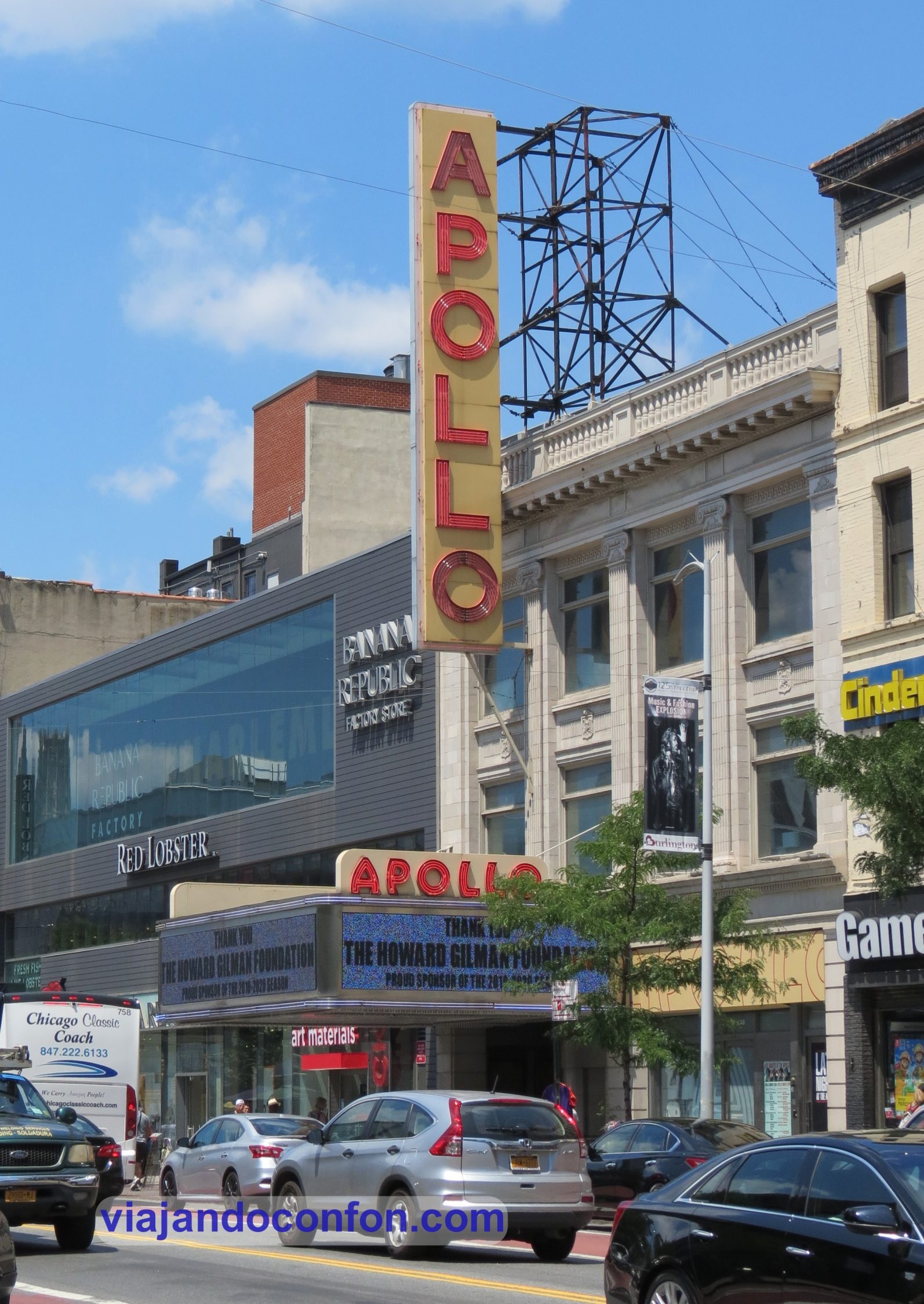
Back in Manhattan and after about half an hour on the subway, we got off at 125th street in Harlem. From there we walked around the neighborhood for a bit, passing in front of the mythical Apollo Theater.
The Apollo Theater is a prominent venue for African-American entertainers, and is home to Showtime at the Apollo, a nationally syndicated television variety show that showcased new talent, from 1987 to 2008, spanning 1,093 episodes. It opened in 1914 as Hurtig & Seamon’s New Burlesque Theatre, and was designed by George Keister in the neoclassical style. It was renamed the Apollo in 1934 when it was opened to black patrons as it had previously been a white-only venue. In 1983 it was designated as a New York City Landmark.
The Apollo Theater
We continue walking to St. John the Divine Cathedral, the cathedral of the Episcopal Diocese of New York. Construction began in 1892 in the Byzantine Revival and Romanesque Revival styles and is still unfinished.
In 1909 the plan was changed and it continued in the Gothic style. The towers above the western facade, as well as the south transept and a proposed bell tower above the crossing, were never completed.
To enter the cathedral you have to pay but from the lobby you can see it quite well and save a few dollars. Although the recommended thing to see in the cathedral is the Fountain of Peace, a 12-meter-high sculpture sculpted in 1985 by Greg Wyatt.
The sculpture represents the fight of good and evil, as well as a battle between the Archangel Michael and Satan. The sculpture also contains the Sun, the Moon and different animals.
Fountain of Peace and the cathedral in the background.
Despite the tremendous heat we went to try to go through Central Park but it was a frustrated attempt. It was hell hot. So we left and went into the American Museum of Natural History where it was cool. It is a complex of 26 interconnected buildings that house 45 permanent exhibition halls, as well as a planetarium and a library.
The museum’s collections contain more than 34 million specimens of plants, animals, fossils, minerals, rocks, meteorites, human remains, and human cultural artifacts, as well as specialized collections of frozen tissue and genomic and astrophysical data.
We entered through the side door which I had read was less crowded and it was. If you buy the ticket for $23 at the machines, you enter directly without queues, so we decided to stand in line (about half an hour) and paid the “voluntá”, which was $5 each, taking into account that there were only a couple of hours left. to close and it only gave us time to see a minimal part.
The museum is quite spectacular but it is not full, saturated with people.
At 6:00 p.m. when they kicked us out, we saw that it was a good time for lunch (we were on the verge of fainting) so we had a quick (and nauseating) hamburger at a Wendy’s and running to Rockefeller center that we had tickets for the Top of the Rock viewpoint at 7:15 p.m. to see the views at sunset.
Rockefeller Center is a large shopping complex consisting of 19 buildings. Of these, 14 Art Deco buildings are originals commissioned by the Rockefeller family.
Until 1928 the land belonged to Columbia University which was leased to John D. Rockefeller Jr. and originally a new building was going to be built for the Metropolitan Opera but it could not afford it financially so they decided to build Rockefeller Center. Its construction in 1931 and the first building was opened to the public in 1933, and it was completed in 1939.
Rockefeller center
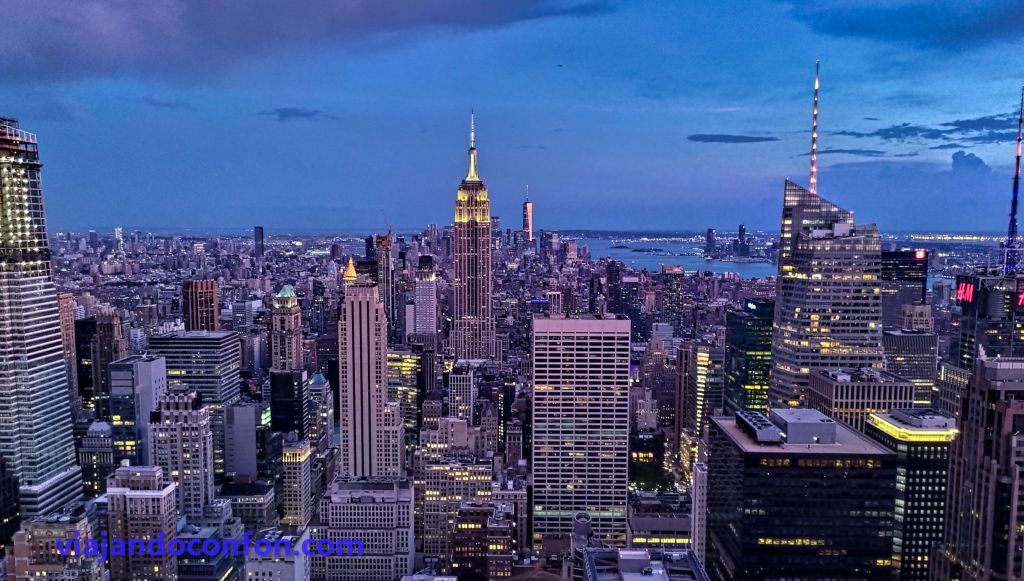
Once again, the views from the spectacular heights, even more than those of the Empire State. That yes, until the flag of people. The spectacular sunset watching how the city gradually lights up, and at night without words. From here we can see the play of lights that they make from the Empire State.
The times of sunrise and sunset are $10 more expensive since they are the most requested. Hiring the joint visit to the 9/11 Museum, it has the same price at any time of the day.
July 22
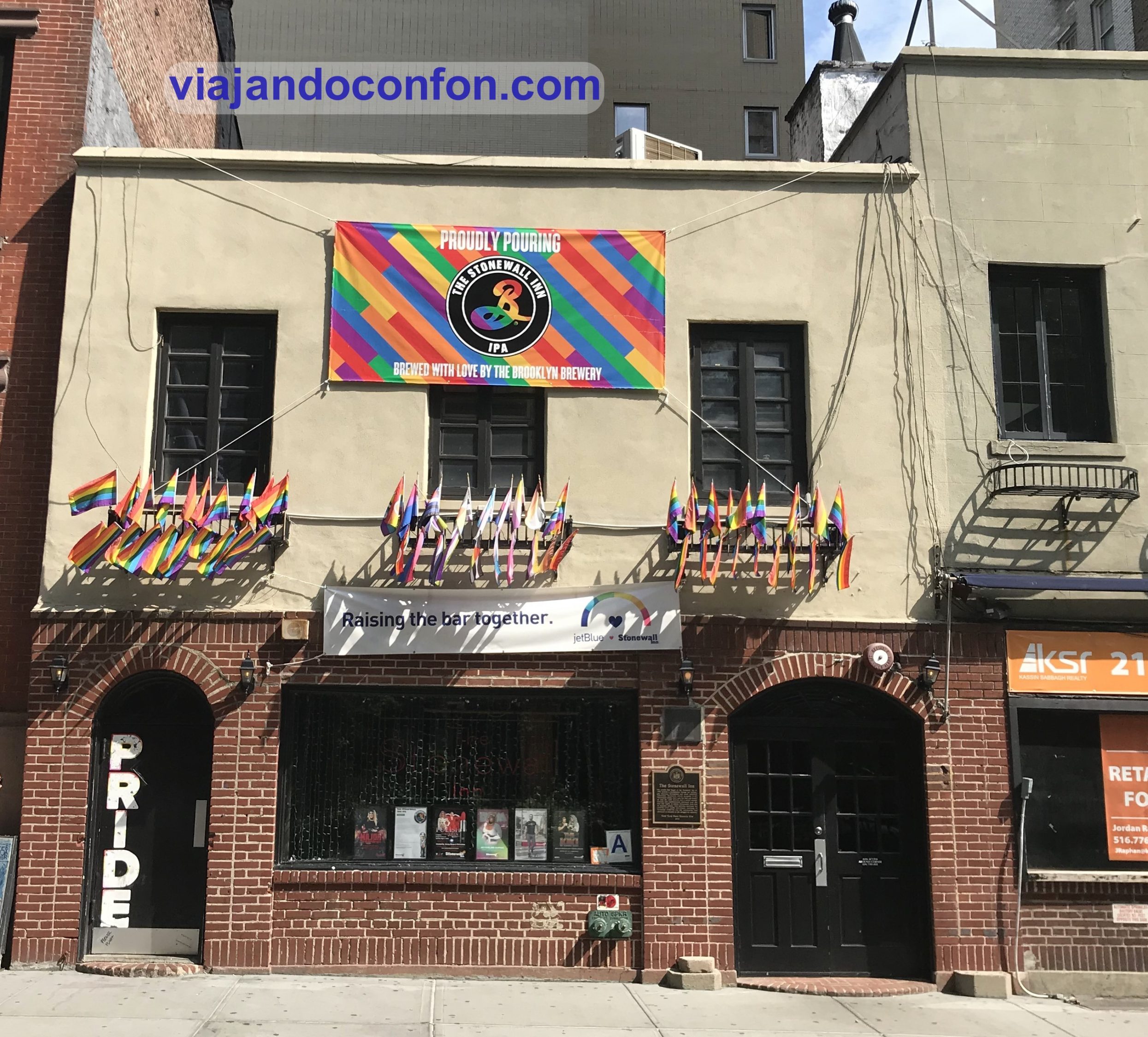
Last day in New York and we will have to take advantage of it. Again we take the PATH to the 9th street station to take the subway to Central Park. To do this, we cross Christopher street passing in front of the mythical Stonewall Inn bar, where the riots took place in 1969 for the liberation of the LGTBI collective.
Already at the Christopher Street station we took the subway to the Columbus Circle station to walk through Central Park.
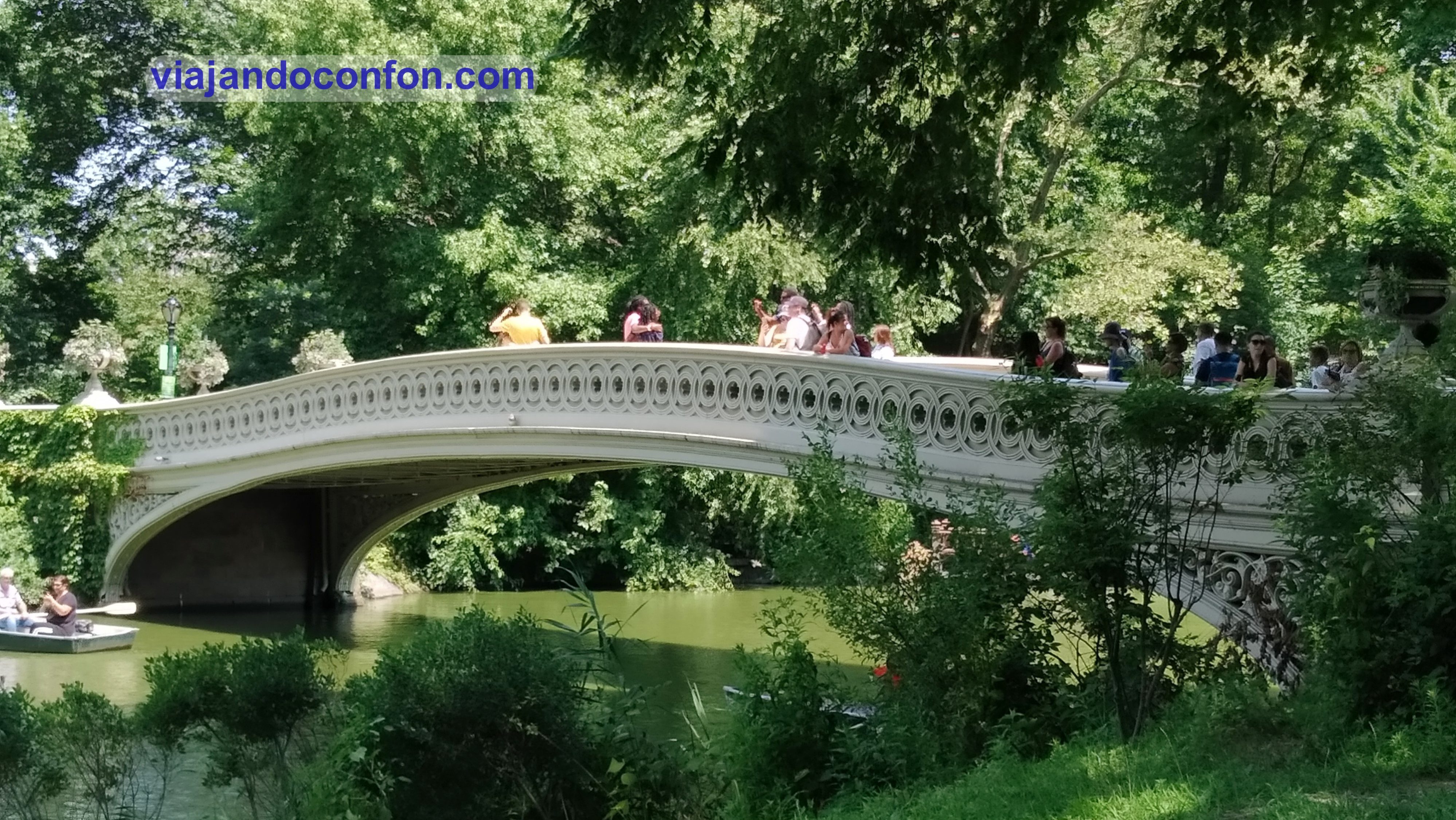
Central Park, located in the center of Manhattan, is the fifth largest park in New York with an area of more than 340 Ha. It is the most visited urban park in the entire United States with more than 40 million visitors a year.
Its construction began in 1857 with a design by landscape architects Frederick Law Olmsted and Calvert Vaux called the “Greensward Plan.” The first areas of the park were opened to the public in late 1858 and it was fully opened in 1876.
After a period of decline in the early 20th century for New York City parks, a program to clean up Central Park began in the 1930s on the orders of Commissioner Robert Moses. In 1980, the Central Park Conservancy was created to combat further deterioration in the late 20th century, renovating many parts of the park beginning in the 1980s.
Taking advantage of the fact that it wasn’t too hot, we took a long walk through the park. After five days of non-stop walking we took it pretty easy and even had a good time (including a nap on my part) lying on the lawn in the shade and buying some souvenirs. Going out for an aperitif we went to Sprinkles on Lexington av. to eat some cupcakes that were to die for.
Apparently the cupcakes weren’t enough, we took the subway to Washington Square Park and, very close to the station, we decided to eat at a Fresh & Co, from the same chain where we had eaten a few days before.
After eating very calmly, we approached Washington Square Park, a public park located in the Greenwich Village neighborhood of Lower Manhattan, while the sky threatened to unload heavy rain. It is one of the best-known public parks in the city and is an icon, as well as a meeting place and a center for cultural activity.
One of the highlights of the park is the Washington Square Arch, a triumphal arch built in 1889 to commemorate the centennial of George Washington’s presidency. The original was built of wood and plaster but was soon replaced by a marble one, designed by Stanford White between 1890 and 1895.
Washington Square Park
Due to the threat of rain it had to be a quick visit. A few pics and running to the subway to go to GrandCentral Terminal.
For movie fans like me, Grand Central Terminal is a must see. Many movie scenes have been shot there and it also has many curiosities. The truth is that the station impresses with its size and beauty… And with the amount of people there are. It can also be even fun since on the ground floor at the entrance to the Oyster bar (which has been open since the opening of the terminal in 1913), if you speak to a column, it is perfectly heard in the column opposite.
Grand Central Terminal was opened in 1913 on the site of two predecessor stations. The largest terminal station in the world in number of platforms (44) and the third busiest train station in North America, after New York Penn Station and Toronto Union Station.
The most striking of its architecture are its brick vaults patented by Rafael Guastavino, called ‘The architect of New York’.
At the exit, the Chrysler building is practically next to it, which you cannot enter but from the outside it is a spectacular building. Inside it must be a real wonder.
The Chrysler Building is a building designed in Art Deco by the architect William van Alen. At 319 meters tall and with 77 floors, it was the tallest building in the world for eleven months, until it was surpassed by the Empire State Building in 1931. Today it is number 11 on the list of tallest buildings in New York.
Our joy did not last long since at that moment it began to drizzle. So we decided to jump to Times Square to say goodbye to Manhattan thinking that with the rain there would be fewer people.
Halfway through we had to stop due to the universal deluge falling on us. It was so much that umbrellas were useless.
When it slowed down and we were able to get out of where we were stuck, we arrived at Times Square and the truth is that there were very few people, what a difference with previous days. He was walking very well until the universal deluge began to fall again and we decided to return to Jersey to have dinner and go to bed because we had to get up very early because the flight left in the morning from La Guardia airport.
Remember to always travel with insurance. With IATI you have a 5% discount for being our reader.
Follow us on social networks for more photos and more articles:
You can find many interesting activities to do in New York here.
Here you can see the map with the places we visited on this trip:
Discover everything you need to know before your trip to New York.
Gestionar el consentimiento de las cookies
Para ofrecer las mejores experiencias, utilizamos tecnologías como las cookies para almacenar y/o acceder a la información del dispositivo. El consentimiento de estas tecnologías nos permitirá procesar datos como el comportamiento de navegación o las identificaciones únicas en este sitio. No consentir o retirar el consentimiento, puede afectar negativamente a ciertas características y funciones.
Funcional
Siempre activo
El almacenamiento o acceso técnico es estrictamente necesario para el propósito legítimo de permitir el uso de un servicio específico explícitamente solicitado por el abonado o usuario, o con el único propósito de llevar a cabo la transmisión de una comunicación a través de una red de comunicaciones electrónicas.
Preferencias
El almacenamiento o acceso técnico es necesario para la finalidad legítima de almacenar preferencias no solicitadas por el abonado o usuario.
Estadísticas
El almacenamiento o acceso técnico que es utilizado exclusivamente con fines estadísticos.El almacenamiento o acceso técnico que se utiliza exclusivamente con fines estadísticos anónimos. Sin un requerimiento, el cumplimiento voluntario por parte de tu Proveedor de servicios de Internet, o los registros adicionales de un tercero, la información almacenada o recuperada sólo para este propósito no se puede utilizar para identificarte.
Marketing
El almacenamiento o acceso técnico es necesario para crear perfiles de usuario para enviar publicidad, o para rastrear al usuario en una web o en varias web con fines de marketing similares.