Today we are going to talk a little more in depth about Mount Nokogiri (鋸山), a beautiful excursion from Tokyo. I think it’s the one I liked the most (so far). His thing is to get up early and go early since the road is long and slow to get there.
Nokogiriyama (鋸山) is a 330-meter mountain on the western coast of the Bōsō Peninsula in southern Chiba Prefecture. Its name means mountain range. It faces the Uraga Channel, the waterway that connects Tokyo Bay and Sagami Gulf. The distinctive features of Mount Nokogiri are its sawtooth-shaped ridges (hence its name). These were created by the extraction of building stone during the Edo period.
Stretching along the slopes of the mountain is Nihonji Temple (日本寺), a Sōtō Zen Buddhist temple (曹洞宗). It was built in the year 725, which makes it one of the oldest temples in the Kantō region.
The temple complex is extensive and consists of multiple areas. A network of walking trails connects the areas that will take us a whole morning to explore and enjoy.
Here we leave you a map taken from the official website of the Nihonji Temple (in Japanese): http://www.nihonji.jp/
Nihonji Temple (日本寺)
It was inaugurated on June 8, 725 by Emperor Shōmu Tennō and the priest Bosatsu Gyōki (行基). He first belonged to the Hosso sect, then to the Tendai sect, and then to the Shingon sect. It became the Sōtō Zen sect during the reign of the third shōgun Tokugawa Iemitsu when it became a center of Zen practice.
In the Kantō region, Nihon-ji is the only Nara Period temple built by imperial decree (such temples were known as chokugansho (勅願所)). Some ancient documents say that the emperor donated 18 tons of gold to the temple. An imperial tablet written by the emperor himself and a scroll depicting 33 Buddha images personally embroidered by Empress Kōmyō.
According to the historical stone monuments that still exist today, the temple consisted of seven shrines, twelve monastic buildings and one hundred lodges for priests.
The temple’s fame reached its peak in the Edo period (1603-1868), especially under the rule of the third shōgun, Tokugawa Iemitsu. It was in 1774 that Guden (愚伝), the head priest of Nihon-ji, expanded the temple and made Nokogiriyama into a sacred mountain. The Nihon-ji Daibutsu and the 1,500 arhats were added to the southern slope in the same period. The temple suffered considerably in the aftermath of the Meiji Restoration, when the haibutsu kishaku (廃仏毀釈), an anti-Buddhist movement, resulted in extensive destruction of temple property. Many of the arhats were beheaded, but later restored.
Sculpture of an Arhat
The main deity of the temple is Yakushi Ruriko Nyorai (Medicine Buddha). Originally revered solely by ruling sovereigns and judicial elites for his own personal benefits (to cure life-threatening diseases), Yakushi would later become the central deity in 8th-century rites to ensure the well-being of the entire kingdom. In the early 9th century, the deity was also called upon to appease vengeful spirits that cause calamities. The main feature is that he has a medicine bottle in his left hand.
Yakushi Ruriko Nyorai is said to heal war wounds, so numerous military commanders have visited this temple. After losing the Battle of Mount Ishibashi, Minamoto no Yoritomo prayed for luck at Nihonji Temple.
Immediately after the start of the Kamakura Shogunate, Minamoto no Yoritomo set about demolishing all Japanese temples that were in disrepair, and rebuilt the Yakushi Honden in the first year of Yowa (1181). Nihonji Temple, which was completely renovated by Yoritomo, would be devastated again due to the continuous fire of the second half of the Kamakura Shogunate, but Takashi Ashikaga will rebuild it again in the 14th century. It was also rebuilt again in the 16th century by the Satomi clan, the local warlords of Awa Province.
Visiting Mount Nokogiri
The most common and popular entrance is the one that is made through the cable car located in the city of Kanaya.
It is convenient to bring water since we will only find water in the vending machines that are next to the Big Buddha and next to the cable car exit.
The only public baths are also very close to the Big Buddha.
The entrance fee (2020) is ¥600 for adults and ¥400 for children.
Summit Area (山頂エリア)
We entered from the cable car station, where there are vending machines for drinks and a small restaurant.
From this point we have spectacular views of the area surrounding Kanaya and of Hota.
From here starts the path that leads to the door where we pay our entrance and they give us a map and an informative brochure.
We climbed about a million steps and arrived at the spectacular and gigantic 30-meter sculpture of Hyaku-Shaku Kannon (百尺観音). Although it looks like it has been here for centuries, it was carved between 1960 and 1966 to commemorate the victims of World War II and traffic accidents. He is revered as a deity to protect the safety of nautical, air, and land transportation.
Hyaku-Shaku Kannon (百尺観音)
After climbing about another million steps in the tremendously humid July heat, we arrived at the Jigoku Nozoki (地獄のぞき) viewing area, the “View of Hell”. The most famous and spectacular viewpoint in Nokogiriyama, it offers stunning views of the Bōsō Peninsula and the Uraga Channel. Across the bay, you can see the Miura Peninsula and, on clear days, Mount Fuji. It consists of a small ledge on the mountain from which there are truly spectacular views while you seem to be suspended in the air. You have to queue to gain access since, from the front, you can take some very cool photos at the viewpoint.
Jigoku Nozoki (地獄のぞき), the “View of Hell”
Rakan Area (羅漢エリア)
After taking the obligatory photos we began the descent. We do it along the main path, the path of the 1,500 arhats (千五百羅漢).
In Buddhism, an arhat is someone who has gained a deep understanding of the true nature of existence, who has reached nirvana and therefore will not reincarnate.
Arhat sculptures
Like Arhats in other parts of Asia, they resemble Li Guangxiu’s brilliant set of figures at the Bamboo Temple outside Kunming in China: each facial expression is different, from the beatific to the Tradition holds that if you start Counting your own age from a certain figure, you will arrive at the Arhat that most resembles your own character and your inner being. You may not like what you find.
Well, on the slope of the mountain there are stone images of 1,500 Tokai Arhats, made by the artist Jingorō Eirei Ōno and his 27 students during 19 years (between 1779 and 1798), carved in a special stone brought from the Izu peninsula. . These Tokai Arhats are found in small natural caves and on carved rocks. Unfortunately, many were destroyed during an Anti-Buddhist Movement in the Meiji period, between 1868 and 1873, reducing their number to 538. That is why sometimes only parts of the statues remain. Many of them have recently been restored.
The way down is truly incredible, with the sculptures in the spectacular wooded setting of the mountain, making you forget the tremendous summer heat.
Explanada del Gran Buda de Nokogiri (大仏広場)
Halfway up the mountain we find the jewel of the temple: the statue of the Great Buddha of Nokogiri or Nihon-ji Daibutsu (日本寺大仏).
It was originally carved out of the same rock it stood on in 1783 (third year of Tenmei) by Jingorō Eirei Ōno and his 27 students and measured 37 meters. At the end of the Edo Period (1603 – 1868), due to erosion by wind and rain, it collapsed. The sculpture that we see today dates from 1969 and measures 31 meters, 7 less than the original.
It rises from a semicircular base, in the shape of overlapping lotus buds, to a stone halo resembling a disk and with “little” Buddhas surrounding Yakushi Ruriko Nyorai.
The sculpture is spectacular and leaves you speechless. On the esplanade there is a kind of shaded picnic area where you can rest in the shade and have a cool drink from one of the vending machines that are here.
Find your ideal hotel at the best price in Japan with Agoda:
*It helps us to maintain the blog
Middle Zone (中腹エリア)
After a well-deserved rest, we begin the descent again, passing through several temple buildings, such as the Yakushi Honden (薬師本殿医王殿), destroyed by the great fire of 1944 and rebuilt in 1997.
Yakushi Honden (薬師本殿(醫王殿)
Omotesando Area (表参道エリア)
Already in the lower part, we can find the Shinji-ike pond (心字池) and some more buildings such as the Kannondou (観音堂).
Kannondou (観音堂)
Here the route of Mount Nokogiri ends, about two hours approximately. An excursion that will not leave you indifferent.
To return to Tokyo, the most practical thing is to take the train from the JR Hota station, which is about a 20-minute walk between crops from the entrance to the complex of the mount, to the JR Hama-Kanaya station and there return to take the boat towards Kurihama.
How to get to Mount Nokogiri
To get to Mount Nokogiri from central Tokyo, it is best to go to Shinagawa Station (品川駅).
From Shinagawa, if you have JRPass, it is best to take the JR Yokosuka Line via Kurihama, to JR Kurihama Station which takes 1 hour and 20 minutes. Without JRPass, the price is ¥950.
*It helps us to maintain the blog
If you don’t have a JRPass, it’s best to take the private Keikyu Main Line, which a little further on, at Horinouchi station, becomes the Keikyu Kurihama line (you don’t have to get out of the car), also from Shinagawa to the station Keikyu-Kurihama. The journey takes 1 hour and 9 minutes and costs ¥800.
If we go with JR, from Kurihama station we have to walk to Keikyu-Kurihama station, which is just opposite. At the main entrance, we got on the number 7 or number 8 bus to the Tokyo Wan Ferry stop, next to the ferry terminal. The journey takes about 12 minutes and costs ¥240 (€1.30).
Remember to always travel with travel insurance. With IATI, specialists in travel insurance, you have a 5% discount for being our reader.
Tokyo
Rokurinsha (六厘舍)
A small (very small) ramen restaurant. It is located on Tokyo Ramen Street in the basement of Tokyo Central Station, just up some stairs. You will recognize it by the permanent tail. The estimated waiting time at that point in the queue is marked on the floor. Trust me it’s worth the wait.
As soon as you enter you have a machine in Japanese (luckily with photos) in which you mark what you want, put in the yen and it takes out a piece of paper that you hand over to a boy and he serves you. On the tables you have a jug of cold water that they change for you.
As a curiosity, if you want they give you a paper bib so you don’t get dirty.
Address: Japan, 〒100-0005 Tokyo, Chiyoda City, Marunouchi, 1 Chome−9−1 東京駅一番街 B1 東京ラーメンストリート内
This is a small restaurant that serves tori no karaage (から揚げ), Japanese fried chicken that is delicious. We discovered it in 2016 and on our 2018 trip we ate there again.
Next to the door you have your machine to make the choice and you give the piece of paper to the boy who attends. It is so small that it only has a bar. The chicken was delicious and very cheap and they put it on a menu with a miso soup, a bowl of rice and shredded cabbage.
Address: Japan, 〒105-0004 Tokyo, Minato City, Shinbashi, 2 Chome−16−1 ニュー新橋ビル 1F.
How to get there: It is located in the southern part of the square in front of Shinbashi station, leaving through the Hibiya exit.
It is a chain that specializes in gyūdon, a bowl of rice with braised meat cut into very thin strips. It is very cheap and very good, with dishes starting at ¥387 (€2.91).
It was founded nothing more and nothing less than in 1899 and they are all over Japan.
It is another chain that we find all over Japan. It is not the cheapest place to eat but it has a lot of variety, from Japanese food to pizzas.
The best thing about this chain is that, paying 200 yen (€1.55) you have an open bar of non-alcoholic drinks. For summer dehydration it is really good.
It’s a small ramen restaurant mainly, although it also has something else like rice. Good and cheap in the heart of Shinjuku: 600 yen for the menu (€4.71).
Address: Japan, 〒160-0022 Tokyo, Shinjuku City, Shinjuku, 3 Chome−21−1 清水館ビル.
How to get there: 2-3 minutes walk north from the East exit of JR Shinjuku station, towards Kabukicho.
Hours: Monday to Saturday from 10:00 a.m. to 2:00 p.m. Sunday from 10:00 to 24:00.
Totobee
Permanently closed
A small sushi place near the old Tsukiji market. It is located in a basement and the sushi is delicious and, since it is not touristy, like most of the restaurants around the market, it is quite cheap. Menu only in Japanese but with photos and employees who only speak Japanese.
It is the most delicious sushi I have ever tasted.
Address: since it doesn’t appear on google maps, we can be guided because it is next to a Spanish restaurant called Brochetería Sol Sevilla located at 〒104-0045 Tokyo, Chuo City, Tsukiji, 2 Chome−14−3 天羽ビル.
How to get there: 100 m walk from the northwest of the entrance of Tsukiji Hongwan-ji temple.
Opening hours: I haven’t found the opening hours but I have to say that it closes on Sundays, since I was able to check it the last time I went.
Mos Burger
It is a chain of hamburger restaurants that are all over Japan, McDonald’s type. It is cheap and they are very good although they are a bit small for a Westerner to see.
Another chain that we found all over Japan. This time specializing in gyudon and grilled eel, although you can find many more things. The eel is very good and they have quite affordable menus.
It is a sushi chain, the kind that passes the dishes around the tables through a belt. The one in Ueno was highly recommended to us. It is very good and well priced, although, in this place specifically, the wait for a table can go up to an hour. Worth.
Address: Japan, 〒110-0005 Tokyo, Taito City, Ueno, 6 Chome−9−9 オリエンタルビル B1.
How to get there: About a three-minute walk south of JR Ueno Station.
Sushi restaurant located in Terminal 1 of Haneda Airport (before security checks). It’s very good and, for being in an airport, it’s not expensive.
Address: Japan, 〒144-0041 Tokyo, Ota City, Hanedakuko, 3 Chome−3−2 第1旅客ターミナル ガレリア 3F 羽田空港.
How to get there: it is located on the 3rd floor of terminal 1 of the airport.
Hours: every day from 11:00 a.m. to 8:00 p.m.
Narita
Ton Ton Tei
Tiny tonkatsu restaurant in the city of Narita. A very nice place with spectacular meat and cheap, although somewhat difficult to reach.
Address: 411-1 Tsuchiya, Narita, Chiba 286-0021.
How to get there: We can get there by taking the bus that leads to Aeon Mall Narita that leaves from outside the JR Narita station. We got off next to the door of the shopping center and walked southeast for about 10 minutes. The price of the bus is 210¥ (€1.60).
We can also walk about 10 minutes from the Peace Pagoda of the Narita San Shinso-ji temple, leaving through the back door of the enclosure.
Hours: every day from 11:00 a.m. to 11:00 p.m.
Utsunomiya
Utsunomiya Gyoza Kan
It is a chain of gyoza restaurants, the Japanese dumplings, originally from Utsunomiya. It has many varieties. Very cheap and delicious.
This tiny restaurant with an unpronounceable name is the place with the best noodles I’ve ever tried. It is found hidden in an alley in Pontocho. The place consists of 10 stools around a bar where a serious and meticulous young man attends.
Discovered by chance, among hundreds of restaurants full of tourists, in this one there were only locals eating. Delicious and cheap.
We choose our food from a machine by the door, insert the money and give the ticket that comes out to the boy.
How to get there: Just a 2-minute walk north of exit 1-A at Kawaramachi Train Station on the Hankyu-Kyoto Line.
Opening hours: Every day from 12:00 to 15:00 and from 17:00 to 2:00.
Kyoto Tower Sando B1 Food Hall
Located on the ground floor of the Kyoto Tower are a series of small restaurants serving a variety of cuisine. They are reasonably priced and offer everything from fried chicken to wagyu burgers and delicious ramen.
It is a place specialized in okonomiyaki. It is very Japanese and they make you take off your shoes before entering. It’s not very cheap but it’s delicious and they make the okonomiyaki right at your table.
The best okonomiyaki I’ve ever had.
Address: 3 Chome-1-12 Tenjinbashi, Kita Ward, Osaka, 530-0041.
How to get there: 3 minutes north of JR Ōsakatemmangū Station and Minami-morimachi Subway Station.
We can also walk 6 minutes from the Osaka Temmangu temple, to the north also by a shotengai.
Opening hours: every day from 11:00 a.m. to 11:00 p.m.
Kobegyu Wanomiya Dotonbori Honten
It is a tepanyaki restaurant specializing in Kobe beef located in Dotonbori. Of course it is expensive, but it is worth it to treat yourself from time to time.
The cook will give you advice on how to eat it, and it is spectacular even the vegetables.
Address: 1-5-2, Dotombori, Chuo, Osaka 542-0071.
How to get there: It is located on the main street of Dotonbori, where we find all the restaurants, about 100 meters east of the Glico sign.
Opening hours: Tuesday to Sunday, from 11:00 a.m. to 3:00 p.m. and from 5:00 p.m. to 10:00 p.m. Closed on Monday.
Nagoya
Rich miso ramen Sakaeya(濃厚味噌らーめん さかえ屋)
It is a small ramen place. It wasn’t touristy at all, so everything was in Japanese and quite cheap and tasty.
How to get there: 3 minutes southeast of the Sakae subway station.
Opening hours: from 4:00 p.m. to 8:00 p.m.
Ichiran Nagoya Nishiki (一蘭 名古屋錦店)
Chain of ramen restaurants that are all over Japan and I even saw one on my trip to New York. The tonkotsu ramen is spectacular and has the peculiarity that it is eaten in a kind of booth, alone. The subject is very antisocial.
You sit down and mark the box on a piece of paper, the broth, the noodles, the toppings, etc… A blind rises in a small window in which there is someone whose only hands you can see, you give them the piece of paper, and in a minute you put your ramen on and close the window.
A small restaurant specializing in tuna sushi, although with a few more things. It is run by a quite old and very serious man, who only speaks Japanese, but has a menu in English.
It must be said that the tuna was to cry. It is very cool as it disembarks at the dock that is just 100 meters away. And it is that Kii-Katsuura is the tuna mecca of Japan.
On this page you can find all the information about Tokyo, the capital of Japan, from its history to learning to move, going through what you can’t miss.
As always, we recommend traveling with good health insurance. IATI is a specialist in travel insurance and, for being our reader, you have a 5% discount.
This will be the means of transportation in which almost all of us will arrive in Tokyo from our home countries.
Tokyo has two international airports, Tokyo International Airport (東京国際空港) known as Haneda Airport (羽田空港) and Narita Airport.
Haneda Airport
Haneda airport is located in the special region of Ōta, 15 kilometers south of Tokyo station, in the middle of Tokyo Bay.
As a curiosity, the 4th floor is decorated as if they were alleys from the Edo period. It is very, very cool and there is a very good and not too expensive sushi restaurant.
How to go from Haneda airport to Tokyo:
Train:
To go to Tokyo from Haneda, we can go by train with the private company Keikyu. This is the one that we have taken in the two routes that we have made. In approximately 15 minutes you get to Shinagawa station and the price is 300 yen (€2.40) and it does not enter the Japan Rail Pass.
From Shinagawa we can take the Yamanote line to any of the other major stations in the city or the shinkansen to Kyoto.
Here we leave the link of thestation map of the airport website.
Monorail:
We can also get there with the monorail. It is the fastest way and enters the JR Pass. But if you do not have the JR Pass activated, the price is 500 yen (€4). The monorail takes 19 minutes to reach Tokyo Station.
We can also go by bus. The company that covers the route is Limousine Bus. The frequency to Tokyo station is between 40 and 50 minutes and the journey takes about 40 minutes. The price is 950 yen (€7.60). The advantage is that they have night services, when the trains no longer work, although the prices are much more expensive, although it will always be cheaper than a taxi.
They also cover the route between Haneda airport and Narita airport, in case you have a flight with a layover in which you have to change airports. The price is 3,200 yen (€25.65). The bus is direct, unlike the train, in which we would have to make transfers.
If you want to make the journey by taxi, like everyone else, it is the most expensive option. The journey has a flat rate depending on the destination and, if the trip is between 10:00 p.m. and 5:00 a.m., the price increases. For example, the price to the Chiyoda area, where Tokyo station is located, is 6,100 yen (€48.90) during the day, plus 1,100 yen (€8) if it is the night trip.
If you want comfort and speed, you can always hire a transfer service that will be waiting for you at the airport and will take you directly to your hotel.
Other destinations:
If you want to go from Haneda airport to any other city such as Osaka or Kyoto, the ideal is to go to Shinagawa station with the Keikyu train and there take the shinkansen or, go with the monorail to Hamamatsuchō station and there take the Yamanote or Keihin-Tōhoku Line to Shinagawa or Tokyo Station.
Narita Airport
Narita Jasiko International Airport (成田国際空港) is located in Narita, Chiba Prefecture, about 60 km from central Tokyo.
How to go from Narita airport to Tokyo:
The star transport is the Narita Express or N’Ex. It is an express train that enters the JR Pass and leaves you at various stations in Tokyo.
The normal frequency is one train every half hour and if you do not have a JR Pass, the price is 4,070 yen (€32.60) with the N’EX TOKYORound Trip Ticket regardless of the destination station, which is a return ticket that is much cheaper. The price of a single trip, for example, to Shinjuku is 3,250 yen (€26). The journey lasts 1 hour and a half.
The downside is that the last train leaves at 9:45 p.m.
The other effective mode of transportation is the Skyliner (スカイライナー), a limited express train service between Tokyo and Narita Airport. It is operated by Keisei Electric Railway, so it does not fall under the JR Pass. It has stops at Nippori and Keisei Ueno stations.
The price of the Skyliner is 2,520 yen (€19.50), which takes advantage of the Narita express as it is cheaper if you pay with money.
Transport in Tokyo
Train
An efficient way to get around Tokyo if you have the JR Pass is to use any of the trains on the JR line.
The Yamanote Line, colored green, is a circular line that stops at most major tourist sites. This line is, surely, the most popular line in Tokyo and is used by an average of 3.5 million passengers PER DAY!!!, ABOUT 1,300 million people per year.
Of course you will use it, and a lot.
Metro
It is the most efficient way to get around Tokyo, following the JR Yamanote Line.
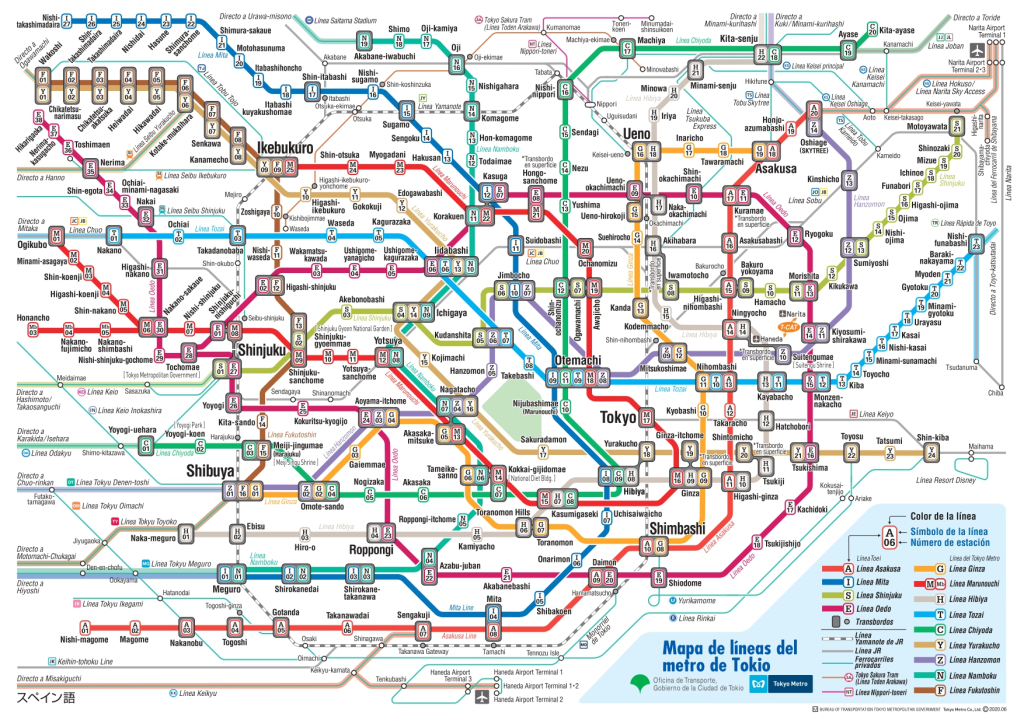
There are two metro companies, both private, so we cannot use them with the JR Pass. They are Tokyo Metro and Toei Subway and, although at first glance the map seems very complicated, it is very easy to use.
On the map you can see the station where you are and the price to pay next to the station where you get off. If you don’t see them clearly, don’t worry, buy the cheapest ticket and when you get off the train, enter the ticket in some machines that are in all the stations that are fare adjustment, where you pay the remaining amount to be able to leave.
For example, we want to travel from Shibuya to Asakusa which is 250 yen. Since we are not sure, we buy the cheapest ticket, which is 170 yen. When we get off in Asakusa, we won’t be able to get out through the turnstile, so we go to the machine that says fare adjustment, insert the bill and it will tell us to insert 80 yen. Now we can go through the lathe.
The tickets are not valid for both companies, that is, if we buy a Tokyo Metro ticket, we cannot transfer to a Toei Subway line, but there are combined tickets.
There are several types of tickets, but the ones we will use the most are the combined tickets for the two companies for 24, 48 and 72 hours. These are the prices updated to August 2020.
PRICE
ADULTS
CHILDREN
24 H
800¥ (6.35€)
400¥ (3.20€)
48 H
1.200¥ (9.55€)
600¥ (4.75€)
72 H
1.500¥ (11.93€)
750¥ (4.96€)
You will find more information on the official websites of both companies:
They are the alternative to the subway and JR trains, but they are much slower and the schedules are very reduced. The truth is that we have never been on a bus in Tokyo so I cannot share the experience.
The price of a single ticket (updated as of August 2020) is 210 yen (€1.67) for adults and 110 yen (€0.87) for children.
The bus is accessed through the back door and the ticket is paid when leaving through the front door. You have to enter the exact amount into the machine. If you don’t have enough change, next to the pay machine you have another one that gives change.
Taxi
Traveling by taxi in Tokyo is expensive, it is very, very, very expensive. A journey through the center of Tokyo can cost you around €10, which would cost us €1.30 on the subway.
Of course, Japanese taxis are very clean and the driver will never cheat you. To get into the taxi, it is the driver who opens the door for you, if he does not open it for you, he does not want you to get in (it happened to us in Kyoto).
Tokyo, the capital of Japan, home to more than 37 million inhabitants in its metropolitan area, almost the same as the total population of Spain.
Tokyo is founded in 1457 under the name of Edo (江戸), with the construction of Edo Castle, the work of Ōta Dōkan (太田道灌), a samurai vassal of the Uesugi clan.
Tokugawa Ieyasu (徳川 家康)
In the year 1590 the shōgun Tokugawa Ieyasu (徳川 家康) took the castle and in the year 1603 established his government here. With this fact, the Edo period (江戸時代) began, which would last until the year 1868.
At the end of this year, with the change of government at the beginning of the Meiji Era, the emperor moved to Edo Castle, turning it into the Imperial Palace and renaming the city with the name of Tokyo. In the year 1871 the fiefdoms were abolished and the prefectures were created, including Tokyo with its 23 special wards.
In the year 1872 the first railway line began to be built and in 1885 the Yamanote circular line (山手線) was inaugurated, which will be the most used on our trip through Tokyo.
In 1923 the great Kantō earthquake (関東大震災) occurs, leaving the city devastated and approximately 143,000 dead.
At the beginning of the year 1936, the Incident of February 26 (二・二六事件) occurs, an attempted coup carried out by about 1,400 young officers of the imperial army.
They assassinated several high officials, including some ministers, but were unable to assassinate then-Prime Minister Keisuke Okada (岡田 啓介) or take control of the imperial palace. Two days later they surrendered.
During World War II, Tokyo was heavily bombed and, after Japan’s surrender, the city was occupied by Allied forces. At present, the United States Army still maintains Yokota Air Base (横田空軍基地) and several barracks.
Discover the best activities and tours in Tokyo with Civitatis:
On this page we are going to narrate in several entries the diary of our trip to Japan in 2018. Our second trip to the country of the rising sun. We continue to fall in love with this wonderful country, to which we will return sooner or later once again.
Two years later we return to Japan, starting with Narita, the city where the airport is located. We wanted to come back for 2019 but we couldn’t wait that long.
July 12th
At 6.20 in the morning we took off from Barajas to Paris. With Air France. Only 2 hours of flight and the plane very average.
We landed around 8:30 in the morning and we had a 5-hour wait ahead of us. We went to the departure terminal and spent the long and boring time there. Until 1:35 p.m. when we finally took off for Tokyo.
This plane, also from Air France, was comfortable with a good food service and a not very good entertainment offer. The crew… the crew is something else. I have never flown with such an unfriendly and unpleasant crew. My partner was a bit sick and it was one hell of a trip. It was terrible.
July 13th
After an 11-hour flight, we landed at Narita airport at around 8:40 in the morning. After passing the pertinent controls, we went to change the JR Passes, although at the moment we were not going to activate them.
Buy your JR Pass
Buy with Japan Experience your JR Pass at the best price. You can travel around Japan for 7, 14 or 21 days.
Then we took out yen at a row of ATMs that were near the JR counter and went down to the platforms to take the train to the city of Narita. We took the Keisei private line for 260 yen (2€-2.40$) and in about 20 minutes we were at the Keisei-Narita station.
We had the hotel next to the exit of the station. This is the APA Hotel Keisei-Narita. It was like 12 noon and we couldn’t get in until 3pm.
As my partner was not feeling well, they gave us the option of entering earlier for 1,000 yen (€7.50) per hour. So after more than 24 hours since we left Granada, we don’t think about it. We paid 4,000 yen (about €30).
The hotel was very good. A three star that, for Japan, the room was quite spacious with two single beds.
Find the best hotel at the best price in Narita with Agoda:
*Helps us to maintain the blog
We rested a bit and went to eat at the Ton Ton Tei tonkatsu restaurant. The food was to die for. The meat melted in the mouth. It’s a bit far but worth the visit.
Already with a full stomach and infernal heat, we walked to the nearby Narita-san Shinsho-ji Temple (成田山新勝寺). It is a Buddhist temple of the Shingon Tochiyama school founded in the year 940 (3rd year Tenkei) and its main image is Daishou Fudo Myo (不動明王).
The temple compound is huge and mixes old and modern buildings, as well as huge gardens. It takes a long time to go through it, especially if it’s hot. Admission is free.
On leaving the temple we went for a walk along Omotesando street, a commercial street where many old buildings are preserved, which, incidentally, brought us closer to the hotel. That night we wanted to go to rest early since the trip had left us exhausted.
Next to the hotel there was a kombini where we bought something prepared to eat and go to sleep early.
Here you can find a map with the points visited in Narita:
July 14th
Tokyo
Very early we set off for Tokyo. With the JR Pass already activated, we boarded the Narita express at Narita station to Shinagawa station. There we changed to the Keihintohoku line to Kamata station to get to the hotel.
For value for money we decided to stay at the Chisun Inn Kamata, the same one we stayed at in 2016.
Find your ideal hotel at the best price in Tokyo with Agoda:
*Helps us to maintain the blog
We left our things and went to the Setagaya neighborhood. We got off at Sangenjaya station and went straight to Carrot Tower, the tallest tower in Setagaya at 124 meters. On the 25th floor it has a free 360º viewpoint from which you can see spectacular views.
Views from Carrot Tower.
After the tower we go to the back where the terminal station of the Tokyu Setagaya tram line (東急世田谷線) is located.
It is one of the two tram lines that remain active in Tokyo. It has stops at various interesting points so we took a day pass. He had a hard time getting it out because not being too touristy, the box office only spoke Japanese. The price of the pass is 330 yen (2.70€). To our surprise, when the tram arrived, it turned out to be in the shape of a cat. How horny are the Japanese.
We got off at Kamimachi Station to visit the Daikan Residence (世田谷代官屋敷) and the Setagaya Tenso Temple (上町天祖神社). Neither of them was too spectacular, but since it caught us almost on the way, we had to visit it.
Retracing our steps, we reached Setagaya Joshi Park (世田谷城阯公園).
Setagaya Joshi Park is a historical park located in the Setagaya neighborhood opened in 1945. It is actually the ruins of the old Setagaya castle.
The castle is believed to have been built in the 14th century during the Muromachi period and belonged to the Kira clan (吉良氏) for more than 200 years.
In the year 1590, during the Tenshō period, the Tokugawa clan won the war and the Kira clan had to leave the castle and it fell into oblivion.
Less than a 5-minute walk away is a truly essential visit: Gotokuji Temple (豪徳寺), the temple dedicated to the lucky cat Maneki-neko (招き猫).
Goutoku-ji is a Buddhist temple of the Sōtō School, founded in 1480, by the Li family of the Hikone clan.
In addition to the Gotokuji Li Family Cemetery, which is a nationally designated historic site, there are many cultural heritage sites related to the Li Family, including the Buddhist temple and the Bell.
Legend has it that Maneki-neko (招き猫) originated here.
In the seventeenth century, one day the feudal lord Naotaka Li, who was hunting, was surprised by a terrible storm, took shelter under a tree. A while later, he saw a cat beckoning him with its right paw to come closer to the temple. Moved by curiosity, Naotaka Li approached the cat and, just at that moment, lightning struck the tree, destroying it. In gratitude for saving his life, Naotaka Li helped finance the temple, which was then in ruins.
Since then Maneki-neko (招き猫) has been a symbol of good luck in Japan (and almost all over the world).
There you can buy a Maneki-neko at the temple offices and leave it as an offering or take it home. I bought two, a small one to leave as an offering and a larger one that I have in my store.
The pavilion where the maneki-neko offerings are left is truly spectacular, not only for its beauty and that of the surroundings, but also for the number of maneki-neko that are left as offerings.
Among those hundreds in the photography, there is mine, but how to find it next time…
After taking a quiet walk around the compound and through the cemetery, we returned to the tram station. The next stop: Shoin-jinja-mae Station. From there we took a short walk through a non-touristy shopping street to the Shoin-jinja Shrine (松陰神社). That is the best thing that Setagaya has, since it is not touristy at all, it is purely Japanese and you can see what normal Japanese life is like.
It is a shrine dedicated to the thinker Shoin Yoshida who was famous during the Meiji Restoration and was built between 1923 and 1952.
The sanctuary is a haven of peace within the hustle and bustle of the neighborhood and has very pretty little gardens. But it has a drawback, when entering one of the gardens there was a sign with a gigantic mosquito drawn on a tree. We figured out what it meant and before going in we bathed in repellent just in case.
After this visit, we took the tram back to the JR station and headed straight for Shibuya. There we ate in a place that we already knew before, one of the Gusto cafe, the food is good and not very expensive and it has an open bar of drinks, which is important considering the tremendous heat it was.
With our stomachs already full and well hydrated, we took a quiet walk through Shibuya.
As night fell, we approached the Shibuya Hikarie Mall building, an impressive 34-story shopping and cultural center. From the 11th to the 16th floor is the Tokyo Theater Orb, a theater with a capacity for almost 2,000 people. From the door there is a huge window from which you can see the famous Shibuya crossing, which is also free.
Shibuya Crossing from Shibuya Hikarie Mall (very dirty glass)
On the way down, we went for a walk around the Shibuya 109 shopping center, which was getting cold. When we left, as it was still quite early, we took the train to Takeshita Dori, which we had never been at night.
There we took the opportunity to go around a bit in a Daiso, a chain of stores selling everything for 100 yen and buy some things like a camera case for 108 yen (€0.85) and an envelope filled with something chemical that when you hit it gets cold and It is ideal to cool off with the heat it was doing.
That night we had to eat something from the konbini at the hotel because we were very tired.
July 15th
Today it was time to get up early and look for an internet cafe to print a part of the guide that I forgot at home, thank goodness I always have a flash drive with everything. I left my partner still convalescing at the hotel and went on an adventure.
Finding a cyber didn’t cost me too much, there was one in front of the JR Kamata station called Net Room, from a chain that is all over Tokyo. The difficult part was making himself understood. They only spoke Japanese so from signs I was able to understand that it was full and that I would have to wait an hour. So I went for a walk around the neighborhood, had a coffee and came back. Again with signs I got them to give me a room for an hour. In the cyber there was a washing machine and shower and you can spend the whole night in it for about €20. At that time there were people leaving to spend the night.
The floor was made of mattress and it was very comfortable. It also has slippers to walk around the facilities since in the room you have to be barefoot. It had a computer with a printer and a tv with dvd. At the reception they had movies and magazines. After fumbling with windows in Japanese I managed to print the document. As it took me practically the entire hour, there was little else I could do in there. The hour cost me 300 yen (€2.20-$2.50).
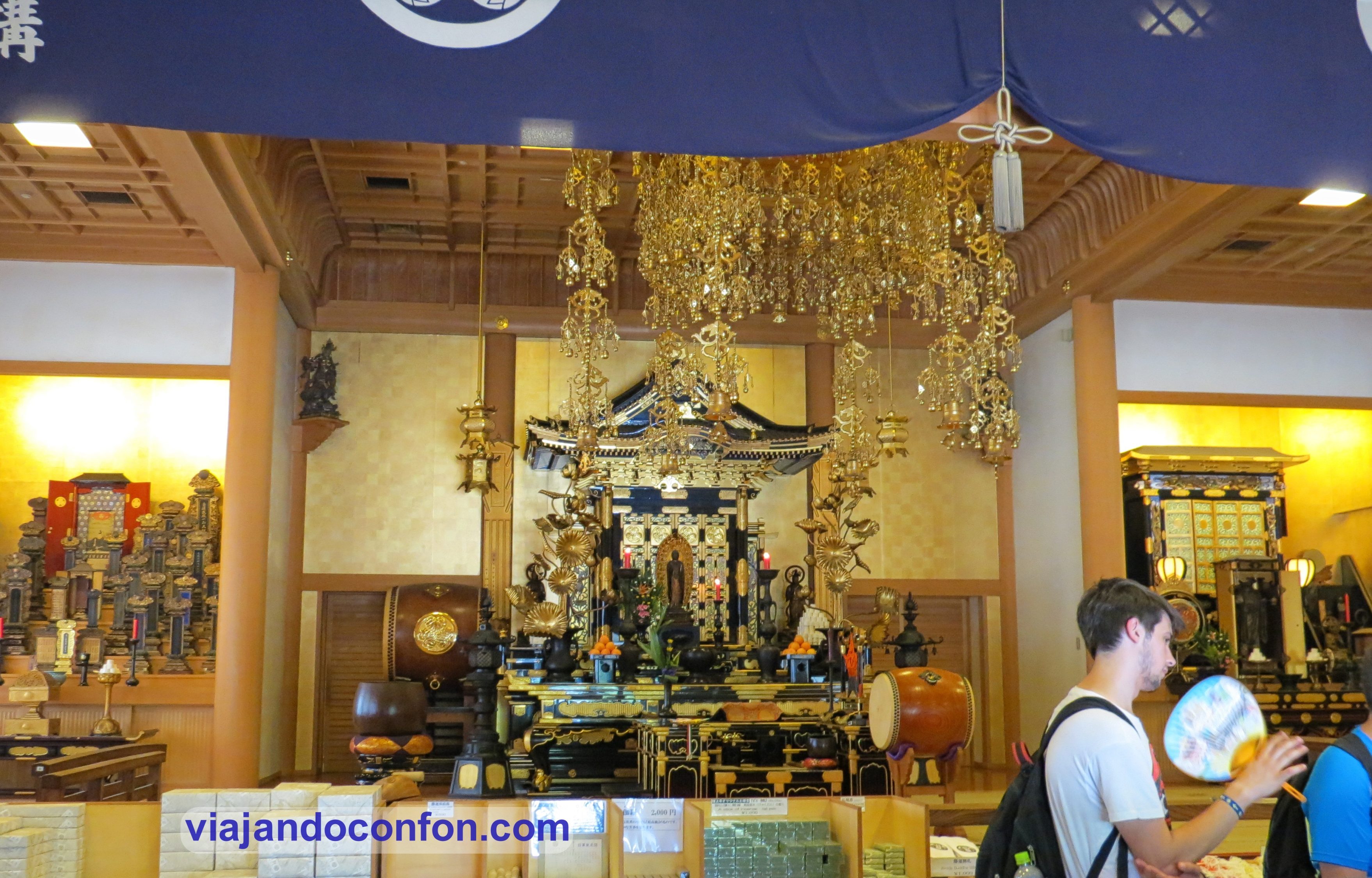
With everything ready, we headed for the Zōjō-ji Temple (増上寺), next to the Tokyo Tower, which offers a beautiful mix of tradition and modernity. It was founded in 1393 as an orthodox nembutsu seminary and central to Jodo shu in the Kanto region.
Zojoji was moved to the present site in 1598 after Ieyasu Tokugawa, founder of the Tokugawa shogunate, chose Edo (present-day Tokyo) in 1590 to establish his provincial government. After the start of the Edo Period when the Tokugawa shogunate ruled Japan, Zojoji became the family temple of the Tokugawa family.
We quietly visited the temple (it’s free) and we sat for a while inside, which had air conditioning.
From there we went to Shimbashi station to visit the Hama Rikyu gardens (浜離宮恩賜庭園). These are traditional gardens that were built as a residence for the Tokugawa family and later converted into a duck hunting ground.
It is known for its saltwater pond that enters directly from Tokyo Bay. The haven of tranquility surrounded by the modern skyscrapers in the area is very impressive. At the entrance they provide you with free umbrellas to mitigate the terrible heat of the Tokyo summer. I consider it an essential visit.
After the impressive visit to the gardens, we went to Ueno looking for a revolving belt sushi chain restaurant that I had seen on the internet and highly recommended: Sushi-ro.
We found it but the queue was huge.
You had to get a number on a screen that, of course, was in Japanese.
After several minutes looking at the screen as if looking into space, a girl approached us to whom we managed to explain that we wanted to take a number to eat at the restaurant since it seems that the screen gave several options. The girl very kindly takes us a number.
Second problem, there is no screen indicating the number she is going for and they sing the numbers in Japanese. So we wait to see what happens. In this they call the girl who had helped us. When she approaches the waiter, she comments to him pointing at us… nothing happens.
About 45 minutes after we entered the restaurant, they suddenly shout our number in English! We already know what the girl told him a while before.
Conclusion: The Japanese are the kindest people in the world. It wouldn’t be the first or the last time they’d give us a hand. It was worth the wait and the sweating of the Japanese language since the sushi was amazing and it was really cheap. We will be back.
After eating we went for a walk in Ueno Park to wash down the food and returned to Shimbashi to see the night show of the Ghibli Clock, in the building of the Japanese television network NTV. Two years ago we saw it during the day but we had been wanting. It is highly recommended even if you are not a fan of anime.
After the show we went to Shiodome station to take the driverless train on the Yurikamome line to go to Odaiba to see the new Gundam Unicorn next to the Diver city Tokyo shopping center, since they had changed it since we were there in 2016. On the way, we took a walk through the Venus fort shopping center where the corridors simulate the canals of Venice (Permanently closed since 2022). It’s all very, very freaky… After taking a good walk we decided to go back to the hotel so we could get up early the next day.
Find the best activities and tours in Japan with Civitatis:
*Helps us to maintain the blog
July 16th
Today it’s time to get up early and go on an excursion to a place rarely visited by Westerners and highly recommended: Mount Nokogiri (鋸山).
It is located on the west coast at one end of Tokyo Bay, already in the Chiba prefecture. There is the largest ancient Buddha statue in all of Japan, with 31 meters high. It is located within the grounds of the Nihonji Temple (日本寺), which literally means temple of Japan. It is a Buddhist temple founded in the year 725, being the oldest in all of Kanto and occupying the entire slope of the mountain.
At 8:30 we took the JR Keihintohoku Line to Yokohama Station, and there we transferred to the JR Yokosuka Line to Kurihama Station. On this train we realized that we were leaving the touristic Japan since during the whole trip we were the only westerners in the whole car. I love hehehe.
From Kurihama station we walked (5 min) to the main entrance of Keikyu-Kurihama station and there we got on bus number 8 (¥200) and in about 15 minutes we were at the Tokyo Wan-Ferry2 ferry terminal minutes before it came out. We bought the tickets in a hurry, one way for 720¥ (roundtrip 1320¥). About 40 minutes later we got off the ferry at Kanaya. We walked about 15 minutes, with a stop in the middle in a kombini to buy supplies for the excursion, until we reached the cable car that was going to take us to the top of the mountain. For another 500 ¥ we bought a one-way ticket (930 ¥ round trip). The ride showed only 5 minutes but the views are truly spectacular.
Kanaya from the cable car
When you get to the top there is a visitor center and from there the route begins. To enter you have to pay ¥600 (€4.50). The views from the center terrace are brutal. The first thing we did was head towards the gigantic statue of Hyakushakukannon. It is carved into the rock and is spectacular, both the statue and the path to reach it.
From here, everything is down. We go down the path of the arhats. Along this path we can find 1,500 stone statues of arhats sculpted between 1779 and 1798. It is a very curious walk as well as beautiful inside the lush forest.
We continue down and finally we arrive at the esplanade where the jewel in the crown is located: the Great Buddha. It is really gigantic. It was definitely worth the exhaustion and sweltering heat. Next to the temple there is a shady picnic area where we sit down to eat something and drink something cold from one of the machines there (of course).
After resting we begin the descent towards the Hota train station. The descent was still spectacular passing through more temples of different sizes.
We had decided to return to Tokyo by train and we made a huge mistake. It took us more than three hours to return, it seemed that the journey would never end. The worst thing is that that night we had a hotel in Nagoya. So we highly recommend coming back by ferry.
As soon as we arrived in Tokyo, we picked up our bags at the hotel and rushed to Shinagawa station to take the shinkansen to Nagoya.
Nagoya
For dinner it was time to buy a bento to eat on the train. We took the shinkansen at 7:10 p.m. and around 9:00 p.m. we were arriving in Nagoya, but not getting off the train. Just before entering the station, it stopped and we stood there for almost half an hour. Every two for three a message in Japanese sounded over the PA system in which I suppose they were saying the reasons, but we will never know. The chosen hotel was the UNIZO INN Nagoya Sakae Higashi. Well located but quite seedy.
Find your ideal hotel at the best price in Japan with Agoda:
*Helps us to maintain the blog
July 17th
Today is an excursion to the city of Ise (Mie Prefecture). We visit the Ise Grand Shrine or Ise Jingū (伊勢神宮) which is the most important shrine in Japan. We were going to visit the Inner Naikū Shrine (内宮) and the Outer Gekū Shrine (外宮).
We got up early and at 8.37 in the morning we were already on the train. We took the Mie line that went directly to Iseshi station where it dropped us off at 10:20. At one point during the journey, an employee of the company passed by charging an extra because one of the sections of track belong to another company. The price was 510 yen per person (€3.50). It is well indicated on the JR Pass. All this the boy explaining everything in Japanese.
Sewer in Ise
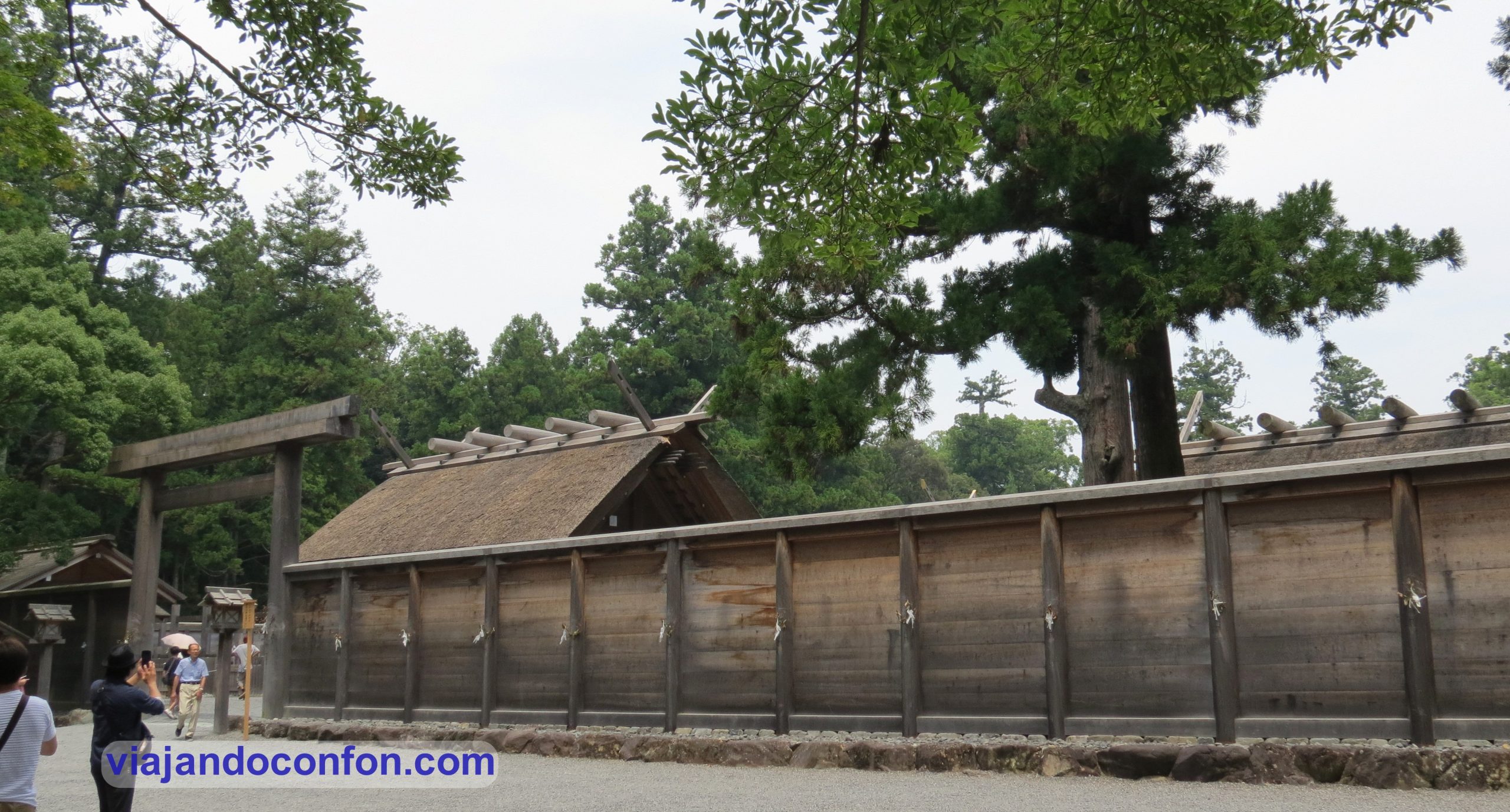
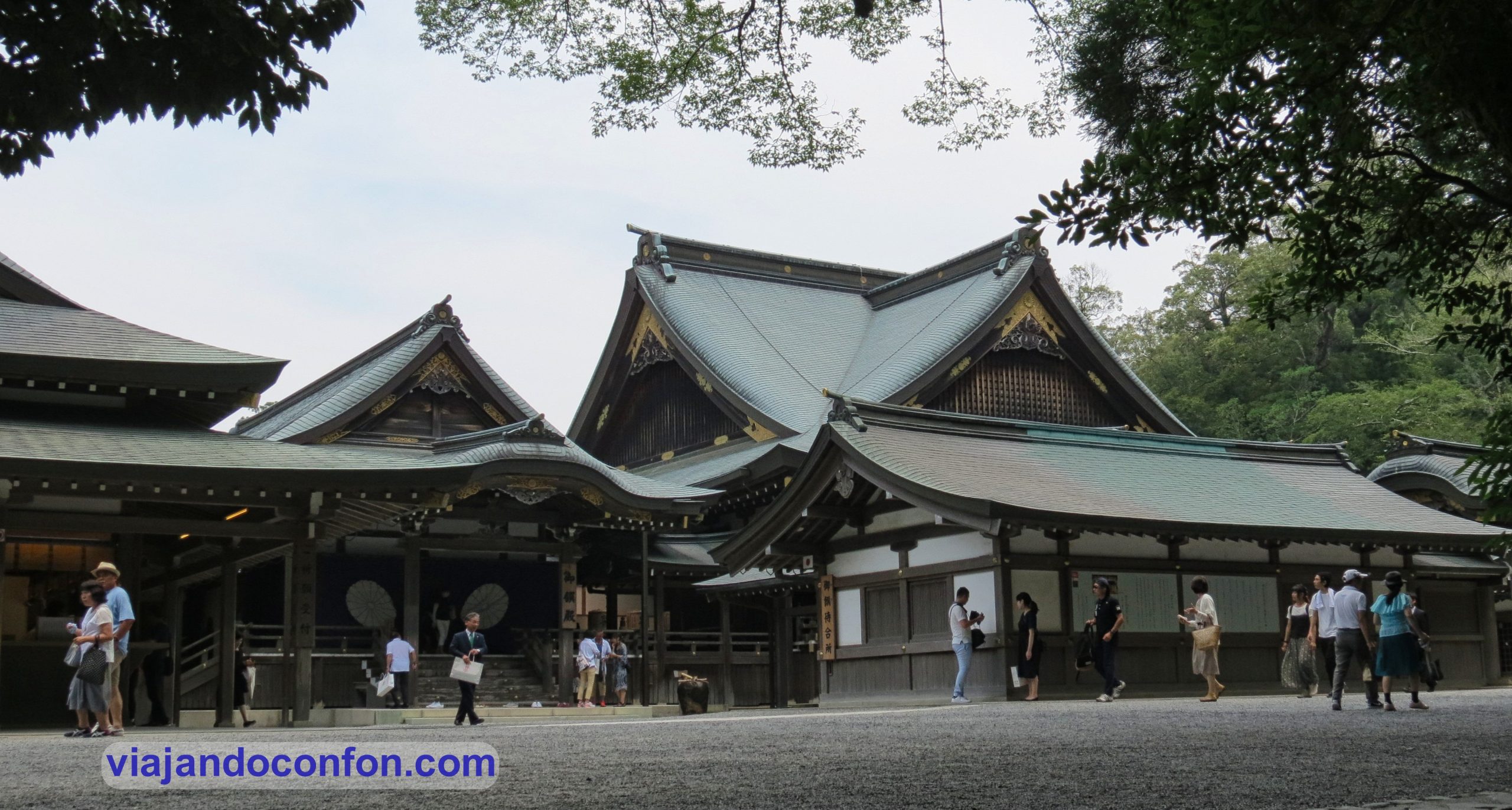
We left the station and walked to the Outer Shrine «Geku». The Sanctuary is truly spectacular. It is nestled in a beautiful wooded area with giant trees and ponds. There were a lot of people since it is one of the main pilgrimage points in Japan. The walk takes a long time but it is very enjoyable.
After a long and relaxing spiritual walk, we left the complex and at the same entrance we took bus number 51 to the outer sanctuary (bus number 55 is also valid). About 20 minutes later we were getting off next to the entrance of the Sanctuary.
The outer shrine was founded 2,000 years ago and is one of the holiest places in Japan. The enclosure is a gigantic haven of peace even though many people walk through it. Despite the time that can be invested to get to Ise, it is worth getting closer because it is really spectacular.
Despite the oppressive humid heat, it is a fairly pleasant and calm walk. In the visitor center near the exit, there are screens with explanatory videos about the temple (in Japanese) as well as air conditioning, cold water and free tea.
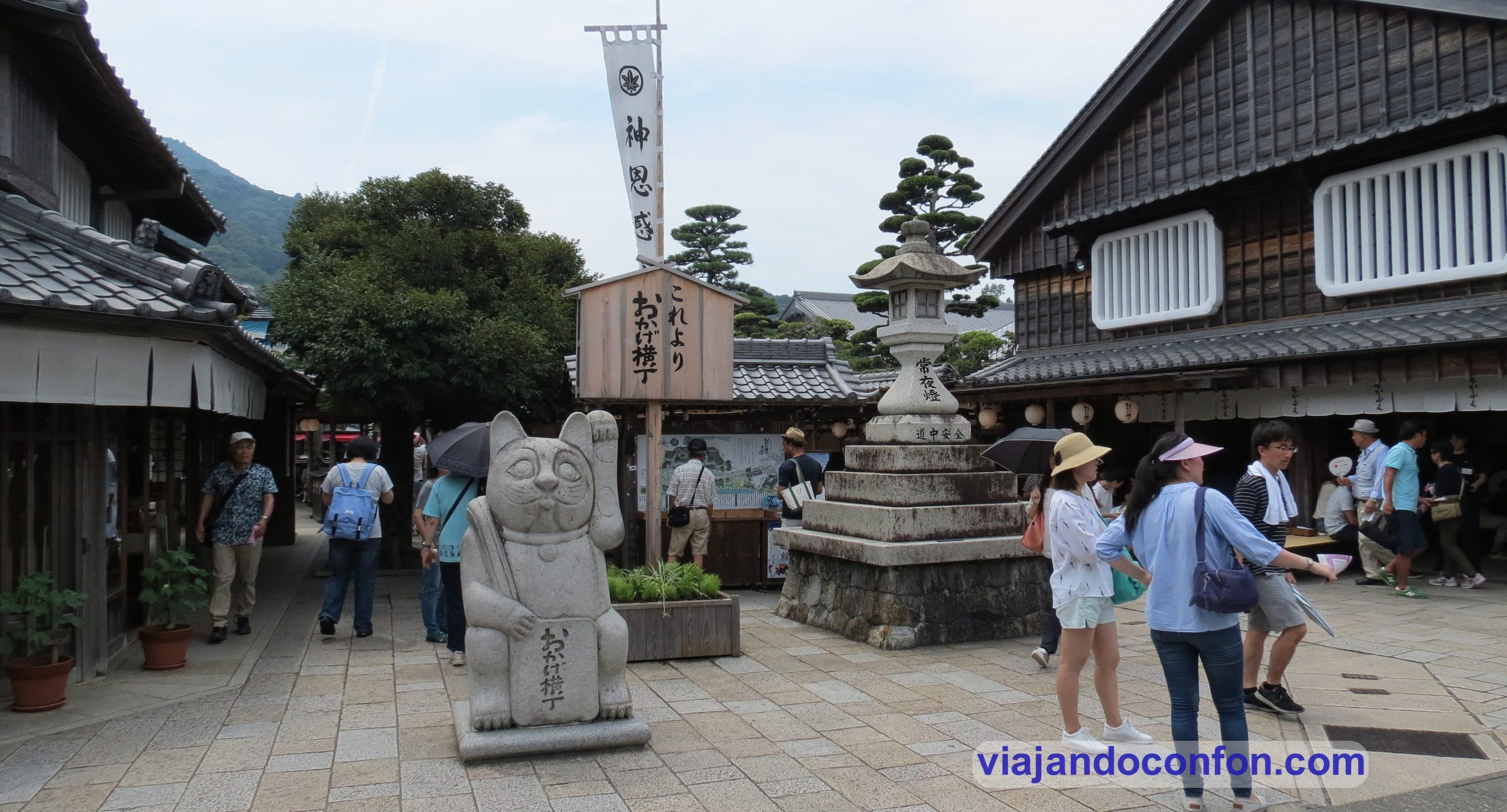
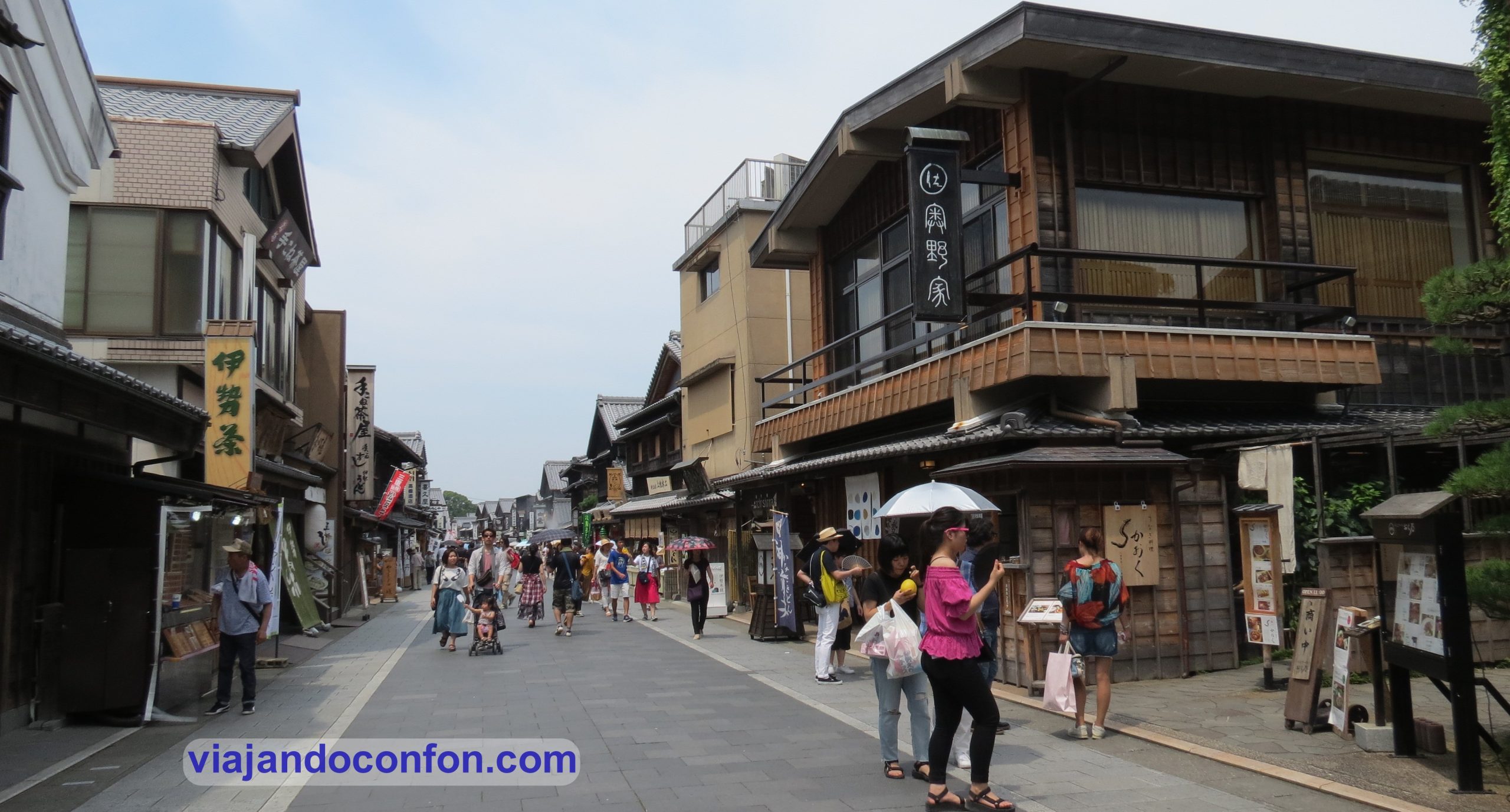
After the well-deserved rest and several liters of fresh water, we left the temple and toured Oharaimachi. It is a commercial area next to the temple, with very old buildings and many shops and restaurants. It is a very touristy area although we were the only westerners that were there. As soon as we entered, we bought some ice cream and we walked through it calmly. It is a highly recommended walk.
Okage Yokocho Street
After the walk we returned to take the bus to Iseshi station and eat something there while we waited for the train to leave.
It had gotten a little late for lunch, we looked for something in the surroundings but everything was closed and there wasn’t even a kombini. We decided to take the train and we would eat when we reached the next destination.
We got off at the Futamino-ura station, which was more of a halt than a station. It had neither lathes nor employees. We still couldn’t find anything to eat but we found a tourist information office. BINGO! We went in to ask to see where we could eat, but to our “surprise”, the man only spoke Japanese. Well very good.
We continue our way towards the Hinjitsukam temple (賓日館) with such bad luck that it closes on Tuesdays. And all this without eating.
Hinjitsukam temple (賓日館)
The area reminded me of some declining tourist spot, with big hotels on the beachfront but deserted and rather old. No one was seen there.
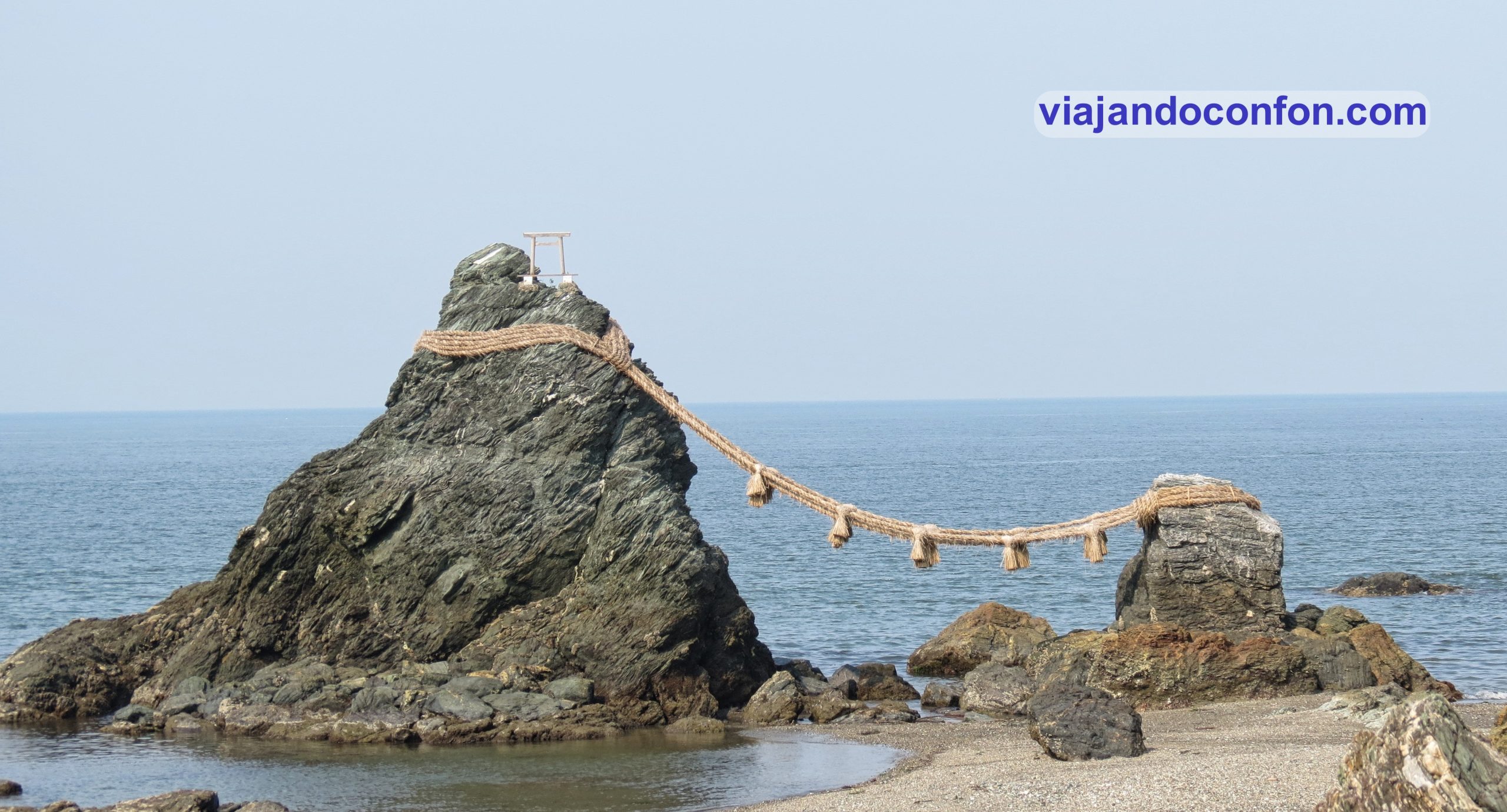
As we were next door, we approached the Meteoiwa temple (夫婦岩) where the so-called “Married Rocks” are located. They are two rocks (one larger than the other) joined by a thick rice straw rope (shimenawa) that represent the gods Izanagi and Izanami, the creators according to the Shinto religion and that represent masculinity and femininity united by marriage. . Here crowds of couples gather to ask for a happy marriage.
At the time we were there it was low tide but, according to the guides, when the tide is high, the rocks seem completely separated and it is quite spectacular, especially at sunset.
Futamiokitama Shrine (二見興玉神社)
After all this, it was about 5 in the afternoon and we still didn’t eat. Luckily on the way to the station we found a Lawson and took a good look at the fridge.
At 7:30 p.m. we were already in the city and, as soon as we arrived, we rushed to Takayama to reserve a seat for the next day, where we had rented a car to go to Shirakawa-go and tour the area. Bad luck caught up with us. It turns out that due to the floods of several weeks ago, together with the heat wave that hit us, the reconstruction work had not been able to be finished and public transport had not yet been restored. So canceling the car rental and looking for plan B for the next day.
Nagoya Tower
After the upset, we squeezed an exquisite ramen for dinner at the Rich miso ramen Sakaeya restaurant, which was very close to the hotel, so that the penalties were less. After dinner we took a short walk through the Sakae area and went to Don Quijote to browse and buy some wasabi and green tea kit-kats.
Don Quijote
July 18th
Since we had to cancel the visit to Takayama, we decided to get up early and go to Kyoto and Nara to see some places that we had missed in 2016 and that we had removed from this year’s itinerary due to lack of time.
At 9:08 we took the shinkansen and at 9:45 we were in Kyoto. When we left the station, the heat was almost unbearable. But it was not a plan to stay locked up.
We went for a walk to the Tō-ji Temple (東寺). It is the main temple of the Shingon Buddhist school, declared a World Heritage Site. Its main attraction is the 5-story pagoda built in the year 826, which is the tallest wooden pagoda in Japan.
After visiting the temple, we went back to the station and took a train to Nara.
At Nara station we got off and walked about 10 minutes to Kintetsu-Nara station to take the Kintetsu-Nara line train to Yamato-Saidaiji station, where we changed to the Kintetsu-Kashihara line to Nishinokyō station.
There we got off and walked for about 10 minutes in hellish heat to the Tōshōdai-ji temple (唐招提寺). It is an essential temple in Nara but it is too far from the city and it takes a lot of turns to get there.
It was founded in the year 759 by the monk Gaijin and is the upper temple of the Buddhist Risshu sect. The entrance to the enclosure costs 600 yen but it is worth it. The golden hall is impressive (photos are not allowed) and the gardens are absolutely amazing. It is ideal to walk very quietly because of the tremendous peace that the enclosure spreads. 100% recommendable.
Back in Nara, we ate a curry at the Coco curry house next to the station, with several jugs of ice water and we went for a walk through the temple area, which we had already visited in depth in 2016 but did not want to return still to Nagoya. At 18.55 we take the Nara line back to Kyoto we take the shinkansen at 19.59 to Nagoya where we arrive at 20.36. We ate dinner and went to bed to get up early the next day.
Find the best activities and tours in Japan with Civitatis:
On this page you can find the diaries of our trips and general information about the wonderful country that is Japan, from its history to learning how to move.
On this page we are going to narrate in several entries the diary of our trip to Japan in 2016. Our first trip to the land of the rising sun and one of my two dream destinations (the other is Iceland, which is yet to come). It was so spectacular that we would return just two years later.
To travel to Japan it is necessary to have a valid passport, whose validity covers the entire period of planned stay in the country, and a proof of return / return ticket.
The Japanese authorities are very demanding when it comes to examining tourists’ passports, and they cause problems at the entrance if it is damaged or has separate covers from the booklet. Therefore, if the document is not in perfect condition, it is recommended to renew it before traveling to the country, and in any case, refrain from trying to manipulate it. Likewise, entry into Japan is not allowed with passports that appear as canceled, so it is important not to travel with documents whose loss had been reported and later recovered, since these are considered invalid passports. It is also worth bearing in mind that passport renewals can only be processed through the Consular Section of the Spanish Embassy in Tokyo and that the passports are issued in Spain, so their renewal may be delayed.
During your stay in Japan, at any time the authorities may require you to show your passport or residence card.
Check the embassy website for the countries that need a visa to enter.
It is illegal to work even temporarily or informally in Japan without a visa. Exceeding the maximum stay period can lead to criminal consequences and eventual prohibition of return to the country.
2. Transport
Important: especially in big cities like Tokyo, you have to avoid rush hours that are from 7 to 9 in the morning and from 5 to 7 in the afternoon. Even so, the silence in transport is sepulchral and it is even mandatory to silence the mobile phone before entering. Of course, if you get on a train around 9 at night, you will coincide with many office workers returning home after spending time with colleagues drinking in the izakayas and then you will already be able to hear a brief murmur (in addition to a bit of vinegar smell).
The Japanese are really orderly. To enter the trains you will see them making two perfect lines on the sides of where the door is going to fall and you will see that no one will enter before those inside come out. Once they leave, you will see the human tide going up or down the stairs in perfect order without crossing the lines on the ground that divide both directions. It is spectacular. Another curiosity about the Japanese and transportation is how easy it is to fall asleep. You’ll see them asleep standing up holding on to the bar. Impressive.
Train
Getting around by train is the most effective way. The trains are very punctual and have an incredible frequency, although it is quite expensive unless you have the Japan Rail Pass. The national train company is Japan Rail, although there are many private lines that complete the impressive Japanese train system.
IMPORTANT NOTE: due to the Covid-19 pandemic, we will not be able to travel on the Shinkansen with our large suitcases without reserving a seat in advance. You will also have to reserve a seat for your suitcase. If you book the day before, as is quite usual, you will not be able to take it on board.
The Japan Rail Pass (JR Pass) is a train pass in which you can make unlimited travel on all Japan Rail company trains except the NOZOMI, MIZUHO and HAYABUSA Shinkansen, which are the fastest.
The JR Pass can be purchased for 7, 14 or 21 days and has 2 classes: the Green Class, which is the first; and the standard class.
Class
7 days
14 days
21 days
Standard
¥29.650
¥47.250
¥60.450
Standard (Children)
¥14.820
¥23.620
¥30.220
Green Class
¥39.600
¥64.120
¥93.390
Green Class (Children)
¥19.800
¥32.060
¥41.690
The prices in this table are the official ones of JR but when you buy it, any agency will charge you a commission.
As a recommendation, I would tell you to study well the routes you are going to do to see if it compensates you. But for example, only Tokyo-Kyoto round trip is already ¥27,700 (€212.65).
It can be purchased online and must be purchased within 90 days before activation. When you buy it, they send you a coupon that you will then have to redeem at one of the JR offices in Japan. If you arrive early you can activate it at the airport for the day you want to start using it. For example: you arrive at Narita on July 1 and there you can activate it on the fly but to use it from July 3.
You can activate it at all major stations in the country and at airports. Once we have the pass, to use it is very simple, next to the turnstiles of the stations there is a window where there is an employee who you have to show the back of the pass and let you pass.
As a recommendation, his thing is that before making a long trip, reserve a seat in any office one day before making the trip.
*It helps us to maintain the blog
Bus
In some cities the bus is essential, as in Kyoto where there are only two subway lines. One that goes from north to south and another from east to west.
Normally you enter through the back door where there is a machine from which a ticket comes out with the number or name of the stop where you get on. Above the driver you will see a screen or illuminated sign indicating the price to pay from each stop. For example: if you got on at stop number three you will see a box with that number and the price to pay at that time. Depending on which city or line it is, the price will go up. When you arrive at your stop, you insert the ticket and the exact money in coins into a machine next to the driver. If you don’t have loose money, don’t worry, you can change money in another machine that is in the same place.
The entrance is normally indicated with the kanji 入口 and exit by the one with 出口. Look carefully because in some cities it is done the other way around, you enter from the front and leave from behind.
In some cities, like Kyoto, the rate is flat and you always pay the same. In the rest you have to look at the type of tickets. If it is not in English, the kanjis to differentiate between them are: 大人 for adults and 小供 for children. If you find that the panel does not put anything, only the prices, logically the highest is for adults and the other for children. Always remember to ask at the tourist office for possible discount cards.
Alternatives to Hyperdia
Hyperdia was a web/application that exactly indicated timetables, prices, platforms, etc… It was a truly complete and essential application until April 1, 2022, when it ceased to be functional.
Google Maps
As in almost all countries, Google maps is a good alternative. It is quite complete and in Japan it even tells you the prices of the journey.
The disadvantage is that it does not clearly indicate the company that makes the journey. For example, if we want to go from Tokyo Station to Narita Airport:
This second option we can take the Ueno-Tokyo Line that does not indicate that it is from the JR company with what the JR PASS would be worth, but we must transfer to the Skyliner, which is from the KEISEI company and is not included in the pass.
Japan Travel by Navitime
It is the best and most complete option. You can exclude some types of transportation and you can choose between JR Pass and other passes. In addition to covering train and flight connections, Navitime is particularly strong with bus connections throughout Japan and also covers driving routes, taxi fares, and expressway tolls.
The service is free and comes as a website and app.
Jorudan has been involved in publishing and developing video games since 1991. Today it offers a website and an app, both of which come with free basic search features and some paid features. The free options available differ between the web and the app, with the app version being much higher than the website version.
Luckily, the free app offers the option to select JR company trains. It also indicates platform details and stations along the way. But only the app, not the web.
Find your ideal hotel at the best price in Japan with Agoda:
*It helps us to maintain the blog
Security in Japan
Japan is a safe country, in fact it has the two safest cities in the world. Wherever you go, no matter how dark it is, you will never feel insecure.
You will be surprised how the stores close in the malls. In 2016 we «lost» the camera in Tokyo and it appeared. In 2018, while we were on the train platform, we bought some soft drinks from a machine and after a while we realized that my bag had fallen to the ground and people were avoiding it.
It also shocks how parked bikes are in cities like Tokyo without chains or clamps.
However, as in any part of the world, and although they are very infrequent, there can be some cases of theft of documentation, cards and cash, especially in certain bars in some nightlife neighborhoods of Tokyo (Roppongi, Kabukicho, Ikebukuro, Shibuya …). In the event of any difficulties, and before going to the embassy, it is advisable to go to a ‘koban’ (easily identifiable community police posts in cities) to report any of these events. The agents will be able to provide the tourist with the assistance that he may need or direct him to other types of public services, as the case may be. The police telephone number is 110 and the fire and ambulance telephone number is 119.
Closed store in a mall
4. Health care
To travel to Japan it is highly recommended to have medical insurance with the widest coverage possible, since health care can be really expensive. For the same reason, it is recommended that the insurance that is contracted does not imply that the insured must advance the expenses.
Sanitary conditions in Japan are good, and Japanese doctors and hospitals have a good reputation. One of the problems that foreigners often encounter is that of language, since few doctors and nurses speak English. Let’s hope we don’t have to use it.
Here you have a good specialist travel insurance, IATI. Also for being our reader you will have a 5% discount on all insurance.
Another thing to watch out for are mosquitoes. In Japan they are as big as sparrows and stings are horrible. We recommend bringing repellents or clothing patches.
5. Electricity
The electric current throughout Japan is 100 volts, but there are two possible frequencies: 50 or 60 hertz. The plugs are two flat pins type A. Sometimes a current transformer is necessary. If your chargers put 110-220 you will not need a transformer. Yours is to buy an adapter. We always carry a universal adapter and a power strip to charge the two mobiles and the tablet or the camera battery.
6. Money
As we all know, the currency of Japan is the Yen. The yen is a currency that fluctuates on the stock market so its exchange rate varies. What is worth €2 today may be worth €1.80 or €2.20 tomorrow.
In Japan, what is most used is cash. The use of the card is not widespread and in most small places such as restaurants and shops they do not charge with it. In any case, from the first time we were in 2016 to the next in 2018, we discovered that it is becoming more and more accepted. Still, make sure you always have plenty of cash in your pocket.
To get money the best option is the combinis. In most there are ATMs although in some they only accept Japanese cards. In many post offices too. In bank ATMs it is more complicated since they only accept Japanese cards.
Another thing is that in Japan there are no tips, never leave more money because they will return it to you.
When you go to pay, they will bring you a tray with both hands in which you must deposit the money, in which they will then return what is left over. Physical contact should always be avoided. Also, whenever you are going to give something remember to give it with both hands, using only one is not well seen.
Find the best activities and tours in Japan with Civitatis:
Para ofrecer las mejores experiencias, utilizamos tecnologías como las cookies para almacenar y/o acceder a la información del dispositivo. El consentimiento de estas tecnologías nos permitirá procesar datos como el comportamiento de navegación o las identificaciones únicas en este sitio. No consentir o retirar el consentimiento, puede afectar negativamente a ciertas características y funciones.
Funcional
Siempre activo
El almacenamiento o acceso técnico es estrictamente necesario para el propósito legítimo de permitir el uso de un servicio específico explícitamente solicitado por el abonado o usuario, o con el único propósito de llevar a cabo la transmisión de una comunicación a través de una red de comunicaciones electrónicas.
Preferencias
El almacenamiento o acceso técnico es necesario para la finalidad legítima de almacenar preferencias no solicitadas por el abonado o usuario.
Estadísticas
El almacenamiento o acceso técnico que es utilizado exclusivamente con fines estadísticos.El almacenamiento o acceso técnico que se utiliza exclusivamente con fines estadísticos anónimos. Sin un requerimiento, el cumplimiento voluntario por parte de tu Proveedor de servicios de Internet, o los registros adicionales de un tercero, la información almacenada o recuperada sólo para este propósito no se puede utilizar para identificarte.
Marketing
El almacenamiento o acceso técnico es necesario para crear perfiles de usuario para enviar publicidad, o para rastrear al usuario en una web o en varias web con fines de marketing similares.