On this page we are going to narrate in several entries the diary of our trip to Japan in 2016. Our first trip to the land of the rising sun and one of my two dream destinations (the other is Iceland, which is yet to come). It was so spectacular that we would return just two years later.
To travel to Japan it is necessary to have a valid passport, whose validity covers the entire period of planned stay in the country, and a proof of return / return ticket.
The Japanese authorities are very demanding when it comes to examining tourists’ passports, and they cause problems at the entrance if it is damaged or has separate covers from the booklet. Therefore, if the document is not in perfect condition, it is recommended to renew it before traveling to the country, and in any case, refrain from trying to manipulate it. Likewise, entry into Japan is not allowed with passports that appear as canceled, so it is important not to travel with documents whose loss had been reported and later recovered, since these are considered invalid passports. It is also worth bearing in mind that passport renewals can only be processed through the Consular Section of the Spanish Embassy in Tokyo and that the passports are issued in Spain, so their renewal may be delayed.
During your stay in Japan, at any time the authorities may require you to show your passport or residence card.
Check the embassy website for the countries that need a visa to enter.
It is illegal to work even temporarily or informally in Japan without a visa. Exceeding the maximum stay period can lead to criminal consequences and eventual prohibition of return to the country.
2. Transport
Important: especially in big cities like Tokyo, you have to avoid rush hours that are from 7 to 9 in the morning and from 5 to 7 in the afternoon. Even so, the silence in transport is sepulchral and it is even mandatory to silence the mobile phone before entering. Of course, if you get on a train around 9 at night, you will coincide with many office workers returning home after spending time with colleagues drinking in the izakayas and then you will already be able to hear a brief murmur (in addition to a bit of vinegar smell).
The Japanese are really orderly. To enter the trains you will see them making two perfect lines on the sides of where the door is going to fall and you will see that no one will enter before those inside come out. Once they leave, you will see the human tide going up or down the stairs in perfect order without crossing the lines on the ground that divide both directions. It is spectacular. Another curiosity about the Japanese and transportation is how easy it is to fall asleep. You’ll see them asleep standing up holding on to the bar. Impressive.
Train
Getting around by train is the most effective way. The trains are very punctual and have an incredible frequency, although it is quite expensive unless you have the Japan Rail Pass. The national train company is Japan Rail, although there are many private lines that complete the impressive Japanese train system.
IMPORTANT NOTE: due to the Covid-19 pandemic, we will not be able to travel on the Shinkansen with our large suitcases without reserving a seat in advance. You will also have to reserve a seat for your suitcase. If you book the day before, as is quite usual, you will not be able to take it on board.
The Japan Rail Pass (JR Pass) is a train pass in which you can make unlimited travel on all Japan Rail company trains except the NOZOMI, MIZUHO and HAYABUSA Shinkansen, which are the fastest.
The JR Pass can be purchased for 7, 14 or 21 days and has 2 classes: the Green Class, which is the first; and the standard class.
Class
7 days
14 days
21 days
Standard
¥29.650
¥47.250
¥60.450
Standard (Children)
¥14.820
¥23.620
¥30.220
Green Class
¥39.600
¥64.120
¥93.390
Green Class (Children)
¥19.800
¥32.060
¥41.690
The prices in this table are the official ones of JR but when you buy it, any agency will charge you a commission.
As a recommendation, I would tell you to study well the routes you are going to do to see if it compensates you. But for example, only Tokyo-Kyoto round trip is already ¥27,700 (€212.65).
It can be purchased online and must be purchased within 90 days before activation. When you buy it, they send you a coupon that you will then have to redeem at one of the JR offices in Japan. If you arrive early you can activate it at the airport for the day you want to start using it. For example: you arrive at Narita on July 1 and there you can activate it on the fly but to use it from July 3.
You can activate it at all major stations in the country and at airports. Once we have the pass, to use it is very simple, next to the turnstiles of the stations there is a window where there is an employee who you have to show the back of the pass and let you pass.
As a recommendation, his thing is that before making a long trip, reserve a seat in any office one day before making the trip.
*It helps us to maintain the blog
Bus
In some cities the bus is essential, as in Kyoto where there are only two subway lines. One that goes from north to south and another from east to west.
Normally you enter through the back door where there is a machine from which a ticket comes out with the number or name of the stop where you get on. Above the driver you will see a screen or illuminated sign indicating the price to pay from each stop. For example: if you got on at stop number three you will see a box with that number and the price to pay at that time. Depending on which city or line it is, the price will go up. When you arrive at your stop, you insert the ticket and the exact money in coins into a machine next to the driver. If you don’t have loose money, don’t worry, you can change money in another machine that is in the same place.
The entrance is normally indicated with the kanji 入口 and exit by the one with 出口. Look carefully because in some cities it is done the other way around, you enter from the front and leave from behind.
In some cities, like Kyoto, the rate is flat and you always pay the same. In the rest you have to look at the type of tickets. If it is not in English, the kanjis to differentiate between them are: 大人 for adults and 小供 for children. If you find that the panel does not put anything, only the prices, logically the highest is for adults and the other for children. Always remember to ask at the tourist office for possible discount cards.
Alternatives to Hyperdia
Hyperdia was a web/application that exactly indicated timetables, prices, platforms, etc… It was a truly complete and essential application until April 1, 2022, when it ceased to be functional.
Google Maps
As in almost all countries, Google maps is a good alternative. It is quite complete and in Japan it even tells you the prices of the journey.
The disadvantage is that it does not clearly indicate the company that makes the journey. For example, if we want to go from Tokyo Station to Narita Airport:
This second option we can take the Ueno-Tokyo Line that does not indicate that it is from the JR company with what the JR PASS would be worth, but we must transfer to the Skyliner, which is from the KEISEI company and is not included in the pass.
Japan Travel by Navitime
It is the best and most complete option. You can exclude some types of transportation and you can choose between JR Pass and other passes. In addition to covering train and flight connections, Navitime is particularly strong with bus connections throughout Japan and also covers driving routes, taxi fares, and expressway tolls.
The service is free and comes as a website and app.
Jorudan has been involved in publishing and developing video games since 1991. Today it offers a website and an app, both of which come with free basic search features and some paid features. The free options available differ between the web and the app, with the app version being much higher than the website version.
Luckily, the free app offers the option to select JR company trains. It also indicates platform details and stations along the way. But only the app, not the web.
Find your ideal hotel at the best price in Japan with Agoda:
*It helps us to maintain the blog
Security in Japan
Japan is a safe country, in fact it has the two safest cities in the world. Wherever you go, no matter how dark it is, you will never feel insecure.
You will be surprised how the stores close in the malls. In 2016 we «lost» the camera in Tokyo and it appeared. In 2018, while we were on the train platform, we bought some soft drinks from a machine and after a while we realized that my bag had fallen to the ground and people were avoiding it.
It also shocks how parked bikes are in cities like Tokyo without chains or clamps.
However, as in any part of the world, and although they are very infrequent, there can be some cases of theft of documentation, cards and cash, especially in certain bars in some nightlife neighborhoods of Tokyo (Roppongi, Kabukicho, Ikebukuro, Shibuya …). In the event of any difficulties, and before going to the embassy, it is advisable to go to a ‘koban’ (easily identifiable community police posts in cities) to report any of these events. The agents will be able to provide the tourist with the assistance that he may need or direct him to other types of public services, as the case may be. The police telephone number is 110 and the fire and ambulance telephone number is 119.
Closed store in a mall
4. Health care
To travel to Japan it is highly recommended to have medical insurance with the widest coverage possible, since health care can be really expensive. For the same reason, it is recommended that the insurance that is contracted does not imply that the insured must advance the expenses.
Sanitary conditions in Japan are good, and Japanese doctors and hospitals have a good reputation. One of the problems that foreigners often encounter is that of language, since few doctors and nurses speak English. Let’s hope we don’t have to use it.
Here you have a good specialist travel insurance, IATI. Also for being our reader you will have a 5% discount on all insurance.
Another thing to watch out for are mosquitoes. In Japan they are as big as sparrows and stings are horrible. We recommend bringing repellents or clothing patches.
5. Electricity
The electric current throughout Japan is 100 volts, but there are two possible frequencies: 50 or 60 hertz. The plugs are two flat pins type A. Sometimes a current transformer is necessary. If your chargers put 110-220 you will not need a transformer. Yours is to buy an adapter. We always carry a universal adapter and a power strip to charge the two mobiles and the tablet or the camera battery.
6. Money
As we all know, the currency of Japan is the Yen. The yen is a currency that fluctuates on the stock market so its exchange rate varies. What is worth €2 today may be worth €1.80 or €2.20 tomorrow.
In Japan, what is most used is cash. The use of the card is not widespread and in most small places such as restaurants and shops they do not charge with it. In any case, from the first time we were in 2016 to the next in 2018, we discovered that it is becoming more and more accepted. Still, make sure you always have plenty of cash in your pocket.
To get money the best option is the combinis. In most there are ATMs although in some they only accept Japanese cards. In many post offices too. In bank ATMs it is more complicated since they only accept Japanese cards.
Another thing is that in Japan there are no tips, never leave more money because they will return it to you.
When you go to pay, they will bring you a tray with both hands in which you must deposit the money, in which they will then return what is left over. Physical contact should always be avoided. Also, whenever you are going to give something remember to give it with both hands, using only one is not well seen.
Find the best activities and tours in Japan with Civitatis:
We are going to tell very briefly the history of Japan.
From prehistory to classical historyof Japan
It is believed that the first settlers of the archipelago arrived around the year 30,000 BC.
Around the year 14,500 B.C. The Jōmon (縄文時代) period begins and it was a semi-sedentary hunter-gatherer culture from Mesolithic to Neolithic, characterized by semi-sunken dwellings with thatched roofs and rudimentary agriculture. The oldest clay objects and utensils found in Japan date from this period.
It is believed that around 1,000 B.C. The Yayoi tribe enters through Kyushu and mixes with the Jōmon, although, officially, the Yayoi period (弥生時代), goes from the year 300 B.C. to 300 AD With them come rice crops and metallurgy.
Jinmu Tennō (神武天皇)
According to legend, Emperor Jinmu Tennō (神武天皇), a grandson of the goddess Amaterasu, founded a kingdom in central Japan in 660 BC. C., beginning an imperial line that still continues with the reign of the current Emperor Naruhito from 2019.
Although most historians believe that the first fourteen more than royal emperors are legendary characters (from Emperor Jimmu to Emperor Chuai).
Japan is first named in the Chinese Book of Han (漢書) written in 111 BC.
In the year 552, Buddhism was introduced from the Baekje kingdom in Korea, but the development of Japanese Buddhism was mainly influenced by China.
Despite initial resistance, Buddhism was promoted by the ruling class, including such figures as Prince Shōtoku (聖徳太), and gained wide acceptance beginning in the Asuka period (飛鳥時代) between 592 and 710.
In 645, the Taika Reforms (大化の改新) nationalize all land in Japan, to be equally distributed among farmers, and mandate the compilation of a household register as the basis for a new tax system.
Prince Shōtoku (聖徳太)
In the year 672, the Jinshin War (壬申の乱) takes place, a bloody war of succession after the death of Emperor Tenji Tennō (天智天皇), between Prince Ōama (his brother) and his son his son and successor, the Prince Otomo. The war is won by Ōtomo, although less than a year after taking the throne he commits suicide and Prince Ōama becomes king.
He introduced the Taihō Code (大宝律令) in 701, an administrative reorganization with a historical law system based on Confucianism. These legal reforms created the Ritsuryō (律令制) state, which was largely an adaptation of the Chinese governmental system of the Tang dynasty.
The Nara period (奈良時代), between 710 and 784, marks the rise of a Japanese state centered on the Imperial Court at Heijō-kyō (present-day Nara). The period is characterized by the emergence of a nascent literary culture with the completion of Kojiki in 712 and Nihon Shoki in 720, as well as the development of Buddhist-inspired works of art and architecture.
In the year 784, Emperor Kanmu Tennō (桓武天皇) moved the capital to Heian-kyō (present-day Kyoto), beginning the Heian period (平安時代), which runs from 794 to 1185. During this period, the Tale of Genji by Murasaki Shikibu and the lyrics of Japan’s national anthem «Kimigayo».
Feudal period
Japan’s feudal era was characterized by the rise and dominance of a ruling class of warriors, the samurai.
In 1185, after the defeat of the Taira clan in the Genpei Wars (源平合戦), the samurai Minamoto no Yoritomo established a military government in the city of Kamakura, giving rise to the Kamakura period (鎌倉時代) that lasted until the year 1333. After his death, the Hōjō clan takes power as regent of the shōguns.
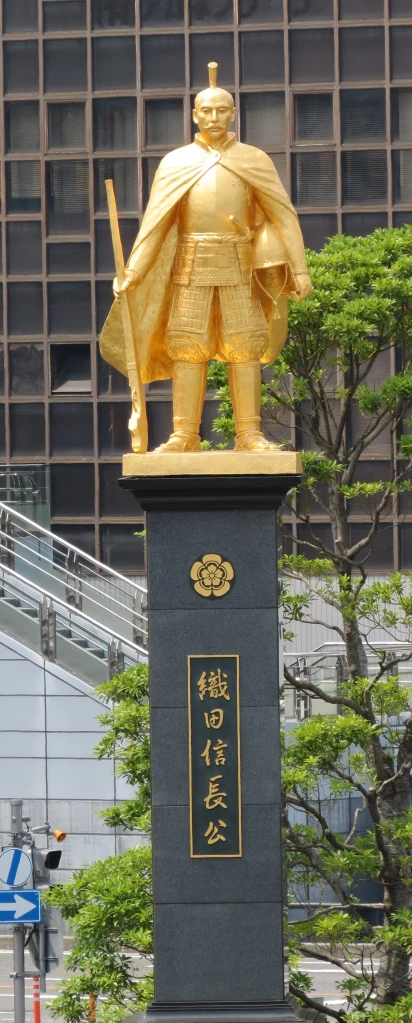
Oda Nobunaga
During the Kamakura period, Zen Buddhism is introduced and becomes tremendously popular among the samurai class. They also repelled the Mongol invasions in 1274 and 1281.
In the year 1318 Go-Daigo Tennō (後醍醐天皇) assumed power after Hanazono Tennō (花園天皇) abdicated, beginning the Muromachi period (室町時代) between 1336 and 1573.
The later Ashikaga shogunate failed to control the feudal warlords (daimyōs) and a civil war began in 1467, opening the century-long period of Sengoku («Warring States»).
In the 16th century, Portuguese merchants and Jesuit missionaries arrived for the first time in Japanese lands. Thanks to the commercial exchange with these, Oda Nobunaga (織田 信長) uses European technology and firearms to conquer many other daimyōs; his consolidation of power began what became known as the Azuchi-Momoyama (安土桃山時代) period.
Following Nobunaga’s death, his successor Toyotomi Hideyoshi unified the nation in the early 1590s and launched two failed invasions of Korea in 1592 and 1597.
Tokugawa Ieyasu served as regent for Hideyoshi’s son Toyotomi Hideyori, and used his position to gain political and military support.
At the Battle of Sekigahara (関ヶ原の戦い) in 1600, Tokugawa Ieyasu defeated rival clans, was appointed shōgun by Emperor Go-Yōzei (後陽成天皇) in 1603, and established the Tokugawa shogunate in Edo (present-day Tokyo).
The shogunate enacted measures including the buke shohatto, as a code of conduct to control autonomous daimyōs, and in 1639 the isolationist sakoku («closed country») policy that spanned the two and a half centuries of tenuous political unity known as the Edo period. (1603-1868).
Modern era
In 1854, Commodore Matthew Perry and the «Black Ships» of the United States Navy forced the opening of Japan to the outside world with the Convention of Kanagawa. Subsequent similar treaties with other Western countries caused a serious economic and political crisis.
The resignation of the shōgun led to the Boshin War (戊辰戦争) between 1868 and 1869, leading to the establishment of a nominally unified centralized state under the emperor, known as the Meiji Restoration (明治維新). Adopting Western political, judicial, and military institutions, the cabinet organized the Privy Council, introduced the Meiji Constitution, and assembled the Imperial Diet.
During the Meiji era (1868-1912), the Empire of Japan emerged as the most developed nation in Asia and an industrialized world power.
After victories in the First Sino-Japanese War (1894-1895) and the Russo-Japanese War (1904-1905), Japan gains control of Taiwan, Korea, and the southern half of Sakhalin. The beginning of the 20th century saw a period of Taishō democracy (1912-1926) overshadowed by increasing expansionism and militarization.
After the First World War Japan, as an allied power, takes control of the German possessions in the Pacific and in China.
In 1931, Japan invaded and occupied China’s Manchuria and in 1936 signed the Anti-Comintern Pact with Nazi Germany; the Tripartite Pact of 1940 made it one of the Axis Powers.
The Empire of Japan invaded other parts of China in 1937, precipitating the Second Sino-Japanese War (1937-1945).
In 1940, the Empire invaded French Indochina. Following this, the United States imposed an oil embargo on Japan.
From December 7 to 8, 1941, Japanese forces carried out surprise attacks on Pearl Harbor, as well as British forces in Malaya, Singapore, and Hong Kong, among others, beginning World War II in the Pacific.
After Allied victories over the next four years, culminating in the Soviet invasion of Manchuria and the atomic bombings of Hiroshima and Nagasaki in 1945, Japan agreed to an unconditional surrender.
Allied occupation ended with the Treaty of San Francisco in 1952, and Japan was granted membership in the United Nations in 1956.
A period of record growth propelled Japan to become the world’s second largest economy; this ended in the mid-1990s after the bursting of an asset price bubble, beginning the «Lost Decade».
Discover the best activities and tours in Japan with Civitatis:
Para turistas españoles no es necesario sacar visado si la visita no supera los 15 días. Solamente es necesario un pasaporte en vigor, con, al menos, seis meses de validez desde la fecha de entrada en el país y con, al menos, dos páginas libres de sellos.
Para estancias superiores a 15 días si se necesitaría sacar visado. Para ello podemos acudir a la embajada de Vietnam en Madrid.
También podemos hacerlo en el mismo aeropuerto de llagada, pagando 25 dólares americanos, aunque hay que hacer una cola bastante lenta y luego comerse la graaaaan cola del control de pasaportes. Esto sería lentísimo.
Vietnam es un país muy seguro, pero siempre hay que tener un poco de sentido común. Los robos se producen en zonas de aglomeraciones tales como: grandes superficies, mercados, lugares turísticos y hoteles. Estos se producen rasgando los bolsos con un instrumento cortante y extrayendo los monederos, o bien por la modalidad del tirón. También son habituales las sustracciones de pasaportes, tarjetas de crédito y carteras durante los viajes nocturnos en autobuses y en los compartimentos del tren. Se recomienda dejar en lugar seguro sus pertenencias, incluido el pasaporte, viajar con fotocopia del mismo y estar alerta.
Las Comisarías de Policía del país ponen grandes dificultades para aceptar denuncias por robo (resulta más fácil hacer una denuncia por pérdida. En todo caso será necesaria la presentación de una denuncia ante la policía para proceder a la solicitud de un nuevo pasaporte). Además, los denunciantes deberán ir acompañados de un guía local para cualquier gestión, ya que no existen intérpretes y solo podrán atenderlos en vietnamita.
Sanidad en Vietnam
Las condiciones sanitarias son bastante deficientes en muchos casos, por lo que se recomienda beber agua embotellada, extremar el cuidado en el consumo de hielo en lugares públicos y lavar y desinfectar cuidadosamente las frutas, verduras y otros alimentos destinados a su consumo crudo. De todas maneras veremos en muchos locales carteles en inglés diciendo que se despachan alimentos seguros. Nosotros no tuvimos ningún problema estomacal.
Las enfermedades más comunes son la fiebre tifoidea, el dengue y la diarrea común, debidas a la poca salubridad en alimentos y agua.
En determinadas épocas del año, como en las estaciones lluviosas, se registra mayor incidencia de enfermedades provocadas por la picadura de insectos, como la encefalitis japonesa y especialmente el dengue, enfermedad endémica en Vietnam, para la que no existe vacuna. La fiebre del dengue presenta los siguientes síntomas: náuseas, vómitos, pérdida de apetito, fiebre alta y fuertes dolores de cabeza. En casos extremos y raros adopta la variedad de “dengue hemorrágico” que puede llegar a producir la muerte.
Para asegurarse lo mejor es evitar salir al amanecer y al anochecer, y no vestir colores oscuros. También es recomendable el uso de repelentes de insectos… bien fuertes.
El equipamiento hospitalario en Vietnam es muy básico, y es recomendable viajar a Bangkok o Singapur para dolencias médica serias, por lo que es imprescindible viajar con un seguro médico que cubra todo tipo de gastos.
Recuerda viajar siempre con seguro de viaje. Con IATI, especialistas en seguros de viajes, tienes un 5% de descuento por ser nuestro lector.
Aquí ponemos una lista de centros sanitarios recomendados por el ministerio de sanidad de España:
En Hanoi:
Hong Ngoc Hospital. 55 Phố Yên Ninh, Quán Thánh, Ba Đình, Hà Nội, Vietnam.
VinMec International Hospital. 458 Phố Minh Khai, Khu đô thị Times City, Hai Bà Trưng, Hà Nội, Vietnam.
Hospital francés de Hanoi. Số 1 Phương Mai, Đống Đa, Hà Nội 100000, Vietnam.
Hanoi Family Medical Practice (clínica). 298I Kim Mã, Ba Đình, Hà Nội 10000, Vietnam.
Raffles Medical Group (clínica). Hanoi City, 51 Xuân Diệu, Quảng An, Tây Hồ, Hà Nội 700000, Vietnam.
En Ciudad Ho Chi Minh:
French-Vietnamese Hospital. 6 Nguyễn Lương Bằng, Tân Phú, Quận 7, Thành phố Hồ Chí Minh, Vietnam.
Cho Ray Hospital. Nguyễn Chí Thanh, Phường 12, Quận 5, Thành phố Hồ Chí Minh, Vietnam.
Raffles Medical Group (clínica). 167A Nam Kỳ Khởi Nghĩa, Phường 7, Quận 3, Thành phố Hồ Chí Minh, Vietnam.
Family Medical Practice (clínica). 34 Lê Duẩn, Bến Nghé, Quận 1, Thành phố Hồ Chí Minh, Vietnam.
En Danang:
Hanoi Family Medical PracticeFamily Medical Practice (clínica). 96-98 Nguyễn Văn Linh, Nam Dương, Hải Châu, Đà Nẵng 550000, Vietnam.
En Vung Tau:
Raffles Medical Group (clínica). 01 Lê Ngọc Hân, Phường 1, Thành phố Vũng Tầu, Bà Rịa – Vũng Tàu 790000, Vietnam.
En Huế:
Bệnh viện Trung ương Huế-Hospital internacional de Huế. 3 Đ. Ngô Quyền, Vĩnh Ninh, Thành phố Huế, Thừa Thiên Huế, Vietnam.
A éste último tuvimos que acudir nosotros.
Dinero
La moneda oficial de Vietnam es el Dong. 1€ son 25.777 VND y 1$ son 24780 VND. Siendo extranjero, la mayor parte de las veces te dirán precio en dólares americanos.
Se recomienda cambiar únicamente en bancos autorizados. Visite la web oficial del Vietcombank para ver el cambio de hoy.
Las tarjetas de débito y crédito españolas funcionan generalmente en los cajeros automáticos locales, con las limitaciones diarias y comisiones que fije el banco emisor. Los cajeros solamente dispensan dongs vietnamitas. Es curioso llegar a un cajero y sacar 5.000.000 como si no quiere la cosa… se siente uno millonario cuando tan sólo son 185€ (215$).
Nosotros tuvimos un problemón y es que ningún cajero nos admitía nuestra tarjeta, de la entidad ING. Tuvimos que llamar a España porque no sabíamos que teníamos que dar aviso de que íbamos a usarla en Vietnam, cosa que nunca nos había pasado.
En cuanto al uso de tarjetas de crédito solamente es posible utilizarlas en el centro de las grandes poblaciones, principalmente Hanoi y Ho Chi Minh City, y únicamente en establecimientos hoteles, restaurantes, tiendas y negocios pertenecientes a empresas multinacionales o a extranjeros o bien a vietnamitas con clientela internacional. Te pueden cobrar comisión por ello así que lo mejor es llevar cash en el bolsillo y no tendrás problema.
Cuidado con sacar mucho dinero en dongs. El penúltimo día nos cancelaron la excursión por la bahía de Hạ Long y la agencia nos devolvió el dinero en metálico. Pues bien, los bancos en Vietnam no te cambian dongs por dólares o euros pero tampoco puedes sacar dongs del país. Así que nos encontramos con 7.000.000 de dongs que no podíamos cambiar, ni gastar ni sacar del país. Al final, por medio de la agencia de viajes, pudimos cambiarlos por euros en el mercado negro. Nos dieron un muy buen cambio pero es una experiencia un tanto oscura y no muy agradable.
Transporte en Vietnam
Moverse por Vietnam es relativamente fácil y muy barato. Los taxis en las ciudades son baratísimos y efectivos, pero sólo de compañías fiables.
Xe Ôm
También existe algo llamado Xe Ôm, que viene a significar literalmente «abrazo en moto«, y son moto-taxi. Estos han sido el medio de transporte más barato en las concurridas calles de Vietnam durante muchas décadas. A veces tienen un letrero que dice «xe ôm» colgando y otras te ofrecerán directamente sus servicios.
Hay que tener cuidado porque, como en todos sitios, pueden estafar a los turistas. Para evitar esto, como consejo importante, lo suyo es acordar un precio de antemano. Lo justo son entre 10.000 y 15.000VND el kilómetro (0.36-0.55€), pero como siempre habrá que regatear, te pedirán de primeras 2-3 veces más.
También es importante que el conductor conozca el destino, así que lleva siempre un mapa contigo (o datos en el smartphone).
Y, finalmente, es aconsejable evitarlos por la noche.
Taxi
Es el medio de transporte que más usamos nosotros. Muy barato y muy rápido. Es aconsejable tomar los de compañías «fiables» para no sufrir estafas, como nos pasó el último día en Hanoi. El único taxi de compañía no fiable que tomamos… ¡PAM! estafa. Tenía el taxímetro trucado y subía muuuuuy, muuuuy rápido. En una carrera que de normal nos costaba unos 60.000 VND (2.25€) se fue a 130.000 VND (4.85€).
Las dos compañías recomendadas que están en todas las ciudades importantes son:
Vinasun Taxi: Los reconocerás porque son de color blanco mayoritariamente, con una línea finita roja y otra verde en la parte inferior. Además lleva el nombre de la empresa en grande en los laterales.
En los taxis que tomamos de ambas compañías tenían el taxímetro y una pantalla del gps bien visibles.
Es el medio de transporte más seguro para viajar de noche. Las tarifas son de 10.000-15.000VND/km (0,40-0,60€).
Autobús
Los buses urbanos son lentos, muy lentos con el terrible tráfico que hay pero el precio es realmente ridículo.
También podemos alquilar motos para circular por el endiablado tráfico de las grandes ciudades pero no se pueden alquilar turismos si no disponemos de permiso de conducir vietnamita (no lo haría ni pagado).
Hay que poner especial cuidado en la Bahía de Ha Long. Lo mejor es reservar los cruceros en compañías serias y huir de los chollos o los que son muy baratos ya que algunas de las embarcaciones no reúnen las condiciones de seguridad exigidas, aunque las autoridades vietnamitas han anunciado controles más estrictos. En los últimos años se han producido varios accidentes, en algunos casos con víctimas.
Encuentra multitud de actividades y tours en Vietnam con Civitatis:
La República Socialista de Vietnam (Cộng hòa Xã hội chủ nghĩa Việt Nam) es el país del sudeste asiático más oriental de la península de Indochina. Su capital es Hanói (Hà Nội) desde la reunificación de Vietnam del Norte y Vietnam del Sur en 1976.
Con una historia reciente bastante turbulenta, con varios conflictos bélicos de importancia, en el año 938 se independiza del Imperio Chino. Fue tras vencer en la batalla del río Bach Dang.
A partir de ahí comienza una época floreciente. En ella expanden su territorio hasta el siglo XIX. Es cuando los franceses colonizan la península de Indochina.
Durante la Segunda Guerra Mundial, el ejército japonés toma el control de la zona durante un breve periodo de tiempo. Lo hace hasta su rendición tras la victoria de los aliados.
Encuentra los mejores hoteles al mejor precio en Vietnam con Agoda:
*Nos ayuda a mantener el blog
En 1945, los vietnamitas comienzan la guerra de independencia liderados por Hồ Chí Minh en la I Guerra de Indochina hasta 1954. Tras la victoria en la batalla de Dien Bien Phu, los franceses deciden retirarse de las colonias.
Ese mismo año, en la Conferencia de Ginebra, los países que habían formado parte de la guerra, deciden dividir el país en dos en el Paralelo 17. Así se forman Vietnam del Norte y Vietnam del Sur.
A partir de 1955, no se consigue reunificar el país a través de unas elecciones democráticas. Estados Unidos se opone por miedo a una victoria comunista que se asocie con la URSS y China. Entonces EEUU decide enviar tropas a Vietnam del Sur. Mientras, Vietnam del Norte recibe ayuda armamentística por parte de la URSS. Se masca la tragedia.
Recuerda viajar siempre con seguro de viaje. Con IATI, especialistas en seguros de viajes, tienes un 5% de descuento por ser nuestro lector.
*Nos ayuda a mantener el blog
El incidente del golfo de Tonkin el 2 de agosto de 1964 fue el detonante para que estallara la Guerra de Vietnam o II Guerra de Indochina. Aunque he leído que unos documentos desclasificados recientemente demuestran que el gobierno de Estados Unidos fingió ese ataque para tener argumentos para atacar. Un informe de la Agencia de Seguridad Nacional (NSA, por sus siglas en inglés) concluye: esa noche no ocurrió ningún ataque.
En 1973 EEUU decide retirarse de Vietnam y en 1975 el ejército norvietnamita empieza la invasión definitiva del sur. El 30 de abril de 1975 el ejército norvietnamita toma Saigón poniendo fin a la guerra.
El 2 de agosto de 1976 queda oficialmente reunificado convirtiéndose en la República Socialista de Vietnam.
Hoy en día el país, a pesar de seguir siendo comunista, empieza a abrirse al libre mercado y a experimentar una ligera evolución económica y social, aunque aún con tremendas desigualdades sociales.
Descubre multitud de actividades y tours en Vietnam con Civitatis:
En esta página podrás encontrar los diarios de nuestros viajes e información general sobre el maravilloso país que es Japón, desde su historia hasta aprender a moverte.
Como siempre, recomendamos viajar con un buen seguro de viajes. IATI es especialista en seguros de viaje y, por ser nuestro lector, tienes un 5% de descuento.
Descubre (casi) todo lo que necesitas saber antes de viajar a Kioto.
Cómo llegar a Kioto
Tren
El tren es la forma más común para llegar a Kioto, ya que no tiene aeropuerto propio.
Llegaremos a la estación de Kioto, un moderno (y gigante) edificio inaugurado en 1997 para conmemorar el 1.200 aniversario de la fundación de la ciudad. La estación cuenta con 15 vías convencionales y 4 de alta velocidad, además de 33 andenes.
La estación se encuentra en el centro de la ciudad y desde la entrada parten multitud de líneas de bus taxis e incluye una estación de metro.
En la estación también podemos encontrar la oficina de información turística.
Para más comodidad puedes contratar un servicio de traslado hasta la puerta de tu hotel.
Cómo moverse
Bus
Es la forma más práctica para viajar por Kioto. Éstos llegan a cualquier punto de la ciudad. El precio es siempre fijo: 230¥ (1.76€) para los adultos y 120¥ (0.92€) para los niños.
Existen ciertas líneas que funcionan los fines de semana de madrugada como la línea 204 y 205 (que recorren la zona más turística) y su precio es justo el doble: 460¥ adultos y 240¥ los niños.
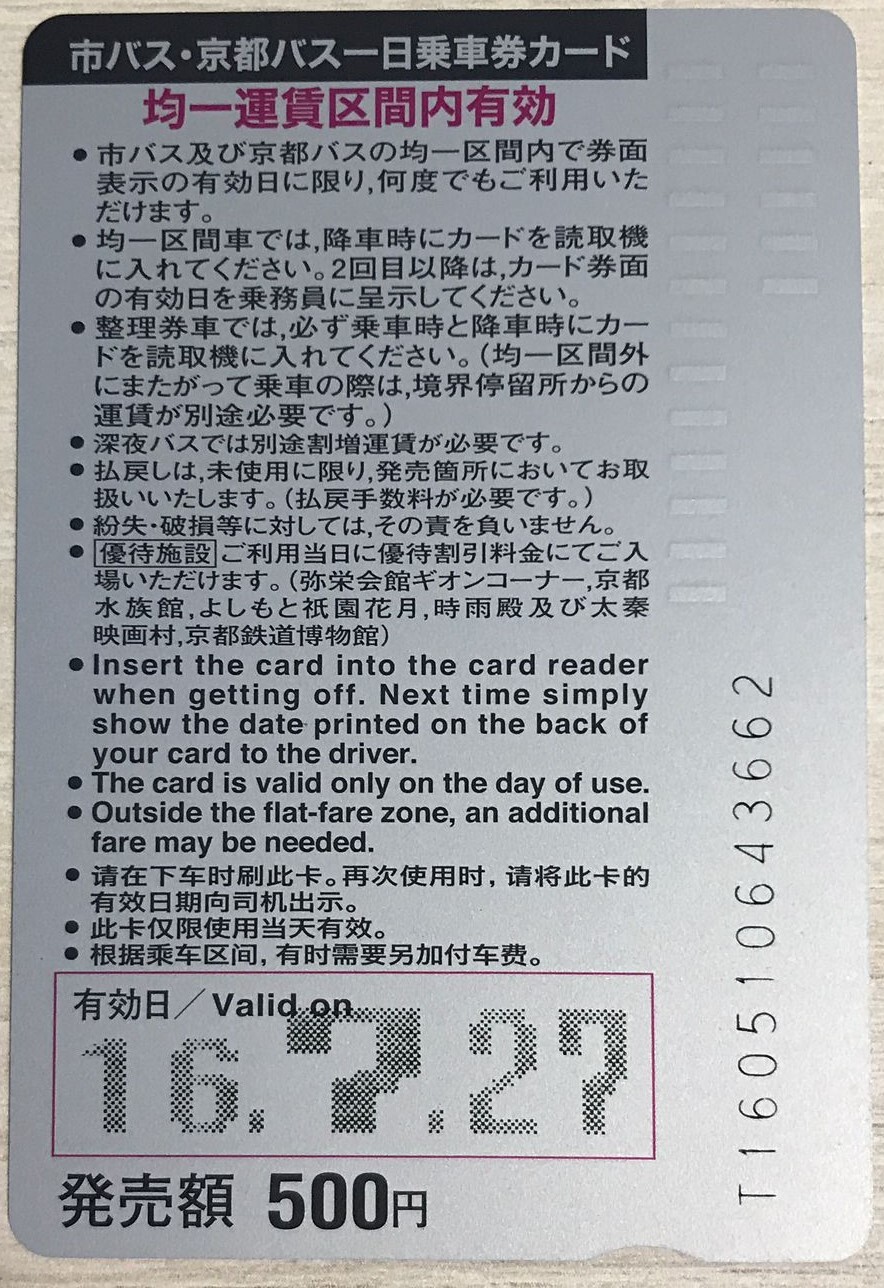
También existe el pase de un día. El precio es de 600¥ (4.60€) para adultos y 300¥ (2.30€) para los niños. Lo puedes comprar en el mismo bus al conductor o en máquinas expendedoras en las paradas de la estación de tren.
El pase es válido sólo para el día en el que se valida, no para 24 horas. Es decir, si lo compras y lo validas el 20 de julio a las 2 de la tarde, es válido hasta las 23.59 del 20 de julio.
Desde 2025 existen dos líneas exprés que te llevan deforma rápida y económica a conocer los puntos más turísticos de la ciudad. Su precio es de 500¥ los adultos y 300¥ los niños.
La línea EX100, que sale de la Estación de Kioto y para cerca de Ginkakuji, Gojozaka, Gion o el santuario Heian Jingu.
La línea EX101, también desde la estación y para cerca de Kiyomizudera.
Al bus se accede por la puerta trasera y se sale por la delantera. Cuando llegues a tu parada introduces el billete y el dinero exacto en monedas en una máquina junto al conductor. Si no tienes suelto no te preocupes, puedes cambiar dinero en otra máquina que se encuentra en el mismo lugar. Si tienes el pase de 1 día, basta con enseñárselo al conductor.
El metro de Kioto consta de tan sólo 2 líneas la Tozai (東西線) de color verde y la Karasuma (烏丸線) de color rojo. La línea Tozai recorre la ciudad de norte a sur y la karasuma de este a oeste.
El metro circula entre las 5.00 y las 23.00. El precio del billete depende de lo largo que sea el trayecto que vayas a realizar. Éstos van de 220 a 360 yenes (1.69€) para los adultos, y entre 110 y 180 yenes para los niños. También existe el pase de un día, que cuesta lo mismo que el de bus y funciona igual.
La verdad es que el metro de Kioto nos va a resultar muy poco práctico y, seguramente, no lo usaremos.
Poco vamos a poder usar los trenes JR pero si que viene mu bien para ir desde la estación de tren hasta Arashiyama con la línea JR San-In en unos 15-20 minutos, mucho menos que en bus.
Taxi
El taxi en Kioto es extremadamente caro y, salvo necesitad porque se te haga muy tarde por la noche y no haya servicio de bus, será muy extraño que lo tomemos.
Descubre las mejores actividades y tours al mejor precio en Kioto con Civitatis:
*Nos ayuda a mantener el blog
Dónde dormir
En el siguiente enlace encontrarás algunos alojamientos recomendados en las principales ciudades japonesas.
Dónde comer
En el siguiente enlace encontrarás algunos restaurantes recomendados en las principales ciudades japonesas.
Para ofrecer las mejores experiencias, utilizamos tecnologías como las cookies para almacenar y/o acceder a la información del dispositivo. El consentimiento de estas tecnologías nos permitirá procesar datos como el comportamiento de navegación o las identificaciones únicas en este sitio. No consentir o retirar el consentimiento, puede afectar negativamente a ciertas características y funciones.
Funcional
Siempre activo
El almacenamiento o acceso técnico es estrictamente necesario para el propósito legítimo de permitir el uso de un servicio específico explícitamente solicitado por el abonado o usuario, o con el único propósito de llevar a cabo la transmisión de una comunicación a través de una red de comunicaciones electrónicas.
Preferencias
El almacenamiento o acceso técnico es necesario para la finalidad legítima de almacenar preferencias no solicitadas por el abonado o usuario.
Estadísticas
El almacenamiento o acceso técnico que es utilizado exclusivamente con fines estadísticos.El almacenamiento o acceso técnico que se utiliza exclusivamente con fines estadísticos anónimos. Sin un requerimiento, el cumplimiento voluntario por parte de tu Proveedor de servicios de Internet, o los registros adicionales de un tercero, la información almacenada o recuperada sólo para este propósito no se puede utilizar para identificarte.
Marketing
El almacenamiento o acceso técnico es necesario para crear perfiles de usuario para enviar publicidad, o para rastrear al usuario en una web o en varias web con fines de marketing similares.