Vamos a conocer, de forma lo más breve posible, la riquísima historia de Kioto.
Se sabe que ha habido población humana desde el Paleolítico. Durante el periodo Jomon (hacia el año 14.500 a.C.) se establecen en la parte de Kitashirakawa y las áreas montañosas de la cuenca de Yamashina.
Durante el periodo Yayoi (300 a.C.-250 d.C) comienzan a desplazarse hacia las llanuras. En el siglo V se construyen proyectos de conservación de agua en la cuenca de Kioto. Esto fue el comienzo del desarrollo a gran escala del área de Kioto.
En el año 784 el emperador Kammu Tennō construye Nagaoka-kyō y traslada la capital desde Heijō-kyō (la actual Nara). Tan solo 9 años después, en enero de 793, el emperador Kammu reune a sus sirvientes y anuncia otra reubicación de la capital. Es debido a las frecuentes inundaciones y enfermedades relacionadas que azotan Nagaoka-kyō. En esta ocasión elige Kadono, a 10 kilómetros al noreste.
Kanmu Tennō (桓武天皇)
Según las palabras de Kammu: «Kadono tiene hermosas montañas y ríos, así como buenas conexiones de transporte por mar y tierra, lo que hace que sea conveniente para la gente reunirse allí desde los cuatro rincones del país».
Se cree que la construcción de Heian-kyō comenzó desde el palacio y luego el resto de la ciudad. A lo largo del río se construyeron los puertos de Yodonotsu (淀 津, hoy Yodo) y Ōitsu (大 井 津) para favorecer el tránsito de mercancías.
Los productos que llegaban a Heian-kyō llegaban a la gente a través de uno de los dos grandes mercados el del este y el del oeste. Esto produjo un suministro estable de alimentos y bienes que fomentó el crecimiento de la población. Para evitar las inundaciones que habían asolado Nagaoka-kyō se construyeron dos canales artificiales. Los actuales Horikawa y Nishi Horikawa, que también aseguraban el suministro de agua a la población.
También se permitió la construcción de templos budistas. Estos estaban prohibidos en Nagaoka-kyō. Se pensaba que el poder de los templos de Oriente y Occidente podría proteger a la ciudad de los desastres naturales y las enfermedades.
El 22 de octubre de 794, el emperador Kammu llega a la nueva ciudad. El 8 de noviembre proclama: «Por la presente llamo a esta ciudad Heian-kyō».
En el año 810, durante un enfrentamiento por la sucesión del emperador, surge un movimiento que reclama que Heijō-kyō (la actual Nara) vuelva a ser la capital. Sin embargo, el Emperador Saga pensó que mantener la capital en Heian-kyō sería lo mejor para la estabilidad del país. Se resistió a este movimiento, nombrando a Heian-kyō «La Ciudad Eterna» (万 代 宮).
En el siglo X, las clases más bajas empiezan a asentarse junto al río Kamo, más allá de los límites orientales de la ciudad. También en las orillas orientales del río surgieron templos y casas de campo. Entonces comenzó una tendencia de la ciudad a extenderse hacia el este.
En 980, en el extremo sur de Suzaku-oji, la Rajōmon (la más grande de las dos puertas de la ciudad) se derrumba. Jamás fue reconstruida. De esta manera, las fronteras originales de Heian-kyō se extienden hacia el este, formando las calles del Kioto primero medieval y luego del moderno.
Durante el período Sengoku (戦国時代) la ciudad sufrió una gran destrucción en la Guerra de Ōnin (1467-1477). No se recuperó realmente hasta mediados del siglo XVI. Durante la guerra, el shugo colapsó y el poder se dividió entre las familias militares. Las batallas entre facciones samuráis se extendieron por las calles. Llegaron a involucrar a la nobleza de la corte y también a las facciones religiosas.
Con el Shōgun instalado en Edo, Heian-kyō empieza a peder importancia como sede del poder. Tras la guerra de Ōnin Heian-kyō se separó en ciudades superiores (Kamigyō) e inferiores (Shimogyō). Cada una de ellas se convirtió en lugares de poca importancia. Sin embargo, los dos se reunirían en una ciudad durante el período Azuchi-Momoyama, después de la ascensión de Oda Nobunaga.
A finales del siglo XVI, Toyotomi Hideyoshi reconstruye la ciudad. Construye nuevas calles para duplicar su número de norte-sur en el centro de Kioto. Crea bloques rectangulares que reemplazaban a los antiguos bloques cuadrados. Hideyoshi también construyó muros de terraplén llamados odoi (御 土 居) que rodeaban la ciudad.
Toyotomi Hideyoshi (豊臣秀吉)
En el año 1864 la rebelión Hamaguri quema 28.000 casas en la ciudad. Con esto muestran el descontento de los rebeldes hacia el Shogunato Tokugawa.
Durante la Revolución Meiji, Edo fue rebautizada como Tokio, convirtiéndose en la nueva capital de Japón. Tras el traslado del emperador a Tokio, la economía se ve gravemente debilitada.
En 1889 se forma la nueva ciudad de Kioto y se construye el canal desde el lago Biwa para revivir la ciudad.
Durante la Segunda Guerra Mundial, Estados Unidos consideró la posibilidad de tirar una bomba a tómica a Kioto porque, como centro intelectual de Japón, tenía una población lo suficientemente grande como para persuadir al emperador para que se rindiera.
Al final, ante la insistencia de Henry Lewis Stimson, Secretario de Guerra en las administraciones de Roosevelt y Truman, la ciudad fue eliminada de la lista de objetivos y reemplazada por Nagasaki. La ciudad también se salvó en gran medida de los bombardeos convencionales. Gracias a ello hoy se conserva la mayoría de su patrimonio histórico.
En 1997, Kioto fue sede de la conferencia que resultó en el protocolo sobre emisiones de gases de efecto invernadero (Convención Marco de las Naciones Unidas sobre el Cambio Climático).
Encuentra la mejores actividades y tours en Kioto con Civitatis:
Today we are going to Kyoto. We don’t get up too early today. We take the Keihin-Tōhoku Line at 9:51 to Shinagawa Station and transfer to the Hikari shinkansen at 10:10. About two and a half hours later we arrived at Kyoto Station. There we take the 206 bus to the hotel. We bought a 24-hour bus ticket from the driver for 500 yen (€3.90-$4.70). Now there are ticket machines at the station.
As a curiosity, buses in Japan enter through the back door and exit through the front.
Before getting off, you have to pay the ticket. You have to put the exact money in coins in a machine that is next to you. If you don’t have enough coins, there is also a change machine next to the driver.
As always, we recommend traveling with good health insurance. IATI is a specialist in travel insurance and, for being our reader, you have a 5% discount.
*Helps us to maintain the blog
We arrived at the stop closest to the hotel. Tonight we were going to sleep in a ryokan, a hotel with traditional rooms, tatami mats and futons to sleep on. We chose the Gion Shinmonso, very well located, with a very cool onsen for €134 ($162) per night. Ryokan are expensive accommodations and this one, I can assure you, was very well priced.
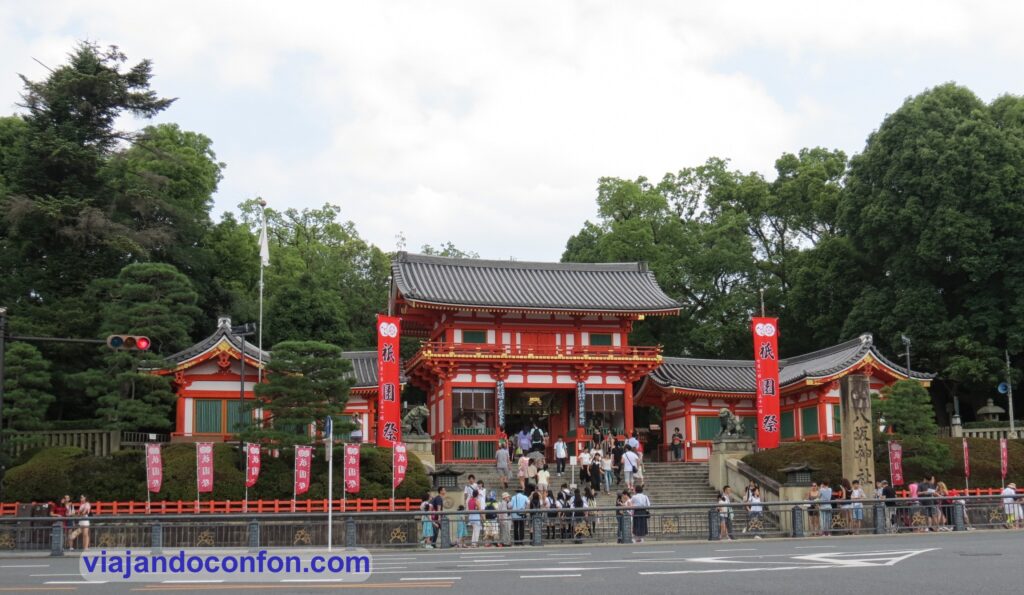
We dropped our stuff and hurried off to Yasaka Shrine (八坂神社) for a walk around Gion.
Yasaka Shrine (八坂神社) is a Shinto shrine located in the Gion district of Kyoto, Japan. Located east of the end of Shijō-dōri (Fourth Avenue) built in 656.
In the year 869, the Gion Matsuri, the most important festival in Kyoto, began. When we visited them we were in the middle of the festival.
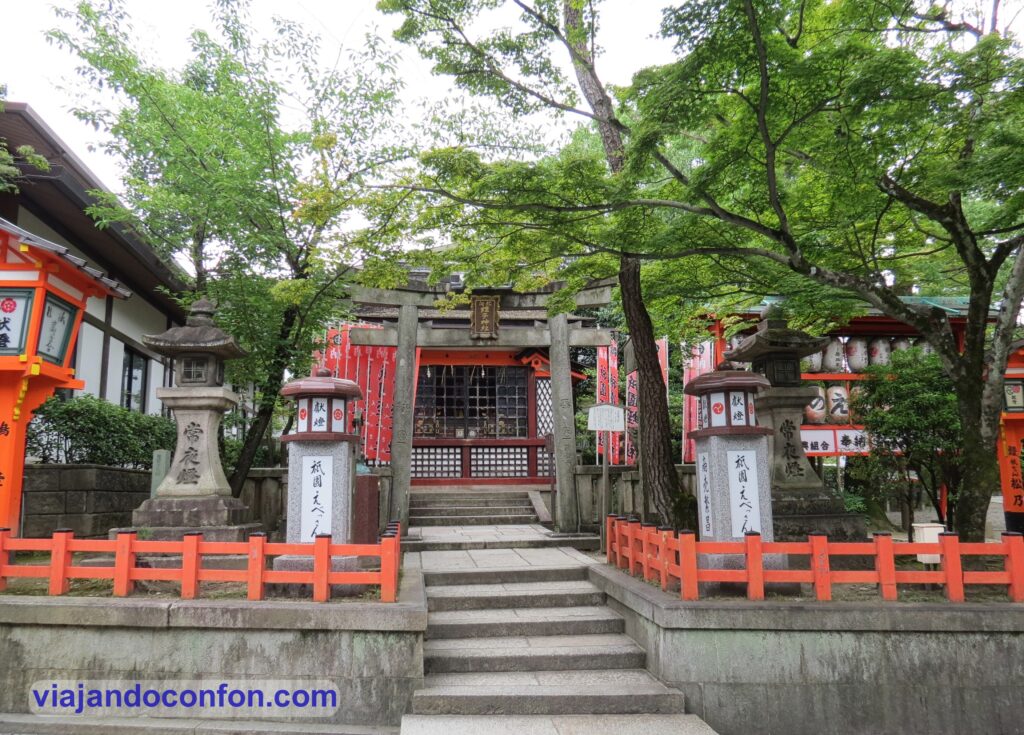
Ebisu-sha Shrine (蛭子社).
The enclosure is huge. We enter through the Nishiromon gate (西楼門) and on the left we find the chōzuya (手水舎), the source of ablutions to purify ourselves. A little further on we will give to several food stalls at the entrance of the enclosure.
We passed through several small shrines until we reached the central courtyard. There we can find the Buden (舞殿), a stage surrounded by hundreds of chochin (paper lamps) with the names of the people and companies that have made donations to the sanctuary, and where several portable thrones of the Gion Matsuri. Although they are only exposed during the festival.
Buden (舞殿)
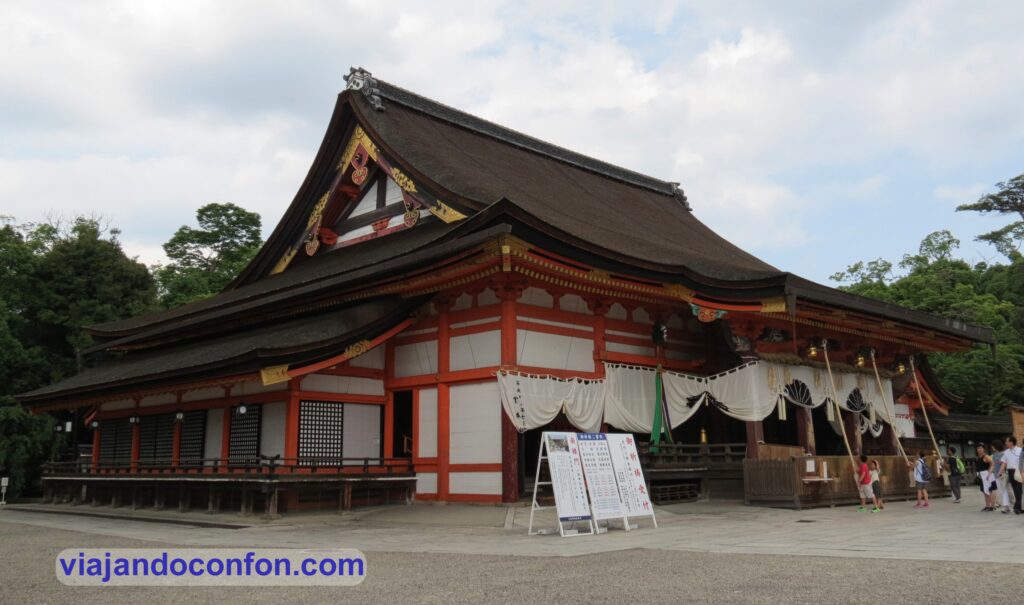
In the central courtyard is also the Honden (本殿), the main hall. There we made a small queue to make a small donation and ring the bell.
Honden (本殿)
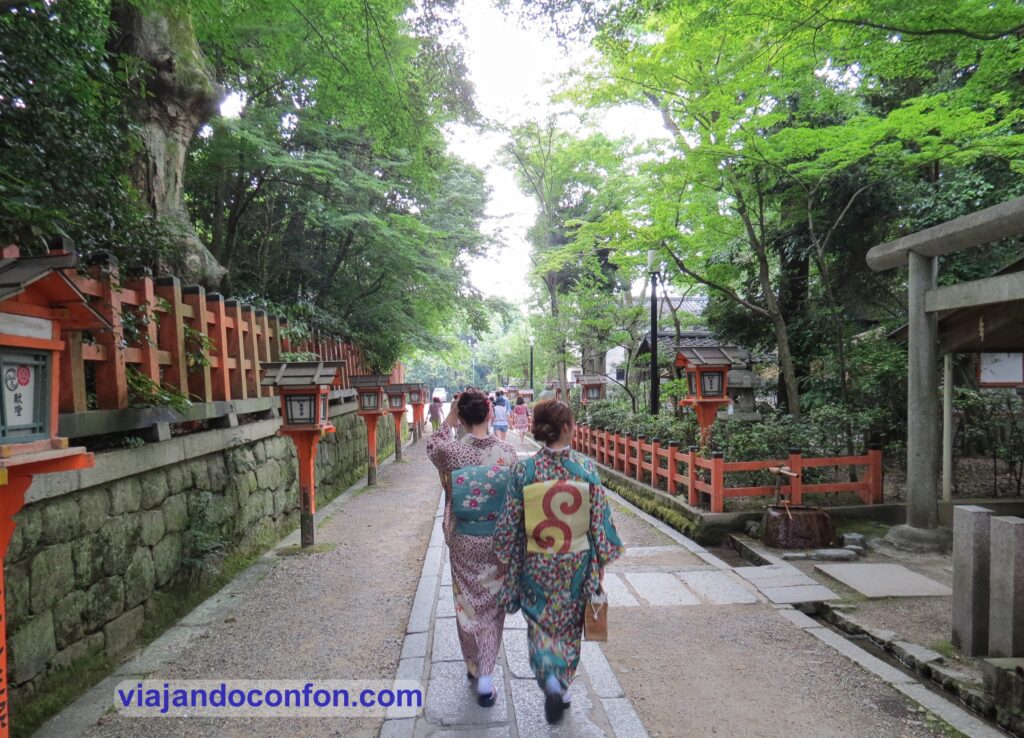
We continue walking through the enclosure between small temples. I don’t know if it was because of the Gion matsuri but there were a lot of people wearing traditional costumes.
We exit through the Nishiromon gate and make our way to the nearby Chion-in Temple (知恩院).
But before we got there, it was already lunchtime, and we passed a ramen restaurant that smelled like vice, so we decided to go inside. We had to wait because it was full but it wouldn’t be more than ten minutes.
I think it’s the best ramen I’ve ever tasted. The restaurant calls ramen Miyako. It is not the cheapest but I recommend it 100%.
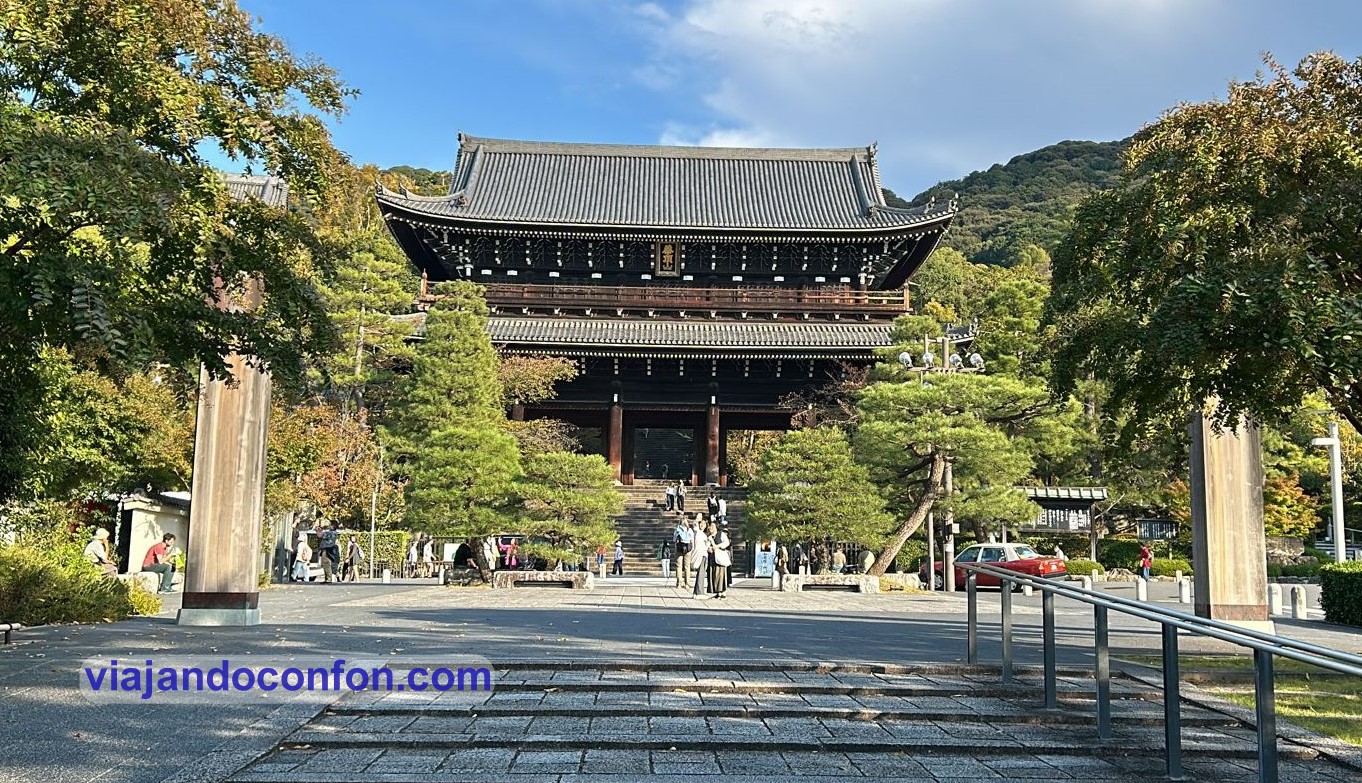
With a full stomach we headed to Chion-in Temple (知恩院). It is the seat of Jōdo shū Buddhism (Pure Land Sect) and was founded by Hōnen in the year 1234. It is a gigantic complex of 106 buildings, no more and no less.
We enter through the spectacular Sanmon gate (三門). Built in 1621, it is the largest wooden gate in all of Japan at 24 meters high and 50 meters long.
Sanmon Gate (三門)
Crossing the door we find the Otokozaka slope, some stairs that take us to the central esplanade of the complex. There we find on the left hand side we see a small pagoda called Tahoto (多宝塔) and on the right hand side the cafeteria and souvenir shop. We bought some fridge magnets there because they were so cheap.
Tahoto Pagoda (多宝塔)
We left the gift shop and went through the box office. Admission is 500 yen (€3.90-$4.70).
The first thing we come across is the Amida-dō hall (阿弥陀堂). The Amida-dō was originally built by Genchi, the second chief high priest of the Chion-in, opposite the Seishidō, but was moved to its current location in 1710. The building later fell into disrepair, but was rebuilt as the present Amida-do in 1910.
The main image is an impressive 2.7 meter tall golden statue of Amida. To enter you have to take off your shoes and unfortunately you can’t take photos.
Next to this temple is the Miei-dō main hall (知恩院 御影堂) that has been under restoration and completely covered from 2012 to 2019 and we could not see it either. This hall was built in 1639 by the third Tokugawa shogun, Iemitsu, and is the center of the Nembutsu teachings.
We then passed through a beautiful corridor to the Shūedō, the assembly hall.
Built in 1635, it is a huge hall with an image of Amida (Amitabha) said to have been created by Bishop Eshin (also known as Genshin). At the front of the room, there are images of the third Tokugawa shogun, Iemitsu, and the fourth Tokugawa shogun, Ietsuna. It is so big that it is said that a thousand tatami mats can fit. Unfortunately you can’t take photos either. Being here they warned that it was time to close the temple and they kicked us out directly. We failed to see much of the temple. We already have an excuse to return, but after 2019 when they open the main hall.
From here we went to rest a bit at the ryokan. There they left us some yukatas and we went directly to the onsen that was completely empty. It was a joy, in terms of hygiene it is the best invention in the history of mankind. Once the bath was over, we went up to the room to have tea and a rather old lady in a kimono appeared who was in charge of preparing the futons for us to sleep on. We already had beds.
Our beds
After the break we went for a walk through the streets of Gion and Pontocho, the neighborhoods of the geishas although we only saw one and she ran out of a taxi so we almost only saw the trail.
Just behind the ryokan, in a series of very pretty little alleys, we came across a small (very small) temple in which there was a girl praying. It is the Gion Tatsumi-jinja (辰巳大明神) and is dedicated to Tanuki, the raccoon with the fat testicles that we see all over Kyoto.
We are looking for something for dinner passing through some very curious places. But they all seemed excessively touristy to us.
In the end we decided on a very small and sketchy place where the people who were eating looked like ordinary Japanese. It was a great find. It’s a noodle place where you eat at the bar because there are no tables. You have the machine at the entrance to pay and you give the ticket to the only kid who was inside. We assume that he will be the owner, cook and waiter at the same time. The name was in Japanese, but researching it, I found out that it is called Ajinotentoku Shijo Kiyamachi (味の天徳 四条木屋町店) and the address is 455 Shincho, Shimogyo Ward.
After dinner we took another walk through the crowded Pontocho and went to the hotel to take advantage of the onsen before it closes. Now there were a few more people. One of the times that I was taking a shower, a boy of about 6 or 7 years old approached me and I think he was berating me for doing it wrong, but I’m not really sure. He was nailed to Sinchan.
July 22nd
Today super early, we have an excursion but first we wanted to take advantage of the onsen of the ryokan, so we got up around 6:30 and went to the bathroom for an hour.
Find the best hotel at the best price in Kyoto with Agoda:
When we finish, we collect our things, leave them at reception and go to the nearest subway station (Gion-Shijo). There we took the Hankyu-Kyoto line to Katsura station. We are going to visit the Katsura Imperial Villa (桂離宮). From there we walk about 15 minutes (10 minutes by bus) to the entrance of the villa.
Deep Kyoto.
The Katsura Imperial Villa (桂離宮) is a country house of the imperial family. Its main feature is that its gardens and buildings are considered a masterpiece of Japanese architecture. Prince Toshihito, son of Emperor Ōgimachi and younger brother of Emperor Go-Yōzei began its construction in 1615 and it was completed by his son Prince Toshitada in 1662.
To visit it we had to book a ticket about two months before through the website. The visit then was free (in 2018 you had to pay 1000 yen) and it is for groups.
When we went to make the reservation, for this villa there was no room. We had booked several more imperial villas, but several weeks after booking, they called us from Japan to tell us that one of the ones we had booked had all tours canceled for that day and we couldn’t go. So we asked if it was possible to book for Katsura and luckily, by phone they let us. The curious thing is that the girl she called insisted on speaking to us in Spanish with the google translator and communication was somewhat complicated.
The guide gave the explanations in Japanese but at the entrance they gave you an audio guide in English, Italian, French or Korean. The villa is spectacular, the gardens are beautiful. It is worth the visit and I recommend it as a must-see in Kyoto.
We were delighted with the visit and headed for the station to go see the imperial palace. From Katsura Station we took the subway Hankyu-Kyoto Line to Shijō Station and there we changed to the Karasuma Line to Imadegawa Station.
We arrive at the imperial park or Kyoto Gyoen (京都御苑) through which we take a walk to the entrance of the palace grounds. As soon as we enter we have a visitor center where we register and are taken to a room (with air conditioning). There we met a group of foreigners who gave us a guide in English to tour the site.
The Kyoto Imperial Palace or Kyoto Gosho (京都御苑) was the official residence of the imperial family until 1869, when the capital was moved to Tokyo.
Shishin-den Hall (紫宸殿).
The visit lasts about an hour and you really only visit the pavilions from the outside, you don’t enter any of them.
Since it was getting late, we decided to eat at a Moss Burger chain burger joint that was next to the subway station. It’s cheap and good but the burgers are tiny.
After eating, we went back to the ryokan to get our things and went to what would be our next base of operations until we returned to Tokyo: the Orient Gojozaka guesthouse. €81 ($97.90) per night and it is a small apartment with a kitchen, a desktop PC with internet connection and a washing machine!
Find the best activities and tours in Kyoto with Civitatis:
At the exit of the subway something very curious happened to us. We went out the door and planted ourselves on a large map that was there to guide us to get to the ryokan. A rather old lady who passed by, seeing the lost face and, speaking only Japanese, we made ourselves understand what we were looking for. Then the lady made a gesture for us to accompany her. She took us to the entrance of the street where the accommodation was. She had a nearby store that caught her on the way. What a great lady.
We left our things and, on the way, we went to a nearby convenience store and through signs we managed to buy a detergent for the washing machine. We left a sunset and went to dinner in Osaka. To do this we went to Kyoto station and took the Kodama shinkansen to Shin-Osaka station and from there we changed to the subway to Namba station and here came the problem. I had read that the Namba station was so big that it had more than 50 exits, we must be exaggerating… well, indeed, more than 50 exits. So we approached an information guy and by beckoning him one more time he told us the exit we had to take: exit 29-d.
We went out to the saturated recreational-festive area of Dotonbori and went straight to dinner, which was already very late. We had dinner at an okonomiyaki place called Ajinoya. The okonomiyakis were very good but quite expensive, I suppose you pay for the area.
Dinner had taken a long time and it had gotten very late so we went back to the station to return to Kyoto.
At that time there were no shinkansen so we took the Special Rapid line at 11:25 at night. While I was on the platform something strange happened to me. Standing in line waiting for the train I hear a kind of snoring behind me, I turn around and the guy behind me was sleeping on his feet! with his head thrown back and his briefcase in his hand and the guy asleep, and without anyone’s support, what capacity do the Japanese have to fall asleep.
About halfway through, hundreds of girls got on the train (without exaggeration) who we assume were coming from a concert. They wore matching shirts and scarves.
We arrived in Kyoto at almost midnight and there were no buses to the hotel and it took us more than half an hour to walk there. We decided to bite the bullet and pay for a taxi. Taxi doors in Japan are automatic, they open by themselves. We approached one and the guy didn’t directly open the door for us… live to see. We waited a bit and someone else appeared if he wanted to take us. Spectacular taxi full of crochet tapestries. The trip cost us 1,000 yen (almost €9-$10.90). We thought it would be much more expensive.
July 23rd
Today we have a long excursion, we are going to Hiroshima and Miyajima. To do this we take the Kodama shinkansen at 8:43 to Shin-Osaka and there we transfer to the Sakura shinkansen at 9:18.
Buy your JR Pass
Buy with Japan Experience your JR Pass at the best price. You can travel around Japan for 7, 14 or 21 days.
At 10:54 we arrived punctually at the Hiroshima station. There we go to the information desk and they tell us that to go to Hiroshima Peace Memorial Park (広島平和記念公園) we can take the Hop on-Hop off buses that are included in the JR Pass, so we don’t think about it.
We got off next to the Peace Monument. Also known as Genbaku Dome (原爆ドーム) or Atomic Bomb Dome, it was the closest standing structure to the epicenter of the atomic bomb blast on August 6, 1945, just 150 meters away.
The building is creepy because of its history and spectacular that it has withstood the explosion considering that the area was totally devastated for miles around.
On one side of the building there were several people giving explanations and telling their own version of the story and that kind of thing… that they were the good guys in the movie and the allies were the bad guys, more or less. Anyway… what the hell is war.
From here we took a walk through the Peace Memorial Park seeing the many memorials and ringing the peace bell reaching the Peace Memorial Cenotaph.
The Cenotaph, built by Tange Kenzo, was inaugurated on August 6, 1952, coinciding with the 7th anniversary of the explosion, to commemorate the 200,000 victims of the bomb. It has an inscription that reads: “Rest in peace, for the mistake will never be repeated” (“安らかに眠って下さい 過ちは 繰返しませぬから”).
After the cenotaph we enter the Hiroshima Peace Memorial Museum (広島平和記念資料館), where we find detailed information about what happened that day, such as a multitude of objects found in the ruins (including human skin). Admission costs 200 yen (€1.55-$1.88) and it is a very interesting visit, although it excites and impacts a lot and leaves a hell of a bad body. Whether they are the good guys or the bad guys in the movie, in my opinion there is no way to justify any such massacre.
Discover the best activities and tours with Civitatis:
From here, we went directly to visit the island of Miyajima (宮島). To do this we take the Sanyo line from Hiroshima Central Station to Miyajimaguchi Station. There we bought something to recharge our batteries in a 7eleven that was already hungry and we went to the ferry, which is included in the JR Pass.
As soon as we get off the boat we are harassed by herds of deer in search of easy food.
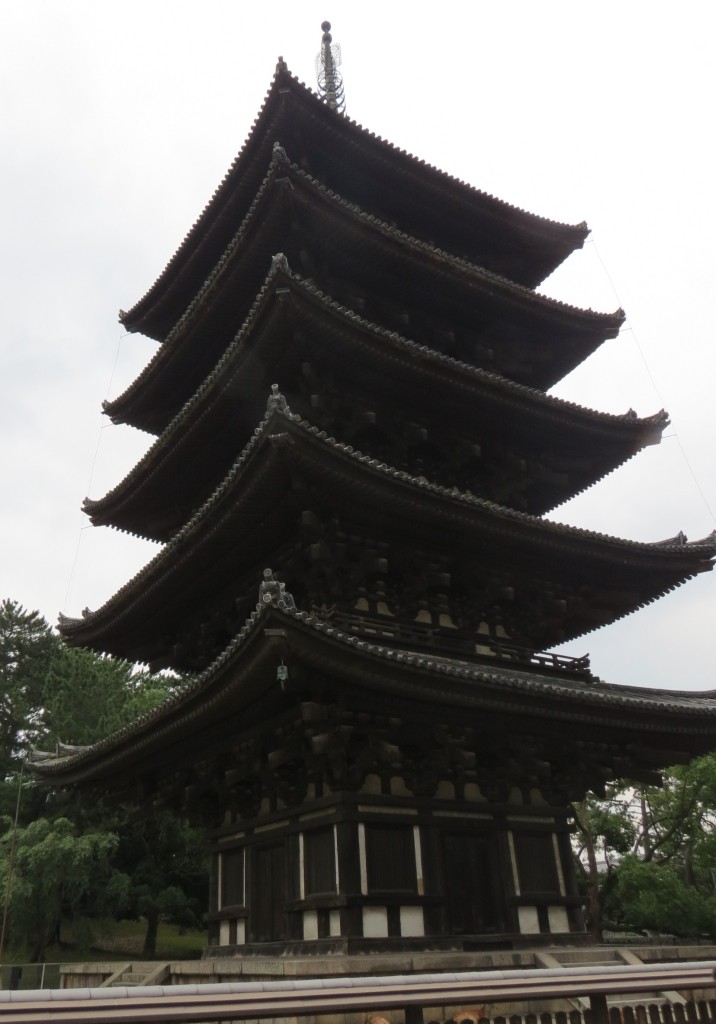
We headed past the Toyokuni Shrine (豊国神社) and the spectacular five-story pagoda to Itsukushima Shrine (厳島神社).
The Toyokuni Shrine (豊国神社) began to be built in 1587 under the name of Hideyoshi Reijin, by order of Toyotomi Hideyoshi. He died before its completion and is still incomplete today. In 1897, Hideyoshi Reijin was consecrated and renamed Toyokuni Shrine, and in 1918, it is consecrated to Kiyomasa Kato, the deity of Hodosan Shrine.
According to an ancient record, Itsukushima Shrine (厳島神社) is believed to have been founded by Saeki no Kuramoto in the year 593, but there is confirmation of its existence from the year 811.
The complex is spectacular, it is made up of 37 buildings (plus another 19 outside the complex) highlighting, above all, the great Torii on the shore of the Seto Sea and the Honden. Leaving the purification room (Haraiden) we go to a kind of terrace where the Takabutai is located, a raised stage used for performances of bugaku or ancient traditional dance.
From here there is a platform from which you can see some wonderful views of the great Torii, that is, you have to wait in line to take the photo. The pity is that at that time the tide was low. When it is high, both the great Torii and the shrine are in the sea.
We leave the complex and go to a small square where there are several temples. Daiganji Temple (大願寺) an ancient temple of the Shinshin sect whose foundation is unknown.
Here we rest a little and we go to the great Torii taking advantage of the fact that the tide is low. It doesn’t look that great from afar, but it’s huge.
After a while taking photos and contemplating the Torii, we go for a walk around the town. The truth is that it has a lot of charm. We bought some citrus kit kat and went back to the shore to contemplate what they say is one of the most beautiful sunsets in the world… And it may be.
We were very sad but we had to start going back, almost 3 hours separated us until Kyoto. At the Hiroshima station we bought a bento to be able to have a proper dinner on the train since we had hardly eaten so as not to waste time.
At 8:48 p.m., the shinkansen left for Shin-Osaka, where we arrived at 10:21 p.m., where we changed to the special rapid line to Kyoto. We took one of the last buses, and to sleep it had been a very long day.
Here we have the map of the places we visited in Hiroshima and Miyajima:
July 24th
Today we get up early and go to visit the nearby temples.
We left for the Kiyomizu-dera temple (清水寺). From the hotel we went up Sannenzaka Street (三年坂), a sloping street that retains its traditional style. It is full of souvenir shops and tea houses. We must to buy some gifts for the family.
Sannenzaka.
At the bottom of the hill, the Kiyomizu-dera Temple (清水寺) awaits us. The Otowasan Kiyomizu-dera Temple was founded in 778 next to the Otowa waterfall, as a sacred place for Kannon who symbolizes great mercy.
The temple has been burned to the ground on numerous occasions. The buildings we see today are a reconstruction of the year 1633.
The first thing we come across is the Niōmon (仁王門) or Deva gate, destroyed by fire during the war at the end of the 15th century and rebuilt at the beginning of the 16th century.
Behind it we find the Saimon gate (西門) or west gate, also rebuilt in the year 1631 and just after passing it we find the three-story pagoda Sanjūnodō (三重塔) built in the year 847 and rebuilt in the year 1632.
Niōmon Gate (仁王門), Saimon Gate (西門), and Sanjūnodō Pagoda (三重塔).
Before crossing the Niōmon gate (仁王門), on the right hand side we find the small Zenkoji temple (善光寺), dedicated to Amida although in its beginnings it was dedicated to the Jizo Bodhisattva. And next we find the stable Umatodome (馬駐), where visitors left their horses before entering the temple.
Umatodome (馬駐).
Crossing the Niōmon gate (仁王門), on the left we find the Shōro bell tower (鐘楼), from 1596 and rebuilt in 1607.
At the top of the stairs we find ourselves in front of the Zuigudō Hall (随求堂), rebuilt in 1718 and dedicated to the mother of Buddha. Admission is 100 yen (€0.78-$0.94).
Zuigudō Hall (随求堂)
Next to it is the Kyōdō Hall (経堂), rebuilt in 1633. By the mid-Heian era, it held all the sutras and flourished as an auditorium for scholarly monks from all over the country. In the hall there is a cult statue of the Three Buddhas.
Behind it is the Kaisandō Hall (開山堂) and behind it is the Todorokimon Gate (轟門). Opposite the gate is Benten Island (弁天島), which contains a small Shinto shrine.
Benten Island (弁天島)
Crossing the Todorokimon gate (轟門) we arrive at the temple’s ticket office. Admission costs 300 yen (€2.30-$2.80). We pay and spend.
We arrive at the main hall, the Hondo (本堂), the most famous image in the temple and one of the most famous in Kyoto. The main hall is built on the cliffs of Mount Otowa. This is a traditional construction method called “Kakezukuri” (懸造), an ancient Japanese method that allows the construction of highly earthquake-resistant structures, even on cliffs where construction is difficult due to the latticed wooden support.
This hall is a dedicated performing arts venue for Kannon, the chief god of Kiyomizu-dera Temple.
The truth is that both the hall and the altar are impressive. I was very shocked to see that there were about a million fire extinguishers stacked on every corner, which is logical considering that it has burned about ten times throughout its history.
Behind the hall we find the Jishu Shrine (地主神社) dedicated to the god of love and marriage. In it, there are two stones of love, if you walk the distance that separates them with your eyes closed, you will find love. While there, a group of girls arrived and one of them jumped to embrace one of the stones. I thought she killed herself.
Love Stone.
From here we went down to the Okunoin Hall (奥の院), which was closed and covered for restoration but from here we could take good photos of the main hall.
From here we approach the Koyasu Pagoda (子安塔). The exact age of its foundation is unknown. The current building was built in the 1500s and is dedicated to Koyasu Kannon (Sente Kannon) and is visited by women to help them have a good birth. From here there are also beautiful views of the main hall.
Koyasu Pagoda (子安塔)
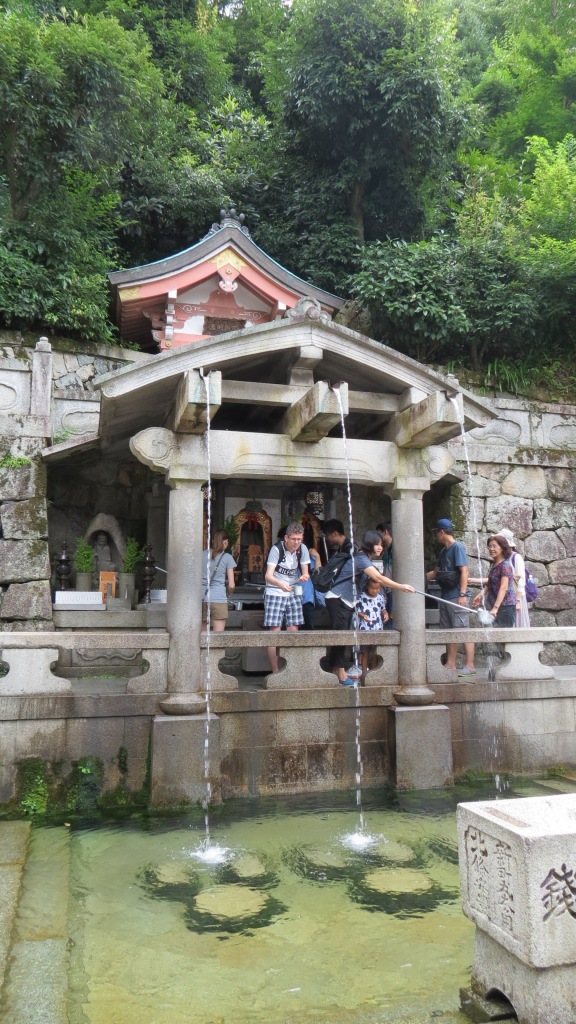
From here we descend to the Otowa waterfall (音羽の滝), which gives the temple its name. Drinking from this waterfall is supposed to have therapeutic properties and give you health and long life. We queued up just in case and drank. You never know.
Otowa waterfall (音羽の滝)
We left the temple and rushed out to visit Nijō Castle (二条城). To do this we take bus 202 and in about 25 minutes we get off at the castle gate.
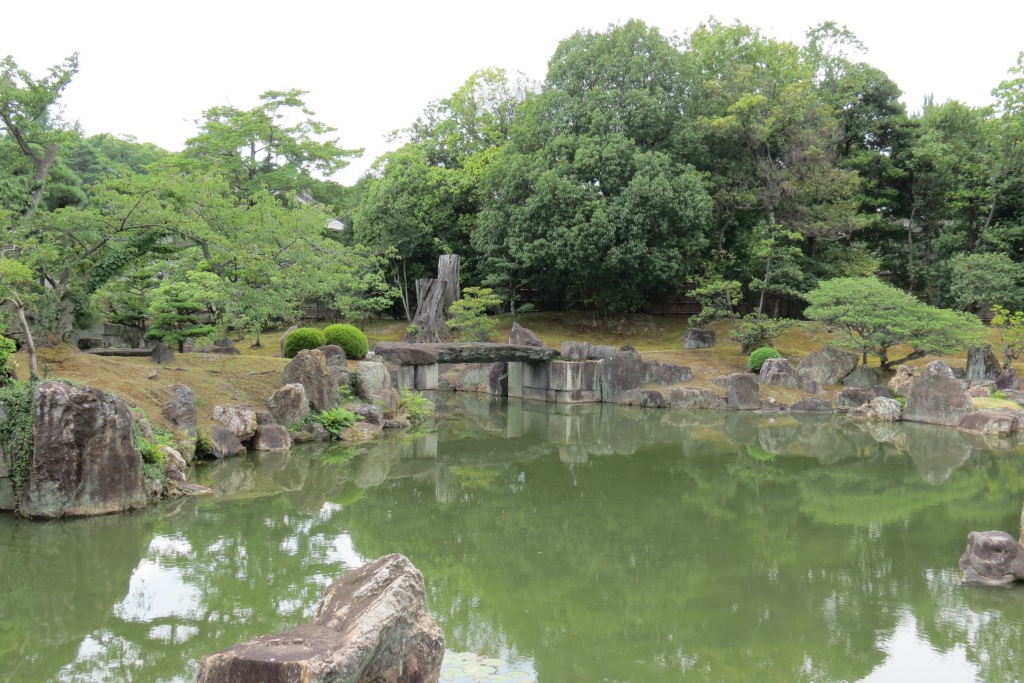
Nijō Castle (二条城) was built in 1603 for the residence of the Shōgun Tokugawa Ieyasu and from then on it was the official residence of the Tokugawa family until the abolition of the shogunate in 1867.
The entrance cost us 600 yen (2016) and the visit was free following a circuit, but you had many explanatory panels. The buildings are spectacular, something that struck us was the lack of furniture, but it seems that what really mattered was nature and not the material objects of ornamentation, so that is why the imperial gardens in Japan are so impressive.
We ran out of the hall without eating, because there was no time to lose. Anyway we have good reservations.
At the gate of the castle we took bus 12 to the Kinkakuji temple (金閣寺) or golden pavilion.
This temple is probably the most recognizable image of Kyoto, it is a Zen temple with the exterior walls covered in gold leaf.
It was built in 1397 as a resting place for Shōgun Ashikaga Yoshimitsu. After his death in 1408, it was converted into a temple of the Rinzai sect and its official name is Rokouon-ji (鹿苑寺).
The enclosure is truly spectacular and is a totally essential visit in Kyoto. Admission is 400 yen (€3.10-$3.75).
From here we run to the Arashiyama bamboo forest. To do this we took bus 59. About halfway we got off at a kind of small bus terminal where we waited about ten minutes and from here we took bus 93. Almost an hour later we arrived in Arashiyama.
We got off next to the Togetsu-kyō Bridge (渡月橋), the bridge that crosses the moon.
As it was getting late, they had already closed everything for us so we could only see the bamboo forest, which is the only thing that does not close. Even so, we crossed the bridge and walked for a while along the banks of the Katsura River enjoying the views. We crossed it again and went into the woods.
The forest is very beautiful but it is not very big and you can walk quietly in a while.
After the ride came the problem. It was 6 pm and we were without eating. There were many places but the problem is that we had about 300 yen (€2.30-$2.80) left in cash and in Japan, practically no business accepts payment by card.
We couldn’t find any combo with an ATM compatible with foreign cards. So we went to the Saga-Arashiyama station and there we took the San-In line to the center of Kyoto, finally we were able to get money and buy something to have a snack.
We went to the hotel to take a shower and then we went out for an early dinner. We dined at a Sukiya, a chain specializing in grilled eel, which was what fell.
After dinner we took a quiet walk and went to sleep.
July 25th
Today is going to be a full day. We get up early and go to the station. There we take the Nara line at 8:23 to Inari station where we get off 5 minutes later. We are going to visit another of the iconic and best-known images of Japan: Fushimi Inari-taisha (伏見稲荷大社), the temple of the 1000 Toriis.
The origin of Fushimi Inari-taisha (伏見稲荷大社) is described in Yamashiro no Kuni Fudoki (山城国風土記), an ancient report on provincial culture, geography, and oral tradition that was submitted to the emperor.
It is said that Irogu no Hatanokimi, an ancestor of Hatanonakatsue no Imiki, threw a rice cake, which turned into a swan and flew away. Finally, the swan landed on top of a mountain, where an auspicious omen occurred and rice grew. Inari is named for this miracle (“ina” is Japanese for “rice”).
The sanctuary was founded in the year 711 and is the main temple dedicated to Inari, god of rice and merchants, the most important in all of Japan. For this reason, merchants donate money to the temple for prosperity which the temple turns into the famous red Torii as an offering. Fushimi Inari has a 4 kilometer path lined with toriis that seems to form an endless corridor.
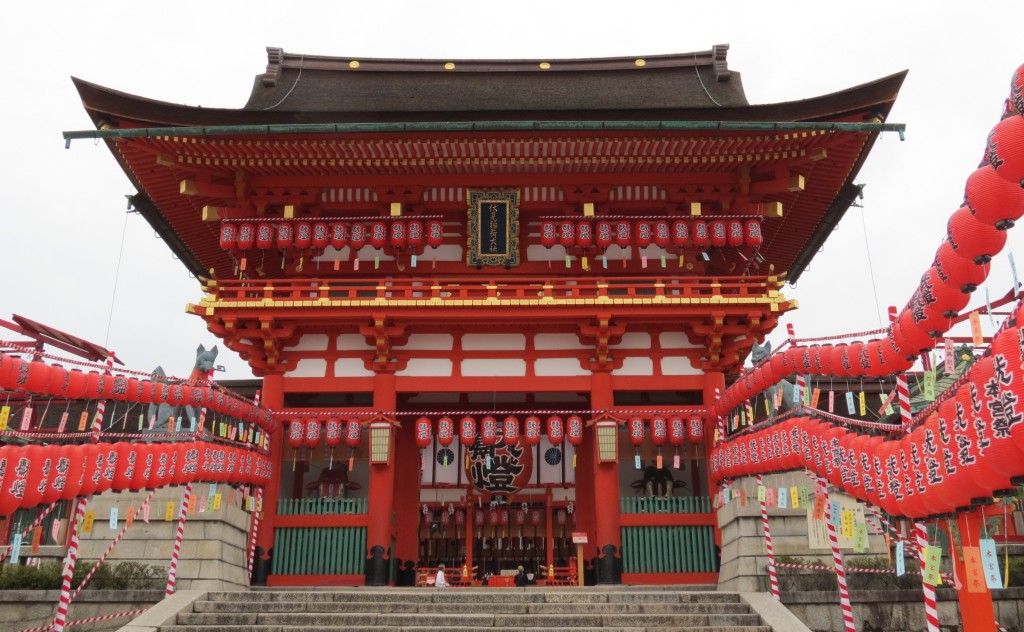
As soon as we leave the small Inari station, we find a large red Torii that gives access to a street that, when we visited it, had hundreds of wrens (lanterns) on the sides, which leads to the Romon no Kitsune gate. (キツネ). The gate was built in the year 1589 thanks to the offerings of Toyotomi Hideyoshi.
As we passed the gate we came to the main hall, the Honden. The hall was destroyed by fire during the Onin Rebellion in 1468 but was rebuilt in 1499 thanks to donations.
Torii price list.
Behind the main hall and passing through several small temples, the path of the thousand Toriis begins. The torii began to be donated during the Edo period and runs from the base of the shrine to the top of Mount Inari. The path is quite hard since it is a constant climb and with the humid heat of July it is very sticky, but it is worth the climb.
After the hard climb, we go down a side where there are many small curious temples and even a small cemetery.
If you want a complete experience, don’t miss the Civitatis guided tour. You will not regret:
After the kick we return to the Inari station. There we take the Nara line again at 9:55 a.m. to Uji station where we get off at 10:16 a.m. to visit the Byōdō-in temple (平等院).
We left the station and began to walk. About five minutes later we reached the bank of the Uji River. There was a small statue of Murasaki Shikibu (紫 式部) a Japanese writer, poet and courtesan who authored the first Japanese novel in the 11th century: Genji Monogatari (“The Genji Novel”), a work that has also been considered the first modern novel of the world.
Murasaki Shikibu (紫 式部).
From here we walk along the traditional Omotesando shopping street until we reach the entrance of the Byōdō-in temple (平等院). The temple was built in 998 as a rural village for Fujiwara no Michinaga, one of the most powerful members of the Fujiwara clan. In the year 1052 it was converted into a Buddhist temple by Fujiwara no Yorimichi.
The most important structure of the temple is the Hall of the Phoenix or Hōō-dō (鳳凰堂), built in 1053 and is the only original structure left standing, as the rest of the structures were destroyed after a fire caused by the war civil in 1336. The hall houses an impressive three-meter figure of the seated Amida Buddha from the year 1053.
The entrance fee is 600 yen (4.66€-5.63$) plus an additional 300 yen if you want to enter the Hall of the Phoenix.
In front of the Phoenix Hall are the beautiful Jodo-shiki gardens from where we can admire the hall from the other side of the pond with the pond reflected in it.
After this we can visit the Hoshokan Museum and in it we can find numerous objects of the temple considered national treasures. It is a very modern building that the truth does not match even with glue but in which it was very cool with the air conditioning.
In the souvenir shop we bought some postcards that were precious engravings of the temple for 50 yen (0.40€-0.47$). At the exit of the museum we find several more temples such as the Jōdo-in (浄土院).
From here we continue running and return to the station after passing through a supermarket that we caught on the way to buy something to snack on. We were going to Nara.
As an important advice to go to Nara: From Kyoto you have to take the Nara line, but there are several services. It is important to take the RAPID SERVICE since it takes 45 minutes and the LOCAL line takes an hour and a quarter.
So, we got on the rapid service at 11:51 and in less than half an hour we got off at Nara.
From the station we took bus 118 for 220 yen (€1.70-$2.06) to the closest stop to Tōdai-ji temple (東大寺), which is Nara Park. The stop is not lost because they are marked on a screen and, in addition, it is where the entire bus full of tourists will get off.
We were very amused that, every time people got off the bus, the driver said something in Japanese, we suppose saying thank you but in a very funny tone.
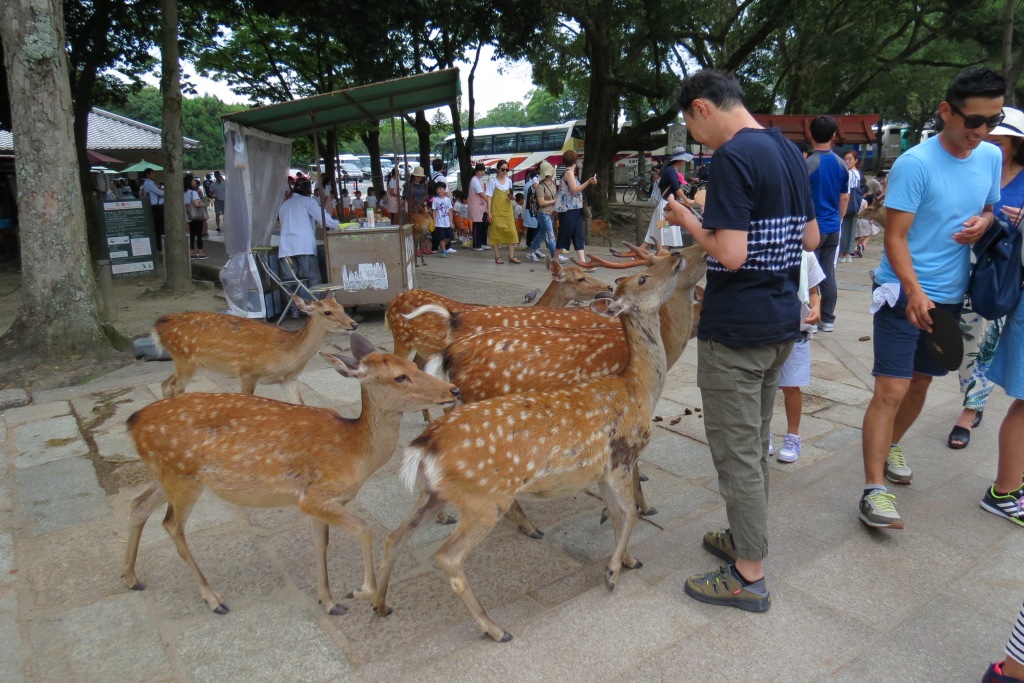
Already from here, you will start to see herds of Sika deer everywhere like in Miyajima. Deer are considered messengers of the Shinto gods and are protected as national treasures.
Throughout the park there are numerous stalls where you can buy cookies to give them to eat. They are very tame but if they think you can bring food, they can give you a snack. In fact, we saw how a guy tried to rip out the back pocket of his pants. The best thing is to go empty-handed and have them look good on you.
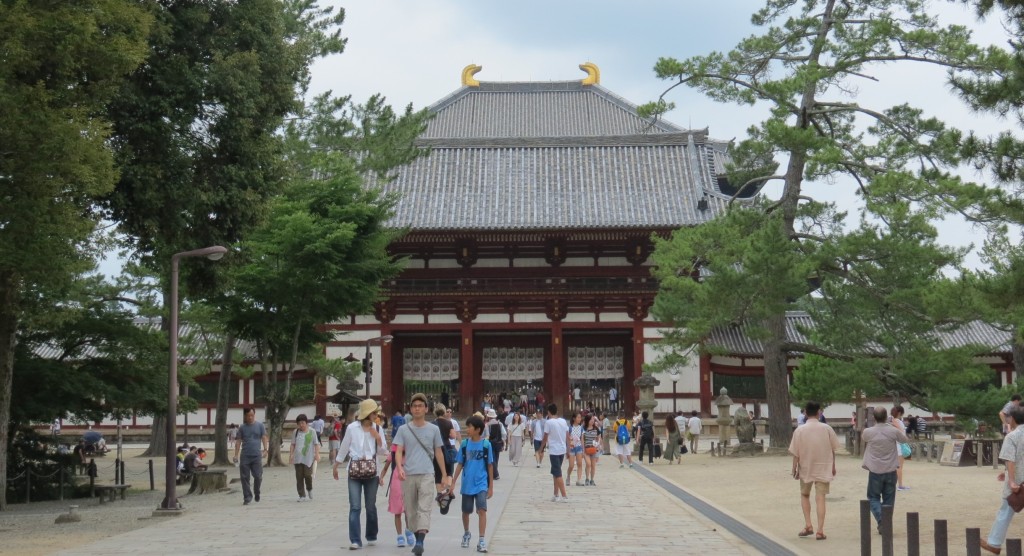
After spending a fun time in the park with the deer (although they can be sooooo heavy), we arrived at the Tōdai-ji temple (東大寺). Construction of the temple began in 728 under the name Kinshōsen-ji (金鐘山寺). The first thing we see is the Nandaimon Gate (南大門) or Great South Gate, built in 1199.
Nandaimon Gate (南大門).
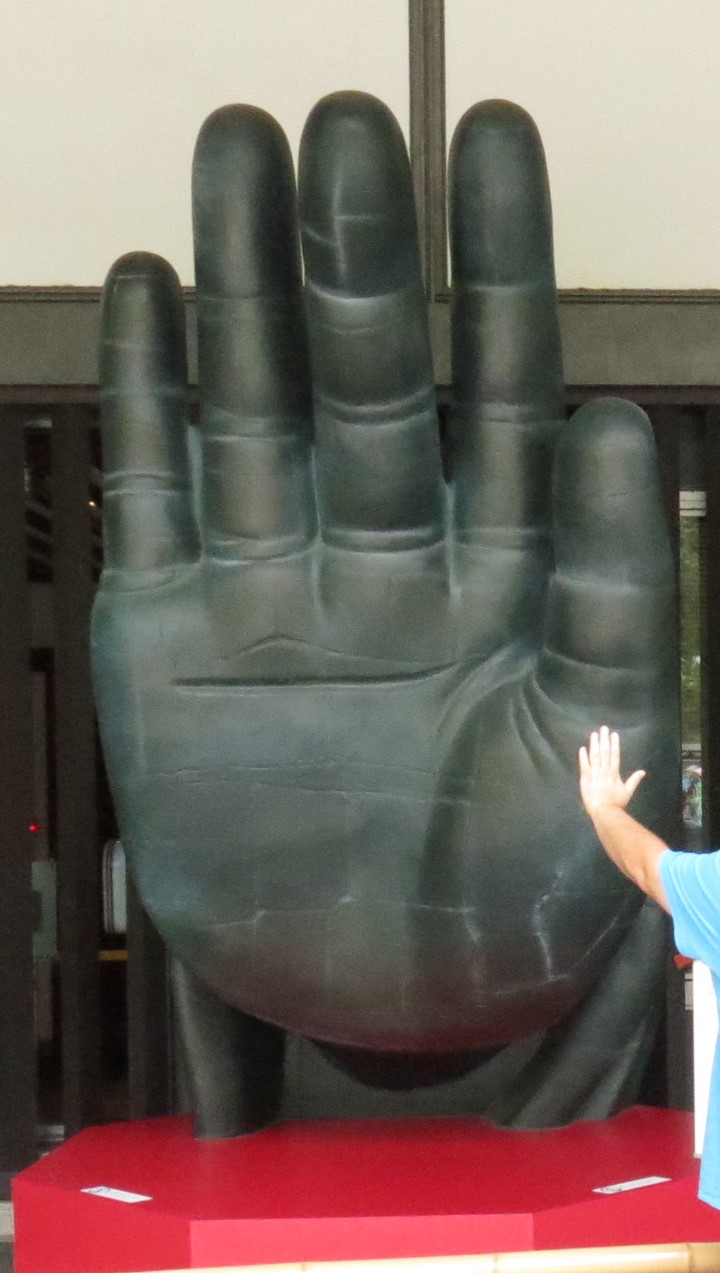
As soon as we pass the door, on the right we find a life-size replica of the right hand of the Great Buddha of Nara. It is really grotesque.
Hand of Buddha
A little further on we come to the gate of the temple complex, the impressive Nakamon Gate (東大寺 中門). This door is closed. To access the complex you have to go to one of the corners where the office is located to buy tickets. Admission price is 600 yen (€4.66-$5.63).
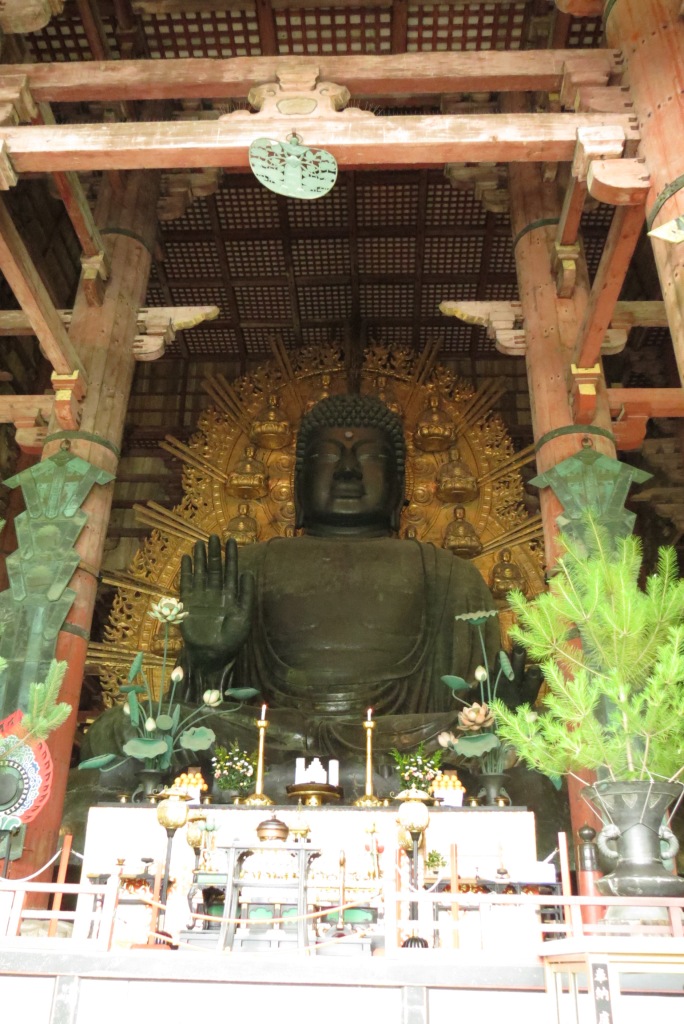
As we leave the office, we behold the grandeur of the Daibutsuden room, the main hall. This is the largest wooden building in the world… spectacular.
As soon as we enter the temple we find ourselves in front of the Daibutsu, the Great Buddha of Nara sitting with its impressive 15 meters high. The Daibutsu is also flanked by two Bodhisattvas.
On one side is another of the elements that most attract tourists, a column with a hole in its base the size of one of the Daibutsu’s nostrils. Legend has it that whoever passes through will be blessed with enlightenment. Children usually have no difficulty getting through, but adults sometimes get stuck and need help getting out. Needless to say, we didn’t even try, I think I couldn’t even get my head around it.
Outside the temple is a statue of Binzuru-sonja (Piṇḍola Bhāradvāja) sitting in the lotus position. It is said that if you rub the parts of your body where you have an illness or injury, it heals you thanks to it.
From here we walked towards the station. We passed the Kōfuku-ji Temple (興福寺). Established in the year 669 by Kagami-no-Ōkimi (鏡大君), the wife of Fujiwara no Kamatari, wishing her husband’s recovery from illness. The temple is the national headquarters of the Hossō school.
Of course, the main hall was completely covered by works and access to its interior was closed.
Kōfuku-ji Temple Pagoda (興福寺).
It had gotten quite late so we decided to eat at a nearby Coco curry house, which had a menu in Spanish and was run by a very nice lady.
Find the best activities and tours in Nara with Civitatis:
Here we have the map with the points we visited in Nara:
With our stomachs full, we walked back to the station to take the train, this time to Osaka. We took the Yamatoji Rapid Service Line at 16:00 and 55 minutes later we got off at Osaka Central Station. From here we got on the metro to the castle. We arrived late and the tower was already closed but you can still walk around the castle grounds, which is a huge park.
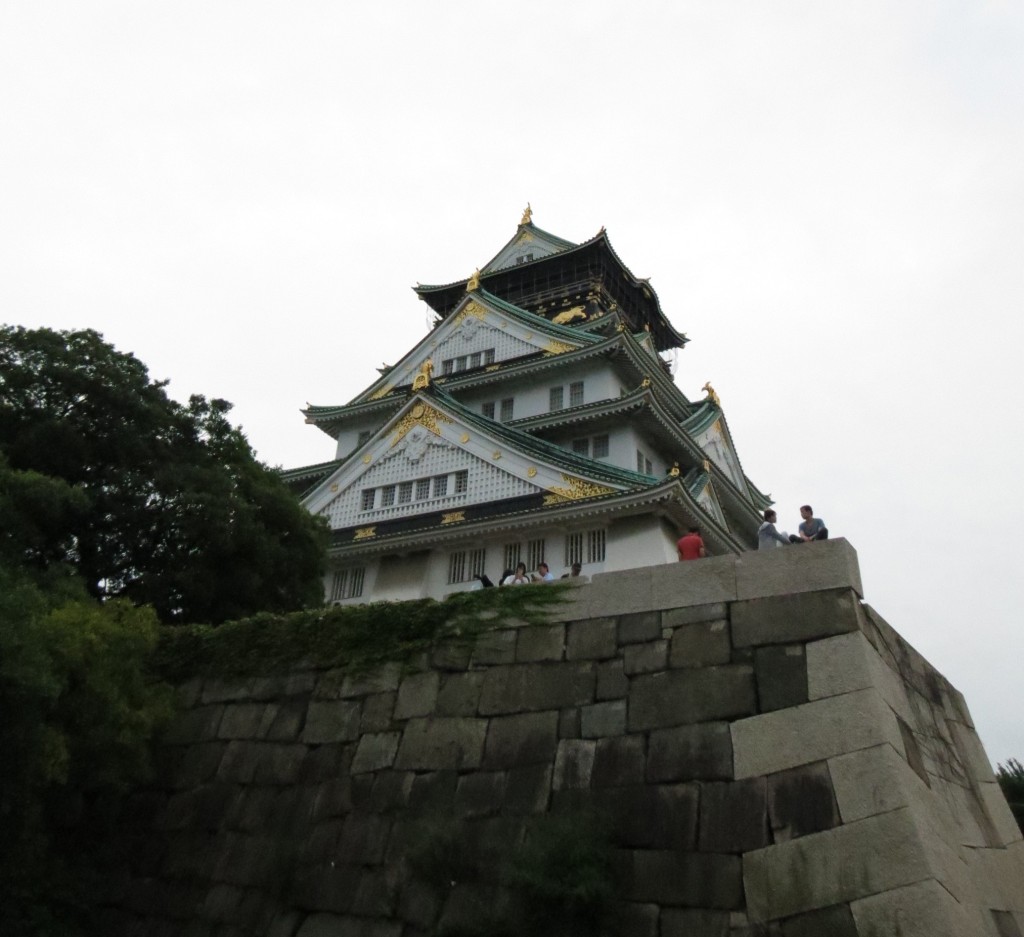
Osaka Castle (大阪城) was built beginning in 1583 by Hideyoshi Toyotomi on the site of Hogan-ji Temple.
In 1615, the shōgun Tokugawa Iyeasu destroyed the castle during the Siege of Osaka after he moved the government to Edo (Tokyo). Between 1620 and 1629 it was rebuilt again by the Tokugawa.
In 1868 it was destroyed again during the Boshin War and rebuilt in 1931. Nice story about the tower…
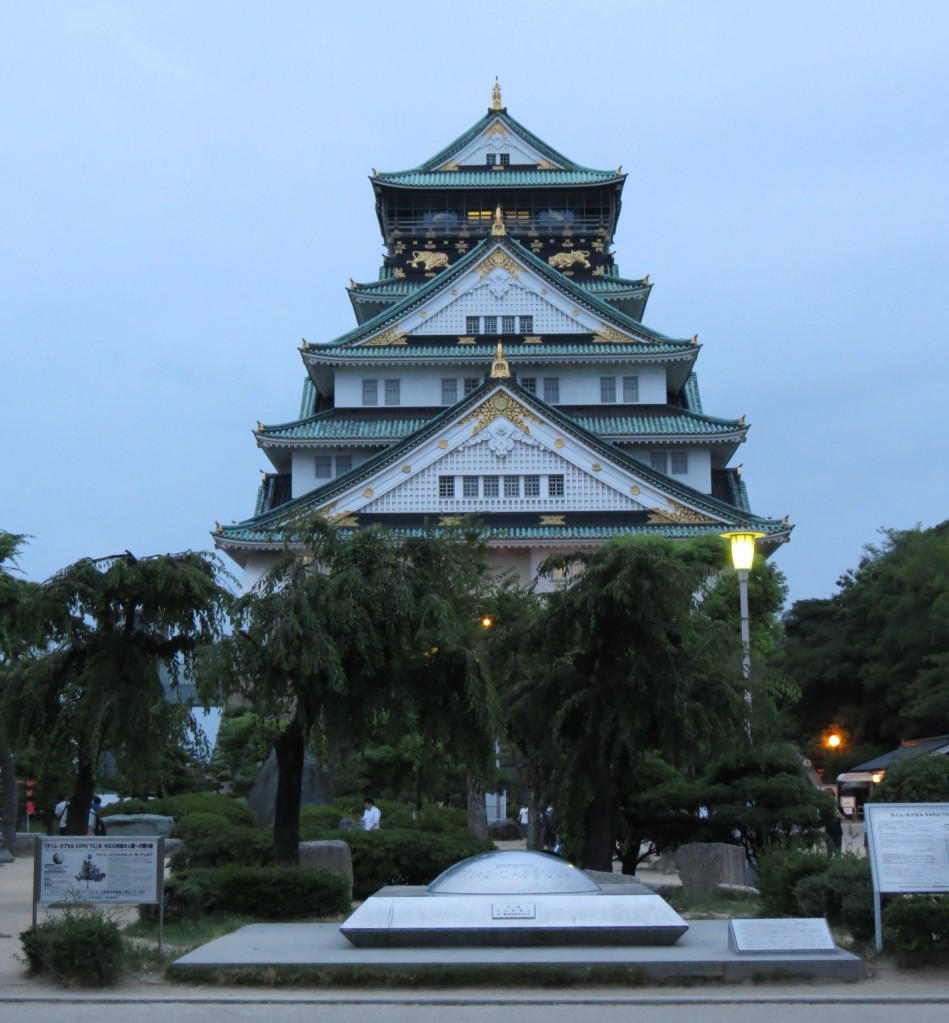
In the park in front of the castle are the two time capsules that were installed during the Universal Exhibition of 1970. One is buried 14 meters underground and will be opened in the year 6970, if the human race is still on earth. , which I highly doubt it the way we’re going. The other is buried at 9 meters and is opened at the beginning of each century. Already in the year 2000 it was opened for the first time.
Castle tower and time capsule.
While sitting on a bench, we noticed that there were many people in the park and the curious thing is that they all went with their heads buried in their mobiles. That night we found out that Pokemon Go had been released that day in Japan and they were all super hooked looking for pokemon.
As night fell, more people began to accumulate but they were occupying positions sitting on one side of the park with their beers and their things. We assumed that something was going to happen. We approached a young couple to see if they spoke any English to ask what was going on… They didn’t understand a thing, but we had a laugh. We decided to wait a while. After a while, a fireworks festival began, which we would later discover was for the Tenjin Matsuri. At that moment, after our reaction to seeing the fireworks, the couple realized what we had asked a while before and we laughed again for a while.
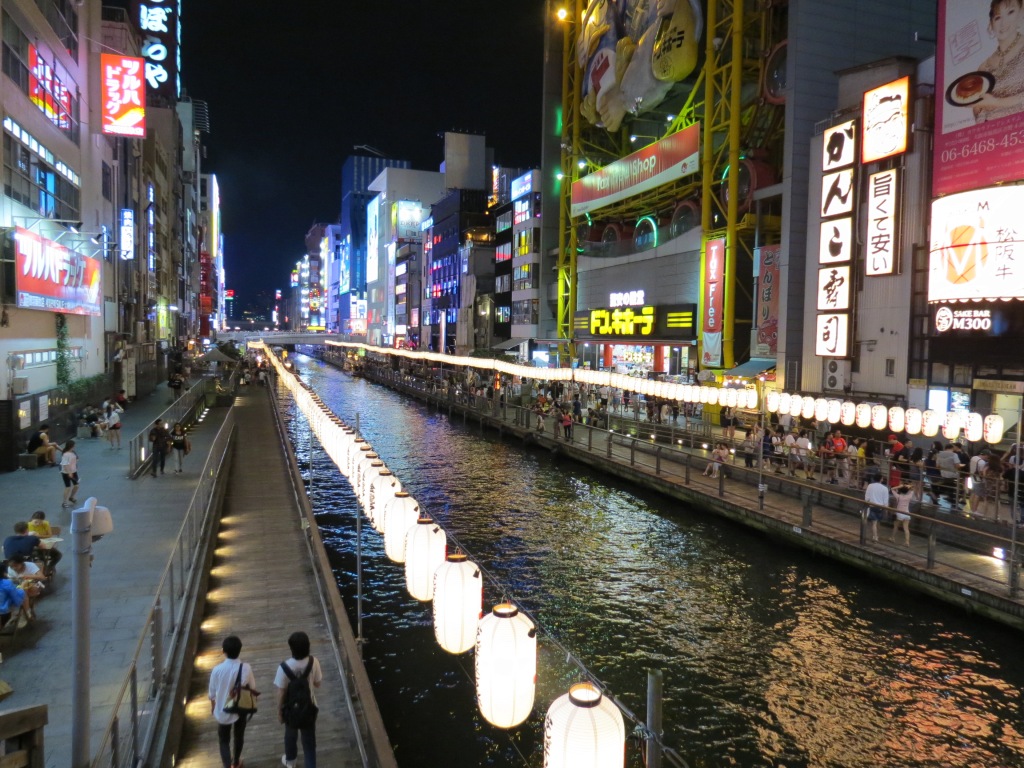
From the castle we went to see the night of Dōtonbori (道頓堀) and its grotesque restaurant facades. It is the largest shopping and tourist center in Osaka. It is a shopping street that runs alongside the Dōtonbori River Canal from the Dōtonboribashi Bridge to the Nipponbashi Bridge.
Since we were already a little hungry, we bought some takoyakis at a street stall. The takoyakis are like some kind of octopus croquettes accompanied by sauce and dried bonito flakes that are to die for.
The most striking of Dōtonbori are the illuminated signs and the signs of the restaurants. The classic among classics is the Glico poster, which shows a long-distance runner on a blue running track and the Osaka skyline. The original sign was installed in 1935 and was then 33 meters high. After several signs throughout all these years, the current one was installed in 2014 and it measures 20 meters.
From the Ebisu bridge you will see a lot of people goofing around taking photos imitating the runner. We, as good foreigners, also did it, of course, but I keep those photos to myself.
Along the canal there was a boat going through it with a bunch of guys yelling that it was part of the Tenjin Matsuri.
We took a little festive walk freaking out with the facades of the restaurants and we returned to Kyoto before the bus services ran out.
Here we have the map with the places we visited in Osaka:
Discover the best activities and tours with Civitatis:
Upon arrival in Kyoto we stop to admire the illumination of the Kyoto Tower, which makes it really beautiful at night. The tower was inaugurated in 1964 and is 131 meters high.
July 26th
We don’t get up too early today. We had time to visit the Sentō Imperial Palace (仙洞御所). To do this, we took bus 202 to the stop closest to the south entrance of the Kyoto Gyoen gardens, where we got off about 20 minutes later.
To enter the palace, we had made a reservation through the official website about two months before. We pass a check and a search and wait. The visit is guided in Japanese, but they put at your disposal an audio guide in English.
Sentō Imperial Palace (仙洞御所) was built on the occasion of Emperor Go-Mizunoo’s retirement in the early 17th century. In 1854 the palace was reduced to ashes and was not rebuilt again. Today only the gardens and some teahouses that survived the fire are visited.
The gardens are spectacular, although I didn’t find them as spectacular as the ones at Katsura. The bad thing is that it was raining almost all the time and it can’t be seen in good conditions either. A shame.
After the extensive visit, we rushed to Osaka to visit the Kuromon Ichiba market (黒門市場). We got on the 14:13 shinkansen to Shin-Osaka where we got off 15 minutes later to transfer to the Midosuji subway line to the market.
Kuromon Ichiba Market (黒門市場) was founded in 1902 and became a point of reference thanks to its high-quality products. Today, with the rise of tourism, restaurants have been opened and you can even eat at the same stalls.
One of the things we went for was Kobe beef. There was a small meat stall there that had a small iron where you passed the meat. It had all an impressive pintón, and some spectacular prices. We decided on some cutouts he had that were some of the cheapest. It cost us €30 ($36) for 100gr. Now, the meat was to cry. I will never forget that taste.
We also ate a tuna korokke (Japanese croquette), a skewer that was an octopus with the head stuffed with a quail egg, some sushi and a yakitori skewer. As it was already closing time, most of the stalls already had their products on sale and it was much cheaper to eat.
After lunch, we headed to Dotonbori for one last ride and to buy some souvenirs. We discovered the Daiso, shops selling everything at 100 yen where you pee on the strange things they have, like chair socks… I swear.
We took the limited express thunderbird line at 7:23 p.m. to Kyoto, where we took another little walk and went to rest early.
July 27th
We got up early to take advantage of the last day in Kyoto. We go directly to Sannenzaka and Ninenzaka streets, traditional streets of Kyoto.
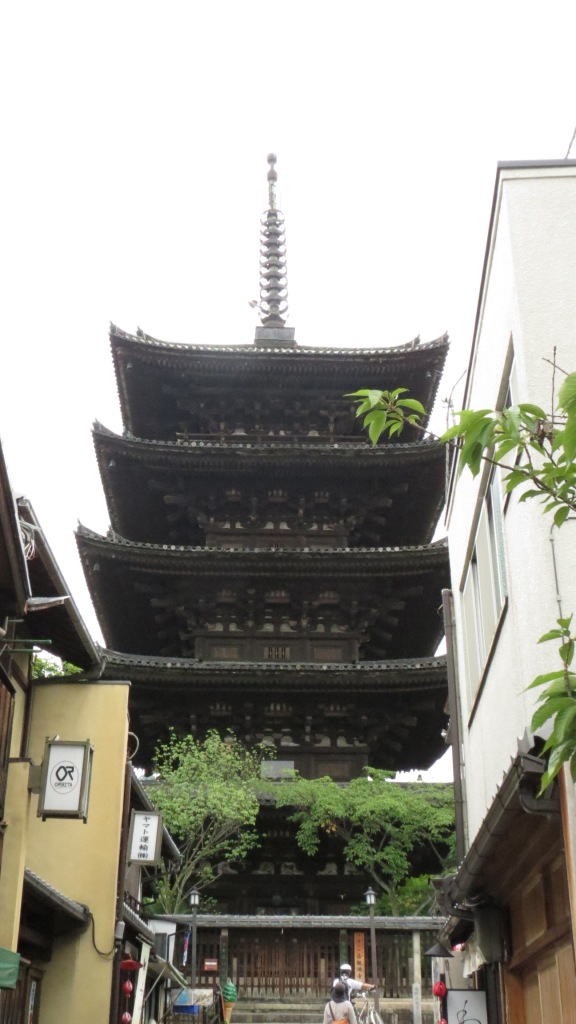
We arrive at the Yasaka Pagoda (八坂の塔), located in the Hōkanji temple (法観寺). Built in 589, it was completely destroyed in 1436. The current building is a reproduction of 1440.
Nearby is the Yasaka Kōshin-dō Temple (八坂庚申堂), a small temple dedicated to Kōshin-san, a nickname of his main object of worship, Shōmen Kongō, a blue guardian warrior, and to the “three wise monkeys”. Kōshin-san is believed to help all those who strive to live, with all their efforts to be good people. It is also thought that he punishes the bad guys. Kukurizaru is a round, ball-shaped talisman made of cloth, representing bona fide monkeys. The temple is tiny but very colorful.
From here we went to visit the Ginkaku-ji Temple (銀閣寺) or silver pavilion. To get there we take bus 100 to the Ginkakuji mae stop.
Ginkaku-ji Temple (銀閣寺) is a Zen Buddhist temple built in 1474 as a retreat for the shōgun Ashikaga Yoshimasa. It is said that the shōgun wanted to imitate the Kinkakuji (golden pavilion) temple built by his grandfather by covering it with silver sheets but could not for economic reasons but even so, the name endured. After his death in 1490 it became a Buddhist temple.
Undoubtedly the best known and most spectacular is the dry sand garden next to the Kannonden, the main building, which is very similar to the Kinkakuji temple but made of wood.
The moss garden is also spectacular, with many ponds and small bridges. If we climb to the top of the garden, we can enjoy wonderful views of the enclosure.
The ticket price is 500 yen (€3.88-$4.69).
Leaving the temple we follow the Tetsugaku no michi (哲学の道) or path of the philosopher. This road, about two kilometers long, connects the Gingakuji and Eikan-do temples and runs parallel to the Shishigatani canal. It is very popular during hanami and momiji. The day we were there, the truth is that we didn’t run into anyone, although we really only did a small part of the way.
On the way to the hotel to collect our things, we approached the Otani Hombyo Shrine (大谷本廟) which was right in front of the hotel. Built in 1272, it stands out for the immense cemetery it houses. While there, several people in executive suits approached the main room where a kind of ritual was officiated at them.
We went back for our things to return to Tokyo for the last night.
We bought some bentos to eat on the train and got on the Hikari shinkansen at 13:33. A little less than three hours later we arrived at Tokyo Central Station where we transferred to the Komachi Shinkansen to Ueno Station, a journey of only 5 minutes.
Here we have the map with the points we visited in Kyoto on those days:
We went straight to the hotel. That last night we took the Ueno Touganeya hotel, very close to the station. It was quite expensive for us since we couldn’t find anything cheaper that was decent near the shinkansen station, €91 ($110). It was, as usual, a room that could only fit the bed against the three walls, but it was very clean and well laid out. And we even had yukatas.
We left our things and went for a walk around Ueno and then we went to Akihabara to say goodbye to the Japanese night.
Last day in Japan and we had to take advantage of it. We got up early and went to post some postcards at a post office near the hotel.
From here we took the Yamanote line and went to Shidome. We go to the nearby headquarters of the television network NTV to see the Ghibli clock.
The Ghibli clock is a must-see for all fans of the world of anime from studios Ghibli. Its author is Hayao Miyazaki and it was installed in 2006. The clock is beautiful and if you can go to the show that it does several times a day you will freak out, especially at night.
From Shiodome Station we take the subway Oedo Line to Tsukijishijo Station to visit Tsukiji Market, the largest fish market in the world.
In 2016 the visit to the fish auction had been very restricted to visitors so getting in early (starts at 5.30 in the morning) for nothing, of course not.
We were walking through the narrow alleys of the outer market, full, above all, of food stalls and utensils. In 2018 it closed for good and moved to the nearby Toyosu Market although the outdoor market stalls and restaurants are still in Tsukiji.
After the walk we approach the nearby Tsukiji Hongwan-ji temple (築地本願寺).
Tsukiji Hongwan-ji Buddhist Temple (築地本願寺) is a branch temple of the Jodo Shinshu Hongwanji-ha denomination, commonly known as Nishi Hongwanji, of which the Mother Temple, or Honzan, is located in Kyoto.
Its construction dates back to the year 1617 when Junnyo Shonin established a temple in Yokoyama-cho near Asakusa in Edo. In the year 1657 a fire destroyed the temple but the feudal lord Edo Bakufu denied permission to rebuild it on the same site but he gave the land where it is currently located.
During the great Kanto earthquake of 1923 the temple was again destroyed. It was rebuilt in stone between 1931 and 1934, this time in an Indian style.
In the main hall there is a standing image of Amida Buddha signifying that the Buddha is actively at work in all of us. The golden altar is really spectacular and, in addition, there is air conditioning in the hall, so we took the opportunity to rest a bit in the cool.
After the well-deserved rest, we walked along a large avenue towards the Kabuki-za theater (歌舞伎座). Along the way we came across a small but saturated craft shop that made woodenware and we took the opportunity to buy some handmade chopsticks (which I still use) for ourselves and to give away.
The Kabuki-za Theater (歌舞伎座) was built in 1889 by Genichiro Fukuchi and is the main kabuki theater in Japan. Kabuki theater is the traditional Japanese theater dating back to the Edo Era. In 1921 it was destroyed by fire. In 1922 the reconstruction began but it could not be finished because the great earthquake of 1923 once again destroyed what had already been done. In 1924 it was rebuilt again but, again, it was destroyed during the bombings of the Second World War. In 1950 it was raised again with the same design of 1924 to be demolished once more in 2010 to be raised again as it is today in 2013 with the new anti-seismic measures. Nice story.
We return to the market area to find a place to eat good fresh sushi. Those around it seemed to us to be too touristy. Walking down an alley we saw several guys who looked like workers go through a small door. We decided to investigate. The small door opened onto some narrow and somewhat seedy stairs that led down to a small, quite simple place where there were many Japanese eating. We decided to stay. The menu was only in Japanese but it had photos so we pointed out what we thought was appetizing.
What to say about the food… I think it’s the best sushi I’ve ever eaten and even today I think it still is. And also relatively cheap, around 900 yen a plate (7€-8.45$).
By the way, it’s called Totobe and it doesn’t appear on google maps but I have it well kept in my head. If you want to get there… ask me.
We leave extremely happy and go to Tokyo Central Station to reserve seats on the Narita Express. We took advantage and ate dessert, a kind of bun filled (very filled) with cream that was brutal. In 2018 we went back looking for him, but unfortunately, he was no longer there.
We returned to Ueno where we took one last walk and went to the hotel to get our things.
At 18:33 we took the Narita Express and an hour later we got off at Terminal 1 of the airport. The flight took off for Dubai on time at 10:00 p.m., arriving in Madrid on July 29 at around 1:35 p.m.
Review of the trip
What to say about the trip. A dream come true and it does not disappoint. The people and their incredible kindness, their culture, a mixture of the traditional and the modern, the landscapes, the gastronomy… all spectacular. The only downside, the heat and humidity of summer. My partner was not convinced at all and came back totally in love and wanting to return. We will be back (we did in 2018) and not just one more time.
At 3:25 p.m. on July 12 we have the departure from Barajas. We are going to fly for the first time with the Emirates company. The aircraft is an Airbus a380, the largest commercial aircraft in the world. It is huge and is connected with two fingers. Hard to believe that such a monster can fly. The organization to access is very good.
The flight takes off on time for Dubai. The plane is quite comfortable and the two of us were alone in a row of 3 seats. More space. The entertainment on board is very, very good and the food is amazing for an airplane.
I was struck by the fact that they give you a bag with slippers, an eye mask, a toiletry kit and lip balm (we were in economy class, not 1st).
There were also a series of stickers to put on the seat in case you wanted to be woken up to eat or not.
About seven and a half hours later we landed at Dubai airport. Ahead 7.15 hours of scale. After 4 hours, the company gave us a voucher to eat something at the airport. After going through the endless airport terminal looking for something appetizing, we decided on McDonald’s, which was the one that offered the most food. I ate a falafel burger menu that was pretty bad.
For the second flight, they put us on a bus and the trip to the plane lasts about 15 minutes. We never arrived. It is a giant airport. When we got in, I couldn’t fit in the seat because it was so narrow. For almost 10 hours of flight it was going to be hell. But luckily the flight was almost empty and I was able to lie down in the 4 central seats. Marvelous.
As we always recommend, always travel with insurance. Healthcare in Japan is tremendously expensive. With IATI, you also have a 5% discount for being our reader:
At 8 in the morning the plane took off on time for Haneda airport in Tokyo. The plane had a very good entertainment service and very good food.
During the journey, the crew handed out the papers that must be filled out to hand in to immigration at the airport.
About 10:45 p.m. on July 13, we finally landed in Japan. I was very excited to find out that I was finally in one of my dream destinations. I thought that day would never come.
As soon as we got off, I was moved to enter the bathroom, with its signs in Japanese and its typical floor toilet (with quite a lot of piss around it. Lack of western aim).
We go through immigration, they stamp our passport and we continue to get our bags. We go through customs where they take a little look at the bags and we go out to the airport hall. That’s it. We are officially on Japanese land.
From the airport we took the Keikyū Airport Line for 210 yen (€1.64-$2) to the Keikyu-Kamata station, which was the closest to the hotel. We went to buy water (we didn’t know you could drink it from the tap) at a 7Eleven that was on the way and we arrived at the hotel. We chose the Chisun Inn Kamata. It is a bit far from the center of Tokyo (about 25 minutes by train) but for a city of almost 40 million inhabitants it is not bad. It cost us €76 ($92.25) per night without breakfast. Being already like 1 in the morning and after about 25 hours of travel, we went to bed.
If after so many hours of flight you prefer comfort, we recommend a transfer service. Fast, comfortable and they leave you at the door of the hotel:
*It helps us to maintain the blog
July 14th
We got up without much hurry and headed for the Keikyu-Kamata station. Nearby was a family mart with a coffee machine. The machine, of course, was all in Japanese and the boy in English… 0. We managed to get some coffees with milk that were boiling and we bought some buns. I specifically a melon pan (Recipe here). The coffee was a bit perrete and on top of that with the heat it was, it never got cold.
After having breakfast sitting on a bench, we entered the station. There was a small tourist office there where they gave us some information. As we wanted to activate the JR Passfrom the 15th, they recommended us to get a 24-hour pass for the metropolitan area for 750 yen (€5.85). We took the train to Tokyo Central Station (東京駅) and there we activated the JR Passes to be able to use them on the local trains of the Japan Rail (JR) company starting on July 15.
*It helps us to maintain the blog
To use the JR Pass you just have to go through the window at the turnstiles and show it to the operator who is there to give information. The truth is that they don’t even look at it, they see you arrive with it in your hand and they make a gesture for you to pass.
The station was designed by the architect Tatsuno Kingo following the design of the Amsterdam Station and was built between 1908 and 1914. During the Allied bombing of 1945 much of the station was damaged but it was rebuilt in 1949.
When we left, it turned out that the surroundings were under construction and could not be seen in conditions.
Tokyo Central Station (東京駅).
Following the avenue that leaves the main gate, we arrive at the gigantic park that is the grounds of the Imperial Palace (Kōkyo (皇居)). It was hot and humid and very sunny. In Spain we use the expression: “Un sol que raja las piedras” / “A sun that breaks the stones”.
There was a small police station there where you signed up to be able to enter the palace facilities. We signed up for the 1pm tour and at the appointed time got in line. Registration and admission is free. The queue was very strict two by two along a line painted on the ground. If you left, anger.
We entered and passed strict security controls (you have to show your passport) and fill out papers with all your data, very similar to the one we had to fill out to deliver to airport immigration. Right there they showed us an explanatory video about the palace.
The Tokyo Imperial Palace is the permanent residence of the Emperor of Japan. It is a large garden complex in Chiyoda. It includes buildings such as the main palace, the private residences of the imperial family, an archive, museums, and administrative offices. It was built on the same site as the old Edo Castle.
Accompanied at all times by a police officer, they led us through the facilities open to the public while giving explanations in Japanese. The visit lasted about an hour and a half and was very, very cool. It was worth it.
After the visit, it was already time for lunch. Yummy, our first authentic Japanese food. For this we returned to the central station. Beneath it, there is a kind of endless underground shopping mall. Rather one could say that below Tokyo, there is another Tokyo. We chose a ramen restaurant that was recommended on some forums in a section called Tokyo Ramen Street.
The restaurant is called Rokurinsha. It is found when going down some stairs and you will recognize it by the permanent queue. The estimated waiting time at that point in the queue is marked on the floor.
The place is very small and as soon as you enter you have a machine in Japanese (luckily with photos) in which you mark what you want, put the money in and you get a piece of paper that you give to a boy and he serves you. On the tables you have a jug of cold water that they change for you. That’s something all Japanese restaurants have, some cold water and some iced tea. The ramen was delicious. If you want, they give you a paper bib so you don’t get dirty.
With a full stomach, we took a walk through the little shops of the shopping center freaking out for a while with how geeks they can be.
After freaking out, we walked to the Nihonbashi Bridge (日本橋), which literally means Japanese bridge. The first bridge was built in 1603 and was made of wood. The bridge has been destroyed by earthquakes and wars on several occasions. The current one dates from 1911. The bridge is beautiful, although the bad thing is that today it has been left under an elevated highway and it is not in good condition.
We walked back to the central station. There we took the Yamanote Line to Hamamatsuchō Station. From there we went for a night walk towards the Tokyo Tower (東京タワ).
Built between 1957 and 1958, it was originally designed for television transmission, although radio antennas were installed in 1961, so the tower is currently used for both types of signals.
It is one of the main tourist attractions in Tokyo. The tower has two observation platforms. The 150-meter-high Main Deck and the 250-meter-high Upper Deck offer an overview of Tokyo. At the base there are shops and also the Tokyo One Piece tower, a permanent theme park dedicated to the One Piece manga. Admission is 1,200 yen (€9.37) for the Main Deck and 2,800 yen (€21.85) for the two observation decks. We went back to the station where we took the train to JR Kamata station. On the way to the hotel we bought some food at a 7eleven that they warmed up for us right there and we went to the hotel to rest.
July 15th
Today if we get up early to make the most of the day. This morning it’s time to visit Shibuya.
We stopped by 7eleven on our way to the station to get some breakfast. Today we bought a bottle of cold packaged coffee that is in the fridges that was much better than the previous day.
If you want to enjoy the day in peace and you don’t have much time, you can get the tourist bus pass to use it throughout the day and visit the most important tourist spots in the city.
*It helps us to maintain the blog
We take the Keihin-Tōhoku Line to Shinagawa Station and there we transfer to the Yamanote Line to Shibuya Station. Being on the train, we read on the screens that gave information about the stops and the line was reporting the delays of some lines and the reason, it is disturbing to see that most are due to earthquakes…
We go out through the main entrance and hit the statue of Hachiko. Hachiko was a dog who became famous because every day he accompanied his owner to the train station when he went to work, but one day he died and did not return, so the dog was waiting for his return for several years until his death. We stand in line and take the required photo.
Something that surprised me a lot and that we would also see later are smoking areas. In Japan it is forbidden to smoke in the street, so in some places there are places that are usually a screen and everyone is smoking like crazy inside.
Opposite is the famous Shibuya crossing, surrounded by buildings full of screens and neon. You could say it’s magical. The truth is that he thought it was going to be bigger but what there are are billions of people crossing at the same time when the traffic light turns green.
On more than one occasion we could see people riding karts through the streets of Shibuya dressed as characters from the Mario Kart video game. The world is full of geeks.
From here we wanted to go to Takeshita Dori but since we didn’t really know how, from the station lobby we connected to the Wi-Fi. While we are consulting the mobile and the information girl appears running (literally) to see if we needed anything. How helpful are the Japanese! Finally we just had to take the Yamanote line again to Harajuku station.
There we got off and the universal deluge was falling from the sky so we waited at the entrance. While we were talking, the (Japanese) boy next to us asked us in Spanish if we were Spanish. It turns out that the boy lived for several years in Granada (the city where we live) and married a woman from Malaga. Of course he had a Granada accent that couldn’t handle him.
When the rain subsided, we left before Takeshita dori to visit Yoyogi Park, in case it rained again and it was too late for us.
Yoyogi Park (代々木公園) is one of the largest parks in Tokyo. The park bustles with activity especially on Sundays when it is used as a meeting place for people who want to play music, practice martial arts and other activities. Famous are the concentrations of rockabillys. They are crazy.
The park is gigantic and inside it is the Meiji Shrine (明治神宮).
Meiji Shrine (明治神宮) is a Shinto shrine dedicated to the deified spirits of Emperor Meiji and his wife, Empress Shōken.
After the emperor’s death in 1912, the Diet (the Diet is the government) of Japan passed a resolution that wanted to commemorate his role in the Meiji Restoration. Its construction began in 1915 and ended in 1920 with its consecration.
During the bombing of World War II it was destroyed but was rebuilt in 1958.
Between the rain and the fact that part of the sanctuary was under construction, the visit was a bit difficult.
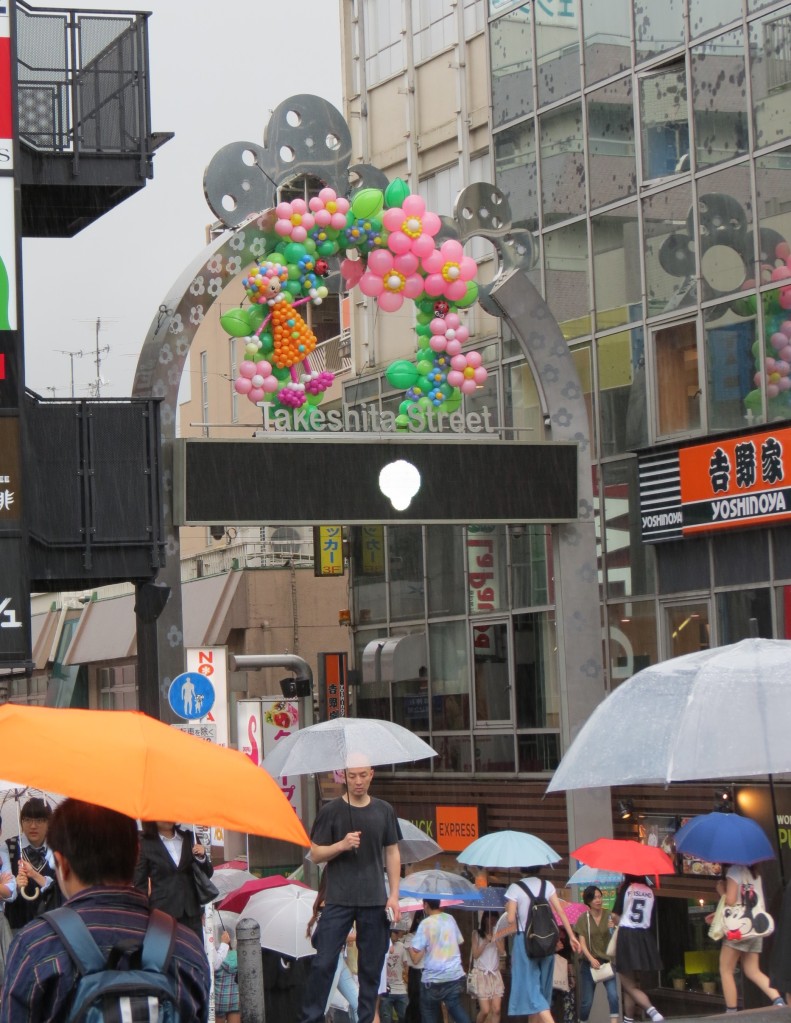
Now that there is no rain, we return to Takeshita. This is the quintessential geek street in Tokyo. Here are the shops where young Tokyoites buy their quirky clothes like dolls and stuff. I don’t know if it was because of the day we were there, but we saw little character despite the fact that the street was full of people.
We walked the entire street and when we reached the end, we took the opportunity to approach the Togo Sanctuary.
Tōgō Shrine (東郷神社) is a Shinto shrine built in 1940 dedicated to Gensui Marquis Tōgō Heihachirō shortly after his death. It was destroyed during the bombing of Tokyo but rebuilt in 1964.
We entered through its beautiful gardens and went up to the main pavilions. It is hard to believe that this haven of peace is located next to such bustling areas as Takeshita or Omotesandō.
It was time to eat, so we came across a Coco Curry House on the way to the metropolitan building and there we went to eat a Japanese curry that cost us 753 yen (€5.88) each.
After lunch we went to the Metropolitan Government Building, a modern and gigantic building inaugurated in 1991, from where all districts of the Tokyo metropolitan area are governed.
In one of the towers there is a viewpoint 200 meters high that is completely free. You just have to pass a fairly strict security check and up.
The views are 360º and in each window you have a panel with the most significant buildings marked. It is said that on clear days you can see as far as Mount Fuji, but we have not had any luck yet.
It is best to go up near sunset to see the views during the day and see how the lights of the city are getting darker and turning on.
It was shocking to me that, wherever you look, you only see the city as far as the horizon. Tokyo is endless.
On the lookout floor, apart from air conditioning, there are vending machines (of course), a souvenir shop and even a restaurant. Good place to take a break.
When we got off we went to Kabukichō (歌舞伎町). Known as Tokyo’s red light district, thousands of adult entertainment venues are found here.
Very close to Shinjuku station we find Golden Gai, a narrow alley with many izakayas; bars to drink and snack.
The Kabukichō area has many bars, hostels, motels, shops, restaurants, and nightclubs for both women and men. It’s full of very clumsy public relations although they didn’t say anything to us, I don’t know if it was because we went as a couple. The truth is that it is a pretty cool walk to enjoy the millions of illuminated signs and its great hustle and bustle any night of the week. The karaokes of various floors that are seen are also impressive. They are very geeky.
It is said that the neighborhood is controlled by the Yakuza, the Japanese mafia and that is why it is not supposed to be very safe, but we did not notice anything.
After the walk around Kabukichō, we went to the hotel to rest. Like the night before, we bought some prepared food at 7eleven and went to sleep.
July 16th
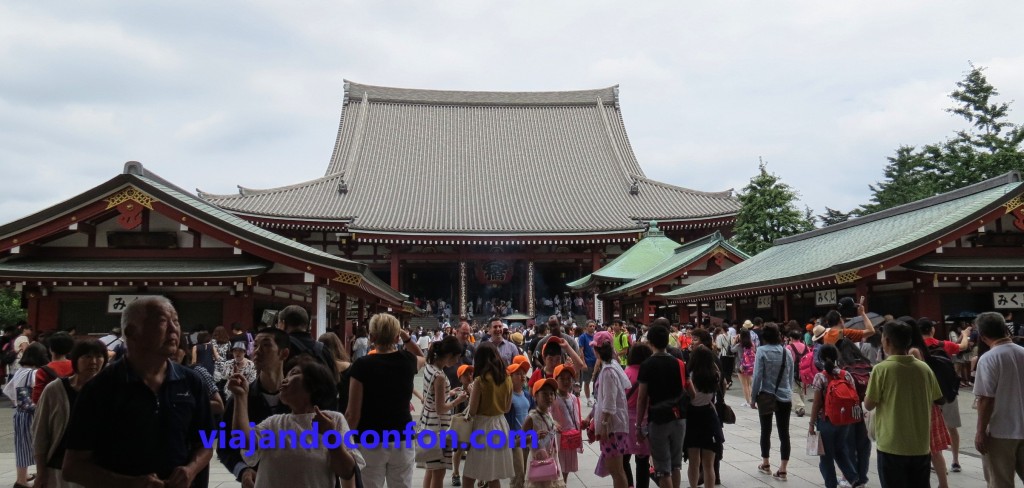
Today we get up early again and go to Asakusa to visit the Sensō-ji Temple (浅草寺). It is the oldest Buddhist temple in Tokyo and one of the most important. Founded in the year 645 and is dedicated to Kannon, the deity of mercy.
Since Senso-ji can’t be easily reached by JR, that day we decided to get a one-day subway pass that cost us 600 yen (€4.68).
We left the subway and immediately found the Kaminarimon Gate (雷門) or Thunder Gate, the outer gate of the temple and a symbol of Tokyo.
Crossing the gate we will find Nakamise Street (仲見世通り), a long street full of shops selling souvenirs and sweets. I was up to the flag no, the following.
At the end of the street, the Hozomon gate (宝蔵門), the main gate of the temple, awaits us.
Passing the gate on the left hand side is a five-storied pagoda. The original was built in the 10th century but was destroyed several times, the last time during the bombings of the second world war, so the current one is quite recent. Still, it impresses.
On the esplanade between Hozomon Gate (宝蔵門) and the main temple there are several temple shops selling amulets, incense sticks and the like.
Very close to the access stairs is the temizu-ya, the area where incense sticks are burned.
There we did as the natives and went to the main hall or Hondo (本堂). It is also known as Kannon-do (観音堂) as the Kannon statue found by fishermen 1,400 years ago and which led to the construction of the temple is supposed to be buried here.
The interior of the hall is truly spectacular. We queued up to make our offering and went to the side. There is a place where you put a 100 yen coin in a piggy bank and take out a stick with a number (in Japanese), look for a drawer with the number of your stick (very complicated if a Japanese does not help you) and take a piece of paper the fortune within. Luckily, on the back it is in English. If you get bad luck, as was my case, you have to leave it tied in some places enabled for it so that the bad luck goes away. Two years later we would return to the temple and this time it would be “the best of fortunes”, so I keep that one with me.
After the Hondo we took a walk through the enormous enclosure admiring the small temples and sculptures. In the back there was like a panel to take photos of the anime of commissioner KochiKame and that’s where I took a photo. There was a local who insisted on taking a photo with me… making friends.
On one side they had set up food stalls so we sat down to rest in the shade while I ate a crab yakitori that was sublime.
We continue walking through the compound and come out on the side to a shōtengai with more little gift shops.
Shōtengai are roofed shopping streets with small shops and restaurants that are found throughout Japan.
We took a short walk around the neighborhood and went to the pier very close to the Kaminarimon gate from where several boats depart that cross the Sumida River towards Tokyo Bay. From the pier we can see the Tokyo Skytree and the Asahi brewery and its golden shit.
Asahi Beer Hall
The Tokyo Skytree (東京 スカイ ツリ) is the main telecommunications tower that replaced the Tokyo Tower. Built between 2008 and 2012, it is the tallest building in Tokyo at 634 meters. The tower has two viewpoints. I particularly have not climbed yet because I am very afraid of heights and pay almost €30 to not dare to go near the glass….
At the pier we hired the cruise that goes from Asakusa to Hamarikyu for 780 yen (6€). We bought the ticket on the cheap boat. The expensive one is in a super modern one that costs 1,000 yen (€7.81) for the same route. The trip lasts about 35 minutes and along the way you see the deep Tokyo, the one that does not appear in the guides. It’s very good.
We arrive at the port and go for a walk to the Hamamatsuchō station. Next stop: Hie Jinja Shrine (日枝神社). To get there we take the Yamanote line to Shimbashi station.
Since it was lunchtime we decided to look for something there.
We made one of the great gastronomic discoveries of the trip and that would serve us for 2018: Karayama Shinbashi, a small Japanese fried chicken place.
Next to the door you have your machine to make the choice and you give the piece of paper to the guy who attends. It is so small that it only has a bar. The chicken was delicious and very cheap and they put it on a menu with a miso soup, a bowl of rice and shredded cabbage.
After lunch we took the Ginza subway line to Tameike-sannō station to go to the Shrine.
Hie Jinja Shrine (日枝神社) is a Shinto shrine dedicated to the deity Oyamakui no Kami. The origin of the temple is uncertain. One of the theories is that it was in 1478 by Ōta Dōkan. Another theory identifies the Hie with the Sannō Shrine mentioned in a 1362 record of the Kumano Nachi Taisha. What is known is that the shōgun Ieyasu relocated it to the grounds of the old Edo castle. In 1604 his son Tokugawa Hidetada moved it to the outskirts of the castle so that the people could access it.
We arrive at the west gate where there is a large stone Torii. Going through it, we reach some spectacular and narrow stairs inside a tunnel of red torii. It is spectacular.
At the bottom of the stairs we find two temples: the Massha shrine and the Obunko shrine. In front of them we find the entrance to the main esplanade. There is the Hall of Prayers and around the esplanade some shops with amulets and souvenirs for the maintenance of the temple.
We approach the hall and make a small offering.
On one side there is another door that leads to the temple office building and a kind of exhibition hall where they were exhibiting a kind of “wedding exhibition”.
Something happened here that we will never forget. We sat down on a stone wall under a tree to rest a bit. After the break we headed back to the torii steps we had climbed up. Before going down I think: from here there is a good photo. I’m going to take the camera and… oh no! I left it on the wall! We ran out and when we got there it was gone. Go head. We went into the office to ask. The security guard calls one of the monks who spoke English. He doesn’t know anything, he looks in lost objects and nothing either. We asked the girl from the expobodas and neither. We sat down to complain about my bad head and in this the girl from the expobodas comes out with the camera in her hand, that if someone found her and left her at the reception but she didn’t know. My bows were so great that I think she could have kissed her feet. Gozaimasu Arigato!!!
Calmer now, we leave the sanctuary and return to the subway. There we took the Chiyoda subway line to Nezu station.
It was time to visit the Nezu Shinto Shrine (根津神社). According to legend, the shrine was founded in Sendagi, north of the present location, in the 1st century by Yamato Takeru (also known as Prince Ōsu), the son of Emperor Keikō.
The main deity of the shrine was Susanoo-no-Mikoto, the kami of the sea and storms. In 1705 the shrine was relocated to Nezu by the shōgun Tokugawa Tsunayoshi.
The sanctuary was already closed but luckily the enclosure was open to walk through it. The gardens are beautiful and it was also very quiet, we were the only ones there.
But there was something that we had not realized, mosquitoes. They attacked us, although curiously only with their legs. They left us like colanders.
When we left the sanctuary we went to a pharmacy for something to soothe the bites. The most curious thing about Japanese pharmacies is to enter and next to the door see refrigerators with soft drinks. Based on signs we managed to make ourselves understood and we bought a little liquid that came in handy.
To finish making the subway pass profitable, we went back to Senso-ji to see what it looked like at night. There was atmosphere but it certainly wasn’t the morning crowd. He walked very well. It was worth it.
From here we went to the neighborhood. Next to the Kamata station there is a revolving belt sushi restaurant. First contact with Japanese sushi. I suppose that being one of the “cheap” ones it will not be one of the best, but the truth is that it was spectacular. By far the best suhi I have ever eaten.
In many sushi strip restaurants in Japan you have tablets at the table where you can order specific pieces, which are sent on a little train to your table.
After dinner, to bed to rest.
July 17th
New day in Tokyo lands. Like every day, a cold coffee and some pastries at the 7eleven on the way to Kamata station.
After a transfer and a forty-minute ride, we arrived at Iidabashi Station. From there we approach the Tokyo Daijingu Shrine (東京大神宮). An unspectacular sanctuary where people go to pray for luck in love. The good thing is that being there we coincided with a traditional wedding and that was spectacular. The bride’s dress was amazing.
From here we went for a walk to the Koishikawa Korakuen Gardens (小石川後楽園) which, for me, is one of the essential visits in Tokyo. Built at the beginning of the Edo period, in the year 1629 the founder of the Mito Tokugawa family, Yoritou.
The gardens are truly spectacular. It is said in the forums that the best time is in the fall, so at that time it has to be amazing.
Noteworthy is the Engetsu Bridge (円月橋) or Moon Bridge, which Ishibashi is said to have designed by the Mitsukuni Confucian scholar Zhu Sunsui. This name is given because it looks like a full moon when combined with the reflection on the surface of the water. The bridge was originally designed to allow pedestrians to pass over it while the barge is operating on the canal.
The gardens are huge and take a long time to walk through. Admission is 300 yen (€2.34).
From here we went to the Tokyo Dome, where the Yomiuri Giants baseball games are held. It was game day and the staff were entering the stadium. I had never seen people enter a stadium in such an orderly and calm manner. live to see A little tour of the official team store and we left buzzing that there was no time to lose.
From Suidōbashi station we took the train to Ueno Park (transferring in Akihabara).
Ueno Park (上野公園) is a large park northeast of Tokyo, very popular, donated by Emperor Taisho to the city of Tokyo in 1924 and in it we can find many tourist attractions such as the zoo with its panda bears, museums and temples. .
Despite the heat, we went for a walk in the park. Walking we arrived at the Kiyomizu Kannon-dō temple (清水観音堂), a small temple dedicated to Kannon.
A little further down, at the Shinobazu Pond or Shinobazu-ike (不忍池), we find the Benten-dō Temple (弁天堂) temple. Bentendo Hall is an octagonal hall dedicated to the deity Benten, goddess of wealth, fortune, music and knowledge. In the pond you can rent pedal boats in the shape of very horny swans.
We took a short break sitting at tables overlooking the lotus pond in the shade before continuing our walk.
After the break we went up to the Yanaka Cemetery Park (谷中霊園). It is considered one of the most beautiful cemeteries in Tokyo. In it you will find the tombs of famous people such as Tokugawa Yoshinobu, the last shogun of the Edo period or famous painters, politicians and actors.
We crossed the cemetery taking a nice walk to Nippori station. There we took the train to Akihabara (秋葉原). Known as the electronic district, it is one of the most well-known neighborhoods in Tokyo. It is also known for being one of the main neighborhoods for otakus.
Here you will find many electronic stores, both small and large, many geek stores, arcades and even one of the largest sex shops in the world with seven floors.
We were walking around the neighborhood a bit going into geek stores looking for Saint Seiya figures to bring me. They only had second-hand and very expensive. Some of the ones I have sold for 20,000 yen (€156-$190). Next time I bring them and it cost me the trip. I don’t appreciate them that much.
After being amazed by the prices, we went into some mandarake and then into some arcades.
Arcades are a joke. On the ground floor they have millions of those machines that are a hook and you have to hook a gift. You saw them all motivated there playing with that.
Another floor was full of purikura machines, which are like photo booths where you can retouch photos. There was even a section for women that men were not allowed to enter.
But what surprised us the most was on the floors where there were skill machines. The Japanese are real pros. You were stunned. Then I read that it seems that they practice at home and then go to the arcade to leave the records. live to see
Since it was getting late, we had dinner at a Yoshinoya, which is a chain of gyūdon, which is a bowl of rice with stewed meat cut into very thin strips. It is very cheap and very good. After dinner we got on the train and went to rest.
Today we return to Ueno Park (上野公園). We take the Keihin-Tōhoku line from Kamata station, which goes directly to Ueno station.
The first stop is the small pagoda where the Great Buddha of Ueno (上野大仏), a gigantic sitting Buddha statue from 1631, once stood. During the Great Kanto Earthquake of 1923, its head fell off. It is preserved next to the pagoda.
Nearby is the Ueno Tōshō-gū Shrine (上野東照宮). Built in 1627 by Tōdō Takatora, it has been preserved almost intact since Tokugawa Iemitsu’s renovation in 1651. Tōshō-gū shrines are characterized by enshrining Tokugawa Ieyasu under the name of Tōshō Daigongen.
We walk along a long corridor flanked by a multitude of lampposts until we reach the karamon gate (唐門) and behind it the Hondo. Mostly gold with very colorful carved dragons and animals, the hall is a real beauty.
karamon gate (唐門)
Adjacent to the shrine is the five-storied pagoda of the ancient Kyū Kaneiji Gojūnotō Temple (旧寛永寺五重塔), built in 1639 and a survivor of the temple’s destruction.
After visiting the sanctuary, we sat down to rest a bit in the shade. In this, a couple of very young boys approach us and ask us in English if they can do a survey for us. Of course. The first question is: do you like Disney movies? We both answered no at the same time. They look at each other, laugh and tell us that they can’t continue because the next one is which one was our favorite. Nice to meet you.
We left the park and headed to the Ameyoko Street Market (アメ横). It is very popular with tourists. The truth is that it didn’t seem like much to us, apart from some stores with a more traditional air, the rest are brand name clothing stores of dubious origin, kebabs and similar businesses.
We went back to the station and took the Yamanote line to Shibuya station. A chalao dressed as pikachu by the way got on the train… Japan…
We were walking in conditions through the commercial area. I bought some frikada in a mandarake and we went to eat. We ate at a Gusto Cafe. It is a chain of family restaurants that are all over Japan. It’s not the cheapest, but paying 200 yen (€1.56) gets you an open bar of non-alcoholic drinks. With the level of dehydration that we carried in the body with that humid heat, it seemed like a good idea.
Some people at Shibuya crossing.
With a full belly, we headed for the station to go to Odaiba.
Across the intersection, at the entrance to Shibuya Station, some kind of political rally was taking place. There were a lot of people. What amazed us is that, in order to get to the entrance of the station, there was a corridor between the crowd and what was there as a fence was a rope that the attendees held in their hands. Japan is another planet.
To get to Odaiba we got on the Yamanote line again to Shimbashi station. There we had to go to Shiodome station, but they are next to each other. There we take the private line Yorikamome. Each ticket cost us 325 yen (€2.54).
The trains on this line are automatic and since they don’t have a cabin, if you take the front you have all the glass to yourself to admire the scenery. The train takes about 15 minutes to reach Daiba station.
Odaiba (お台場) is an artificial island in Tokyo Bay connected to the city center through the Rainbow Bridge. It was built in 1853 to defend the city and at the end of the 20th century it was expanded due to its commercial development.
Now it is for the most part a place dedicated to leisure. There are two beaches where bathing is not allowed but the Japanese are going to spend the day. There are several shopping centers, each bigger and even a replica of the statue of liberty.
The building of the Fuji TV television channel is also located here, where there is a viewpoint from which to enjoy good views.
Another of the stars of Odaiba is to contemplate the Rainbow Bridge as night falls and lights up with the colors of the rainbow. We spent an hour and a half there and we left as it was already dark and nothing at all.
From here we went to the Divercity shopping center. At the entrance there is a giant Gundam that puts on a show at certain times of the day. For freaks like me, it’s amazing.
Then we walked around the mall but the stores were already closed. What surprised me is the way they have to close the stores. Here I put an example in photo:
The quality of the photo is a bit pitiful but there it is. No doors or anything. Here they would be taken to the net.
Upon reaching the entrance, to freak out even more, you could ask a robot in the shape of a talking girl for information. It was very scary.
After Divercity we went back to see if the bridge was already lit and nothing. So we went back to the station and for another 325 yen a head, we went back to Tokyo. Something to have dinner at the 7eleven on the way to the hotel, and to sleep.
Here you can see a map with the places we visited in Tokyo:
July 19th
Today we get up very early because it’s time for an excursion: Kamakura (鎌倉). Kamakura is a city in Kanagawa Prefecture about an hour from Tokyo and is known for its many temples, shrines and, above all, its great Buddha. From the year 1185 to 1333 it was the main city of Kantō, chosen as a base by the shōgun Minamoto Yoritomo.
To get there, we took the Keihin-Tōhoku line from Kamata station to Yokohama station where we changed to the Yokosuka line to Kamakura station. We were unaware of its existence at the time, but in Kamakura we recommend taking the Enoden train (it does not enter the JR Pass) because walking to the Big Buddha is 2 kilometers, which we did on foot.
From the station we walked towards the Kōtoku-in (高徳院) Buddhist temple. The path is very cool between single-family Japanese-style houses but it was a bit disturbing for us to find every certain distance signs of an escape route in case of a tsunami.
After 20 minutes of walking, we arrived at the temple grounds, from the side or back, so we began to walk along the wall looking for the entrance. We finally found it. A large wooden door with huge signs in Japanese. We entered some gardens where there was a gardener working quietly. We walked for a bit and suddenly we came across the Big Buddha. How strange, he had read that there was an entrance fee… When we left the premises we realized that we had sneaked in through a back door. 200 yen we saved per peson.
The Great Buddha of Kamakura, also known as Kamakura Daibutsu (高徳院), is a gigantic image of Amitabha Buddha (Amida-butsu) over 11 meters high and weighing 121 tons. Its construction is believed to have begun in 1252 with donations collected by the priest Joko.
The building it was housed in was destroyed by a series of typhoons and an earthquake in the 14th and 15th centuries. During the Edo period, the Great Buddha was repaired by deciding to leave it outside instead of putting it inside a temple.
You can access the interior of the Big Buddha by paying 20 yen (€0.16) but the truth is that it did not appeal to us too much.
Since we had sneaked in, we decided to make an offering to the Buddha and buy some souvenirs and a lucky charm. I don’t know if it’s because of the amulet, but since then I’ve had a couple of very lucky years. Just in case, I revere him.
We walked out the main gate like gentlemen and headed to the nearby Hase-dera temple (長谷寺), about a 5-minute walk away. This is another of the essential temples. Legend has it that it was built during the Tenpyō era (729-749).
Admission costs 400 yen (€3.14) and as soon as you walk down the street, you can see that it’s going to be spectacular. The enclosure is an immense garden that extends towards the top of the mountain. By that I mean there are quite a few stairs to climb.
We were really shocked by the number of Jizo statues up the first few flights of stairs. Jizo statues are small figurines that are placed in temples by parents who have lost their newborn or unborn children. I was very moved by the offerings in the form of toys that were on the small altar that is next to the pond. They can seem very nice until you discover what their sad meaning is.
We continue climbing and arrive at the main complex, which is spectacular. Next to the stairs there was a stone statue of a tiny Buddha with whom, given my physical resemblance to him, I took a picture. At that moment a local was passing by who was examining the scene and the fucker began to laugh. Luckily I don’t look so much anymore…
The main resort area is amazing, there’s even a small bamboo forest. There is also a small terrace with tables and benches and, of course, drinks machines, where we rested a bit.
After the break we continue climbing a little more and reach the top from where spectacular views of the coast can be seen.
We go back down to continue visiting the site. After a pleasant walk down to the lower part again, we arrive at the Benten Cave (弁天窟), a cave with narrow corridors with various figures carved into the rock, including that of the goddess of Indian origin Benzaiten, the patron saint of the music and the fine arts who, moreover, is the only woman among the gods of fortune.
The deeper you got into the cave, the lower the temperature. It was a good…
Here you can see the map of the points we visited in Kamakura:
After the visit to the temple, we went back to the station to go back to Tokyo to eat, which had gotten late.
Taking advantage of the fact that we were in a large station, we went to the JR office to reserve a seat on the shinkansen for the 21st to Kyoto, in case we stayed out. Then we went to Shinjuku station to visit the area.
For lunch, we ate a good ramen with a Japanese fried chicken dish that was on the menu at a place called Hidakaya ramen. It was very cheap for us: 600 yen for the menu (€4.71).
Since it was early, we went to Nakano Broadway. This is a shopping center that is the mecca of manga and anime… freakland to understand us. There were quite a few comic book shops and things like that but we got the impression that it was a run-down place as many of the shops were closed. Closed and abandoned. Of course, there was a small room with arcade machines where there was a group of 10 or 12 kids around a street fighter style fighting game machine who were all crazy. We assume they were doing some kind of tournament.
July 20th
Today it’s time to get up a little earlier. We’re going on a trip to Nikkō. But before we got up, at 7:25 in the morning, we woke up with the building hula hooping. An impressive earthquake. I had never experienced something like this in my life.
If you want comfort, you can hire a wonderful tour in Civitatis:
*It helps us to maintain the blog
To get to Nikko we took the Keihin-Tōhoku line to Tokyo Central Station and there we changed to the Shinkansen Nasuno.
Being on the platform, the doors open and the crew comes out bowing to all of us who were waiting to get on.
Another thing that struck us about the shinkansen is that every time the conductor entered the car he bowed and when he reached the end, he turned around and bowed again. live to see By the way, what is said in networks that when a train is delayed in Japan an employee passes by asking for forgiveness from each and every one of the passengers is a myth. What if they apologize for the public address.
About 50 minutes later we arrive at Utsunomiya Station and there we transfer to the Nikkō Line to the final station in Nikkō itself about 45 minutes later. In total, the journey took us about two and a half hours.
Nikkō (日光) is a small city in the mountains of Tochigi Prefecture. It is famous for its complex of temples and sanctuaries in the middle of a spectacular forest, which make the town a highly visited religious and tourist center.
At the station gate we took a bus that leaves us next to the Nikkozan Rinnoji temple (輪王寺), which unfortunately was under restoration and was completely covered.
We begin to climb the slope that leads to the Tōshōgū Shrine (東照宮). The slope is already beautiful among huge trees.
At the bottom of the slope we come to the stone Torii built in 1621 that marks the entrance to Tōshōgū Shrine. Just after crossing is a spectacular five-story wooden pagoda.
Next to it were the lockers to buy tickets. The price is 1,300 yen (€10.20).
Tōshōgū Shrine (東照宮) is dedicated to Tokugawa Ieyasu, the first Tokugawa shōgun, and his mausoleum is located here.
After buying the ticket, we pass through the main gate of the temple. The entrance overlooks an esplanade where the warehouses and stables are located. In it are the carvings of the three monkeys that neither speak nor see nor hear evil. Very famous image.
Directly opposite is a beautiful building with two impressive carvings of elephants, which were curiously made by an artist who had never seen an elephant in his life.
A little further on is the Yomeimon gate, decorated with more than 500 carved motifs, but unfortunately it was also completely covered by restoration.
Past the gate we come to the Karamon gate, which you can’t enter but you can go through on one side. Behind it are the prayer hall and the Hondo. You have to take off your shoes to enter and photos are prohibited.
On one side we find the Sakashitamon gate and behind them some spectacular stairs that go inside the impressive forest. Spectacular until you realize that you go up, up, up and never seem to end. But they have it.
At the bottom of the stairs is Ieyasu Tokugawa’s mausoleum. There was a kind of picnic area (with its drinks machine) where we sat down to catch our breath before touring the mausoleum.
We go back down the million steps and go to the mausoleum of Iemitsu Tokugawa, the third shōgun of the Tokugawa clan and grandson of Ieyasu. On the way we passed the Jogyodo temple (常行堂), a small Buddhist temple of the Shingon sect built in 848 by Jikaku Daishi Enjin and consecrated to the goddess Amida-Nyorai.
A little further on is the Nio-mon gate, the entrance to the Taiyuinbyo (大猷院廟) compound, the mausoleum of Iemitsu Tokugawa. Crossing the door we enter a large esplanade where the Omizu-ya is located, the fountain where ablutions are performed with precious ornamentation.
Omizu-ya.
On one side is the Niten-mon gate, which was also completely covered by restoration, although it is said that it is a real blast. And from here, another million steps start, which we begin to climb, already quite tired and still without eating, being almost 4 in the afternoon. The good thing is that we were the only ones there. Enjoying the venue with the peace of mind of being alone is priceless.
Luckily it was worth the effort. Almost at the top we find some spectacular drum and bell towers and, behind them, the Yasha-mon gate. In it we can see the 4 Buddhist guardian deities. Is beautiful.
Behind this door, we find another door, the Kara-mon, the golden and most spectacular door of all. Behind it is the impressive prayer hall and the main hall. The prayer room is open to the public but unfortunately you can’t take photos because it’s amazing. You can get an idea on their website: https://www.rinnoji.or.jp/temple/taiyuuin/.
If we turn it around and go up another flight of stairs, we find Koka-mon gate. Behind her is the temple that houses the tomb of Iemitsu Tokugawa but cannot be visited.
Almost at closing time we began the descent towards the town in search of something to eat, something complicated due to the time it was. But when we hit the main road we ran into a Lawson. We bought something and ate it on a bench at the door.
With a calm stomach, we walked towards the train station. On the way we come across the Shinkyo Bridge (神橋), built in 1636 and considered one of the most beautiful bridges in all of Japan. Today you can cross it by paying 500 yen (€3.92), but I would almost say that it is more beautiful to contemplate from the front.
Shinkyo Bridge (神橋).
From here we went for a pleasant walk through the town to the train station. The truth is that it is a charming town.
We took the 18:15 Nikko Line train to Utsunomiya, which is the gyoza capital of the world. It has thousands of gyoza restaurants and on the outskirts of the station they even have a statue.
40 minutes later we arrived at Utsunomiya, we went to the entrance of the station and the universal deluge was falling there. We book a place near the door and there we go running giving ourselves a good “shower”. We ordered several dishes that brought 6 gyozas without really knowing what they were but they were all brutal. Well, wing, we were already having a snack.
At 7:59 p.m. we took the Yamamabiko shinkansen on time. About 50 minutes later we were at Tokyo Central Station and then transfer to Kamata. There we went back to dinner sushi in the restaurant of tape and to sleep.
Discover the best activities and tours at the best price in Japan with Civitatis:
In this post we will describe the free viewpoints that we have visited in Tokyo. We only rely on our experience.
First of all, we recommend travel insurance. IATI are specialists in travel insurance and, for being our reader, you will have a 5% discount.
*It helps us to maintain the blog
Carrot Tower (キャロットタワー)
The Carrot Tower is a 26 floors commercial building in the Setagaya neighborhood. It is directly connected to Sangenchaya station, from which one of the two electric tram lines still in operation in Tokyo starts: the Setagaya line.
The building contains offices, shops and even a theater. On the 25th floor there is a free observation deck with 360º views and the Sky Carrot, a restaurant with views.
It’s worth stopping by and admiring the views on the way to the tram line.
Adress: 4 Chome-1-1 Taishido, Setagaya City, Tokyo 154-0004.
How to get: We can easily get there from Shibuya with the private line Tōkyū Den-en-toshi. The price of the ticket is ¥160 (€1.30) and the JR Pass is not valid.
*It helps us to maintain the blog
Metropolitan Government Building (東京都庁)
Opened in 1991, it was the tallest building in Tokyo with its 243 meters high and 48 floors, until 2006 when it was superseded by the Midtown Tower.
It is located in the Shinjuku neighborhood, very close to the station of the same name. It has two towers in which there is (in both) a viewpoint 202 meters high from which we can enjoy wonderful views of practically the entire Tokyo metropolitan area. It is said that, on clear days, Mount Fuji can be seen, but we have not been able to see it any of the times we have climbed it.
Tokyo Tower.
Tokyo Skytree.
We recommend going up before sunset. The sunset is spectacular when it begins to get dark while the millions of lights of the city come on.
Of the two trips we have made to Japan, only the north tower observatory has been open. In it there is a small restaurant and a gift shop. oh! and also drink machines (of course).
To go up, you have to pass a strict security check at the entrance.
Adress: 2 Chome-8-1 Nishishinjuku, Shinjuku City, Tokyo 163-8001.
How to get: About a 10-minute walk from Shinjuku Station (by Chuo-Dori Avenue exit).
We can also get there from the Tochomai station of the Toei subway, which is located next to the building.
Shibuya Hikarie (渋谷ヒカリエ)
It is a commercial building 183 meters high and 43 floors, opened in 2012.
It has approximately 200 stores and boutiques spread over 8 floors (from -3 to 5). It also has 26 restaurants and cafes on the 6th and 7th floors, an art gallery on the 8th floor.
And, between floors 11 and 16, is the Tokyo Theater Orb, a theater with capacity for almost 2,000 spectators. On the 11th floor, we find a large window in a corner from which we can see (somewhat removed) the Shibuya crossing and its hive of people. It is worth approaching.
Adress: 2 Chome-21-1 Shibuya, Shibuya City, Tokyo 150-8510.
How to get: About a 5 minute walk from Shibuya crossing.
Find a multitude of activities and tours in Tokyo on the Civitatis website:
*It helps us to maintain the blog
And you, have you visited any of these viewpoints or any other that we have not visited? Leave us your comment or experience to learn a little more.
Ứng Lăng Khải Định es la tumba-mausoleo del emperador Khải Định el duodécimo rey de la dinastía Nguyen (1885-1925). Se encuentra en la ladera suroeste de la montaña Châu Chữ. Esta fue renombrada por el rey como Ứng Sơn, al sur de la ciudad de Huế.
Recuerda que puedes encontrar diferentes excursiones en Civitatis en el siguiente enlace:
*Nos ayuda a mantener el blog
Emperador Khải Định
El emperador Khải Định, cuyo nombre de nacimiento era Nguyễn Phúc Bửu Đảo, reinó desde 1916 hasta 1925. Fue honrado póstumamente como Hoằng Tông.
Era el hijo mayor del emperador Đồng Khánh y de Dương Thị Thục. Tras la muerte de su padre en 1889, siendo aún demasiado joven para reinar, Thành Thái fue quien asumió el trono.
Thành Thái se vio obligado a abdicar en 1907 por estar en contra de los franceses. Fue sucedido por su hijo Duy Tân. Este fue arrestado en 1916 y enviado a cumplir condena a la isla de Reunión junto a su padre. Para entonces, Khải Định, con 31 años, asumió el trono.
A este se le consideró un rey débil ante la ocupación francesa ya que no le interesaba para nada la política, siendo un gran aficionado al juego y al lujo. También le gustaba maquillarse, vestirse de forma extravagante rechazando la vestimenta real tradicional.
Como sólo estaba a sus apuestas y sus cosas, no tuvo fricciones con los franceses ya que, realmente, las decisiones las tomaba Tòa Khâm sứ, que venía a ser una especie de embajador francés.
Khải Định
Debido a esto era atacado continuamente por la prensa y por los movimientos patrióticos vietnamitas. A partir de 1919, el emperador promulgó un decreto para que Vietnam dejara de usar el chino como idioma oficial escrito y fuera reemplazado por el vietnamita romanizado.
En 1922, el líder nacionalista Phan Châu Trinh lo acusó de vender su país a los franceses y vivir en el lujo imperial mientras el pueblo era explotado por Francia.
Nguyễn Ái Quốc (más tarde conocido como Hồ Chí Minh) escribió una obra de teatro sobre Khải Định llamada “El dragón de bambú” que lo ridiculizaba por ser una gran apariencia y ceremonia, pero un títere impotente del gobierno francés.
La impopularidad del emperador Khải Định alcanzó su punto máximo en 1923 cuando autorizó a los franceses a aumentar los impuestos a los campesinos vietnamitas, parte de los cuales era para pagar la construcción de su tumba palaciega, y que causó grandes dificultades. También firmó las órdenes de arresto contra muchos líderes nacionalistas, como Phan Bội Châu, obligándolos al exilio y haciendo decapitar a sus seguidores que fueron capturados.
Aunque Khải Định tuvo un total de 12 esposas y consortes, sólo tuvo un hijo, Nguyễn Phúc Vĩnh Thụy (más tarde Emperador Bảo Đại) en 1913. Los registros y estudios históricos afirman que el emperador Khải Định solo tenía deseos homosexuales. Rara vez durmió con sus esposas durante su reinado. Estaba cerca de su guardia masculino, Nguyễn Đắc Vọng, y siempre dormía con él.
Khải Định murió de tuberculosis en 1925 a los 40 años de edad.
El mausoleo
Tras subir al trono, Khải Định comienza la construcción de varios palacios y edificios, incluyendo su propia tumba.
Se construye entre 1920 y 1931 en la ladera suroeste de la montaña Châu Chữ, a 10 kilómetros al sur de la Ciudadela de Huế, con un estilo que mezcla elementos asiáticos y europeos. Fue financiada gracias al incremento de los impuestos locales antes de la muerte del rey, por lo que no era apreciado por los vietnamitas.
El rey asignó la obra al comandante Lê Văn Bá, que se encargó de contratar a los mejores artesanos de todo el país, como Phan Văn Tánh, Nguyễn Văn Khả, Ký Duyệt o Cửu Sừng.
El mausoleo es una estructura hecha en hormigón, dividida en tres terrazas conectadas mediante una ancha escalera con 127 escalones. Es mucho más pequeño que los mausoleos de los otros emperadores pero tiene una construcción muy elaborada. En su arquitectura se pueden observar elementos de varios estilos como hinduismo, budismo e incluso góticos, como por ejemplo:
Los pilares de la puerta en forma de torre son influenciados por la arquitectura india.
La estupa en forma cilíndrica del budismo.
Vallas con forma de cruz romana.
En su construcción se emplearon multitud de materiales como hormigón, hierro forjado y baldosas Ardoise traídos desde Francia; o porcelana y vidrio traídos desde China y Japón.
Una de las particularidades de este mausoleo es que está conectada a la red eléctrica. Entonces ninguna otra tenía electricidad.
Tras la muerte de Khải Định en 1925, su hijo y siguiente y último emperador de Vietnam, Bảo Đại, se encargó de terminar la construcción del mausoleo.
Visitando el mausoleo
Ya desde la calle podemos empezar a observar la grandiosidad del recinto. Desde aquí debemos subir unos cuantos escalones (37), protegidos por unos preciosos dragones en los extremos, que son los más grandes de todo Vietnam, hasta la puerta de hierro forjado que da acceso al recinto.
Subimos los 37 escalones y llegamos a la explanada donde encontramos las casas de los mandarines a ambos lados. En una de ellas es donde compramos la entrada para el recinto. En la otra hay una tienda de recuerdos.
Subimos los 29 escalones que nos separan de la siguiente explanada, también custodiadas por dragones. Esta explanada es el el patio de ceremonias.
Aquí nos encontramos de frente con el Pabellón de la Estela, un edificio octogonal que conmemora la vida y los logros de Khai Dinh, que se encuentra en el centro de la explanada (la subordinación a sus amos franceses… supongo).
A los lados del pabellón encontramos dos grandes pilares de hormigón. Como el resto de tumbas imperiales, también tiene una guardia de honor de guardaespaldas de piedra, mandarines, elefantes y caballos. Esta guardia de honor, a diferencia del resto de la tumba real, está tallada en piedra y ocupa dos filas a cada lado de la explanada.
Palacio Thiên Định (Cung Thiên Định)
En lo más alto del recinto encontramos el Palacio Thiên Định, donde encontramos el sarcófago del emperador.
Accedemos por uno de los laterales ya que, la entrada principal se encuentra cerrada; suponemos que está reservada para la familia imperial.
El palacio está dividido en varias estancias y, comparado con los colores grises del exterior, el interior está ricamente decorado con mucho colorido. Las estancias exteriores están decoradas con un espectáculo floral de vidrio y porcelana que se puede describir como “barroco”. Éstas estancias estaban reservadas para los guardianes de la tumba.
En el centro, llegamos a una estancia en la que encontramos un altar con un retrato de Khải Định y una pequeña urna, junto con algunos elementos que vienen a ser ofrendas.
Tras esta sala encontramos la espectacular (me quedo corto) cripta de Khải Định, donde encontramos una estatua a tamaño natural del emperador sentado en su trono, realizada en bronce en Francia en 1920.
Tras la estatua encontramos la imagen del sol poniente representando la muerte del emperador y, a sus pies, el sarcófago donde se encuentra enterrado.
La sala es un auténtico espectáculo, adornado con unos impresionantes mosaicos llenos de color realizados en porcelana y vidrio. Aunque puede parecer algo recargado.
Salimos por la puerta del otro lateral y desde aquí, ya podemos observar tranquilamente el recinto desde lo más alto y las vistas del espectacular entorno en el que está enclavado el mausoleo.
Desde luego es una visita imprescindible si vamos a Vietnam.
Cómo llegar: Hasta el mausoleo no llega transporte público así que ha de ser por privado. Podemos contratar un Xe Ôm (moto-taxi) o en coche con conductor.
Nosotros lo hicimos a través de una agencia llamada Cafe Mandarin (si, también es restaurante), por 25$ por coche. Visitamos las tres tumbas imperiales más importantes. Coche con conductor muy nuevo y con aire acondicionado (importante). Te deja en la misma puerta y te recoge a la salida de la visita.
Horario: Todos los días de 7.00 a 17.30.
Precio: 100.000VND (3.65€).
Descubre más sobre Vietnam con el diario de nuestro viaje de 2017.
Si quieres, puedes contratar excursiones impresionantes en Huế en el siguiente enlace:
Nakasendo o Nakasendō es una de las cinco principales rutas del Periodo Edo (1603-1868). Unía Edo (actual Tokio) con Kioto y significa “Camino a través de las montañas“.
La ruta se extendía durante 534 km desde el puente Sanjo en Kioto hasta el puente Nihonbashi en Edo. cruzaba las antiguas provincias de Musashi, Kōzuke, Shinano, Mino y Ōmi; y contaba con 69 shukuba (宿場), estaciones de correo (paradas). Actualmente serían las prefecturas de Saitama, Gunma, Nagano, Gifu y Shiga.
Debido a su cómodo trazado, directo y sin tener que vadear ríos, fue el camino elegido por mucha gente. Al contrario que la ruta Tōkaidō por la costa, aún siendo unos 40 km más larga. Además, ésta era una ruta más barata.
Había 16 estaciones más que en la ruta Tōkaidō ya que había algunos tramos relativamente empinados. En invierno, con el frío y las nevadas, complicaban el camino de los que lo hacían andando.
Valle de Kiso
El valle de Kiso se encuentra entre las prefecturas de Gifu y Nagano. Hoy en día es el tramo más popular de la ruta Nakasendō (y el que hicimos nosotros como buenos turistas).
Éste ha sido muy apreciado durante siglos debido a la gran calidad de la madera de los cipreses y hinokis, con los que se construyeron los templos del Gran Santuario de Ise. Tal era su importancia que, en tiempos del shogunato Tokugawa, talar árboles sin permiso estaba penado con la muerte.
También son muy apreciados los productos agrícolas como el arroz de gran calidad y el sake.
El Caballo Kiso, un caballo bajo y robusto, fue criado en la región para su uso como montura de guerreros samuráis y como animal de carga por los pasos altos del Nakasendo.
Valle de Kiso
Historia
Durante la era Ritsuryo (律令), hacia el año 701, se llamaba Tōsandō. Se construyó como una vía principal desde el área de Kinai (provincias de Yamashiro, Yamato, Settsu, Kawachi e Izumi) a la privincia de Mutsu (actualmente las prefecturas de Fukushima, Miyagi, Iwate y Aomori). A través de la zona interior donde se encuentra cada área importante del este de Japón.
Entre los siglos XV y XVI Tōsandō fue terreno de batalla entre los grandes clanes rivales de la época: Takeda (Kai), Ogasawara (Shinano), Kanamori (Hida) y Oda (Mino). Para entonces, los clanes Takeda y Oda establecieron una conexión entre Tōsandō y Tōkaidō, estableciendo las que actualmente son las carreteras nacionales 52 ,151 ,153 ,22, etc…
Durante el periodo Edo se le renombra como Nakasendō. A partir de 1601 y se establece por el shogunato Tokugawa como ruta oficial para que los daimyo (señores feudales) y sus familias y sirvientes viajen a la capital para realizar sankin-kotai. Este era sistema de residencia alternativa obligatorio en Edo, que permitió a las autoridades centrales vigilar y controlar a los señores feudales.
Este sistema de carreteras en buen estado también facilitó la expansión del poder central a las provincias periféricas.
A lo largo de la carretera se encontraban 69 estaciones de correo. Éstas proporcionaron alojamiento y provisiones a los viajeros que la recorrían.
Algunas de las ciudades posteriores, como Tsumago, han conservado sus honjin y waki-honjin, ryokan de clase alta reservados para daimyo (señores feudales) y otros funcionarios de alto rango.
Muchas estaciones conservan los tablones de anuncios de kosatsuba y las linternas de piedra de joyato.
Tablones de anuncios
Recorriendo Nakasendo
Actualmente casi nadie hace el recorrido completo entre Tokio y Kioto. La mayoría realiza un recorrido organizado por las partes más hermosas del valle de Kiso al que se accede desde la estación de Nagoya. El tramo más popular es el que discurre entre las villa de Magome y Tsumago. Las estaciones número 43 y 42 respectivamente, con unos 8 km de distancia.
Empezamos la ruta desde la villa de Magome, que es lo más recomendable ya que la mayor parte del tramo es cuesta abajo. Para llegar tenemos que tomar desde la estación de JR Nakatsugawa la línea M de bus hasta Magome. Reconoceremos la parada porque, además de venir marcada en rōmaji en la pantalla, es donde se bajará casi todo el mundo. Más abajo lo explicaré en detalle.
Según nos bajemos del bus, encontramos unos aseos y tiendas de recuerdos. Al cruzar la carretera empieza, cuesta arriba, la calle principal de la villa.
Magome.
Magome-juku (馬籠宿)
Magome-juku (馬籠宿) fue la estación nº43 de la ruta Nakasendō y la nº11 y última del valle de Kiso. En tiempos del shogunato Tokugawa era una ciudad próspera a la que la línea Chūō de ferrocarril hundió económicamente al dejar de ser transitada a pie.
Los senderos de Nakasendo están bien señalizados y atraen a un número creciente de excursionistas de Japón y del extranjero, que desean buscar algo del Japón antiguo, rural y de ritmo más lento.
En las últimas décadas, se ha restaurado a su aspecto como una ciudad postal del período Edo y ahora es un destino turístico popular.
Parte de la ruta también fue pavimentada con piedras, conocidas como ishidatami, para proporcionar una base sólida para los porteadores y los caballos de carga. Poco queda de este pavimento original. Excepto un tramo de 800 m antes de la aldea alrededor de Shinchaya Inn, a las afueras de Magome.
La mayoría de sus edificios fueron construidos para la gente común a mediados del siglo XVIII, con tiendas y posadas para viajeros a lo largo de la ruta. Los registros muestran que en 1843, Magome-juku tenía 717 residentes y 69 edificios. Entre los edificios, había un honjin (posada para funcionarios del gobierno), un sub-honjin y 18 hatago (posadas para viajeros comunes).
Subiendo por la cuesta, dejamos de lado el antiguo molino hidráulico de la villa, una de las fotografías más típicas del pueblo.
Molino de Magome.
Un poco más arriba encontramos el museo Shimizuya (清水屋 資料館), la posada regentada por la familia Shimizuya Hara durante generaciones. Hoy expone de cerámica, vestuario y artículos de la época.
Un poco más arriba encontramos el Honjin, la posada para funcionarios del gobierno en la que vivió el popular escritor y poeta Tōson Shimazaki (島崎 藤村), hijo del último posadero, y el museo Tsuchimaya (槌馬屋資料館), una casa popular que exhibe artículos de su familia.
Un poco más arriba se encuentra la oficina de turismo. Allí podemos obtener información sobre la ruta, dejar nuestras maletas en consigna y hasta comprar campanillas para espantar osos por el camino.
Seguimos subiendo y al cruzar la carretera encontramos el tablón de anuncios del Shōgun y, un poco más arriba, un precioso mirador desde el que divisar la belleza del valle de Kiso.
Desde aquí nos faltan 7.2 km hasta Tsumago.
Seguimos subiendo un poco más y comienza una pequeña bajada. Allí nos encontramos con la primera campana espantaosos. Como buenos turistas, la tocamos. Creo que tocamos todas por las que pasamos jejeje
Las estatuas de piedra de Jizo, un protector budista de los viajeros y los dosojin, que son guardianes sintoístas que cumplen la misma función, también se pueden ver a lo largo de la ruta, junto con tramos de árboles a lo largo de la carretera, conocidos como namiki, que brindan sombra y protección contra los elementos.
También se han recreado varios ichirizuka: estos son marcadores de distancia para un ri, aproximadamente 3.9 km, y son montículos con un árbol o una piedra que marcan el lugar.
Desde aquí comienza un pequeño tramos por la carretera de unos 100 m antes de volver a un sendero. Un poco más arriba volvemos a cruzar la carretera, dejando a un lado un viejo molino medieval en el río y otra campana espantaosos.
Sigue la subida y, tras cruzar varias veces la carretera, a unos 2 km de Magome, nos encontramos con una pequeña hilera de casas y, a su lado, el santuario Kumano-jinja (熊野神社), un buen sitio para hacer un pequeño descanso a la sombra.
Santuario Kumano-jinja (熊野神社)
Santuario Kumano-jinja (熊野神社)
Un poco más arriba, volvemos a cruzar la carretera y comienza el descenso en el espectacular entorno boscoso espantando osos. La verdad es que la ruta es realmente impresionante.
A unos 3 km de Magome nos encontramos con una casa de té en medio del bosque llamada Tateba Tea House (一石栃立場茶屋). Allí nos ofrecen descanso al fresco y un té a cambio de la voluntad. Se agradece mucho (en forma de yenes). Durante el periodo Edo y hasta 1869 era una estación de inspección, para controlar transportara más de 5 árboles talados en la región, ya que estaba prohibido.
La tranquilidad del entorno te contagia y te lo tomas con mucha calma, una tranquilidad que solo se rompe cuando pasa algún turista haciendo la ruta, sobre todo si lleva una campanilla espantaosos.
A partir de aquí empieza un tramo largo en medio del bosque donde sólo encontramos paneles explicativos en varios idiomas, sobre algún árbol histórico y algunos servicios.
A unos 4 km de Magome encontramos un desvío que lleva a la pequeña cascada Odaki-Medaki (cascada del hombre y la mujer). Luego debemos volver sobre nuestros pasos. Un poco más adelante nos encontramos a mano derecha con el pequeñísimo santuario Kurashina Tamaya (倉科祖霊社).
Cuenta la leyenda que en el año 14 de la era Tensho (1586), el principal sirviente de Ogasawara Sadayoshi (Señor del castillo de Matsumoto), Kurashina Shichirozaemon Asagari fue atacado por dignatarios locales en este lugar, mientras llevaba un regalo a Hideyoshi Kampaku, y fue aniquilado junto a más de 30 sirvientes. El templo se construyó para consagrar al espíritu de Kurashina.
A mano izquierda encontramos unos prácticos servicios.
A partir de aquí se empiezan a alternar partes boscosas con pequeñas plantaciones de arroz.
A 5 km de Magome volvemos a pasar un pequeño tramo de carretera de unos 50 metros. El sendero continúa a la izquierda y está bien señalizado.
Y así, entre pequeñas villas, arrozales, pequeños tramos de bosque y algún cementerio, llegamos a Tsumago, la estación número 42 de Nakasendō.
Tsumago (妻籠)
Tsumago está ubicado en la margen oriental del río Araragi. Antes de formar parte de Nakasendō era la décima de once estaciones a lo largo del Kisoji, siendo una ciudad próspera y cosmopolita, pero al igual que el resto de estaciones, la línea Chūō de ferrocarril, trajo consigo la ruina al dejar de ser transitada la ruta.
Según el “Nakasendo Yadomura Daishocho” de 1843, el número de posadas en Tsumago-juku era de 31, de las cuales 1 era Honjin, otra era Wakihonjin y 31 eran Hatago.
En 1968 se inició un plan de restauración de la ciudad. El 1 de mayo ese mismo año, se fusionó con las villas de Yomikaki y Tadachi para formar el pueblo de Nagiso entre todas.
En 1976, Tsumago fue designada por el gobierno japonés como un sitio de preservación arquitectónica designado a nivel nacional.
Tsumago.
Tsumago da la sensación de ser menos artificial que Magome, pero aún así se nota que está muy cuidado gracias al turismo. Tiene varios puntos de interés como el templo Kotokuji o el museo Nagiso, pasando por tiendas de artesanía. Tiene también una oficina de información turística donde te dan todo tipo de información y en la que hay wifi y se puede descansar al fresquito.
Cómo llegar
Para ir hasta Magome:
La manera más fácil de llegar a Magome es desde Nagoya. Desde la estación central de Nagoya tenemos dos opciones:
Tomar la Chuo Line Rapid hacia Nakatsugawa. El trayecto dura 75 minutos y el precio es de 1.340 yenes (10.17€). Está incluido en el JR Pass.
Tomar la línea Limited Express Shinano. El trayecto dura 48 minutos y el precio es de 1.340 yenes (10.17€). Está incluido en el JR Pass.
Según salimos de la estación de tren, a mano derecha encontramos los andenes de autobús. Debemos tomar la línea M en la plataforma 3. La plataforma cuenta con un cartel vertical grande donde pone MAGOME. Está junto a la oficina de turismo.
El trayecto dura unos 25 minutos y el precio es de 570 yenes (4.30€).
Puedes consultar los horarios en la página web de la empresa (en japonés).
Para volver desde Tsumago:
Para volver desde Tsumago podemos tomar la línea de bus Hogami hasta la estación de tren de Nagiso. El trayecto dura unos 10 minutos y su precio es de 300 yenes (2.28€).
Tomar la línea Limited Express Shinano a determinadas horas directo a Nagoya. El trayecto dura 69 minutos y el precio es de 1.690 yenes (12.85€). Está incluido en el JR Pass.
Tomar la línea Local Chuo a Nakatsugawa y allí hacer transbordo a la línea Chuo rapid a Nagoya hasta la estación central de Nagoya. El trayecto dura 1 hora y 41 minutos, y el precio es de 1.690 yenes (12.85€). Está incluido en el JR Pass.
Descubre las mejores actividades y tours en Japón con Civitatis.
*Nos ayuda a mantener el blog
Descubre todo lo que debes saber antes de tu viaje a Japón en el siguiente enlace.
El Gran Santuario de Ise, oficialmente Jingū (神宮), es el santuario Shintō más importante de Japón. Se encuentra en la ciudad de Ise, en la Prefectura de Mie.
Consta de 125 templos. Están centrados alrededor de Kotaijingu (Naikū), dedicado a Amaterasu-Ōmikami. Y también a Toyo’uke-daijingu (Gekū), dedicado a Toyouke Ōmikami (豊受大神) encargado de purificar los alimentos que son usados como ofrendas a Amaterasu-Ōmikami.
Aquí se llevan a cabo más de 1.500 rituales anualmente para orar por la prosperidad de la familia imperial, la paz del mundo y una gran cosecha.
Breve Historia
Según Nihonshoki (日本書紀), el segundo libro más antiguo sobre la historia de Japón, hace 2.000 años Yamatohime-no-mikoto (倭姫命), hija del emperador Suinin Tennō (垂仁天皇) y que en 1920 fue elevada su figura como Kami (diosa), partió del monte Miwa (en la actual Nara) vagando durante 20 años por las provincias de Ōmi y Mino hasta llegar a Ise.
Allí estableció Naikū tras escuchar la voz de Amaterasu diciéndole que aquella era una tierra aislada y agradable: “En esta tierra deseo habitar”.
Yamatohime-no-mikoto (倭姫命)
Cuando Yamatohime-no-mikoto llegó a la aldea de Uji-tachi, instaló cincuenta campanas para designar el área consagrada a Amaterasu. De ahí viene el nombre del río Isuzu: “cincuenta campanas”.
A partir del período Edo (1603 a 1867), la ciudad de Ise fue un destino para innumerables peregrinos de todo el país que querían presentar sus respetos en el Santuario de Ise.
En aquellos tiempos en los que los desplazamientos eran tan complicados, una de cada cinco japoneses hicieron el camino de peregrinación hasta Ise. Incluso hubo una canción popular con letra que decía, en parte: “Quiero ir Ise, quiero ver a Ise, al menos una vez en mi vida”.
Visitando el Gran Santuario de Ise
Lo más cómodo es empezar por el Santuario Exterior Gekū (外宮), que se encuentra a menos de 10 minutos andando de la estación Iseshi.
Recorremos la calle comercial semipeatonal Geku-sando y llegamos a la entrada del complejo del Santuario Exterior.
Cruzamos el puente Hiyokebashi y llegamos al torii que marca la entrada al lugar sagrado: Daichi Torii (第一鳥居). Recuerda que nunca debes atravesar el torii por el centro, siempre por alguno de los lados.
El centro está reservado para los dioses
Daichi Torii (第一鳥居).
Gekū (外宮) está dedicado a Toyouke-Ōmikami (豊受大神) deidad que personifica a los alimentos, al comercio y a la industria.
Ésta era consagrada antiguamente en la región de Tanba. Pero hace 1.500 años, durante el reinado del emperador Yūryaku Tennō (雄略天皇), fue llamada a residir en Gekū para ofrecer comida sagrada a Amaterasu-Ōmikami, la Diosa del Sol.
Toyouke-Ōmikami (豊受大神)
Tras atravesar el torii, paseando entre gigantescos cedros llegamos a otro torii más pequeño: Daini Torii (第二鳥居). Lo cruzamos y llegamos al Kaguraden, salón de oración personal donde se ofrece música y danzas ceremoniales.
Tras este llegamos al santuario principal. En el hay varios edificios como el Mikeden (御饌殿) en el que, dos veces al día, los sacerdotes ofrecen comida sagrada a Amateraso-Omikami para orar por la prosperidad y la felicidad del mundo.
Por desgracia, solo se puede llegar hasta la puerta Tonotamagakiminamigomon (外玉垣南御門). Y no, no se me ha quedado el teclado loco, esa parrafada tan grande es el nombre. Tras la puerta hay una pequeña valla y, además, no se permiten fotos.
Algo que nos sorprendió es que, para tener 1.500 años de antigüedad, se ve todo muy nuevo. Resulta que, cada 20 años, reconstruyen el templo desde 0, a través de un ritual llamado Shikinen Sengū. Se celebra desde hace más de 1.300 años.
Fuera del santuario principal existen varios pequeños santuarios que podemos ver pero solamente desde fuera, como el santuario Tsuchi-no-miya (豊受大神宮別宮 土宮) o el pequeñísimo santuario Shimomii (下御井神社).
Santuario Shimomii (下御井神社).
Al otro lado del pabellón principal podemos ver el Imibiyadono (忌火屋殿) en donde se preparan diariamente los platos para alimentar a la diosa Toyouke, quien luego los lleva a Amaterasu.
El Santuario Exterior se visita rápidamente. En la salida podemos ver el estanque Magatama (勾玉池), donde en otoño, durante la cosecha de arroz se llevan a cabo ceremonias y danzas rituales.
Enfrente del estanque podemos tomar el bus número 51 ó 55 y bajarnos en la parada Kaikanzen (神宮会館前).
Desde aquí podemos acceder fácilmente a la calle Okage Yokocho. La calle se inaugura en verano de 1993 coincidiendo con el 61 Shikinen Sengū con el que se renuevan los santuarios cada 20 años. Es una calle turística y comercial inspirada en la época final del periodo Edo (1603-1868).
Calle Okage Yokocho
Okage Yokocho tiene una hermosa y variada arquitectura que data de los períodos Edo y Meiji, lo que crea una atmósfera encantadora e histórica. En ella podemos encontrar multitud de restaurantes y tiendas de recuerdos.
Calle Okage Yokocho.
Al final de la calle nos encontramos por fin con el Santuario Interior Naikū (内宮).
Lo primero que nos encontramos es el Torii Ujibashi (宇治橋鳥居), que da acceso al puente Uji (宇治橋).
El puente está construido en estilo típico japonés y, con sus 100 metros de longitud, cruza el río Isuzu. El puente también se reconstruye cada 20 años a través del ritual Shikinen Sengū y lo hacen carpinteros jóvenes para adquirir experiencia antes de trabajar en la reconstrucción del templo.
Río Isuzu desde el puente Uji (宇治橋).
Al final del puente encontramos otro torii que da acceso a los jardines Shinen (神苑).
Unos 150 metros después de dejar el puente, cruzamos otro muy pequeñito y a su lado se encuentra el Temizusha, la fuente con la que nos purificamos.
Un poco más adelante nos encontramos otro torii: Ichinotorii (一の鳥居). A su lado encontramos el Saikan (salón de purificación) a la derecha en donde los sacerdotes del santuario se purifican antes de realizar las ceremonias. Aquí deben pasar una o dos noches para liberar sus mentes de los problemas mundanos, tomar baños y comer alimentos cocinados con el fuego sagrado.
A la izquierda encontramos el Anzaisho, un salón reservado para los visitantes de la familia imperial.
Seguimos el camino y llegamos a otro torii: Ninotorii (二の鳥居). Nada más cruzarlo nos encontramos con Kotai Jingu kaguraden (神楽殿) un santuario para rezar por la felicidad pública. Si alguien tiene un deseo personal, aquí puede dedicar una oración ofreciendo kagura (música y danza ceremonial) a los kami (dioses) del santuario.
Kotai Jingu kaguraden (神楽殿)
Frente a Kotai Jingu kaguraden sale un pequeño camino que va al puente Kazahinominomiya (風日祈宮橋), que cruza el río Shimamichi. Tras cruzarlo, llegamos al pequeño santuario Kazahinomi-no-Miya (皇大神宮別宮 風日祈宮) dedicado a los Kami del viento y de la lluvia, en agradecimiento por repeler con grandes tormenta a las tropas mongolas a finales del siglo XIII.
Puente Kazahinominomiya (風日祈宮橋).
Volvemos sobre nuestros pasos de nuevo hasta Kotai Jingu kaguraden. A su lado podemos ver Imbiyaden (忌火屋殿), la cocina sagrada.
A su lado parte un camino de subida en la que dejamos a lado izquierdo Mishinenomikura (御稲御倉), uno de los santuarios auxiliares para almacenar el arroz cosechado para ofrecerlo a los kami en los rituales.
Al principio del camino hay un cedro gigantesco para el que la gente hacía cola para sacarse una foto. Uno de los visitantes me dijo que se llamaba Hideko pero desconozco su historia.
Al final de la subida nos encontramos con el santuario Aramatsuri-no-miya (荒祭宮) dedicado al espíritu de Amaterasu-Omikami. Hay 14 santuarios afiliados superiores que son venerados junto a los santuarios principales de Naikū y Gekū en Jingu. Este santuario ocupa el rango más alto entre ellos.
Por desgracia no se permiten fotos del interior.
Santuario Aramatsuri-no-miya (荒祭宮).
Volvemos sobre nuestros pasos y seguimos el camino hasta el santuario principal. Aquí se encuentra el palacio divino de Amaterasu-Omikami.
En su interior se encuentra el Espejo Sagrado Yata No Kagami (八汰鏡), un símbolo de Amaterasu-Omikami y uno de los tres tesoros sagrados de Japón, junto a la espada Kusanagi no Tsurugi (草薙劍) y la joya Yasakani no Magatama (八尺瓊曲玉).
Tampoco está permitido realizar fotografías tras la puerta.
Volvemos atrás y pasado el Kaguraden hay un camino que lleva a la parte trasera donde se encuentra el Sanshū-dono (参集殿), el salón de reuniones. Aquí encontramos la sala de descanso para peregrinos en la que tenemos videos explicativos, bebidas y aseos.
En esta sala terminamos la enriquecedora visita a uno de los lugares imprescindibles para visitar en Japón, el Gran Santuario de Ise
Encuentra tu hotel ideal al mejor precio cerca del Gran Santuario de Ise Japón con Agoda:
*Nos ayuda a mantener el blog
Santuario Futami Okitama (二見興玉神社)
Podemos combinar la visita al Gran Santuario de Ise con el Santuario sintoísta Futami Okitama ya que estamos en Ise y ver las famosas Rocas Casadas o Meoto Iwa (夫婦岩).
Este santuario está consagrado a la piedra de Sarutahiko Ōkami (猿田毘古大神), líder de los kami terrenales y patrón de artes marciales, que se encuentra hundida a 700 metros de la costa.
Aquí se encuentran las Rocas Casadas consideradas sagradas por los fieles del santuario. Se trata de dos rocas, una más grande y otra más pequeña, unidas por una shimenawa (標縄), una cuerda enrollada hecha de paja de arroz de 35 metros de largo.
Esta shimenawa lleva uniendo ambas rocas desde el siglo XIV, y es sustituida varias veces al año.
En lo alto de la roca grande se encuentra un pequeño torii.
Las rocas representan la unión de los dioses creadores de Japón Inazagi (伊邪那岐) e Izanami (伊弉冉尊), el hombre y la mujer.
Estas rocas son visitadas por las parejas que van a contraer matrimonio para rezar un matrimonio fuerte y duradero.
El mejor momento para ver las rocas es al amanecer durante el verano, cuando el sol parece elevarse entre ellas. Y si la marea está alta, dan la sensación de estar unidas solamente por la shimenawa.
Ésta es la manera más rápida de llegar a Ise. Desde la estación de Nagoya tomamos la línea Mie hasta la estación de Iseshi. El trayecto dura unos 90 minutos y el precio es de 2.040¥.
Si dispones de JR Pass, la mayor parte del trayecto está incluida, salvo un tramo que es privado y te cobran dentro del mismo tren. El precio son 520¥.
Desde Osaka:
Desde la estación Tsuruhashi tomamos la línea Kintetsu Limited Express hasta la estación de Iseshi. El trayecto dura 1 hora y 45 minutos y el precio es de 1.830¥. Está incluido en el JR Pass.
Cómo llegar a Gekū desde Iseshi: Se llega andando a menos de 10 minutos por la calle Gekū-sando.
Cómo llegar a Naikū: Tanto desde Iseshi como desde Gekū podemos tomar los buses 51 ó 55 hasta la parada Naikū Mae. El trayecto dura entre 15 y 20 minutos y el precio es de 440¥. Recuerda que se paga a la salida del bus en el destino.
Cómo llegar a Rocas Casadas o Meoto Iwa desde Iseshi:
La manera más sencilla es tomar la línea Mie (por Toba) de tren hasta la estación Futamino-Ura. El trayecto es de 7-9 minutos y el precio es de 210¥. Está incluido en elJR Pass.
Si hacemos la visita después del Santuario de Ise, desde la misma estación Futamino-Ura podemos volver directamente a Nagoya u Osaka.
Descubre las mejores actividades y tours al mejor precio en Japón con Civitatis:
La Catedral de Notre-Dame de Saigón, oficialmente Catedral Basílica de la Inmaculada Concepción, es la catedral de la Archidiócesis de Ho Chi Minh City. Originalmente se llamó l’eglise de Saïgon (iglesia de Saigón). En 1959 empezó a llamarse Catedral de Notre Dame.
Historia de Nhà thờ Đức Bà
Nada más llegar a Saigón, los franceses montaron una pequeña iglesia católica en la calle 5 (ahora calle Ngo Duc Ke. Allí se encontraba un templo vietnamita abandonado durante la guerra.
En 1863, habiéndose quedado pequeña, se empezó la construcción de una nueva iglesia. Fue por orden del gobernador de Saigón, almirante Bonard. La iglesia se terminó en 1865 y era de madera y se llamó Catedral de Saigón.
En octubre de 1877 se inició la construcción de la actual catedral. Fue por orden del entonces Gobernador de Conchinchina Víctor Auguste Duperré. El 11 de abril de 1880, en Semana Santa de ese año, se inaugura con la presencia del entonces gobernador de Cochinchina, Charles Le Myre de Vilers.
En 1885 se construyen dos nuevos campanarios de 57 metros de altura con una cruz en la parte superior de cada una.
En 1903 se instala en los jardines delanteros una estatua de bronce del misionero y diplomático Pierre Pigneau de Behaine (conocido en Vietnam como Bá Đa Lộc), con el príncipe Nguyễn Phúc Cảnh unidos de la mano. Dicha estatua fue destruida en 1945 por el gobierno del Imperio vietnamita del primer ministro Trần Trọng Kim.
En 1958, el padre Giuse Phạm Văn Thiên, aprovechando que viajaba a Roma para un Congreso Mariano, encargó una estatua de Nuestra Señora de La Paz tallada en mármol blanco. La estatua se instaló el 15 febrero de 1959. Fue en el pedestal en el que anteriormente se encontraba la estatua de Pierre Pigneau de Behaine con el príncipe Nguyễn Phúc Cảnh.
Dos días después, el cardenal Gregorio Pedro XV Agagianián, enviado desde Roma para presidir la ceremonia de clausura del Congreso Nacional Mariano, bendijo la estatua. Es a partir de este momento, en el que se conoce como Catedral de Notre Dame.
En diciembre de 1959, la santa sede concede el título de basílica. Con lo que pasa a llamarse oficialmente Basílica Catedral de Notre Dame de Saigón.
Como curiosidad, el 29 de octubre de 2005 se corrió el rumor de que la estatua de la virgen había derramado lágrimas. Este hecho congregó a miles de fieles ante ella obligando a cortar el tráfico en los alrededores de la catedral.
Al día siguiente, el párroco de la catedral, Gioan Baotixita Huỳnh Công Minh, desmintió el milagro en la televisión. Fue basándose en que podía ser marca de lluvia y suciedad.
El 4 de noviembre de ese mismo año, el cardenal de la Archidiócesis de Ciudad Ho Chi Minh, Gioan Baotixita Phạm Minh Mẫn, lanzaba un comunicado en el que confirmaba que no había pruebas. Pero no desmentía ni confirmaba el milagro.
Información general de la Catedral de Notre Dame
Dirección: 01 Công xã Paris, Bến Nghé, Quận 1, Thành phố Hồ Chí Minh.
Cómo llegar: La catedral se encuentra junto a la oficina central de correos. Se puede llegar andando 5 minutos desde el palacio de la reunificación.
También se puede llegar andando desde la ópera o el ayuntamiento. Unos 5 minutos también.
Si vienes desde más lejos, puedes llegar en los baratísimos taxis. También en bus con las líneas 36, 120, D1 o DL01.
Horario: de 6 de la mañana a 8 de la tarde.
Precio: Gratis.
Descubre las mejores actividades y tours en Ho Chi Minh con Civitatis.
El Palacio de la Reunificación de Ho Chi Minh City, anteriormente conocido como Palacio de la Independencia (Dinh Độc Lập), está construido en el lugar donde antiguamente se encontraba el Palacio Norodom. Fue diseñado por Ngô Viết Thụ como hogar y lugar de trabajo del presidente de la República de Vietnam.
Breve historia del Palacio
Aquí se encontraba antiguamente el Palacio Norodom. Fue construido entre 1868 y 1873 por los franceses tras la ocupación de la región de la Conchinchina. El nombre se le puso en Honor al Rey de Camboya Norodom (នរោត្តម).
Palacio Norodom
Hasta 1887 el palacio Norodom fue ocupado por el Gobernador de la Conchinchina. Entre 1887 y 1945 por el Gobernador General de Indochina.
En marzo de 1945, con la ocupación japonesa durante la Segunda Guerra Mundial, se convierte en el cuartel general japonés. Fue hasta septiembre de ese mismo año en el que Japón se retira y vuelve la ocupación francesa.
En 1954 con la retirada de los franceses, el General Paul Ély, entrega el palacio primer ministro de la república de Vietnam Ngô Đình Diệm. En 1955 este se autoproclamaría Presidente de la República. Cambia el nombre de éste a Palacio de la Independencia (Dinh Độc Lập).
Como dato curioso, según el fengshui, el palacio está ubicado en la cabeza de un dragón. Por lo que también se le conoce como el Palacio de la Cabeza del Dragón.
En febrero de 1962, dos pilotos de la fuerza aérea de la republica se sublevan y bombardean el palacio desobedeciendo la orden de bombardear al Việt Cộng. Como consecuencia de ello, queda destruida el ala izquierda prácticamente en su totalidad.
Como restaurar el palacio era casi imposible, Ngô Đình Diệm ordenó demolerlo y se construyó un nuevo palacio, diseño del afamado arquitecto vietnamita Ngô Viết Thụ.
En julio de 1962 se inician las obras y se alargan hasta 1966 en el que se inaugura el edificio por el jefe de la junta militar Nguyên Van Thieu (que más tarde sería presidente de la república). En ese lapso de tiempo, Ngô Đình Diệm y su hermano y asesor Ngô Đình Nhu son asesinados en un golpe de estado orquestado por el general Dương Văn Minh en noviembre de 1963.
Desde 1967 es la oficina del presidente de la República de Vietnam Nguyên Van Thieu hasta 1975, cuando huye del país antes de que las fuerzas del ejército comunista del norte llegara a Saigón.
El 8 abril de 1975, Nguyễn Thanh Trung, piloto de las fuerzas aéreas del ejército de Vietnam del Sur y espía norvietnamita, bombardea el palacio causando mínimos daños. El 30 de abril de ese mismo año, un tanque del ejército norvietnamita atraviesa la puerta principal del recinto del palacio tomándolo y poniendo fin a la guerra.
En noviembre de 1975 el Gobierno Revolucionario Provisional cambió el nombre del Palacio a la Sala de Reunificación (Hội trường Thống Nhất).
Visitando el Palacio de la Reunificación
Lo primero es comprar la entrada, para ello nos dirigimos a las oficinas que se encuentran a un lado de la entrada principal. El precio es de 40.000VND (1.30€).
Después de un caluroso y húmedo paseo por el jardín delantero entramos al fresquito del hall. Desde aquí podemos movernos libremente como queramos.
Podemos visitar la sala de recepciones del presidente Nguyên Van Thieu, varios salones y la residencia presidencial. También podemos visitar una sala en la que exponen regalos hechos al presidente, incluidas unas patas de elefante (espeluznante).
En la azotea del edificio podemos ver un helicóptero del ejército norteamericano en el helipuerto del edificio.
En el sótano podemos ver enorme búnker con el centro de mandos y mapas de las operaciones expuestos. Está bastante curioso.
Información general
Dirección: 135 Nam Kỳ Khởi Nghĩa, Phường Bến Thành, Quận 1, Thành phố Hồ Chí Minh.
Cómo llegar: hay una parada cercana de autobuses muy cerca en la calle Lê Duẩn. Pero lo más fácil es llegar en moto de alquiler o en taxi.
Horario: de 7.30 a 11.30 y de 13.00 a 16.00. Durante los actos oficiales no es posible la visita.
El templo San’en-zan Kodo in Zojoji, conocido como templo Zojoji, es el templo principal de la región de Kantō de la secta budista Jōdo-shū (浄土 宗).
Fue fundado en el año 1393 durante el periodo Muromachi por Yūyo Shōsō. Este fue el 8º patriarca de Jōdo-shū, en Kaizuka (actual Kōjimachi). Aunque ya antes aquí se encontraba el templo Kōmyō-ji fundado por Shūei (宗叡), sacerdote de la escuela budista Shingon (真言宗).
El templo se trasladó en el año 1598 tras el ascenso al poder en 1590 de Ieyasu Tokugawa. Tras esto, Zōjō-ji se convirtió en el templo de la familia Tokugawa. Junto con el templo Tōeizan Kan’ei-ji Endon-in (東叡山寛永寺円頓院), situado en la región especial de Taitō también en Tokio.
Entonces se convirtió en el lugar principal y centro administrativo para dirigir los estudios religiosos de Jōdo-shū.
En aquel momento, el templo constaba de 48 edificios y 150 aulas con unos 3.000 sacerdotes y novicios residiendo en él.
Tras la caída del Shogunato Tokugawa y la entrada en la Era Meiji en 1868, tras el movimiento anti budista que recorrió el país, el recinto del templo fue reconvertido en parque público.
Durante los bombardeos de la Segunda Guerra Mundial, la mayor parte de los templos y el mausoleo Tokugawa fueron destruidos. Hoy en día, después de su reconstrucción, el templo continúa sirviendo como el templo principal de Jōdo-shū. Así como el seminario central de nembutsu para sacerdotes y novicios.
Visitando el Templo Zōjō-ji
Desde la estación de metro, lo primero que nos encontramos es la puerta Daimon (大門). Era antiguamente la puerta principal del templo. Construida inicialmente en madera pero destruida durante los bombardeos de la Segunda Guerra Mundial, se reconstruyó en hormigón.
Puerta Daimon (大門)
A unos 200 metros, nos encontramos con la Puerta Sangedatsumon (三解脱門). Es una gigantesca puerta de 21 metros de alto y 28 de ancho, construida en 1622. Es la única estructura del templo que sobrevivió a la Segunda Guerra Mundial. Esto la convierte en la estructura de madera más antigua de Tokio.
Su nombre significa una puerta (mon) para librarse (gedatsu) de tres (san) estados mentales terrenales: codicia, ira y estupidez. Cuando cruzamos la puerta, somos liberados de los tres estados.
La puerta consta de dos plantas. En la segunda se encuentra la imagen del Buda Shakyamuni, los bodhisattvas Samantabhadra y Manjusri, y los dieciséis discípulos arhat del Buda. Estos fueron creados por escultores de imágenes budistas de Kioto cuando se construyó Zōjō-ji.
Puerta Sangedatsumon (三解脱門)
Según cruzamos la puerta, a mano izquierda nos encontramos con la fuente de abluciones. A la derecha, la campana Daibonsho. Ésta fue colocada en 1673 después de repetidos trabajos de fundiciones de hasta 7 veces. Con un diámetro de casi 2 metros, 3 de altura y 15 toneladas de peso, es una de las Tres Grandes Campanas del Periodo Edo.
Al fondo nos encontramos con el Hondo, reconstruido en 1974 mezclando la arquitectura tradicional con toques de arquitectura moderna.
Hondo con la Torre de Tokio detrás
En esta sala se encuentra la imagen principal del templo, el Buda Amida, que data del Periodo Muromachi. También encontramos una imagen del Gran Maestro Shan Tao, que perfeccionó el budismo Jōdo-shū en China a la derecha de Buda Amida y una imagen de Honen Shonin (que fundó el Jōdo-shū de Japón) a la izquierda.
Bajo el Hondo se encuentra la Sala de Tesoros.
A la izquierda del Hondo encontramos el Koshoden (光摂殿), una sala de lectura y conferencias para “limpiar el alma y fomentar el vigor para vivir”.
El artesonado de su gran salón presenta imágenes de plantas con flores, donadas por 120 artistas fieles japoneses y colocadas en cofres.
Al otro lado del Hondo, se encuentra el Ankokuden (安国殿), templo consagrado a la Imagen Negra del Buda Amida, venerada por Ieyasu Tokugawa. Se dice que esta imagen salvó en repetidas ocasiones a Ieyasu Tokugawa de diversos peligros y le ha ayudado a ganar batallas. Desde el Período Edo, ha sido muy venerada como una imagen budista que trae la victoria y protege contra los males.
Ankokuden (安国殿)
Detrás de éste se encuentra el Mausoleo Tokugawa, en el que se encuentran las tumbas de seis Shogun Tokugawa, la Princesa Imperial Kazunomiya (esposa del Shogun Iemochi) y las esposas e hijos de los shoguns.
Si volvemos sobre nuestros pasos, veremos Sentai Kosodate Jizō (Jardín de los niños no nacidos). En él encontramos numerosas estatuas Jizō a los niños fallecidos antes de nacer o durante el parto. Estas estatuas las colocan sus padres y las decoran con prendas de vestir o juguetes. Por lo general, las estatuas van acompañadas de ofrendas para Jizō para asegurarse de que los niños lleguen al más allá. La verdad es que es sobrecogedor.
Con esto terminamos la visita al templo Zojoji, una interesante visita para combinar con la cercana Torre de Tokio. Si viajas en verano, es bueno saber que el Hondo tiene aire acondicionado para mitigar la caló.
Información general
Dirección: 4 Chome-7-35 Shibakoen, Minato City, Tokyo 105-0011.
Cómo llegar: La estación de JR más cercana es la de Hamamatsuchō, a unos 10 minutoas andando de la Puerta Sangedatsumon.
También podemos tomar el Toei Metro y bajarnos en la estación Daimon que está a unos 5 minutos andando de Sangedatsumon.
Precio: La entrada al complejo es gratuita. Si queremos acceder a la sala de tesoros hay que pagar una entrada de 700 yenes (3.78€).
Para ofrecer las mejores experiencias, utilizamos tecnologías como las cookies para almacenar y/o acceder a la información del dispositivo. El consentimiento de estas tecnologías nos permitirá procesar datos como el comportamiento de navegación o las identificaciones únicas en este sitio. No consentir o retirar el consentimiento, puede afectar negativamente a ciertas características y funciones.
Funcional
Siempre activo
El almacenamiento o acceso técnico es estrictamente necesario para el propósito legítimo de permitir el uso de un servicio específico explícitamente solicitado por el abonado o usuario, o con el único propósito de llevar a cabo la transmisión de una comunicación a través de una red de comunicaciones electrónicas.
Preferencias
El almacenamiento o acceso técnico es necesario para la finalidad legítima de almacenar preferencias no solicitadas por el abonado o usuario.
Estadísticas
El almacenamiento o acceso técnico que es utilizado exclusivamente con fines estadísticos.El almacenamiento o acceso técnico que se utiliza exclusivamente con fines estadísticos anónimos. Sin un requerimiento, el cumplimiento voluntario por parte de tu Proveedor de servicios de Internet, o los registros adicionales de un tercero, la información almacenada o recuperada sólo para este propósito no se puede utilizar para identificarte.
Marketing
El almacenamiento o acceso técnico es necesario para crear perfiles de usuario para enviar publicidad, o para rastrear al usuario en una web o en varias web con fines de marketing similares.