We continue our trip through South Korea. A change of scenery for one night.
August 14th
Remember that we left Seoul at 15.40 by bus. At around 18.30 we arrived at the Express Station in the city of Sokcho, on the north-east coast of South Korea.
Sokcho is a major Korean beach destination, with beautiful beaches of fine blonde sand. So we were going to meet a lot of tourists, but almost all of them Korean. The reason for our visit was not the beach, but a trip to Mount Seoraksan.
The first thing we did was to go to the hotel to leave our things and get some rest. We chose the Pampas Resort, just 100 metres from the station. A 3-star hotel with the classic beach destination cut.
It is by far the most expensive hotel we booked, 114€ a night. But it was difficult to find decent accommodation.
Find your ideal hotel at the best price in Sokcho with Agoda:
We arrived at reception and the guy told us that they had a special offer and gave us a superior room. That was not a room, it was a huge flat.
It consisted of a large living room, a huge bedroom, a kitchen and two bathrooms. The furniture was simple and the kitchen looked a bit old, but apart from that, it was great.
After a short rest we went in search of something to eat. As we didn’t feel like walking around much, we decided to have dinner at Lotteria.
This is a Japanese burger chain that we had already tried there in 2016. Not bad, although the burgers are a bit small. Two medium menus and some chicken pops cost us 20.700₩ (14.50€).
As it was quite late for Korean dinner time, it was just us and two western girls. It turned out that the girls were Spanish. They told us where we could take the bus to Seoraksan as they had been there that morning.
After dinner, we went for a short walk along the beach. At the entrance there was a Ferris wheel and a lot of people around enjoying the nice evening.
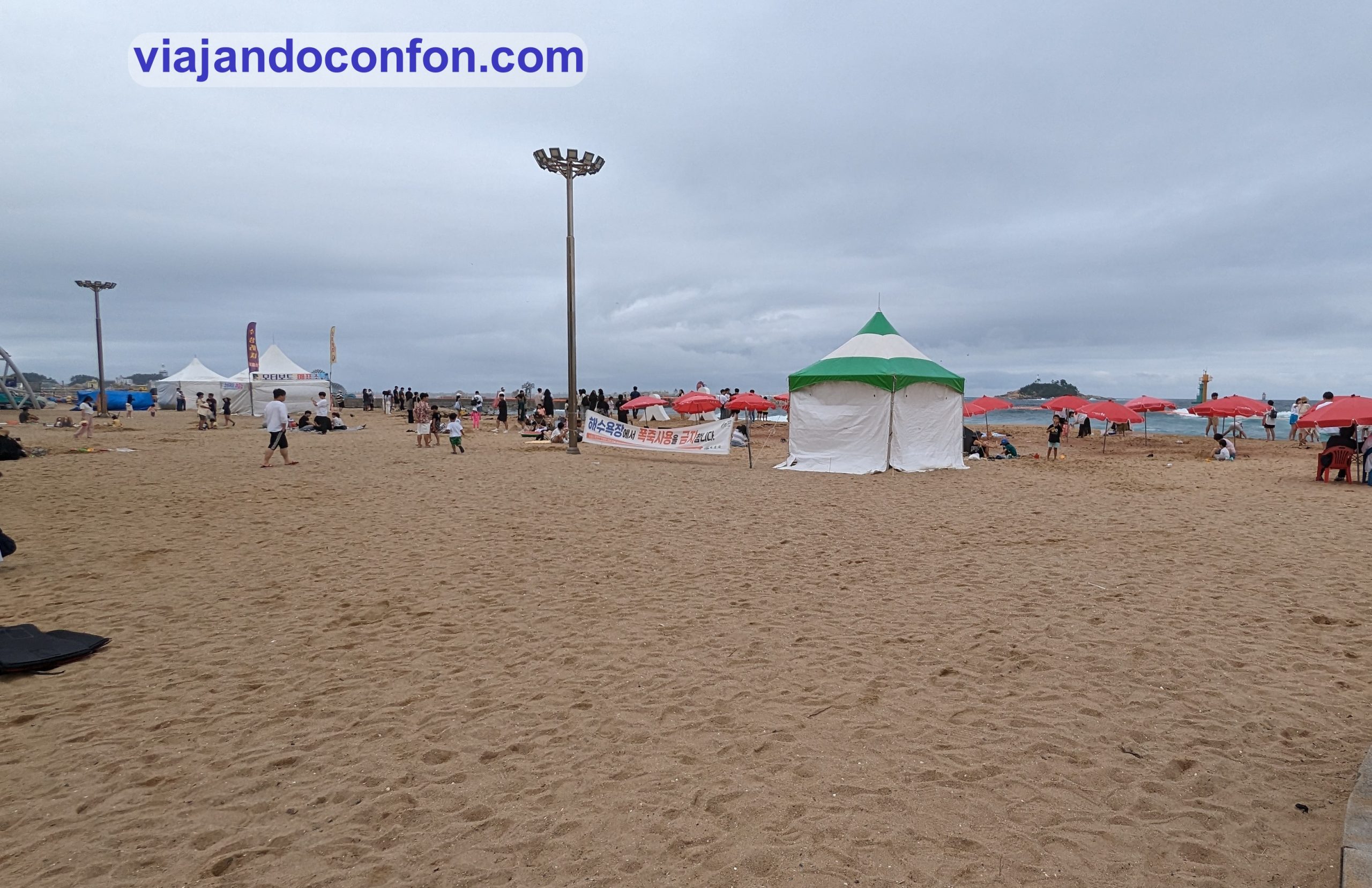
We were surprised to find that the shore of the beach was cordoned off, preventing access to the water. We assumed it was because of the big swell and the typhoon that had just passed through South Korea the day before. The next day we would find out why the beach was closed.
Now it was time to go and rest.
August 15th
We are up early again. We have to make the most of the day. We have some breakfast at the hotel and head for the bus stop. But first we went to the station to buy our tickets back to Seoul.
The lady at the ticket office seemed to be very angry and didn’t speak English. We were having a hard time understanding each other until the girl next to us noticed and helped us. Eternally grateful.
We got tickets by the skin of our teeth, at 16.10, the rest were full and there were only tickets at night. Change of fortnight and end of holidays for the Koreans.
We took line 7 to Seoraksan National Park for 1.250₩ (0.88€). In about 40 minutes we arrived at the stop at the entrance to Seoraksan Park.
Seoraksan National Park is one of the most important attractions for Coeean nature lovers. It covers more than 163 km² and was designated a UNESCO Biosphere Reserve in 1982.
For the time being, the rain is holding off, so we walk through the entrance to the park. Here we find some monuments, the information office and a few restaurants.
We go straight to the Seoraksan Sinheungsa temple. It is believed to have been built in 653 by the monk Jajang under the name Hyangseongsa. It was totally destroyed in 699 and rebuilt in 710.
It burned to the ground in 1645 and was rebuilt on its present site in 1648. It is believed to be the oldest Zen Buddhist temple in the world.
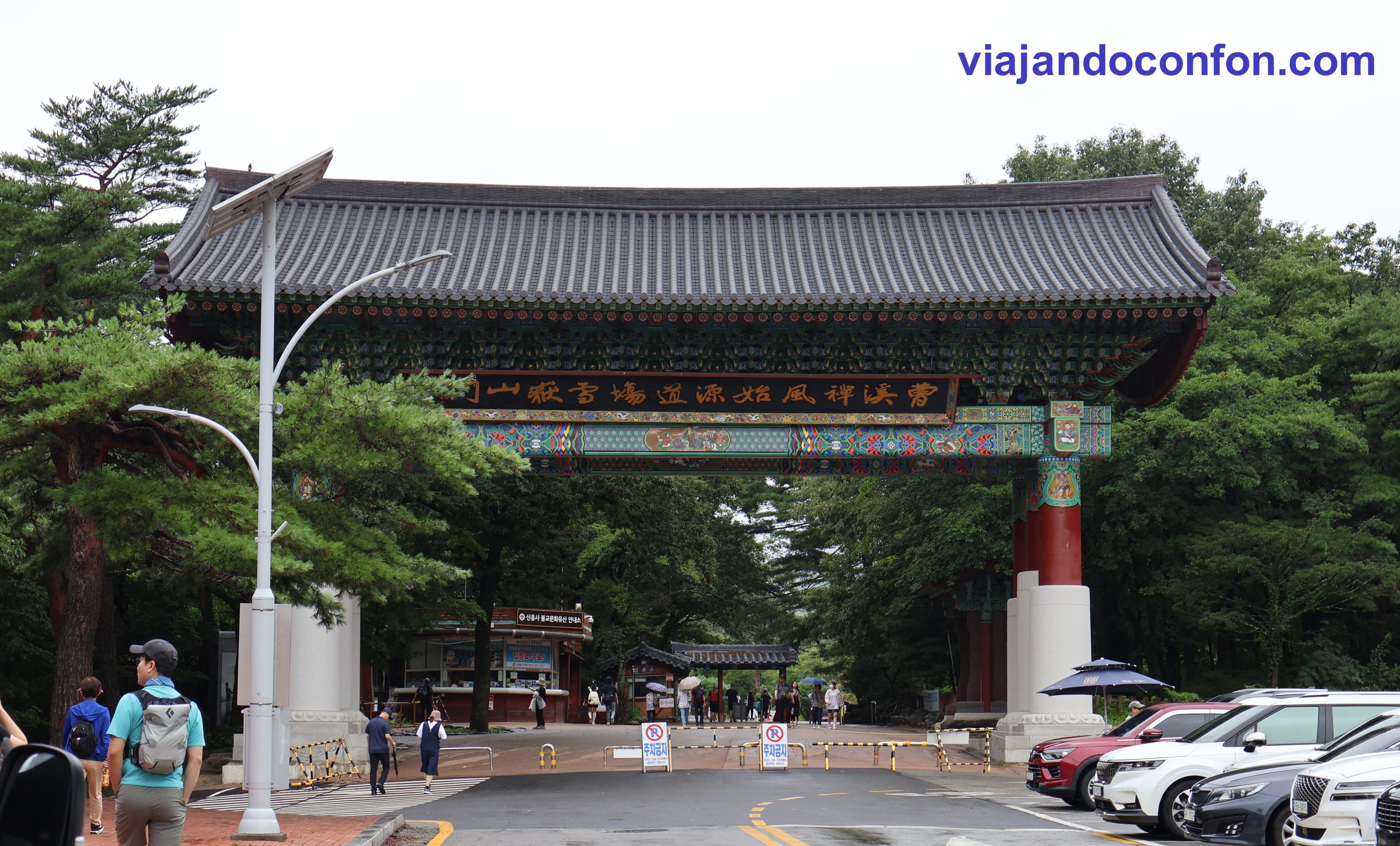
The first thing we come across is the Iljumun Gate, the main gate of the complex. We pass through it to rid ourselves of worldly worries, sort out the mind and head towards the world of truth and enlightenment.
Past the gate we come across the Great Buddha of Unification. It was built between 1987 and 1997 in bronze and is 14 metres high and weighs 108 tons. It was created to pray for the unification of the families of South and North Korea.
Below the Great Unification Buddha is the Naewon Buddhist Temple. In the centre are the Thousand-Armed Bodhisattva Avalokitesvara, the left Yeoui-ryun and the right Bodhisattva Junje Avalokitesvara. In addition, three Buddha relics donated by the Myanmar government in 1992, the Dharani Sutra and cloisonné relics are enshrined.
Across one of the bridges is Sacheonwangmun Gate, built in 1881. The present gate was rebuilt in 1972 after the original gate was destroyed in a fire. This gate provides access to the main temple complex.
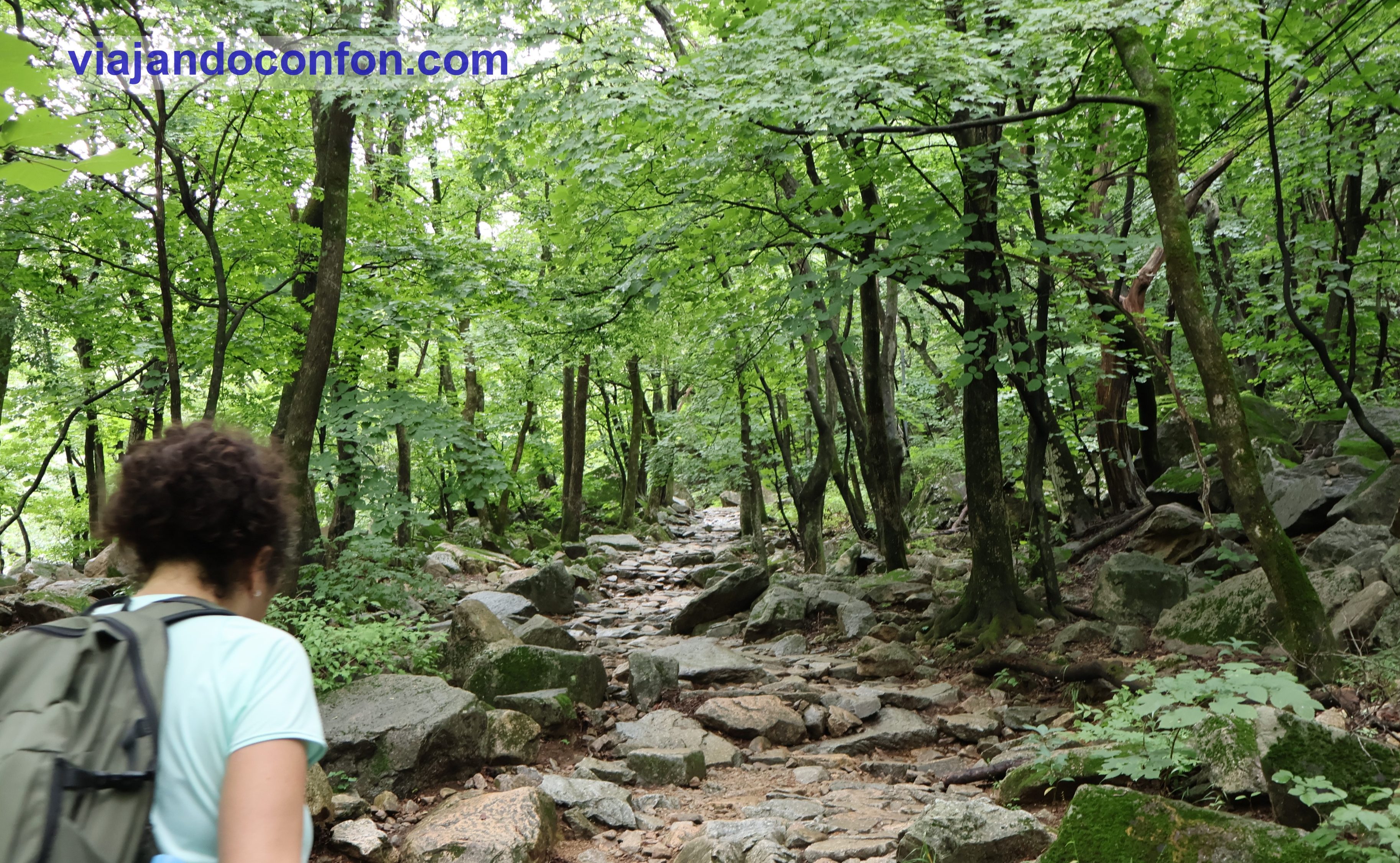
After visiting the temple we set off for the Biseondae rock. The route is about 3 km long and is linear, i.e. 6 km round trip. It takes about 1 hour each way.
The route is fairly easy and along the way there are information panels about the park, fauna and flora.
As we climbed higher and higher, the fog became thicker and thicker until, when we reached the rock, we could see nothing.
The name ‘Biseondae’ comes from a legend that tells of a fairy who flew up into the sky while admiring the beauty of the landscape. The scenery is breathtaking.
On the way down, we passed the Seoraksan cable car, but the screens showed us that the fog was very thick and there was no visibility at all. We decided not to spend the money to see nothing. The price is 15.000₩ (10.50€).
We decided to go straight to the Biryong waterfall, which was another 3 km each way. After a while, it started to rain lightly. Although it was gradually getting heavier.
Between the rain and the very hard path, once we reached the previous waterfall, Yukdam, we decided to turn back. The beautiful thing is the path, as the waterfalls were not impressive either, especially after having visited Iceland.
If you don’t want to make life difficult for yourself, you can book a wonderful excursion to Seoraksan with Civitatis:
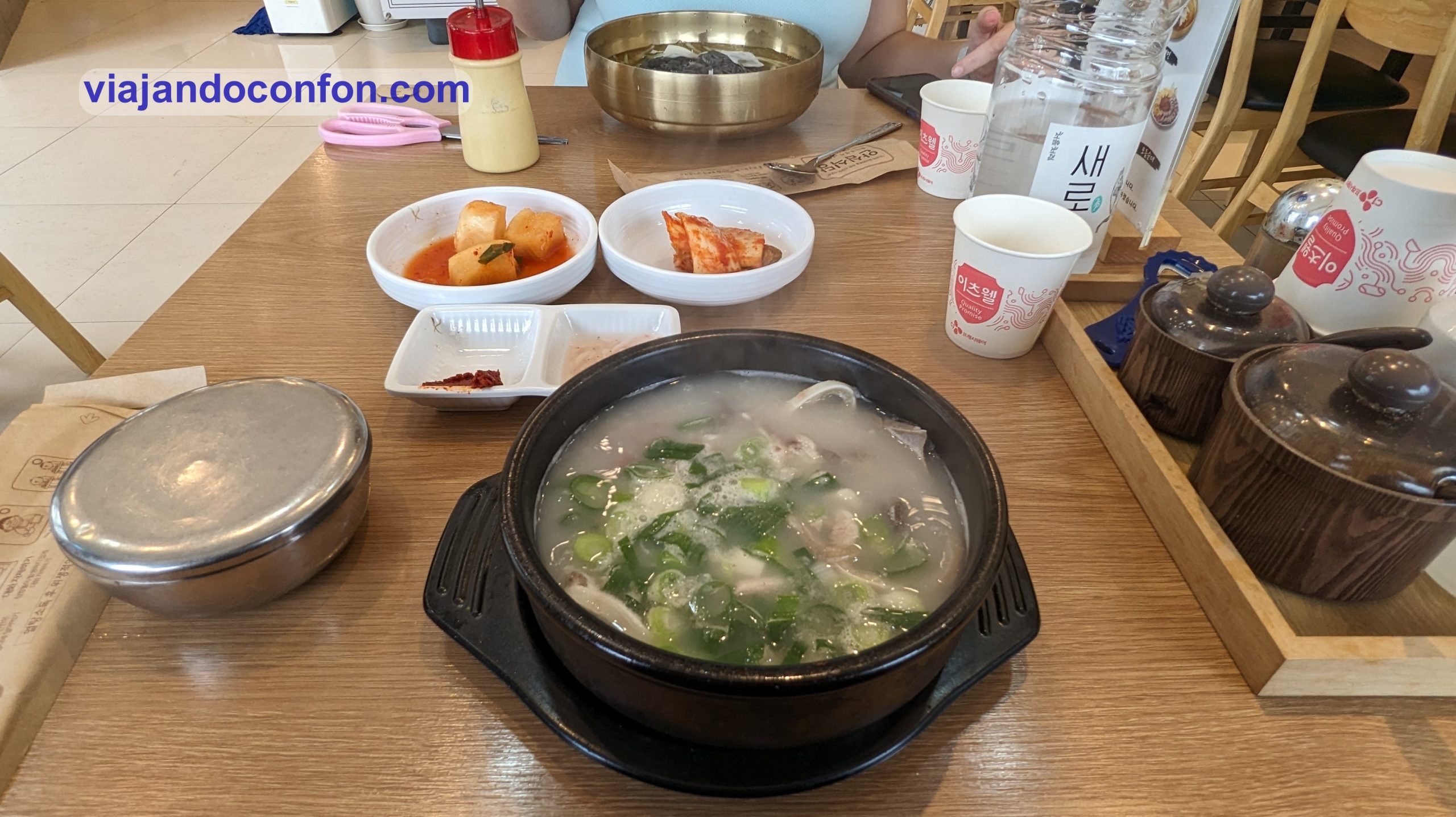
Soaked with rain and sweat from the humid heat and exertion, we sat down to wait for the bus to the city. Once there, we went to eat at a place next to the station. It’s called 아바이명가 (abaimyeong-ga) and they serve local cuisine.
It was a lottery. We pointed to a photo, and prayed to luck. Mine was a kind of soup of some kind of pork-flavoured gristle and a kind of rice blood sausage, garnished with salted shrimps. It wasn’t bad…
Sara’s was cold noodles with an unrecognisable flavoured broth. So cold that the broth had ice in it. Hers was better.
The meal cost us a total of 22,300₩ (15.70€).
After lunch, we took a stroll along the beach. It was quite lively. When we got to the sand, we learned the reason why the shore is acrodoned… the presence of the BIG WHITE SHARK! As if to get close to it.
After the walk, we pick up our luggage at the hotel. We change into our damp clothes and head for the station.
The bus leaves on time. About 15 km into the journey, we start to see a lot of traffic. So much that we come to a standstill. The traffic jam at the entrance to Seoul… 150 KM FROM THE CITY!
From a 2.20h trip it took us 4.30. We were supposed to arrive at 18.30 and we got there at 20.36. Thank goodness we had all kinds of junk to eat.
The bad thing doesn’t end there. We grab our bags and get on the metro. As soon as we get on, Sara notices that her mobile phone is missing. How marvellous. More than half of the journey incommunicado.
We arrived at the hotel, which was the same Ibis as the previous nights. They knew us so well that they didn’t even ask for our passports.
The receptionist gave us a voucher for drinks while they checked that the room was in order. It was. By the way, we told her about the telephone and, very kindly, she called the station. It wasn’t there, but they agreed to try again in the morning.
With all the stress, we decided to go down to the hot bath they had in the basement to relax. We had some dinner from the combini and went to sleep.
August 16th
In order not to lose our habits, we got up early. Last morning in Seoul (so far) before moving to Busan.
We had breakfast and went down to reception to ask for the phone. He hasn’t turned up. We check out, drop our bags and leave.
First stop: Chongmyo Shrine, very close to the hotel. We arrive and… closed. We don’t know the reason. But little by little locals were arriving who were also surprised to see it closed.
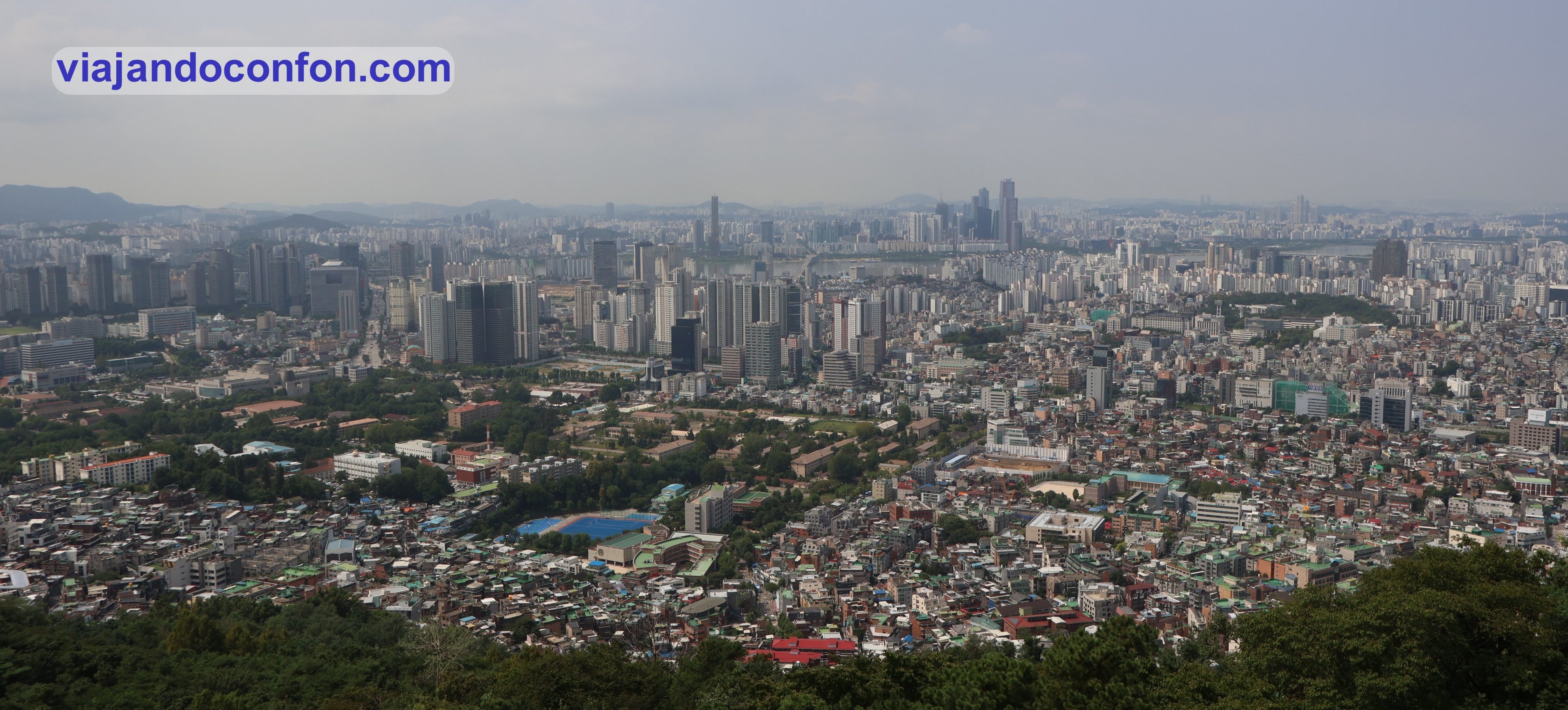
With the disappointment we went to Mount Namsan. We got off the underground at Myeongdong station and took some pictures at the Seoul sign.
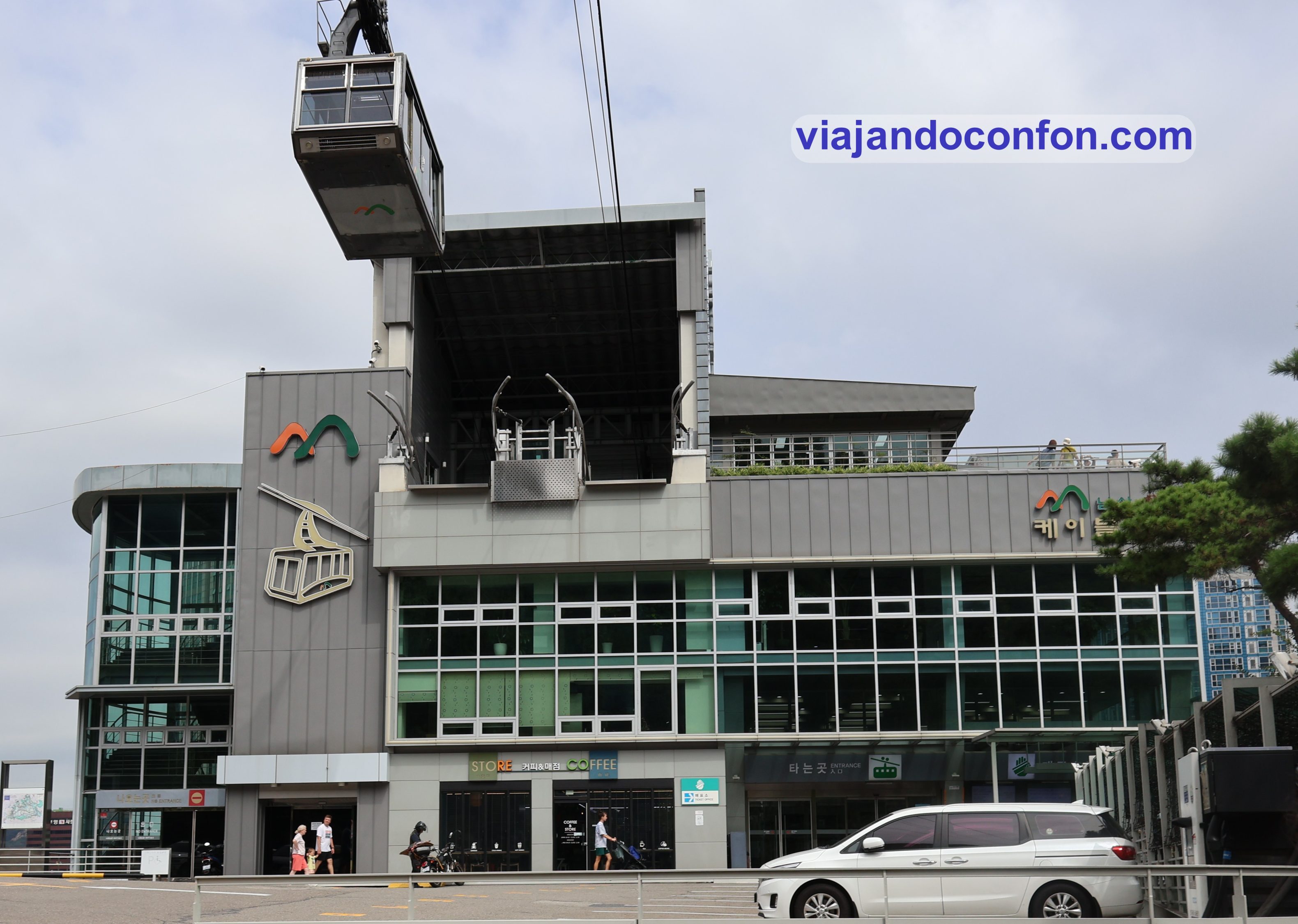
To climb Mount Namsan we went in search of the cable car. We started by following the signs and got lost, but after a huge detour through some pretty amazing terrain, we got there. We arrived.
Tip: The best way to get to the cable car is to take Sogong-ro Avenue and then take the free lift to the cable car. You’ll avoid the steep slopes.
The cable car costs 11,000₩ one way (7.70€) and 14,000₩ return (9.80€). Logically, we bought the return ticket.
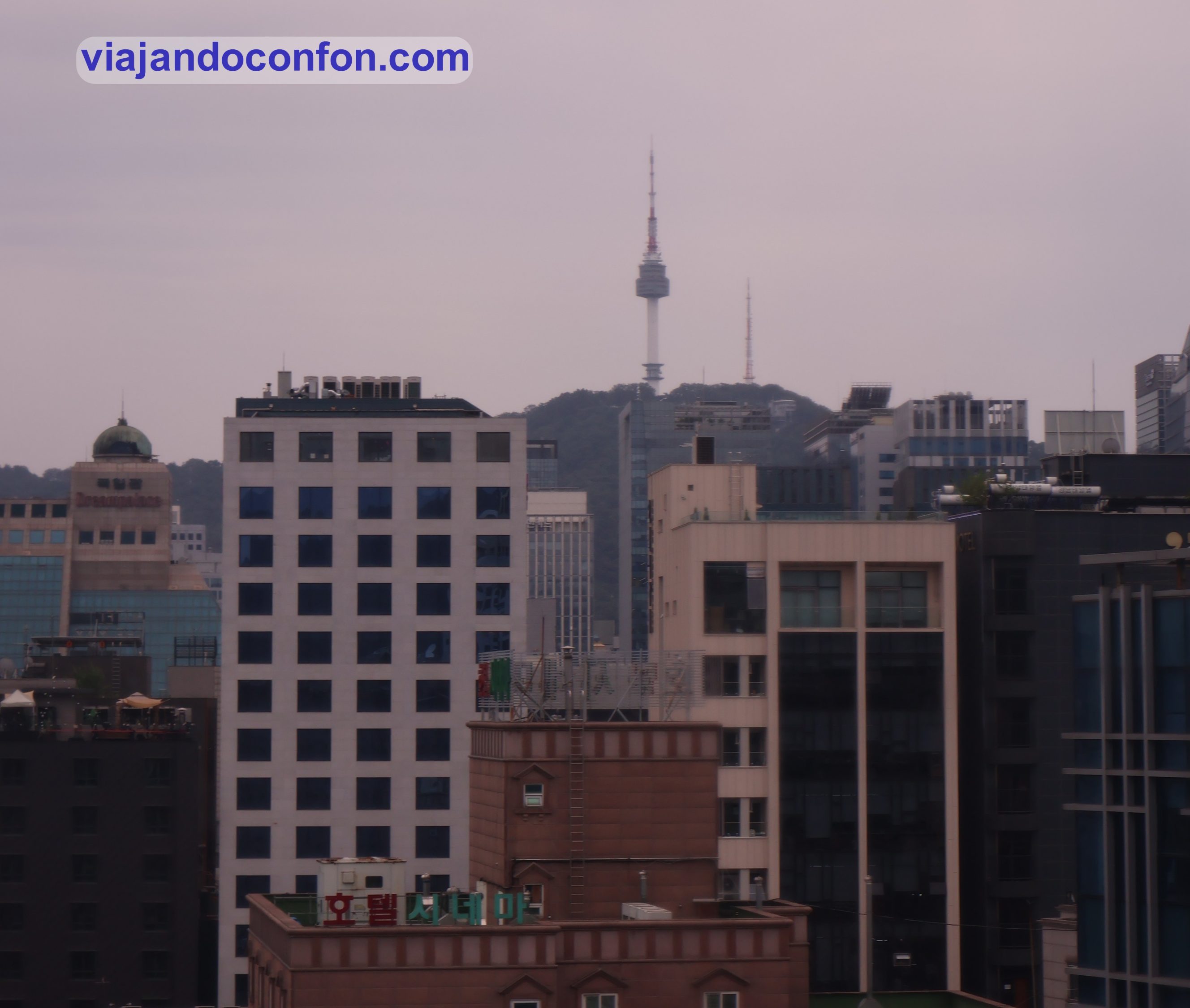
At the top of the mountain there are several remarkable features. Starting with the incredible views of Seoul. But for views, the N Seoul Tower.
This is a 236-metre high telecommunications tower built in 1969. It was opened to the public in 1980 and has wonderful 360º views of Seoul.
The price for the 5th floor observatory is 21,000₩ (€14.70).
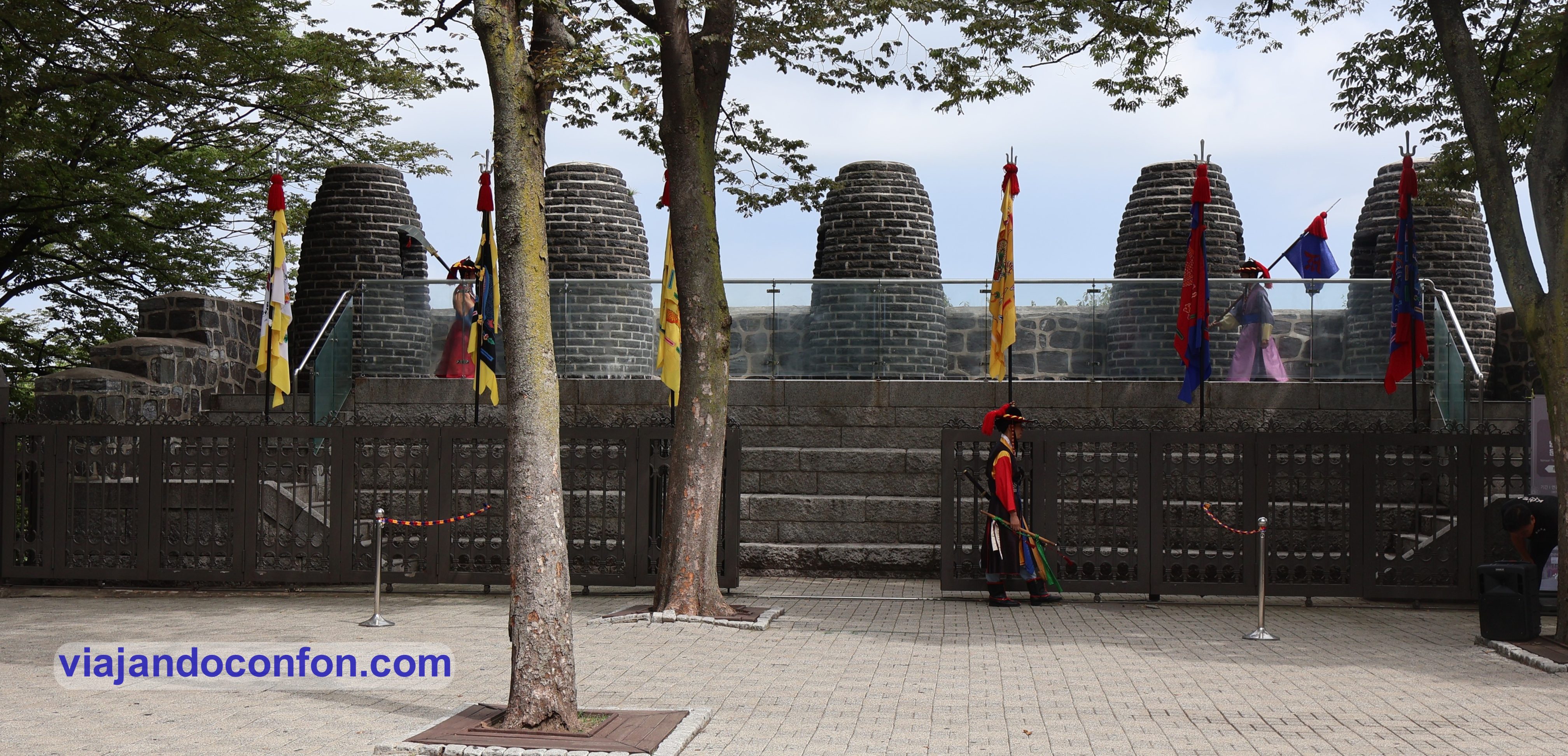
There is also the Namsan Beacon Mound, a Joseon-era guard post. From time to time, a military re-enactment of the era is staged there.
Namsan Beacon Mound
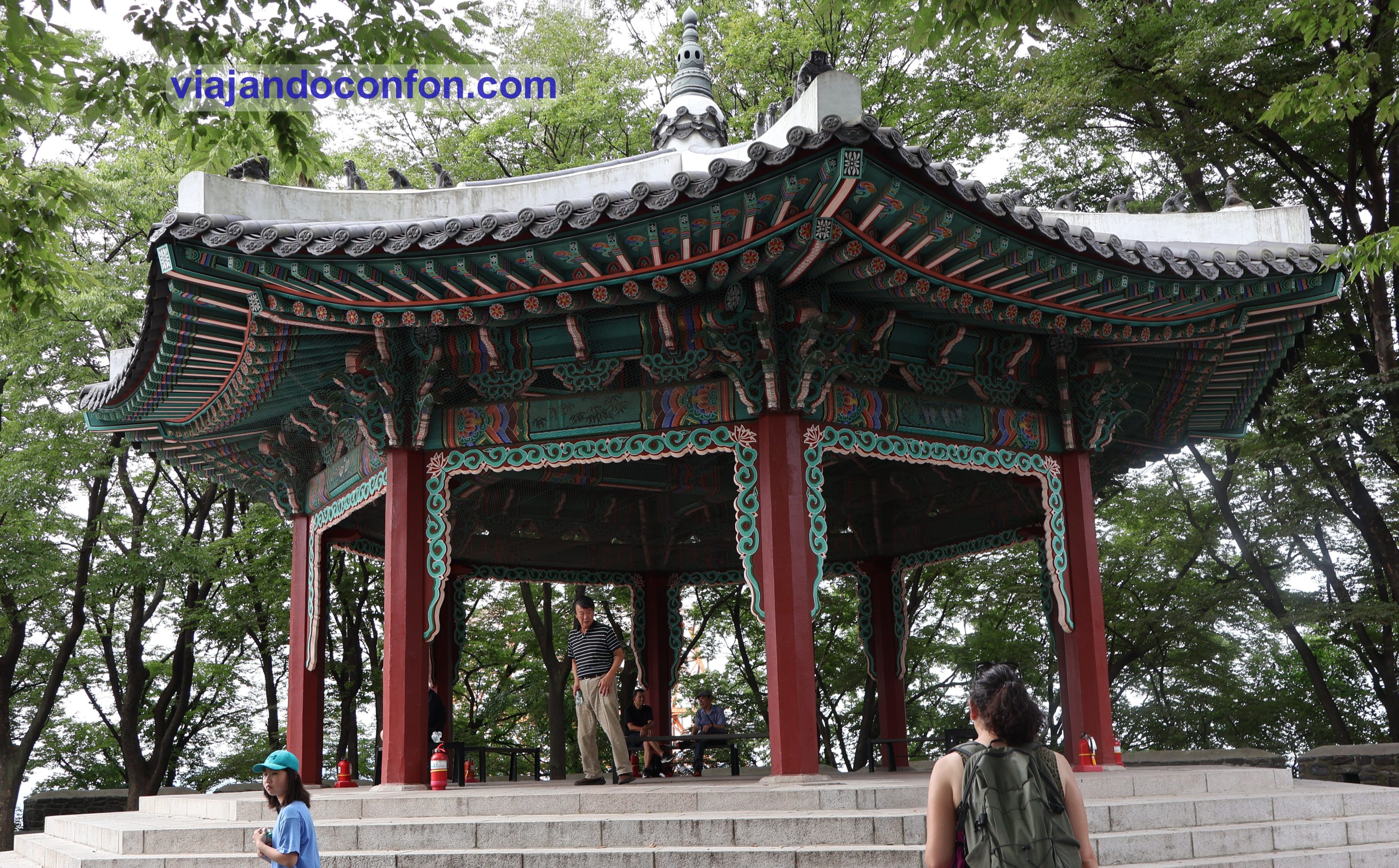
There is also the Namsan Pavilion. It was built in 1959 to commemorate the former Korean president Rhee Syngman. It was originally called Unamjeong Pavilion.
It was destroyed during the April Revolution of 1960 against President Syngman, which led to his resignation. It was rebuilt in 1968.
It is especially famous during the New Year when crowds of Koreans go up to watch the first sunrise of the year.
There are also a million of those padlocks that are so fashionable, destroying the heritage of the world’s cities. Although here they are actually sold on purpose to do so. I still think it’s a stupid thing to do.
We continue admiring the views for a while longer. We are not in a hurry.
While we were there we discovered that there were those ball machines with the Korean horoscope. There we ventured. We got a piece of paper with a lot of text on it. Text that we couldn’t understand even with the translator. 1.000₩ per head thrown away.
We took the cable car back up. When we came out of the building, we noticed that there was a lift that took you down to the lower part of the city, where the metro station is.
Cable car lift
We head for the bus station to see if we can find a lost property office. As we couldn’t find one, we asked at the information desk. As the lady at the counter barely spoke a few words of English, we managed to understand each other with the translator on the phone.
She told us that there was no lost property but gave us the telephone number of the bus company. As we didn’t want to spend a lot of money and we didn’t know if they would speak English, we decided to wait until we got to the hotel to pick up our luggage. As they were looking down their noses at us for all the complaints, we asked them to call them so that we could understand them in Korean.
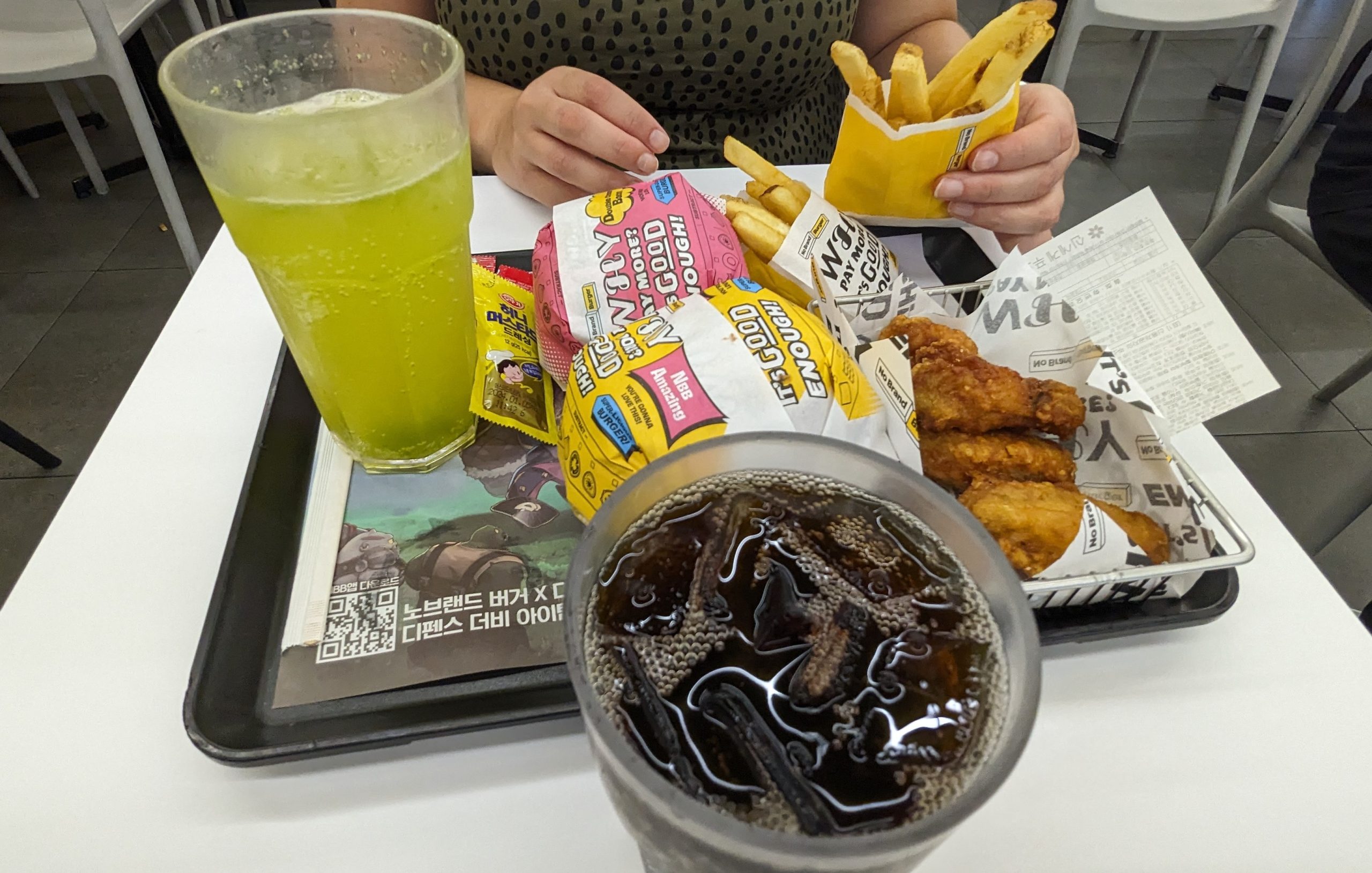
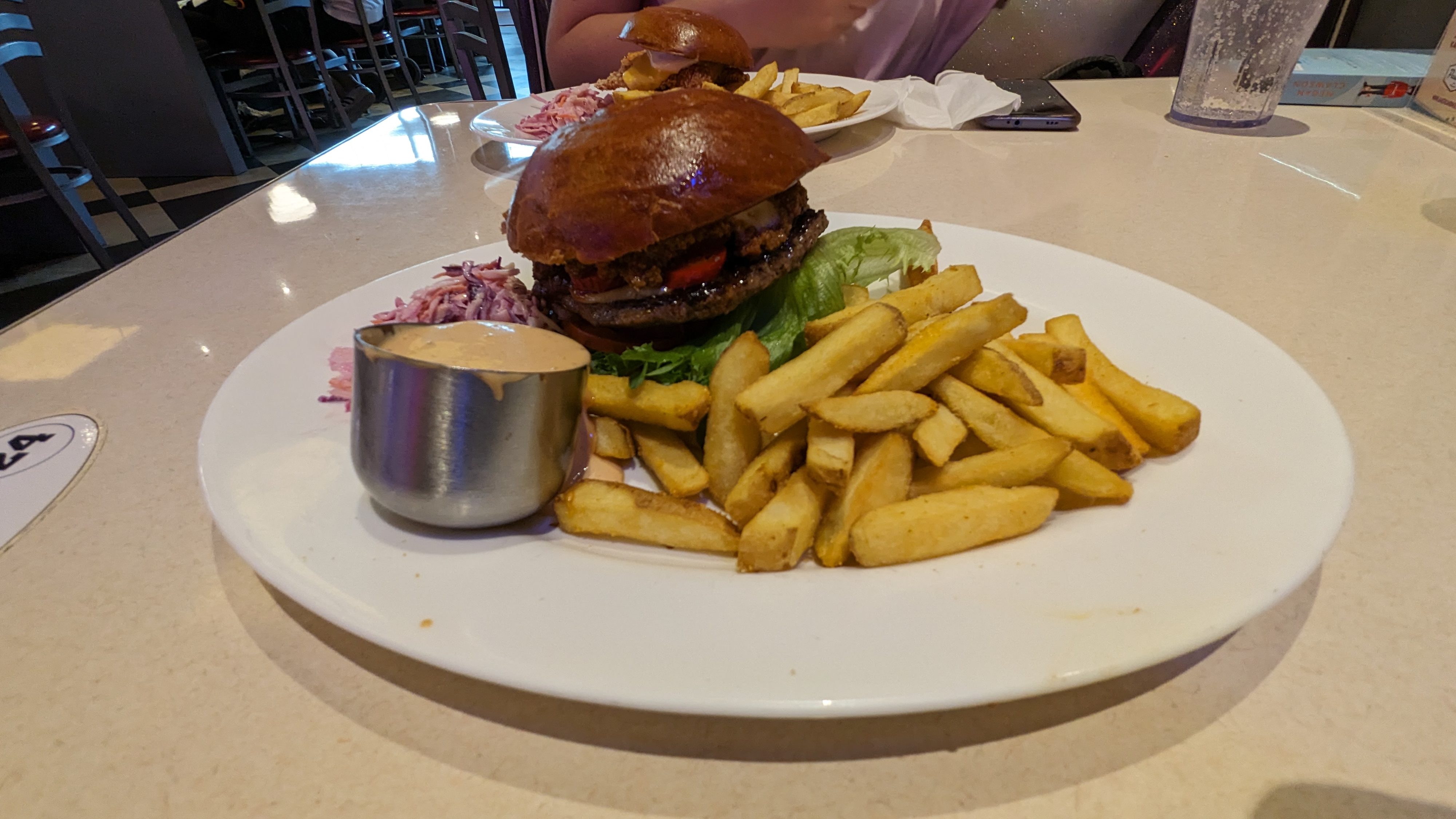
The Express Bus Terminal is also a big shopping centre. Here we decided to have something to eat before we went to pick up our stuff. We did so at a burger joint called No Brand Burger. They were not bad and not too expensive.
The meal cost us 22,700₩ (16€).
I also took the opportunity to buy a memory card for the camera as I had just run out of 32gb and the other one is 16gb. A 32gb card in a chain called Artbox cost us 15,900₩ (11.15€).
Now we go to the hotel. There we give a guy called Paul the phone number of the bus company to see if he will do us the favour of calling. The guy calls but is told that he has not turned up. He takes our email and says he will try again.
We sit down to rest for a bit while we drink the drinks we were given. We pack up our things and leave the hotel. Just then Paul comes out and says that the bus company has called to say that he has turned up and that we can pick him up the next day. They keep it for us until we get back from Busan.
He was going to show up in Spain…
We happily set off for the train station. There we take the 17.22 train to Busan… let’s hope there are no zombies (note for geeks).
The ticket price is 59.800₩ (€42) per person. I left on time and we arrived at Busan station at 20.11. We took the metro and went straight to the hotel.
We chose another hotel of the Ibis chain. It is the Ibis Ambassador Busan City Centre. Similar to the rest of Ibis. The room was flawless… in principle. The price was 60€ per night.
Find your ideal hotel at the best price in Busan and South Korea with Agoda:
The hotel’s reception was on the top floor, on the 14th floor.
As we were quite tired, we decided to buy some dinner (and breakfast) in a combini next to the entrance of the hotel and went to bed.
Discover the best activities and tours in South Korea with Civitatis:
As always, we recommend traveling with good health insurance. IATI is a specialist in travel insurance and, for being our reader, you have a 5% discount.
We continue our trip through South Korea. We are still in Seoul, but now it’s time for an excursion.
August 13th
Today we are getting up quite early again. We are going on an excursion to the city of Suwon. But this time on our own, not like the visit to the DMZ.
The city of Suwon is located 30km south of Seoul and is the capital of the province of Gyeonggi. To get there we took line 1 of the Seoul underground. Approximately 1 hour and 15 minutes later we arrived at Suwon station. Yes, the underground goes to Suwon.
We got off the underground and went in search of the bus stop to go to the first stop: Padalmun Gate. There we got on the bus nº11 and we got off next to the gate.
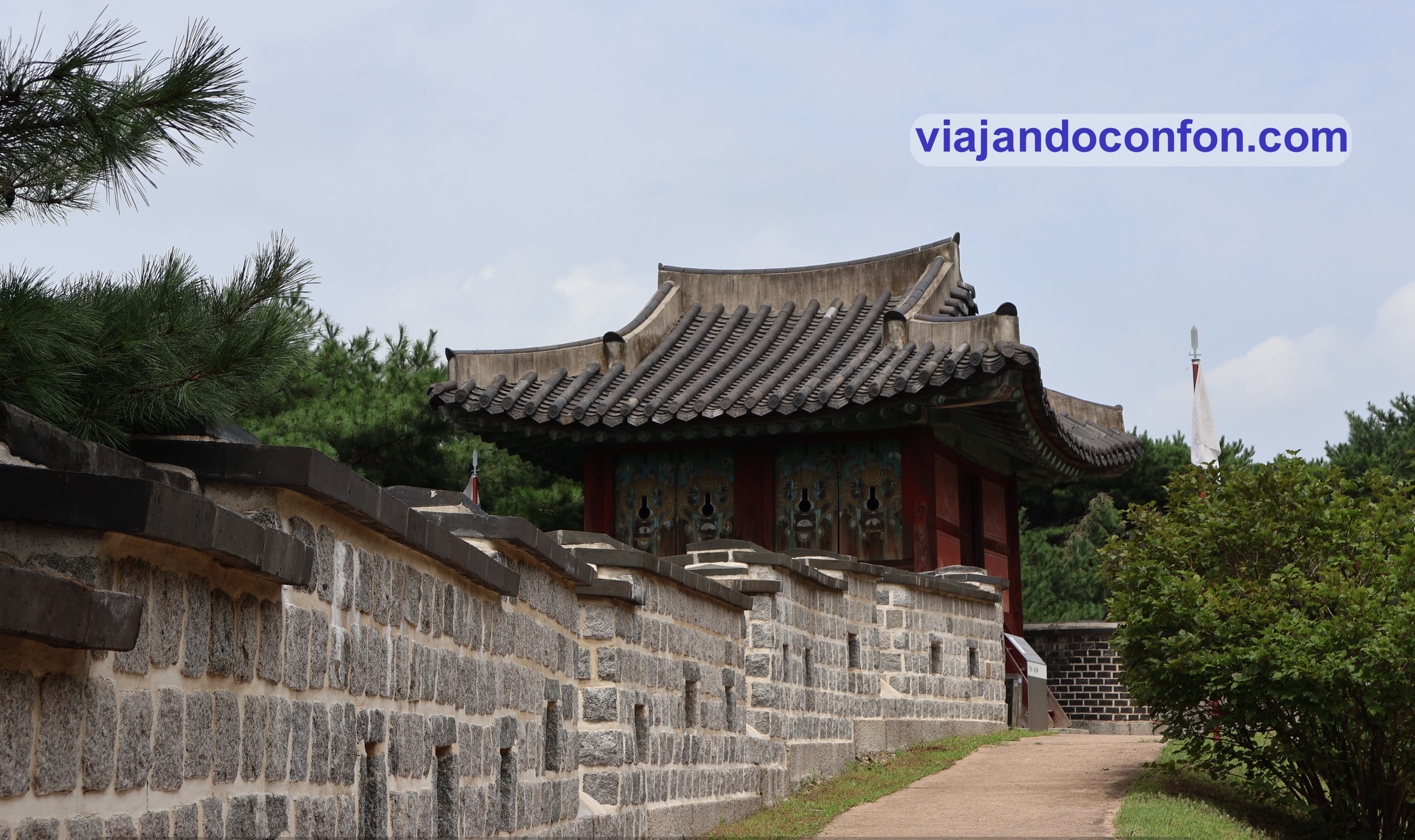
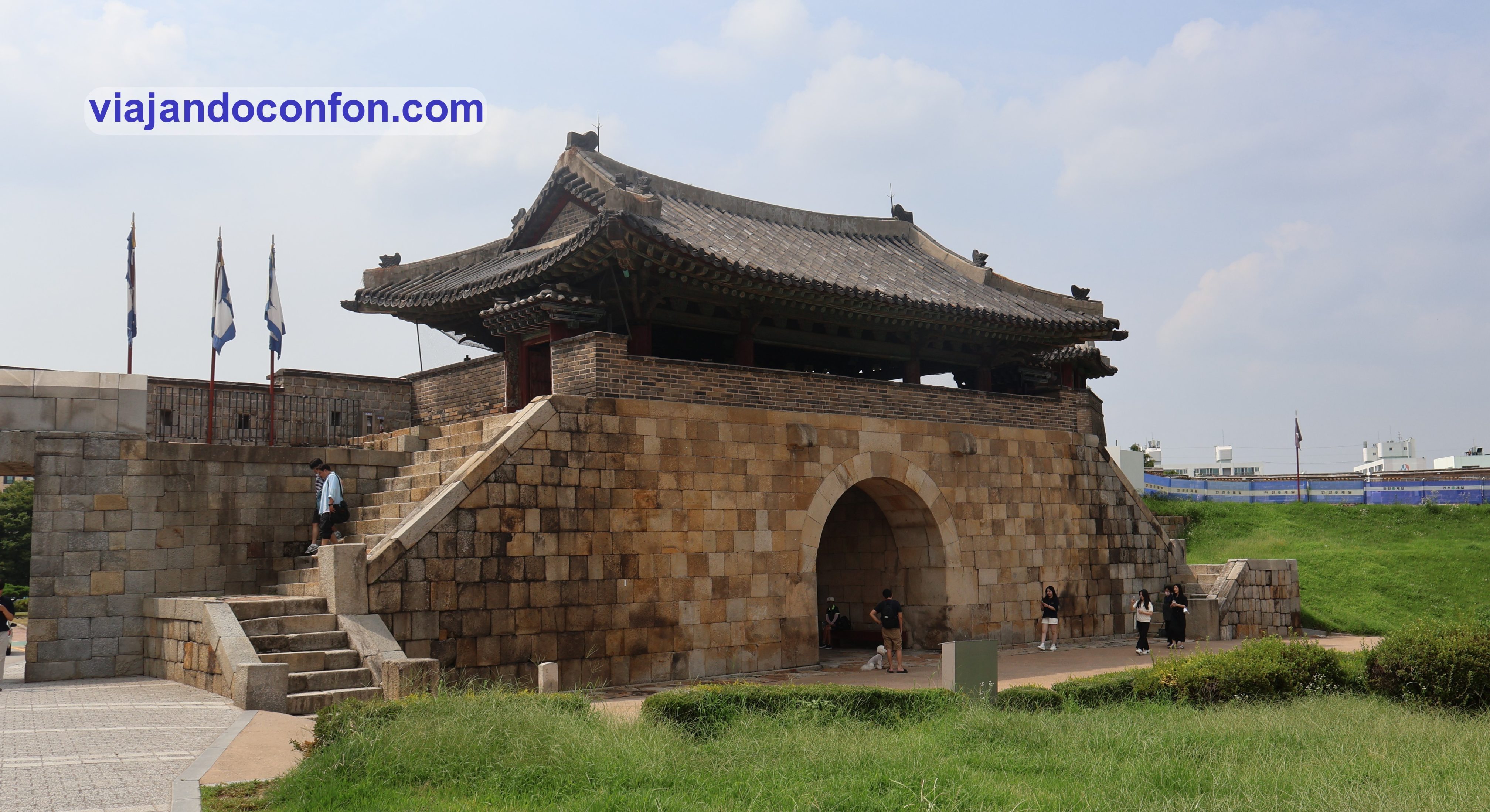
Built in 1794, Paldalmun is the southern gate of Hwaseong Fortress in Suwon. The area around Paldalmun Gate was a road leading to the Samnam region. Therefore, people frequented it even before the construction of Hwaseong Fortress.
The current building is the original one, which was restored in 2013.
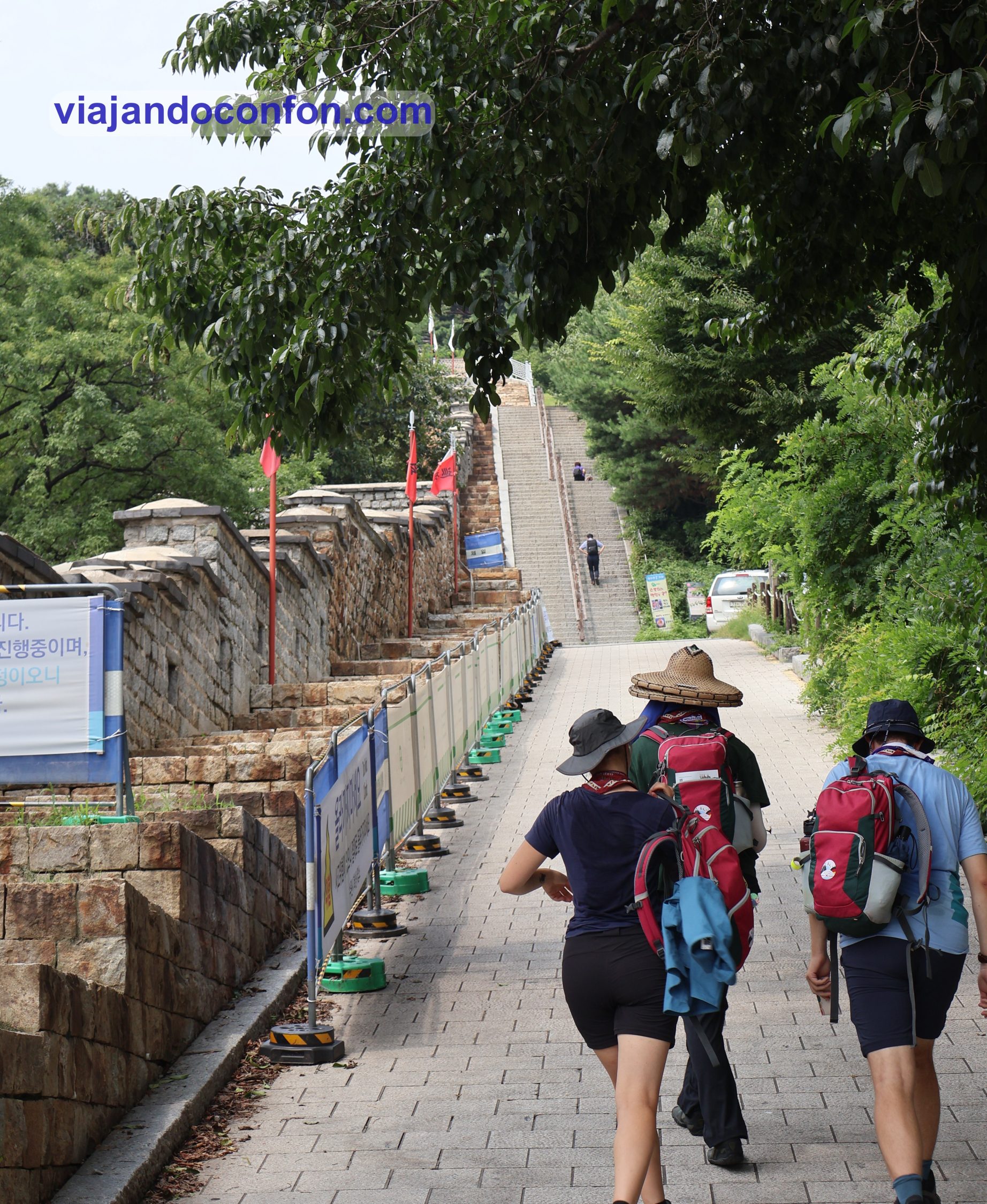
We go round the gate and head for Mount Padalsan to walk along the wall. Note that the climb can be really tough. A combination of hills and steep stairs.
At the end of the climb we needed a well-deserved rest. Between the steps and the humid heat, it felt like we had taken a shower. Here we can sit on shady benches next to the Korean Independence Monument.
At the bottom of the stairs is the Seonamammun Gate. Built in 1796, it is an emergency gate built in the southwest of Hwaseong. It is one of the 5 secret gates of the fortress.
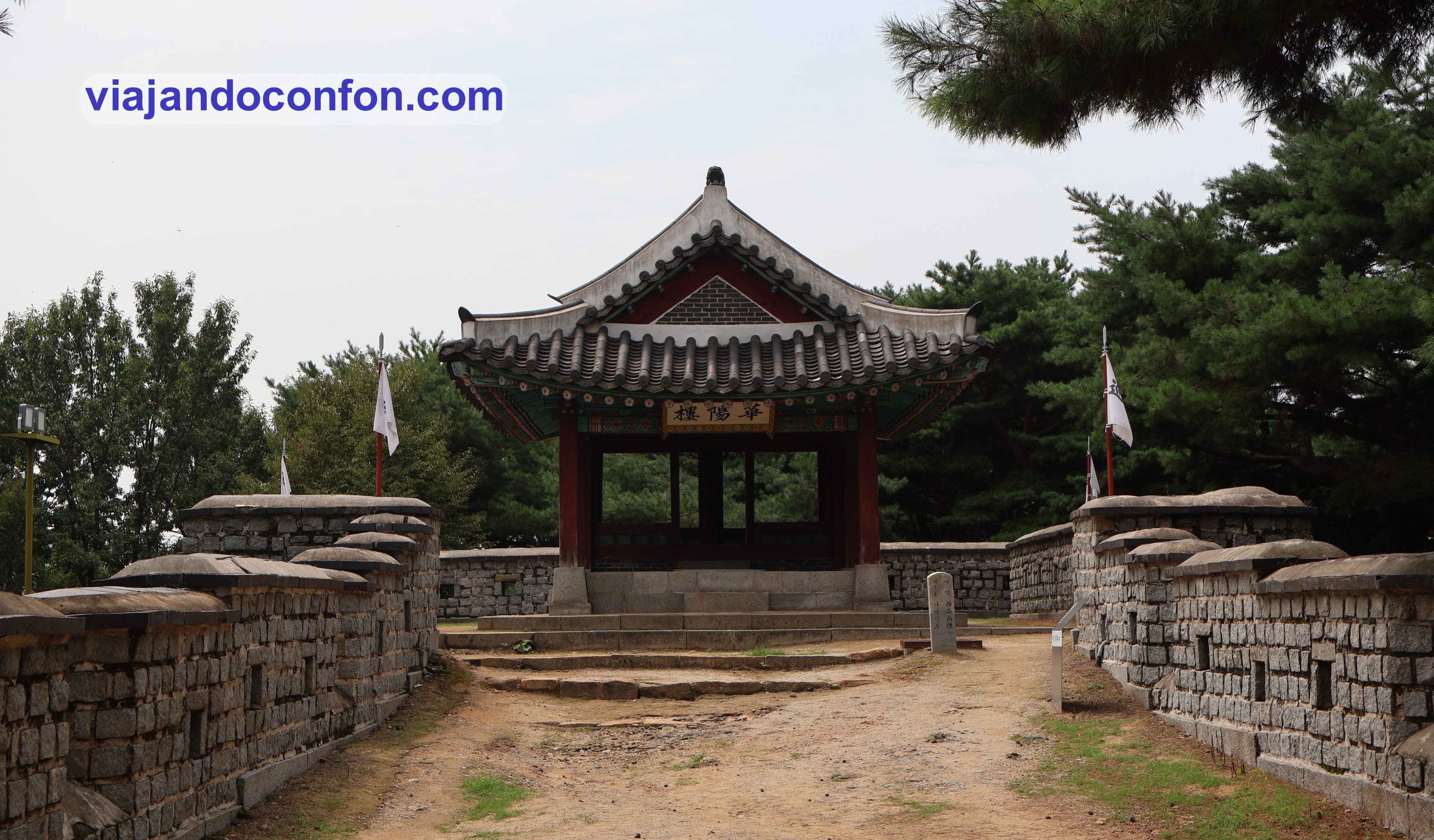
If we go south through the gate, we come to the south-west tower or Huayang Tower. It is located in a very high area perfect for surveillance… if the trees would let us. I suppose it would be clearer at the time.
We retrace our steps, cross the gate again and head towards Seoporu. This is a guardhouse that served as a lookout for the soldiers. It is one of the five guard pavilions in Hwaseong Fortress.
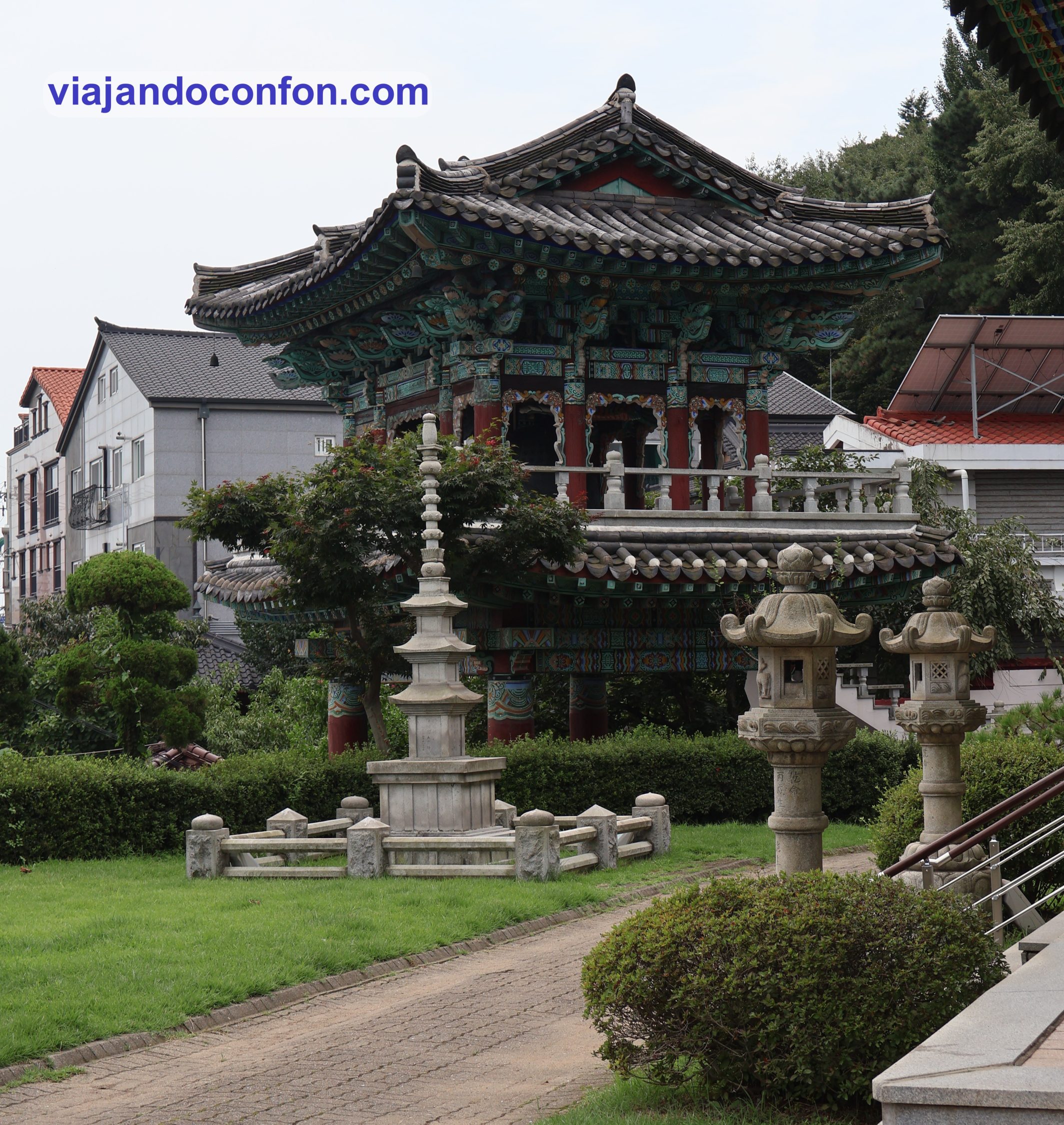
A little further north is the Hyowon Bell. It was created to honour King Jeongjo’s filial devotion to his father, Crown Prince Sado.
The bell must be rung three times. The first ringing is in gratitude for parental love. The second is to hope for happiness in the family. And the third as a prayer for self-improvement.
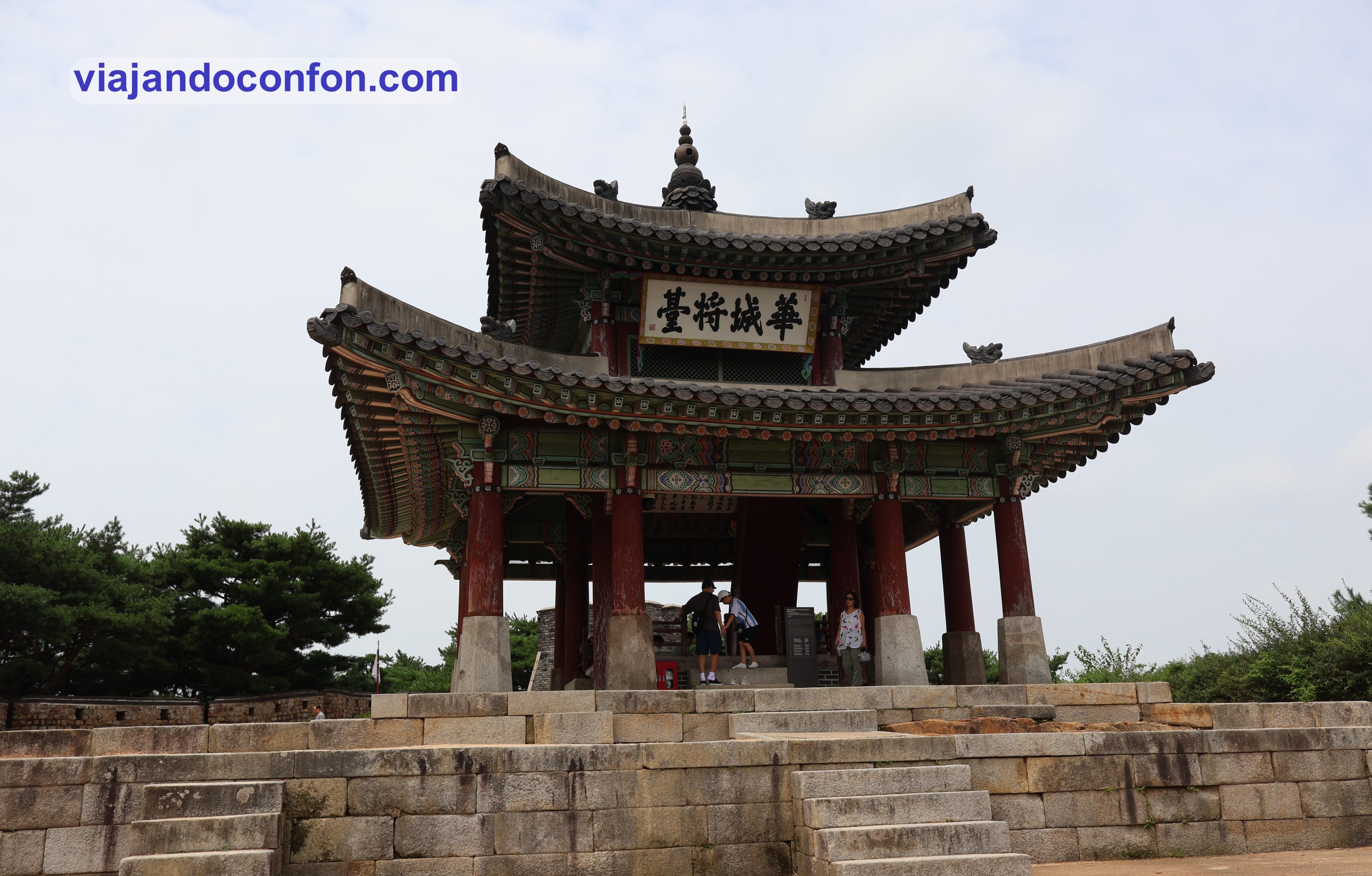
A little further on we come to the jewel in the crown of Mount Paldal: Seojangdae. This is the Western Command Post and was the general command centre of Hwaseong Fortress.
In 1795, when King Jeongjo visited the fortress, he took command of military training from this post.
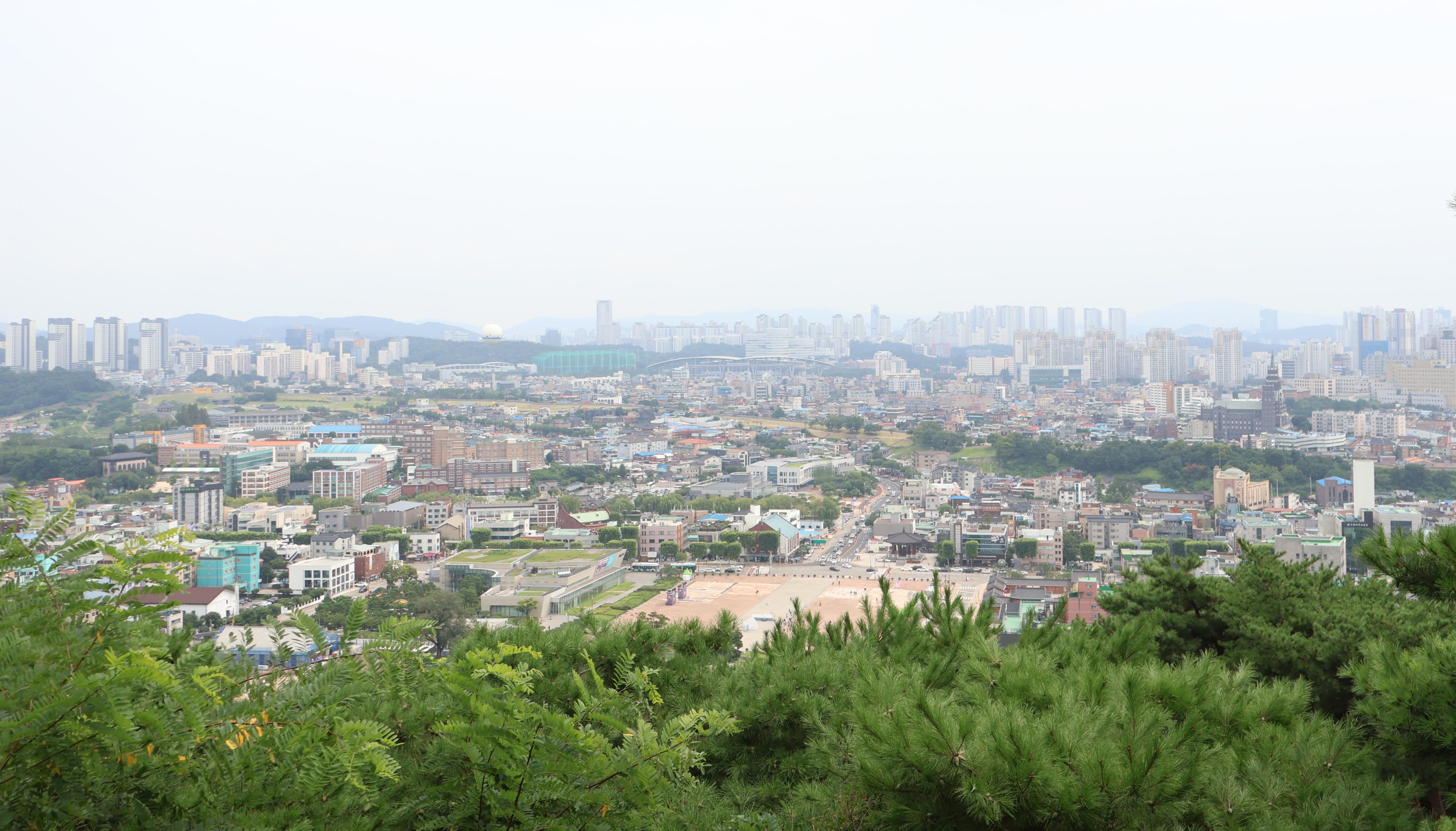
From here we can enjoy wonderful views of the city of Suwon. It’s a long climb but, frankly, it’s worth it.
We start the descent to Hwaseong Haenggung Fortress. The descent through the forest is wonderful, except for the terrible humidity that makes you sweat profusely.
On the way we pass the Padalsan Daeseungwon temple belonging to the Mahayana Monastery. It was founded in 1954 under the name ‘Mahasa’.
This temple does not belong to any particular sect. It is a place of research and education on Buddhist thought. Its 19-metre high golden Buddha statue is visible from many parts of the city.
The place was a real haven of peace and quiet. We were the only tourists there.
We continued our descent towards the fortress. By the time we reached the bottom we were so overwhelmed by the humid heat that we decided to take a little rest while we had a cool drink. We did so at a local coffee shop chain called Tom N Toms Coffee. We had some lemonade, which was good but still syrupy.
After refreshing ourselves we went back to the tourist trail. First stop: Yeomingag. This bell was installed in front of Huwaseong Palace in 1796 by order of King Jeongjo. It was lost during the Japanese invasion and was restored in 2008.
On the night of 31 December, the New Year’s Eve chimes are rung here.
Now we move on to the jewel of the city: the Hwaseong Haenggung Palace. It was built in 1789, year 13 of the reign of King Jeongjo of the Joseon dynasty.
Its original function was as a government office. It was also used as a temporary palace where the king stayed when he travelled to Suwon.
King Jeongjo elevated the status of Suwon by promoting it to Hwaseong Yusubu, and built a new one in 1795 to celebrate the 60th birthday of his mother, Lady Hyegyeonggung Hong. It was completed in 1796 with a total of 600 rooms.
We arrive at the ticket office. We queue up and buy our ticket, which cost us 3,000₩ (2€).
The first thing we come across is the Sinpungru Pavilion. It is the main gate of the palace and was built when the government office building was constructed. It was originally called Jinnamru but was changed to the current name in 1795.
In the building there is a large drum on the upper floor, which the soldiers used to monitor the surroundings and send signals.
We pass through the gate and find ourselves in an esplanade. To the right are some buildings of the original government offices.
On the left is a 600-year-old zelkova tree. This tree was already here before the palace was built. Note that it is propped up and riveted…
Next to the tree is the entrance to the butler’s office. This is where the meetings between the officials of Suwon and the neighbouring areas were held. On the 1st and 15th of each month, the magistrate of Suwon held a ceremony at the guesthouse. It was called Uhwagwan, and a deep reverence was paid to the royal capital.
Today, there is an exhibition of royal robes from the period.
Bongsudang, the main hall, is located in the centre of the well-protected enclosure. It was used as the throne room when the king visited and as the magistrate’s office at other times.
In 1795, King Jeongjo held a royal banquet here for his mother’s 60th birthday. During this banquet, he called the hall ‘Bongsudang (壽堂)’, which means ‘longevity prayer hall’.
Adjoining and connected to Bongsudang is Jangnakdang. It was built in 1794 to be used as a hall for King Jeongjo’s mother during her 60th birthday banquet in 1795. Its name ‘Jangnakdang Long (樂堂)’, means ‘hall of lasting happiness’.
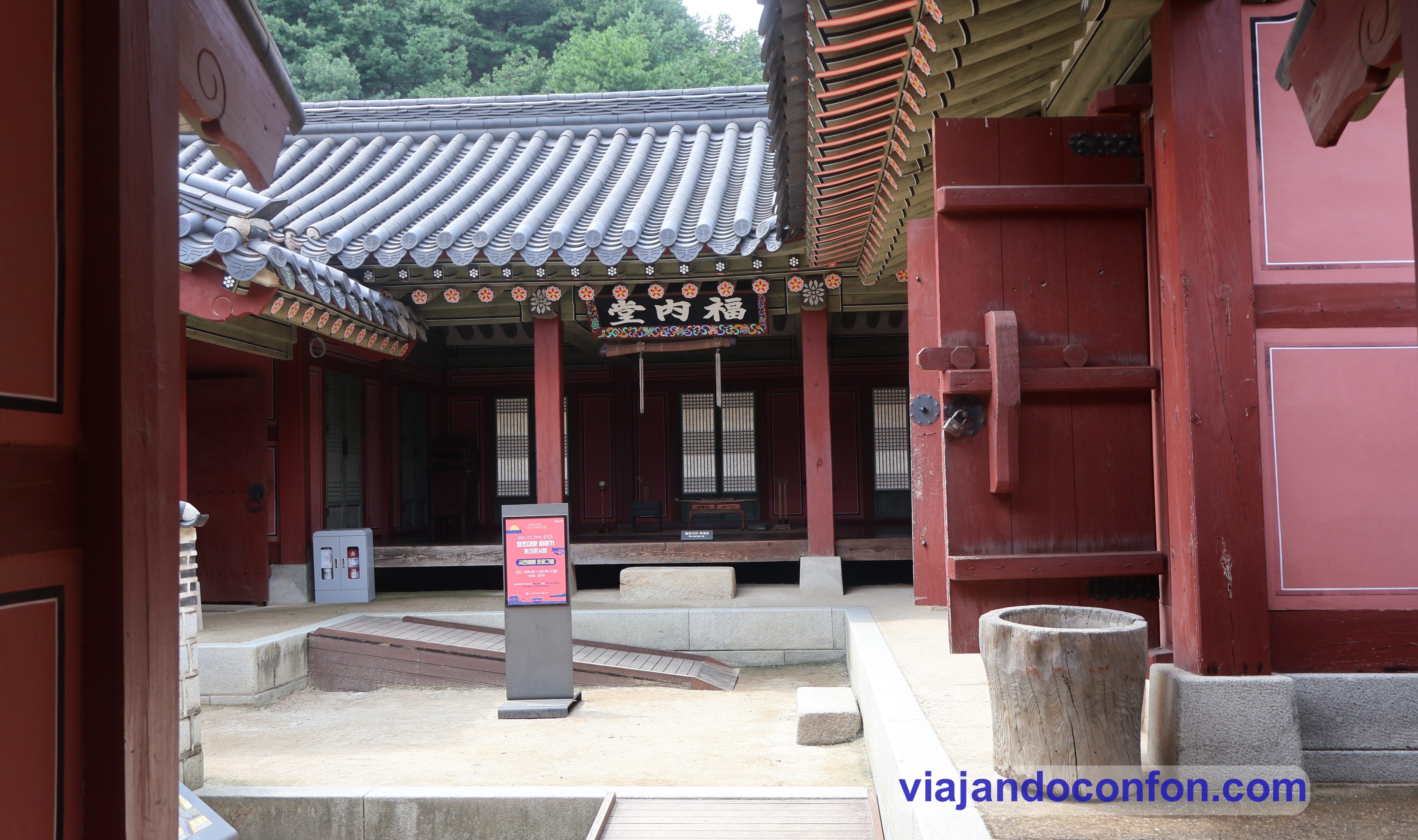
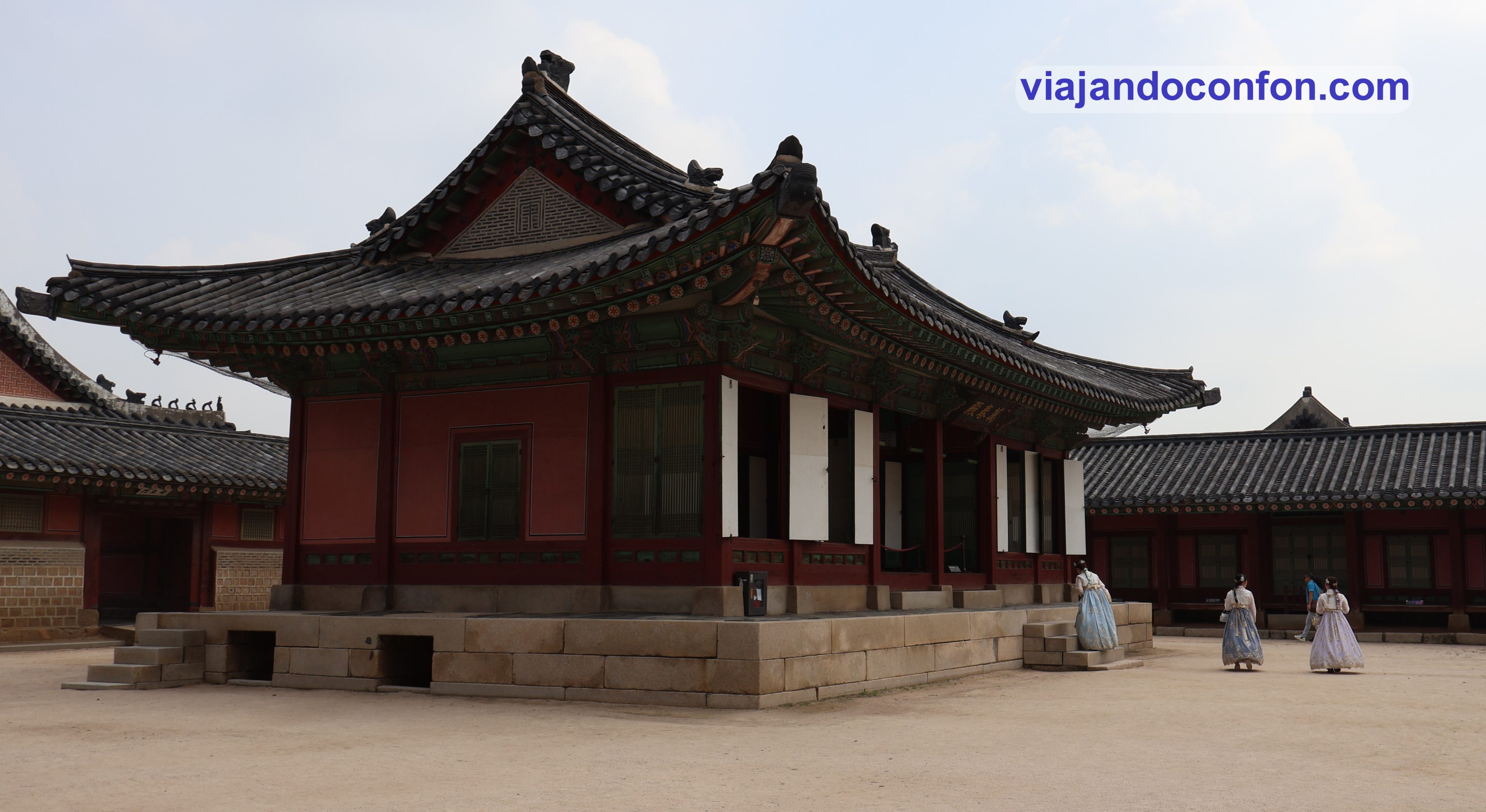
To its left, in the next courtyard, is the Bongnaedang. Built in 1789, it was one of the first buildings to be constructed in the palace. Initially it was used as the king’s dormitory, but after Jangnakdang Hall was built in 1794, it was used by the local magistrates.
The name ‘Bongnaedang (福內堂)’, chosen by King Jeongjo, means ‘hall that radiates happiness from within’.
We leave Bongnaedang through the back gate. There we come to a staircase with steps at least half a metre high, leading up to the guard post. We reach it by turning off to the right.
It was used to inform people inside the temporary palace about emergencies. It is one of the three remaining guard posts in the palace. Although it is a reconstruction from 2006. The original one was destroyed in the early 20th century.
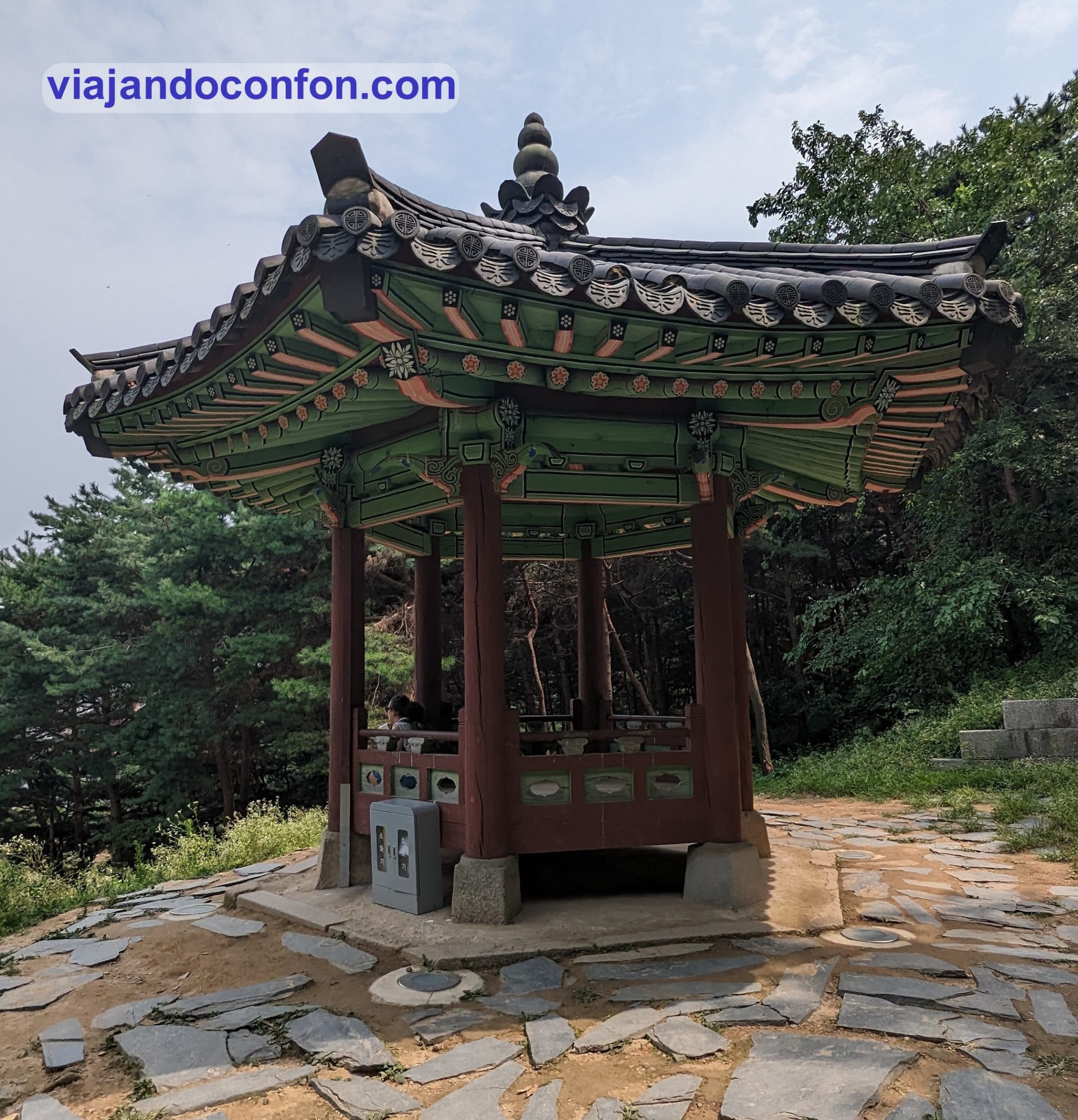
On the left hand side is the Mirohanjeong Pavilion. It was built in 1790 and was originally called ‘Yungmyeonjeong (六面亭)’. This translates as six-sided pavilion… guess why.
In 1795, King Jeongjo changed its name to ‘Mirohanjeong (未老閑亭)’, which means ‘a pavilion for relaxing in old age’. The king intended to abdicate and retire to the temporary palace from 1804. Unfortunately he died in 1800.
From here we can see beautiful views of Suwon and the palace.
This is the end of our visit to Hwaseong Haenggung. But not Suwon. Although we were starting to feel like eating. But first we preferred to finish with the city. We went straight to Hwaseomun Gate.
Hwaseomun is the west gate of Hwaseong Fortress and that is the meaning of its name. Although the gate is actually located to the northwest of the fortress. One of the four gates of Hwaseong Fortress, it was built in 1796.
Along with the adjacent Northwest Watchtower, it is considered one of the most iconic scenes of Hwaseong Fortress.
Now it’s time to eat. We retrace our steps looking for a place that looks tasty. In the end, after a lot of walking around, we enter a fried chicken place called Maehyang Whole Chicken.
We ordered a portion of chicken for one person and two soft drinks. When the chicken arrived, IT WAS A WHOLE CHICKEN!!!! We had our doubts as to whether we had been served for two until the bill arrived. Well no, it was a single portion, what a barbarity.
It was really tasty and the whole thing cost us 19.000₩… 13€… THE TWO OF US. Exaggeratedly cheap. We were very amused that they also gave you plastic gloves to avoid staining your hands.
Now our visit to Suwon is over. We get ready to take the bus to the station. The bus took forever to pass and it was packed to the rafters. To push and padentro.
We arrived at the station just in time for the underground departure to Seoul.
Seoul
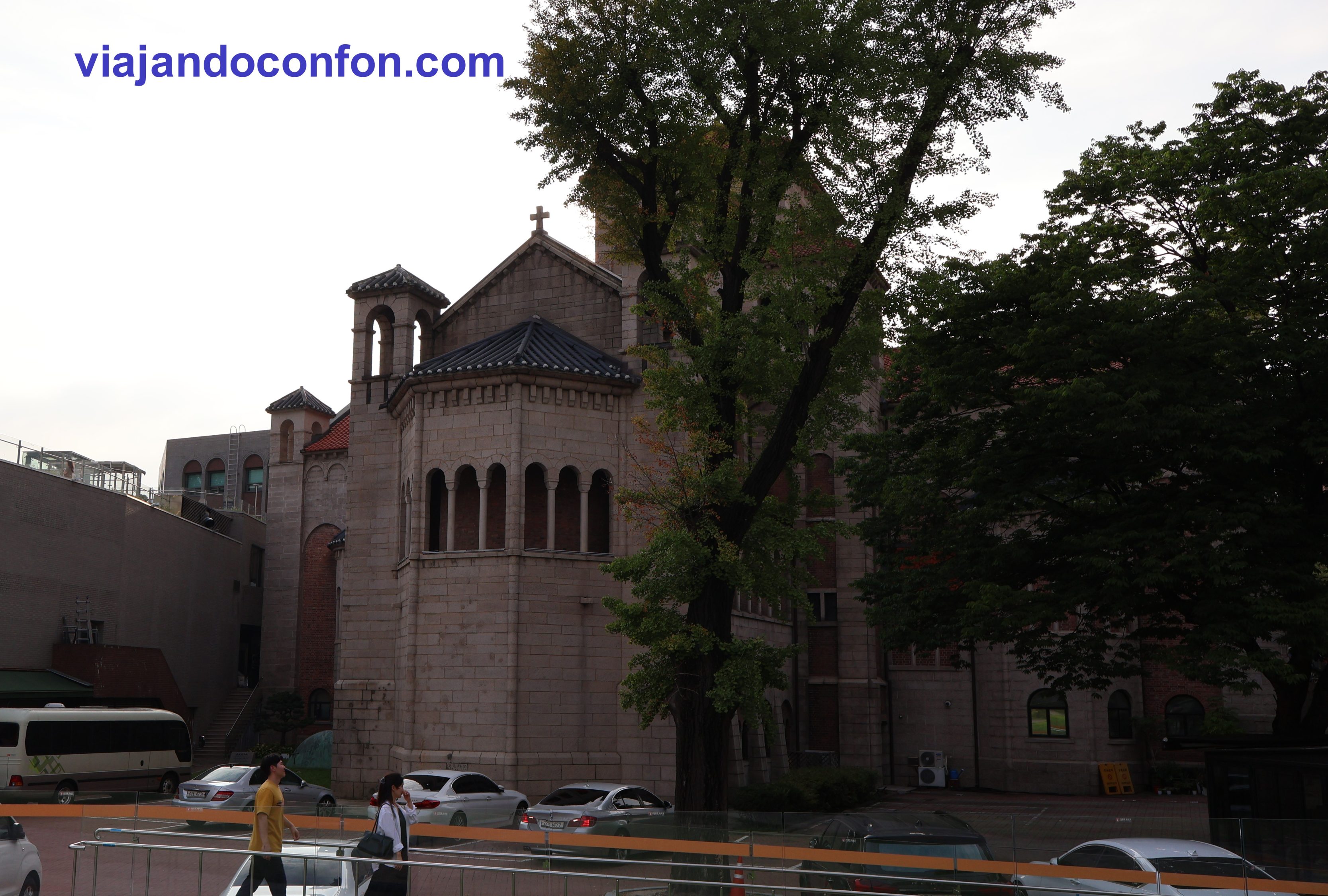
We got off at City Hall station. Nearby is the Cathedral of St. Mary the Virgin and St. Nicholas. This is the cathedral of the Anglican Diocese of Seoul.
In 1890 the first Bishop Charles John Corfe bought a hanok and land for the church on this site. He called this hanok Janglim Cathedral. In 1892 it was replaced by another hanok and its consecration took place.
After the purchase of adjacent land, the present cathedral was built in 1922.
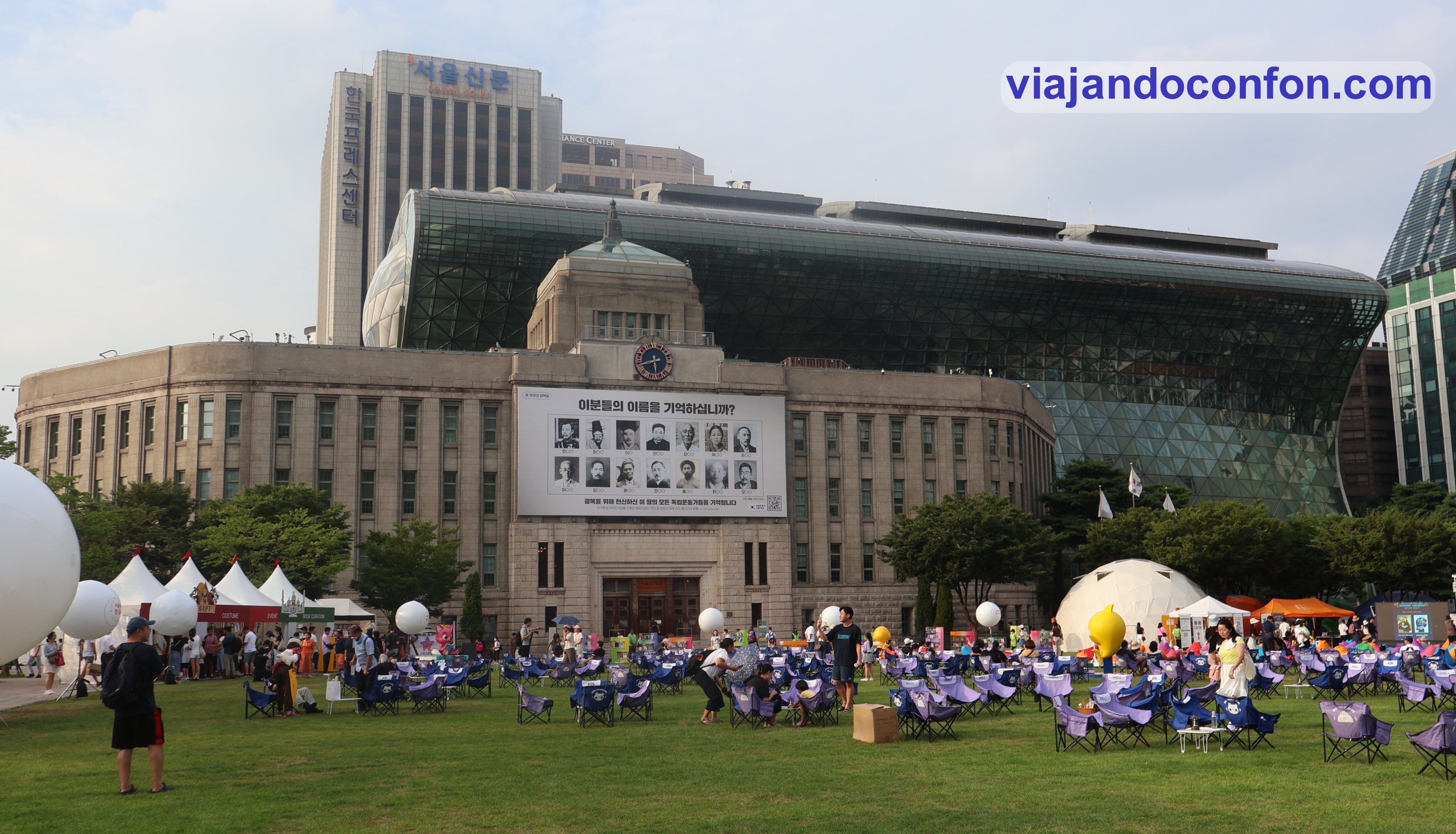
Directly opposite is the town hall building. It consists of two buildings. The original was built in 1925 during the Japanese occupation. It served as the city hall from the liberation of Korea in 1945 until 2008. It now houses the Seoul Metropolitan Library.
Behind it is the current modern building, which was opened in 2012.
At that time, the Jamboree 2023 was being held in South Korea. It was a kind of world scout convention. It was supposed to be held in Saemangeum, in the centre of the country. Because of the typhoon that hit Korea these days they had to be evacuated and brought to Seoul.
That meant that everywhere you went there were huge groups of kids, including the hotel where we stayed. To give you an idea, there were more than 400 kids just Spaniards.
In the town hall square they were organising events and it was packed with kids and stalls related to the Jamboree.
In one corner of the square there was also a stand commemorating the victims of the stampede on 29 October 2022 during the Halloween celebration in Seoul. On that day 152 people died.
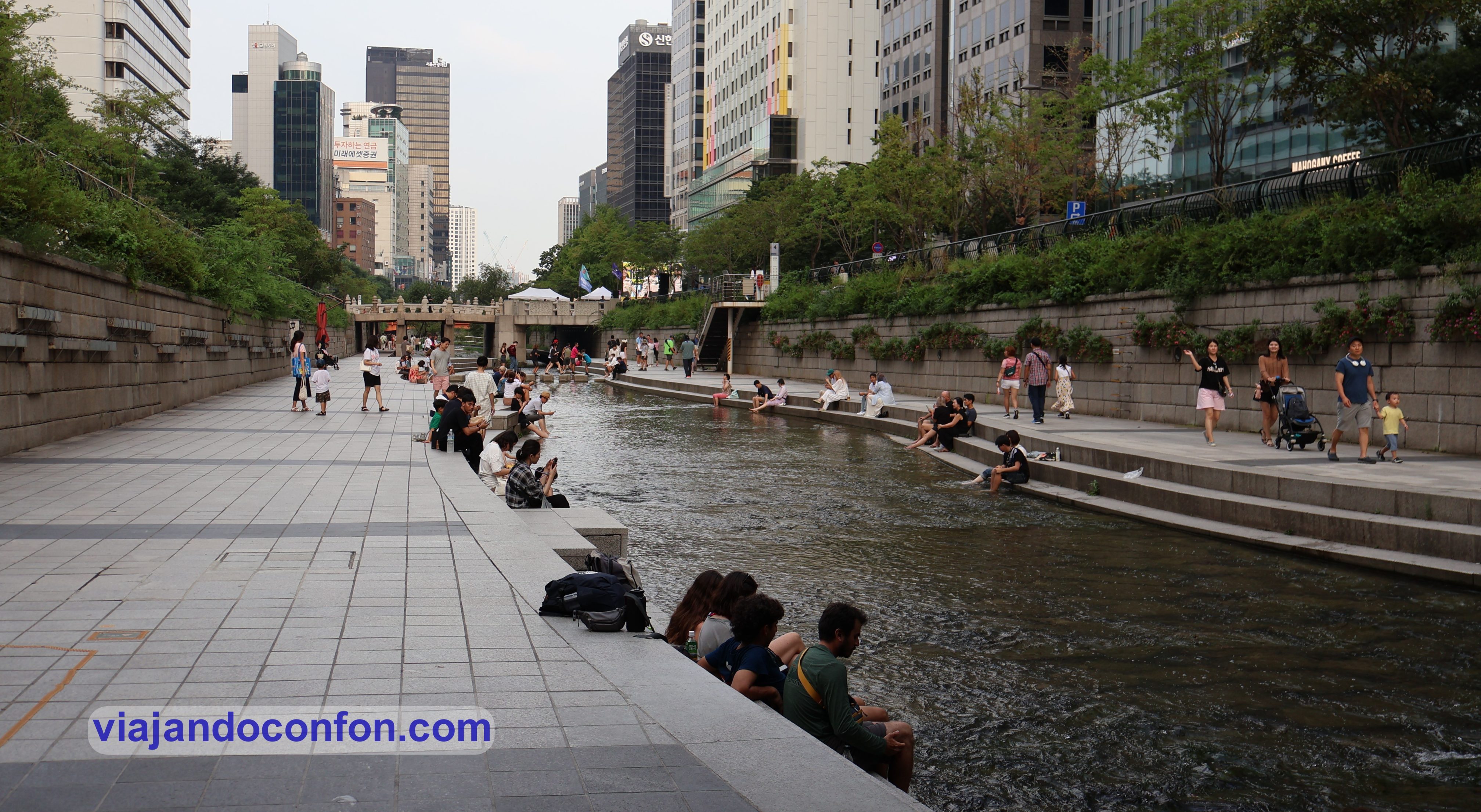
From here we went to the Cheonggyecheon stream.
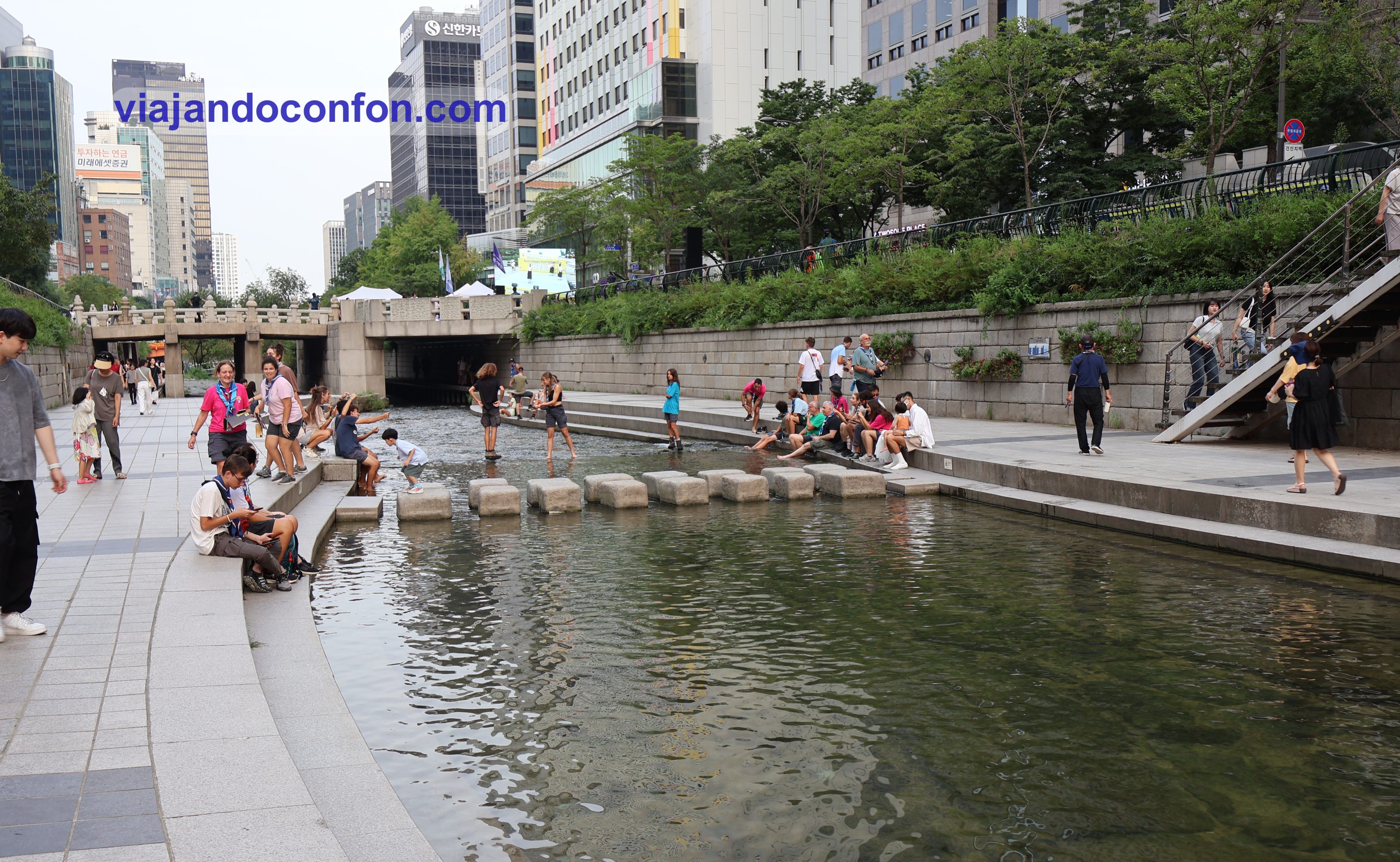
Cheonggyecheon Creek originates from Baekdongcheon Creek in the Inwansang Mountain Valley northwest of Gyeongbokgung Palace. It runs through the centre of Seoul and is almost 11 km long.
During the Japanese occupation, it was planned to cover the stream, but it was not realised. However, the project was realised between 1958 and 1978.
In 2003, the Metropolitan Government proposed a project to restore the area. In 2005, the restoration work was completed and about 5 km of the creek was repaired, leaving it as it is today.
Here we decided to sit down for a while and soak our feet in the water to cool off a bit. If it wasn’t forbidden, I think I would have jumped in head first.
One custom that we found very funny was that many women walked down the street with their fringes in curlers. You don’t see it in Spain, nor in the many countries we visited.
One example:
Here we could hear the music of a nearby concert with what sounded like traditional songs.
After a well-deserved rest, we headed to nearby Gwanghwamun Square. It is the nerve centre of Seoul. You will pass this place a thousand times.
In 1395, King Taejo established the city of Hanyang. In front of the palace, numerous government buildings were built, forming Yukjo Street. Some of these buildings were seriously damaged during the Japanese invasion in 1592.
During the Japanese occupation in the early 20th century, Yukjo Street was renamed Gwanghwamuntong Street. In 1926, the Joseon General Government built the Korean General Government building here and extended the street.
The current square was renovated in 2009.
The first thing we come across, at the southern end of the square, is the statue of Admiral Yi Sun Shin. He was a Korean admiral and general who successfully defended his homeland from Japanese raids in 1592. He is also credited with the invention of the turtle ship, although he only modified an existing vessel.
In the centre of the square is the statue of King Sejong the Great who reigned from 1397 to 1450. Among his many achievements was the creation of the Hangul alphabet, today’s Korean alphabet. Until that time only the Chinese alphabet was used. Changing it brought culture closer to the Korean people.
He also contributed to the development of agriculture and science, the systematisation of medical techniques, music and law, and the expansion of the national territory.
At the back of the statue is the entrance to King Sejong’s exhibition hall. There is an exhibition on the achievements of Sejong the Great.
King Sejong is considered the most admired figure by Koreans and his image appears on 10,000₩ banknotes.
At the northern end of the square is the Gwanghwamun Gate, the entrance to Gyeongbokgung Palace. But let’s not get ahead of ourselves. We will talk about it later.
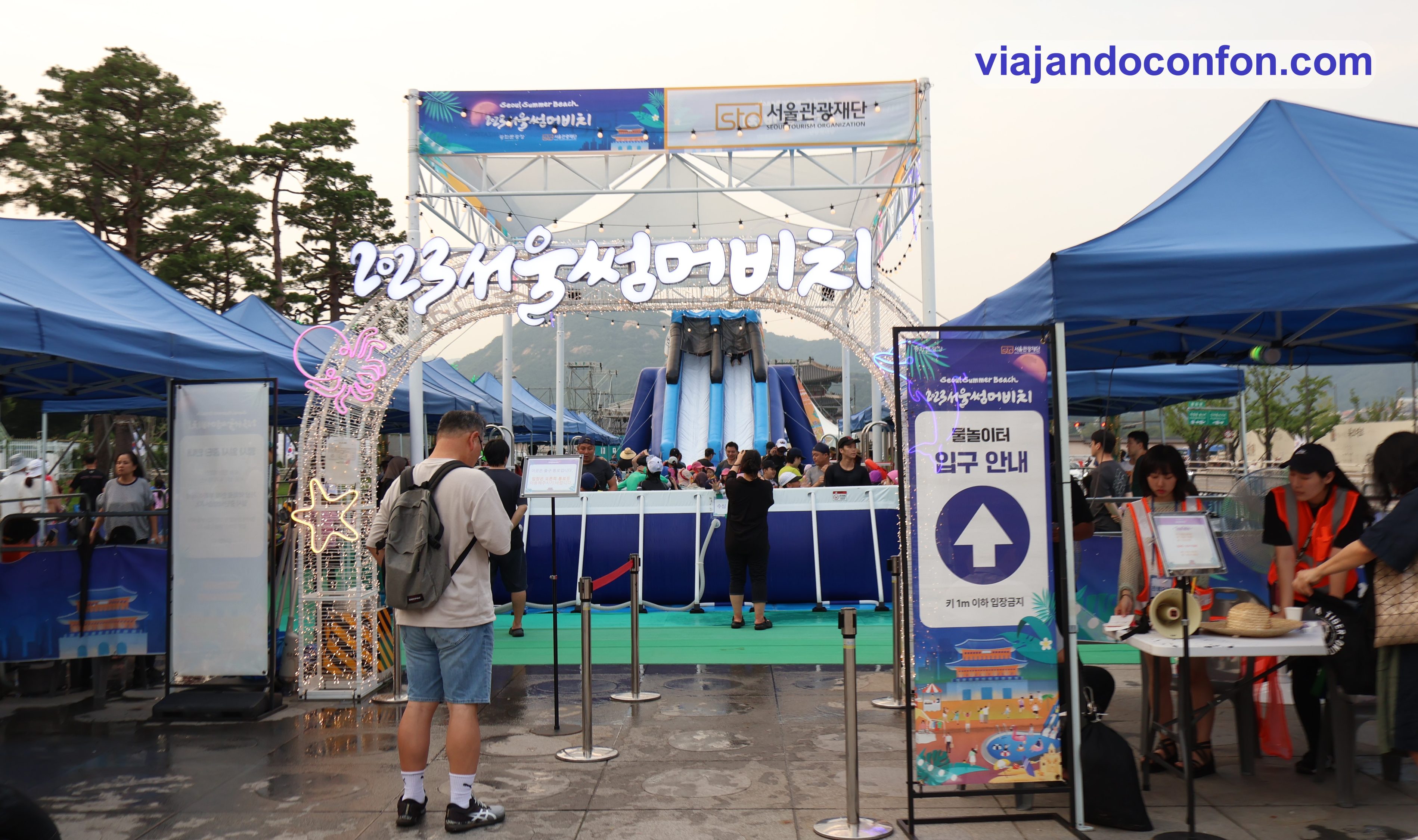
Those days there was some kind of event going on in the square. There were many food stalls, craft stalls and even a swimming pool. The pool was full to the brim.
The best thing was that there was a row of fans on display there, I don’t know why. But it was a good way to cool off…
On one side of the square there is also a monument to the 40th anniversary of the enthronement of King Gojong, the penultimate emperor of Korea.
Across the road to the north of the square is the National Museum of Korean Contemporary History. It was opened in 2012 and is an institution affiliated with the Ministry of Culture, Sports and Tourism of the Republic of Korea, which oversees matters related to the collection, preservation, research, exhibition, education and exchange of modern and contemporary Korean history.
From here we took a walk back to the hotel. On the way we passed Dongshipjagak. It is a guard post that was located in the old wall, now disappeared and belongs to the Gyeongbokgung palace.
Nearby is the Beobryeonsa Temple. It was built in 1973 and is dedicated to its founder, Bodhisattva Beopryunhwa. It is a fairly modern building, although its upper part has the appearance of a traditional hanok.
Now we are. We go to the hotel. We buy some dinner at the supermarket and go to sleep.
August 14th
Today we have to get up early again. We pack our bags because today we move, for one night only, to the city of Sokcho, on the east coast of South Korea.
But that’s in the afternoon. Now we visit a bit more of Seoul.
After a light breakfast with things we had bought at the supermarket the night before, we head to the spectacular Gyeongbokgung Palace.
The palace was inaugurated in 1395 three years after King Taejo founded the Joseon dynasty. It was built when the capital was moved from Gaeseong to Hanyang (present-day Seoul). Its name means “Palace Greatly Blessed by Heaven”.
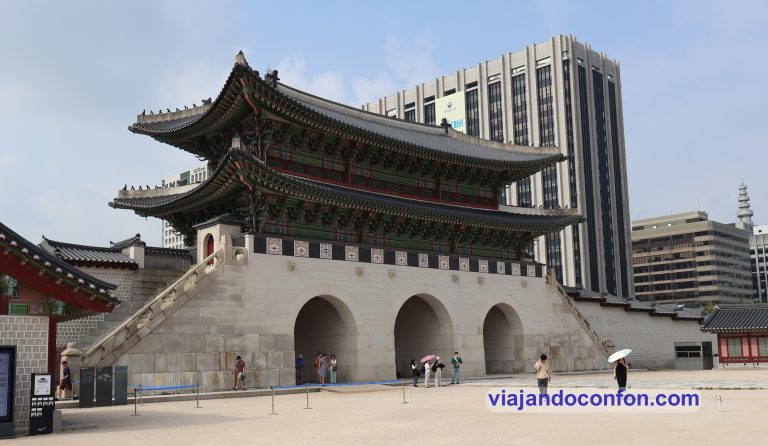
The first thing you come across is the Gwanghwamun Gate, the main gate of the complex.
The king used the central arch, while the crown prince and officials entered through the openings on either side. A bell in the gate pavilion announced the time of day.
During the bombings of the Korean War (1950-1953) the wooden pavilion was destroyed and the stone wall severely damaged. It was rebuilt in 1968 as a concrete structure, but restored to its original form as a wooden and granite structure in 2010.
Entering through the gate you come to a huge esplanade where the ticket booths are located. The price is 3,000₩ (€2.10) and is included in the Royal Palace Pass. It’s also free if you’re in traditional dress. In fact, there is an exclusive line for these people.
In any case, attending the concourse and the changing of the guard is completely free.
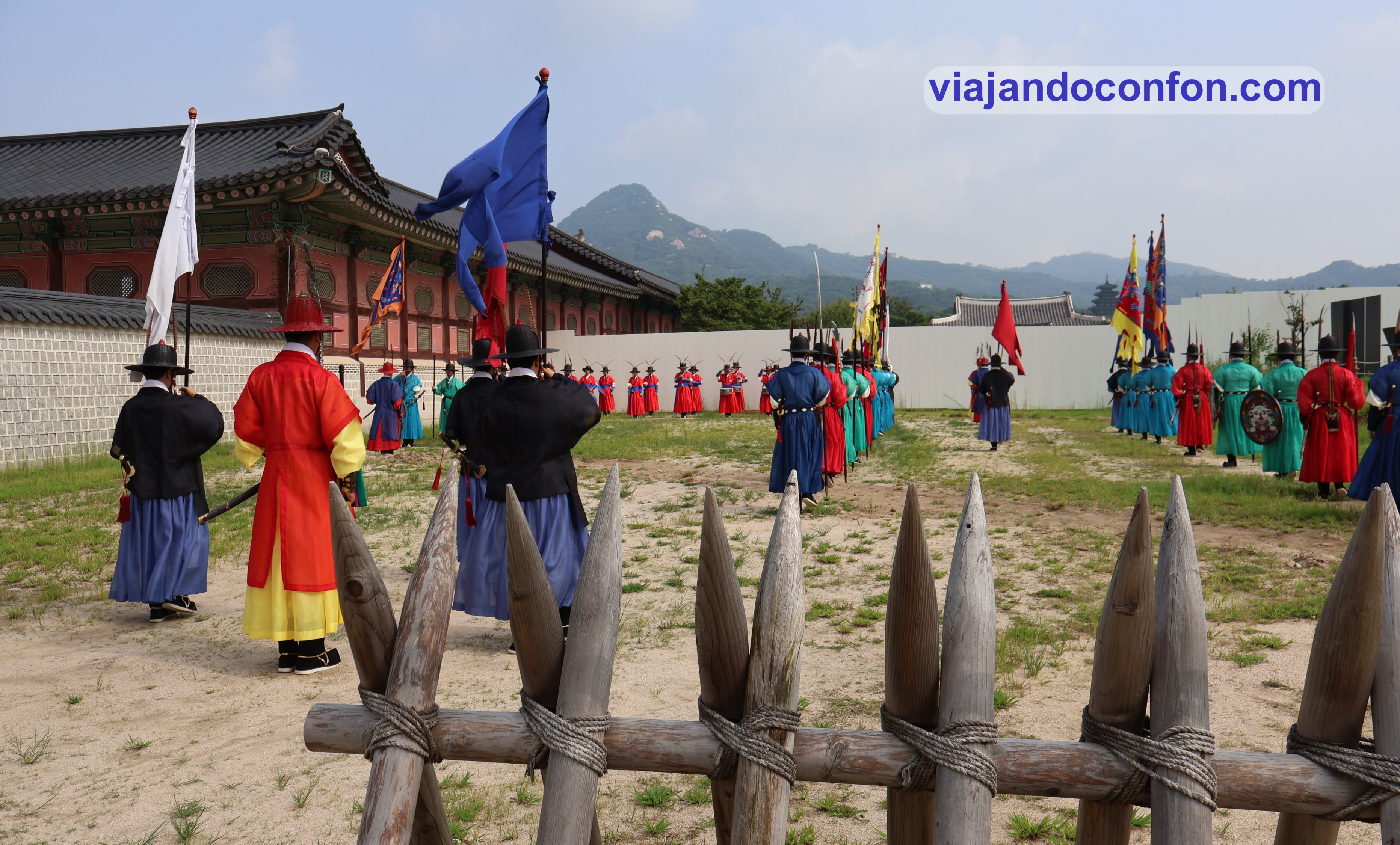
It is on this vast esplanade that the changing of the guard takes place every day (several times). But before that, on a small outdoor esplanade, outside the Hyeopsaengmun gate, a military training simulation is held. The Sumungun military training. That’s where we went.
As soon as it was over, we returned to the esplanade, where the changing of the guard was about to begin. We positioned ourselves well and enjoyed the spectacle.
Once the show was over (it lasted about 20 minutes), we were ready to enter the palace. But after the changing of the guard, there were about a million people trying to get in at once.
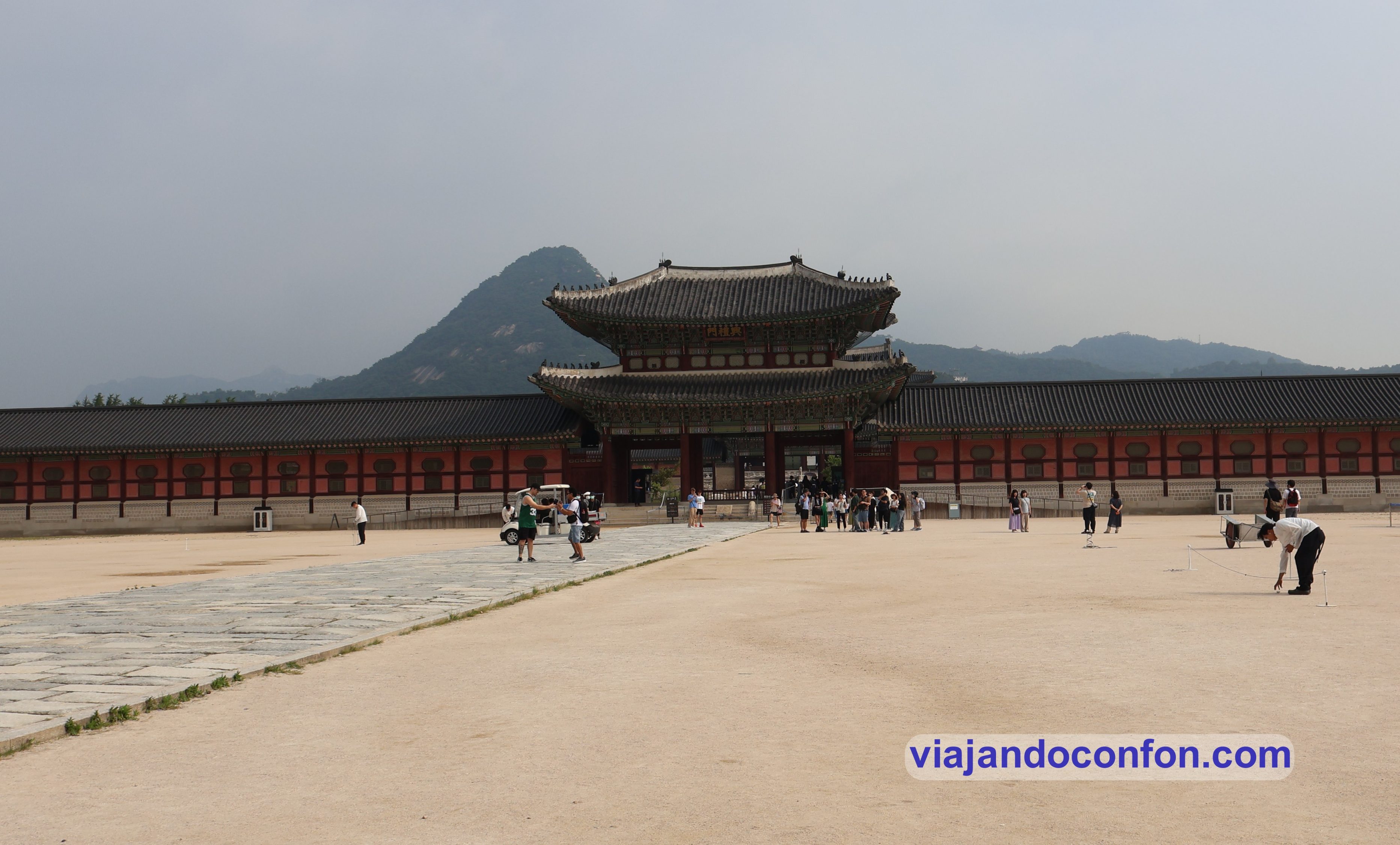
We walked around a bit while the entrance was clearing up a bit and off we went. The entrance is through the Heungnyemun Gate.
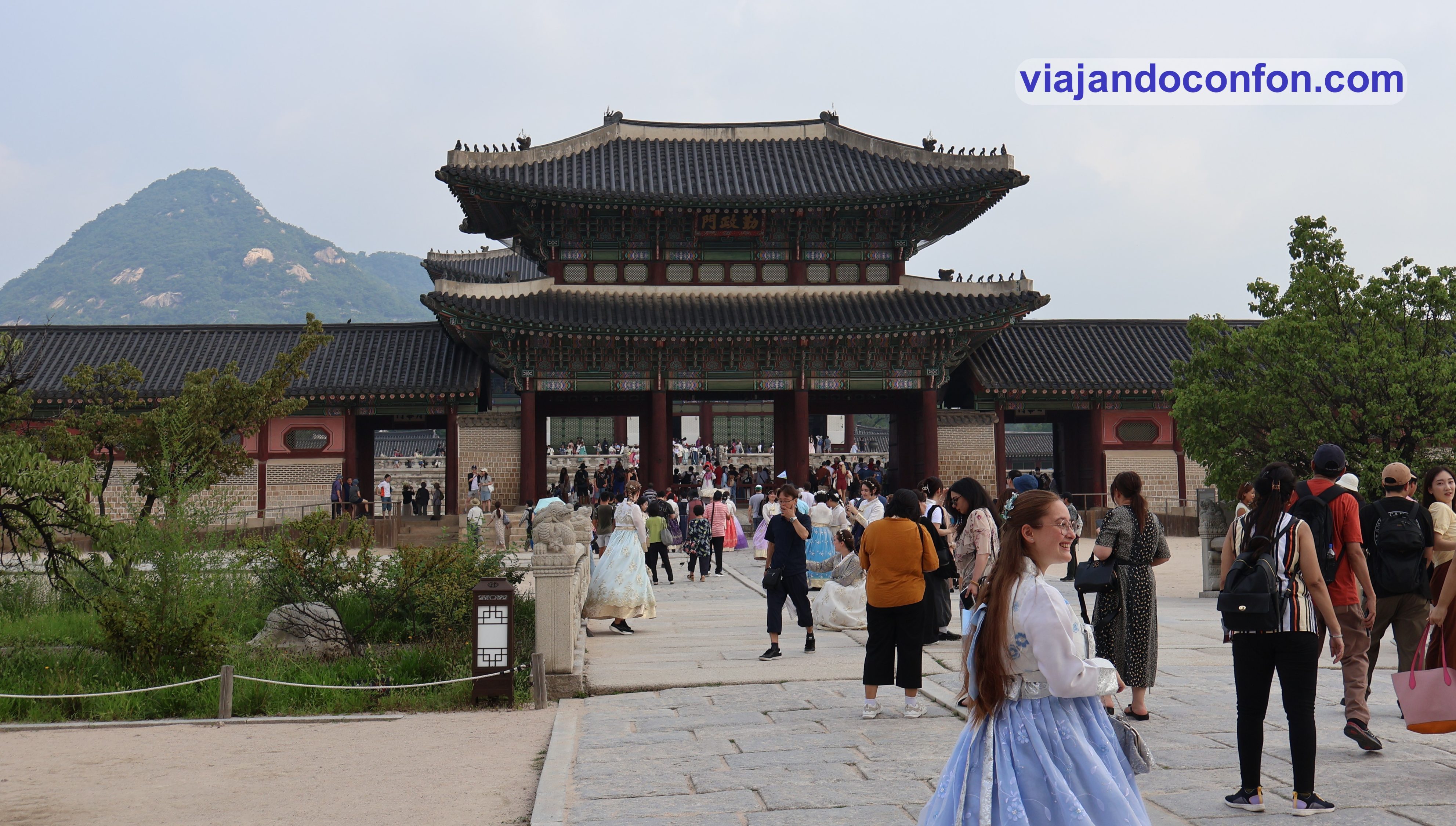
We pass through the gate and enter another esplanade. This is crossed by the Geumcheon Stream, which is designed to flow through the palace from west to east after descending from Mt Baegak.
The stream is crossed by Yeongjegyo Bridge. In the background is Geunjeongmun Gate.
Beyond the gate is Geunjeongjeon. This is the central palace building where the subjects greeted the king on New Year’s Day, held national ceremonies and received foreign envoys.
It was built in 1395, although the present building is a reconstruction from 1867.
We leave through a small gate to the west of the Geunjeongjeon forecourt and go to the Sujeongjeon Pavilion.
It is located in the grounds of the former Gwolnaegaksa Temple and was the seat of civil affairs, including the establishment of the Hangul. It was also an institution that conducted academic research during the reign of King Sejong and advised and suggested important policies to the king.
Sujeongjeon is the only surviving building of Gwolnaegaksa Temple.
Behind it is Gyeonghoeru. It is set within a large pond and was a place where banquets were held when auspicious events occurred or envoys visited the country.
We re-enter the palace grounds and move on to Sajeongjeon. This was where the king worked on state affairs, including morning council meetings, administrative reports and discussions, and policy formulation with government officials.
Behind, through another gate is Gyotaejeon, the queen’s quarters. To one side is Jagyeongjeon, the King’s mother’s quarters.
We visited a lot more buildings but they were all closed. We went out from the north onto a large esplanade. Here we found the Jipgyeongdang Hall. This was where the king’s concubines stayed.
Behind it is the beautiful Hyangwonjeong Pavilion in the centre of a large pond.
In 1873, King Gojong built Geoncheongung Palace in the northern part of Gyeongbokgung to assert his political independence from his father, Prince Regent Heungseon. This northern palace included rooms for the king and several dormitories.
It was here that a tragic chapter in Korean history was recorded in 1895, when Empress Myeongseong was assassinated by the Japanese.
Originally, the Chwirojeong Pavilion stood on the islet in the centre of the pond and was replaced by a hexagonal pavilion called Hyangwonjeong when Geoncheonggung was built.
It makes for a beautiful landscape.
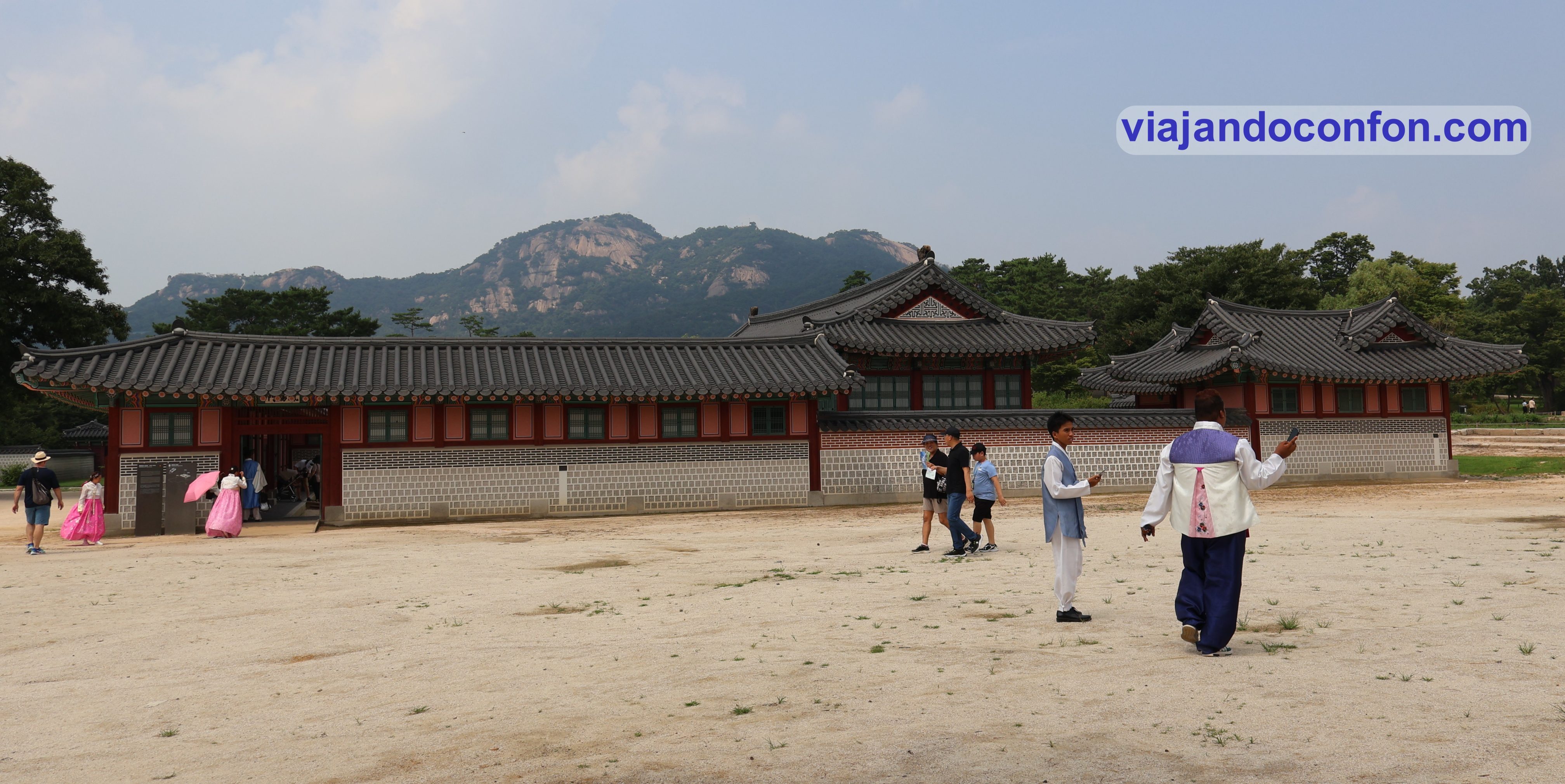
At the northwestern end of the compound are Jibokjae and Hyeopgildang.
After Gyeongbokgung Palace was severely damaged by fire in 1876, King Gojong moved temporarily to Changdeokgung Palace.
He returned here in 1888 and spent his time at Geoncheonggung. Jibokjae (Jade Gathering Hall) and Hyeopgildang Pavilion were moved from Changdeokgung Palace to positions west of Geoncheonggung.
These buildings were used as a library and reception hall to receive foreign envoys.
This is the end of our visit to the spectacular Gyeongbokgung Palace. All that remains is to exit through Sinmumun Gate.
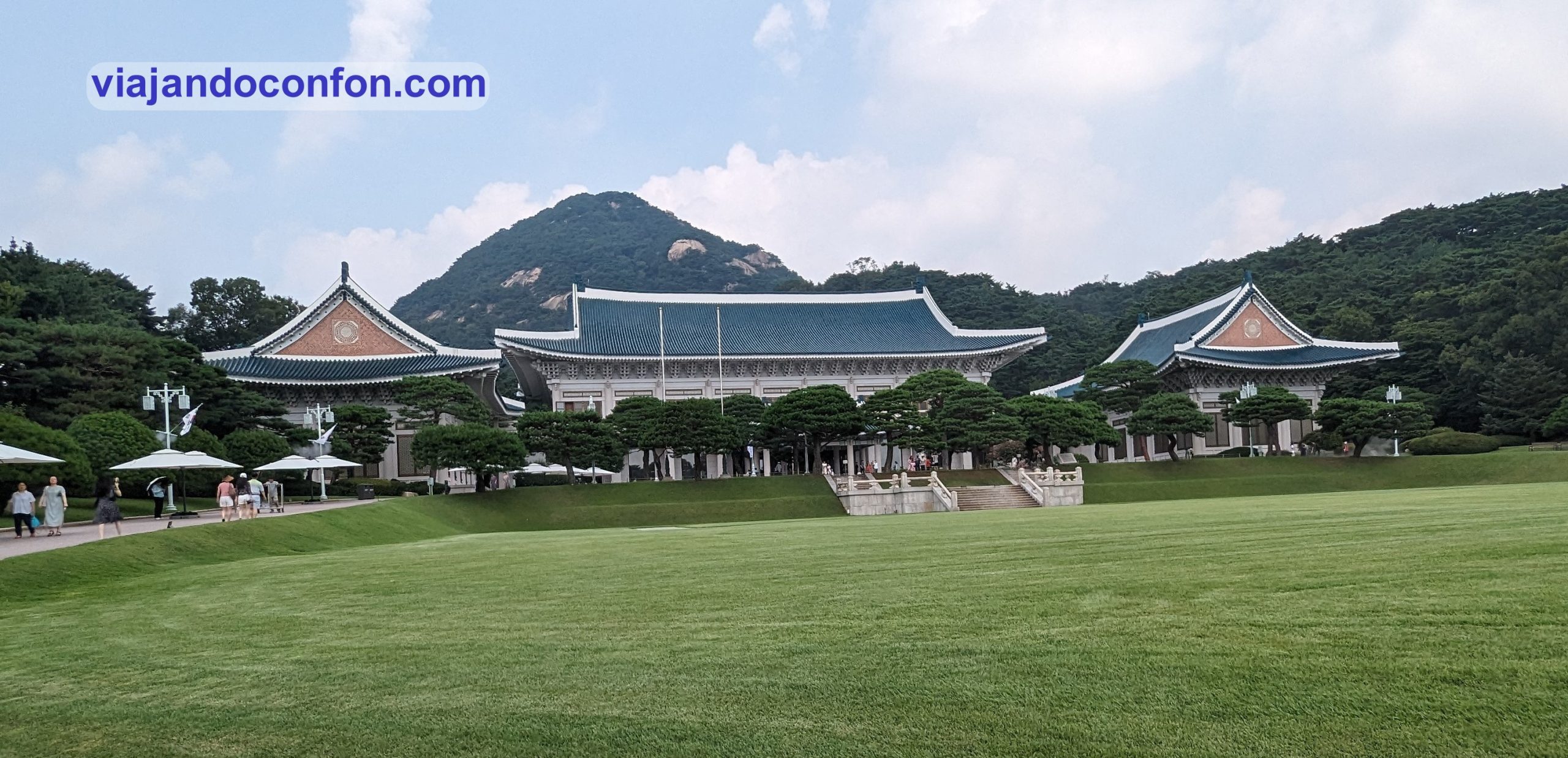
We leave the palace and, crossing the street, we come across Cheong Wa Dae or The Blue House. This is the former executive office and official residence of the president of South Korea from 1948 to 2022.
Cheong Wa Dae is a complex of multiple buildings constructed largely in the traditional Korean architectural style with some modern architectural elements and facilities.
It was formerly the site of the Joseon dynasty’s royal garden dating back to 1426. The complex burned down in 1592 during the Japanese occupation and remained abandoned for 270 years.
In 1865, Prince Regent Heungseon began reconstruction in the second year of King Gojong’s reign.
During the Japanese occupation in the early 20th century it was used to hold the Joseon Exposition from 1937 to 1939 and later served as a park before the official residence of the Japanese governor-general was built on the site.
After registering our passports at the entrance and passing a strict security check, we enter the grounds. The gardens are beautiful.
We go through another security check into the building and visit the offices and various rooms, which include a collection of objects used by the different presidents and the president of South Korea, portraits of everyone and photos of the first ladies… and even a security guard sleeping in a chair. The poor guy must have had a bad night.
By the way, admission is free.
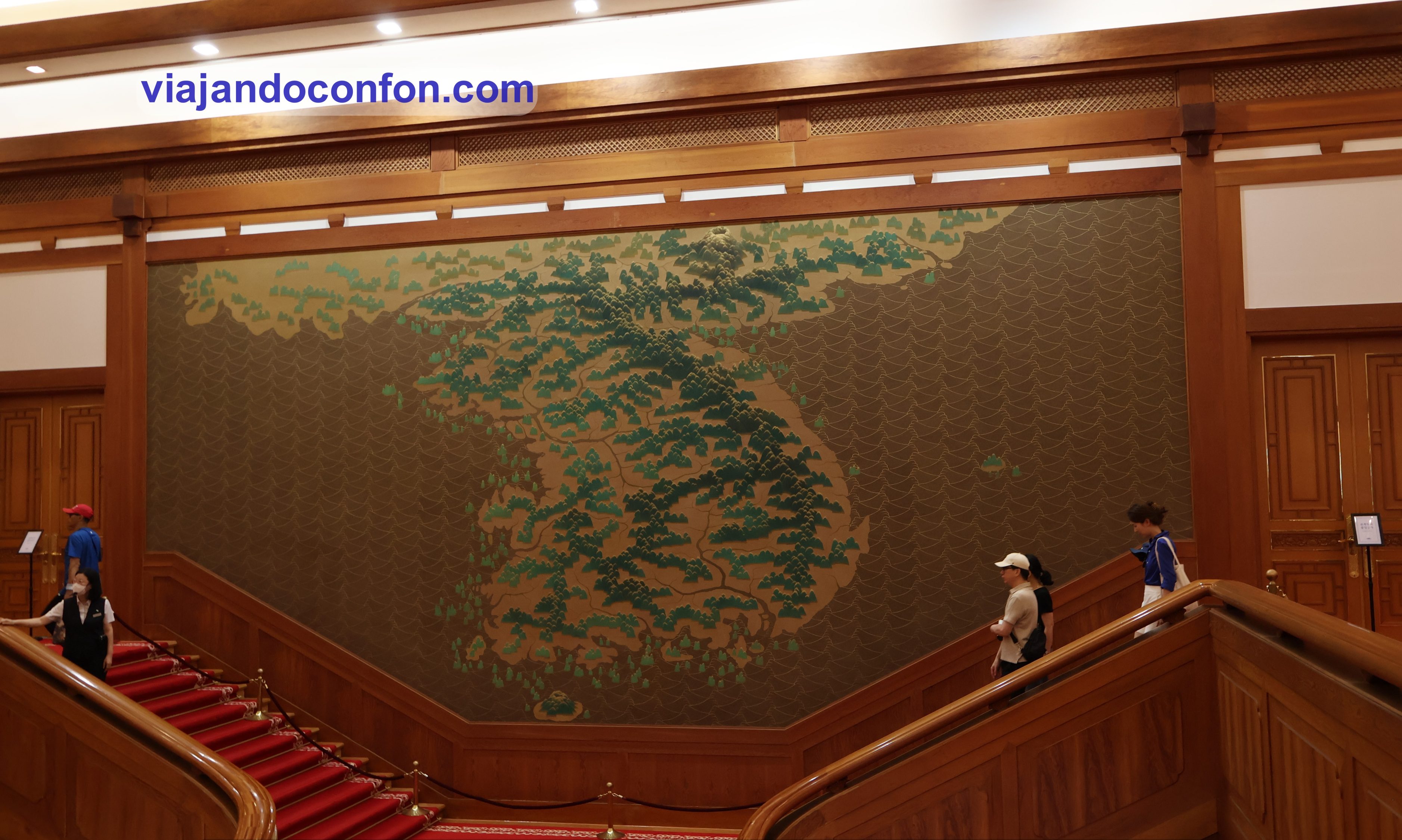
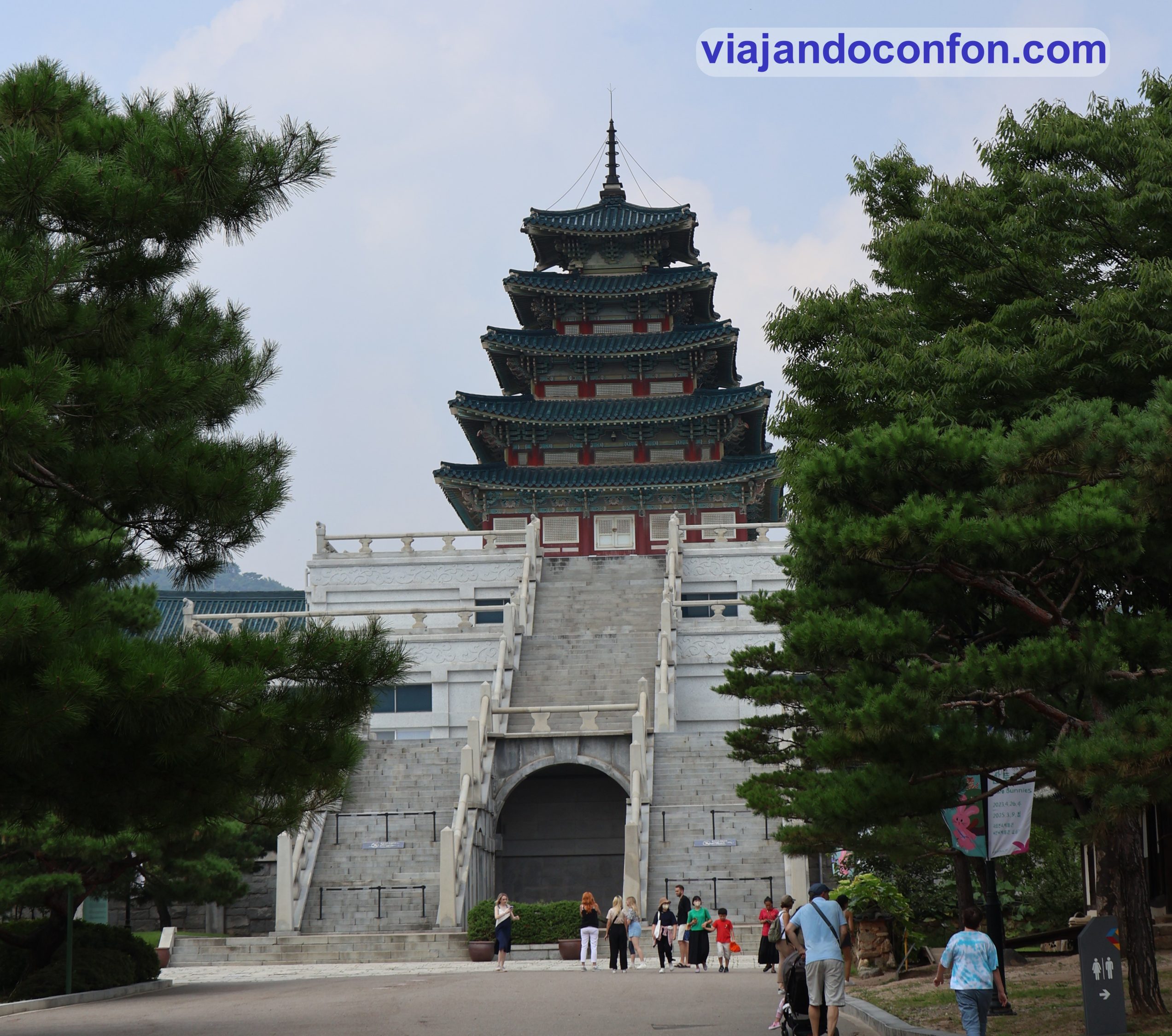
From here we took a nice, hot walk to the National Folk Museum of Korea. It was founded in 1946 and is a museum representing Korean daily life and culture. It is visited by more than two million people every year.
The beautiful building alone is worth a visit. You can also see many exhibits in the gardens.
It was getting late in the afternoon and the rain was beginning to take its toll. As we had to take a bus to transfer the camp, we decided not to complicate our lives. We ate at the same Korean barbecue restaurant as a couple of days ago. It was close to the hotel, too.
Today it was very crowded but the service was just as good and the food just as spectacular.
After lunch we picked up our stuff at the hotel and went to the Express Bus Terminal. Our new destination is the city of Sokcho, on the east coast of South Korea.
At 15.40 we take the bus. It is about 3 hours to our destination, but that is information for the next entry.
Discover the best activities and tours in Seoul with Civitatis:
To travel to Seoul, we chose the Finnish airline FinnAir. It was the best value for money but it was really a mistake. With the closure of Russian and Ukrainian airspace due to the invasion of Ukraine, the flight made a big detour, taking 12 hours one way and 14 hours return.
The plane was quite comfortable but another negative aspect was the food. 2 meagre meals for such a long flight. On the way out we were hungry as hell.
We learned our lesson and on the way back we didn’t take a few sandwiches and a bunch of junk with us. On the way back, there was a gap of more than 8 hours between the two meals. Very, very bad.
August 8th
At 20.15 in the evening we took off on time from Malaga airport. Four and a half hours later we landed in Finland. It was 1.45 in the morning there.
The stopover is long: 16 hours. That’s why I decided to book a hotel near the airport. The Holiday Inn Vantaa Airport. It cost us 119€. The hotel was simple and comfortable but quite old.
Find your ideal hotel in Helsinki at the best price on Agoda:
But there was an unforgivable issue with the hotel. Before I booked it, through the chat on their website, I asked if there would be any problem with the free transfer they offer at the time the flight landed. I was told there would be no problem.
Two days before arrival, I contacted them again to remind them of the time. It turned out that the last transfer trip was at 1.10am. So they screwed me. 19€ taxi fare to get there and the taxi driver’s annoyance at such a short journey.
August 9th
We get up at about 10 am and have breakfast with some biscuits that we had brought along. We put on our swimming costumes and went in search of the Finnish sauna that I had seen in photos of the hotel.
Well, that’s another lie. There is no sauna. We go back to the room, pack our things and check out.
We go to the shopping centre which is a 10-minute walk from the hotel for a stroll. We took the opportunity to have an early lunch.
We ate in an American themed place from the 50’s called Classic American Diner. Very good burgers at a good price for Finland. It cost us 45.38€.
After lunch we return to the hotel to take the transfer to the airport.
At 17.30 the flight to Seoul leaves on time. We have 12 hours and 50 minutes to get to the South Korean capital.
August 10th
Around 11 am we finally landed at Incheon International Airport. Exhausted and hungry, we get off the plane, go through immigration and pick up our bags. It takes forever for them to come out.
We go straight to take the AREX express train. It takes 40 minutes to travel the 60 km from the airport to Seoul station. The ticket costs 9,500 won (6.60€).
We left the station on our way to the hotel and… Seoul greeted us with rain. We were in the middle of a typhoon in South Korea and it was going to last for a couple of days.
Buy your Arex Express ticket conveniently at the following link:
Curiosity number 1 as soon as we arrived in Korea. At the central train station on the way to the underground, we found conveyor belts for the suitcases to overcome the flights of stairs. Very convenient.
If you prefer more comfort, you can hire an efficient transfer service:
With all the rain and the exhausting plane ride, we decided to take a break and have something to eat at the hotel. We chose the Ibis Ambassador Seoul Insadong. 2 stars for 80€ a night.
It was to be a busy stay, which we will explain later. We were given a room on the 10th and last floor. In line with all the Ibis in the world and with a good view of Insadong Hanok Village.
Find your ideal hotel in Seoul at the best price on Agoda:
Views from the hotel
Ikseondong Hanok Village
After a short break, we set out for a short walk to get a feel for the city. We went to Gwanghwamun Square, the nerve centre of the South Korean capital.
Unfortunately, the typhoon took a toll on our small umbrellas and we had to buy bigger and stronger ones. Even so, the tiredness and the water took its toll on us. We decided to buy some dinner in a combini and went to rest.
Tomorrow is another day.
11th August
We get up early to make the most of the day. I look out of the window and… it’s still raining. We have some breakfast that we had bought at the supermarket and we set off.
We set off for the nearby Changdokkung Palace Complex.
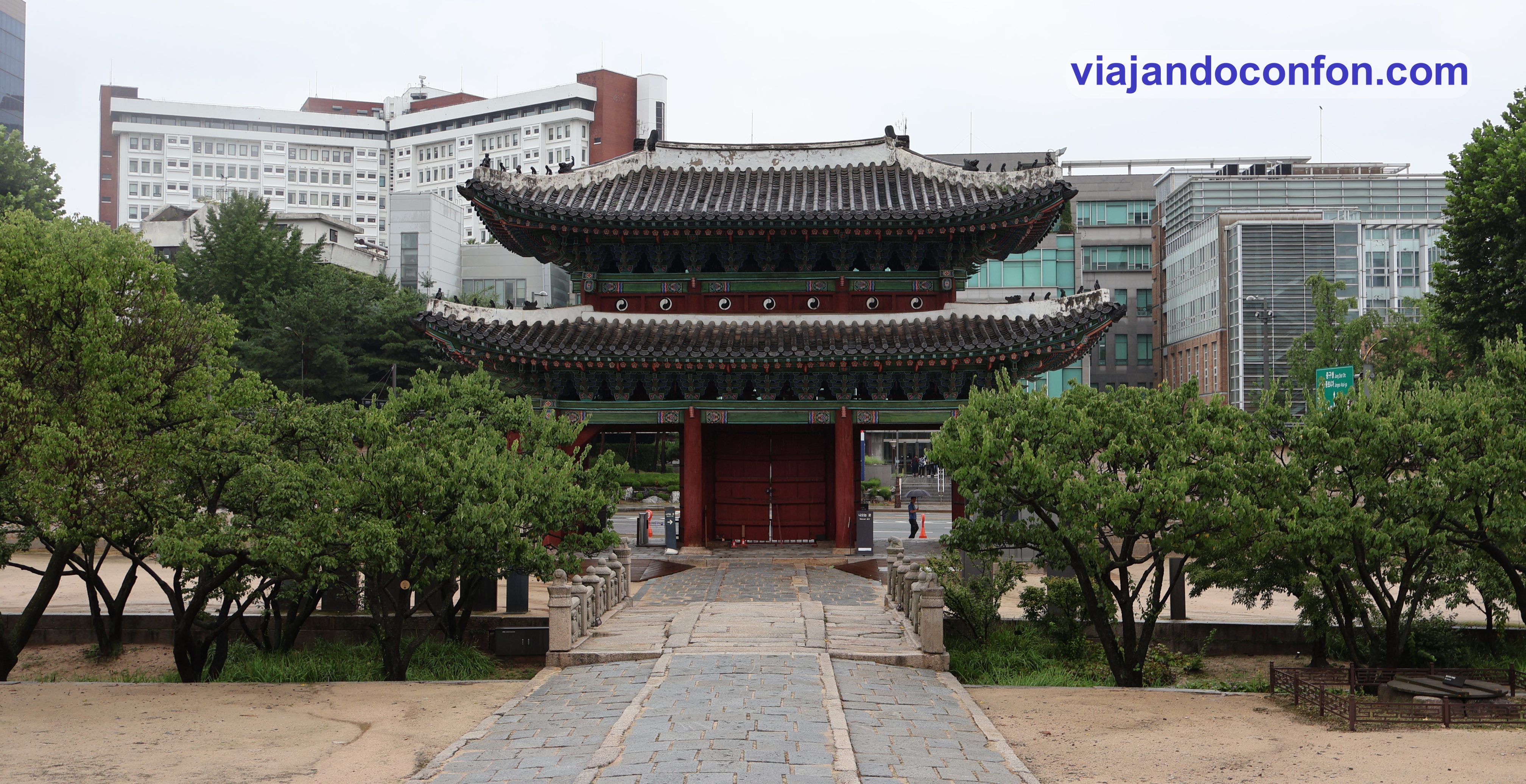
Donhwamun Gate
Fortunately the rain respected us from time to time. At times it rained heavily, at others a little, and at some (very short) moments it stopped raining.
We went to the office next to the palace to get our tickets. We bought the Royal Palace Pass. It costs 10,000₩ (7€) and gives us access to five palaces and temples, including the Secret Garden. The pass is valid for 3 months from the date of purchase.
Royal Palace Pass
The individual price of the Palace is 3,000₩ (€2) and if you want to visit the Secret Garden (a must) you must add a supplement of 5,000₩ (€3.50). As you can see, these two tickets almost cover the total price of the Royal Palace Pass.
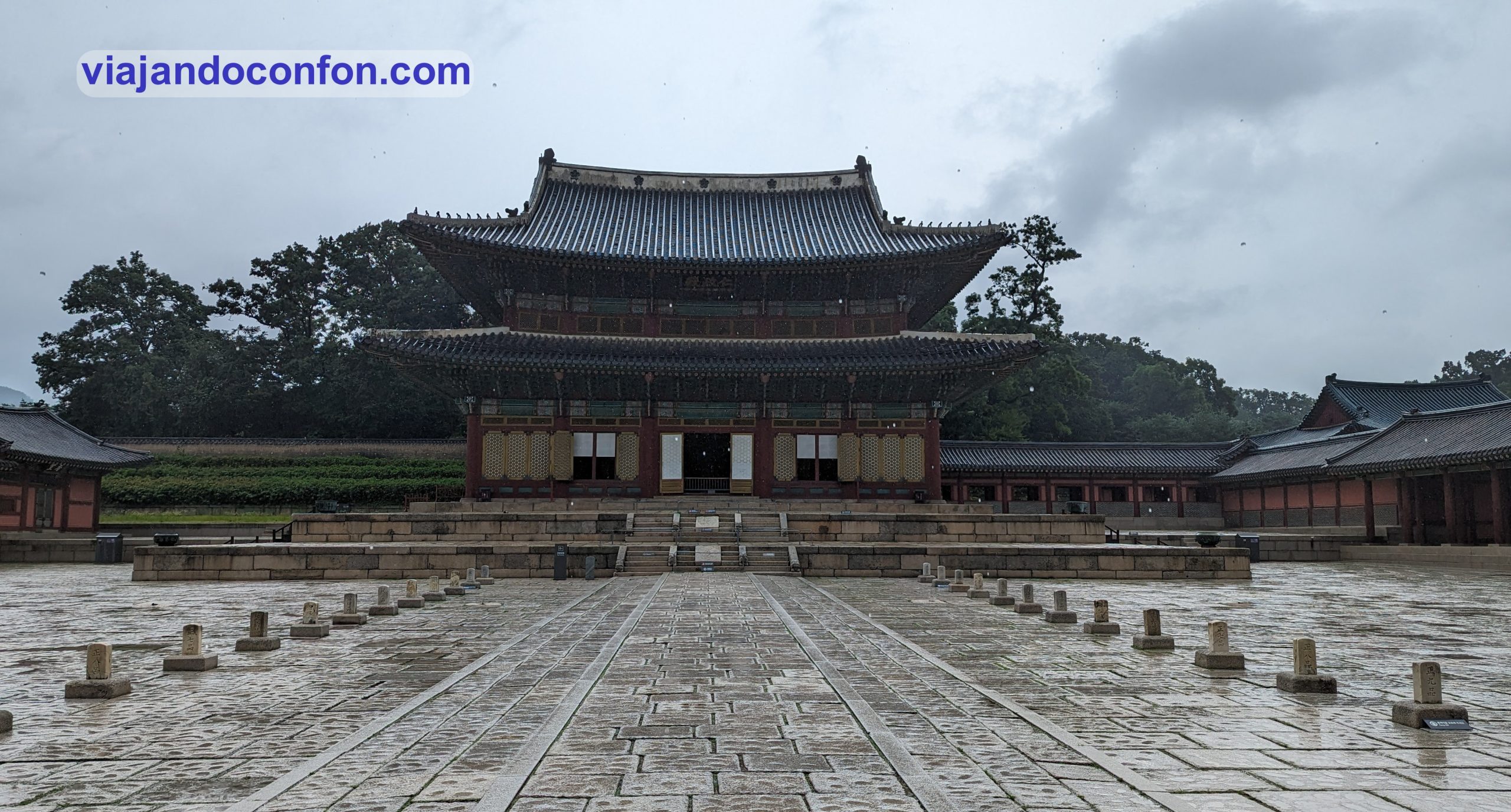
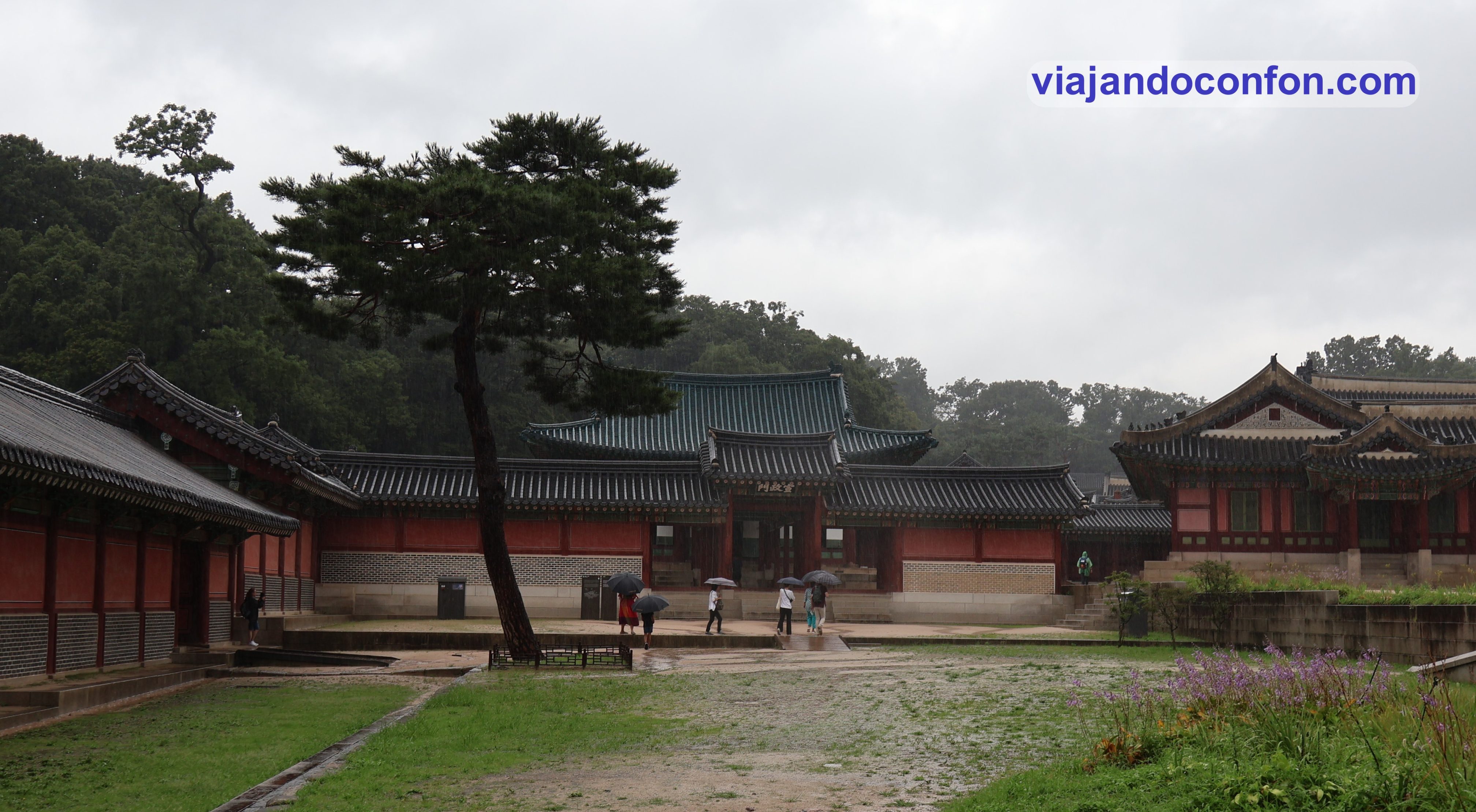
Changdeokgung Palace was a favourite of the kings of the Joseon Dynasty (1392-1910) because of its spacious and beautiful back garden.
It was built as a secondary palace for the Joseon in 1405. After its destruction during the Japanese invasion (1592-1598), it was rebuilt in 1610 and served as the main palace for about 270 years.
Typhoon in Seoul
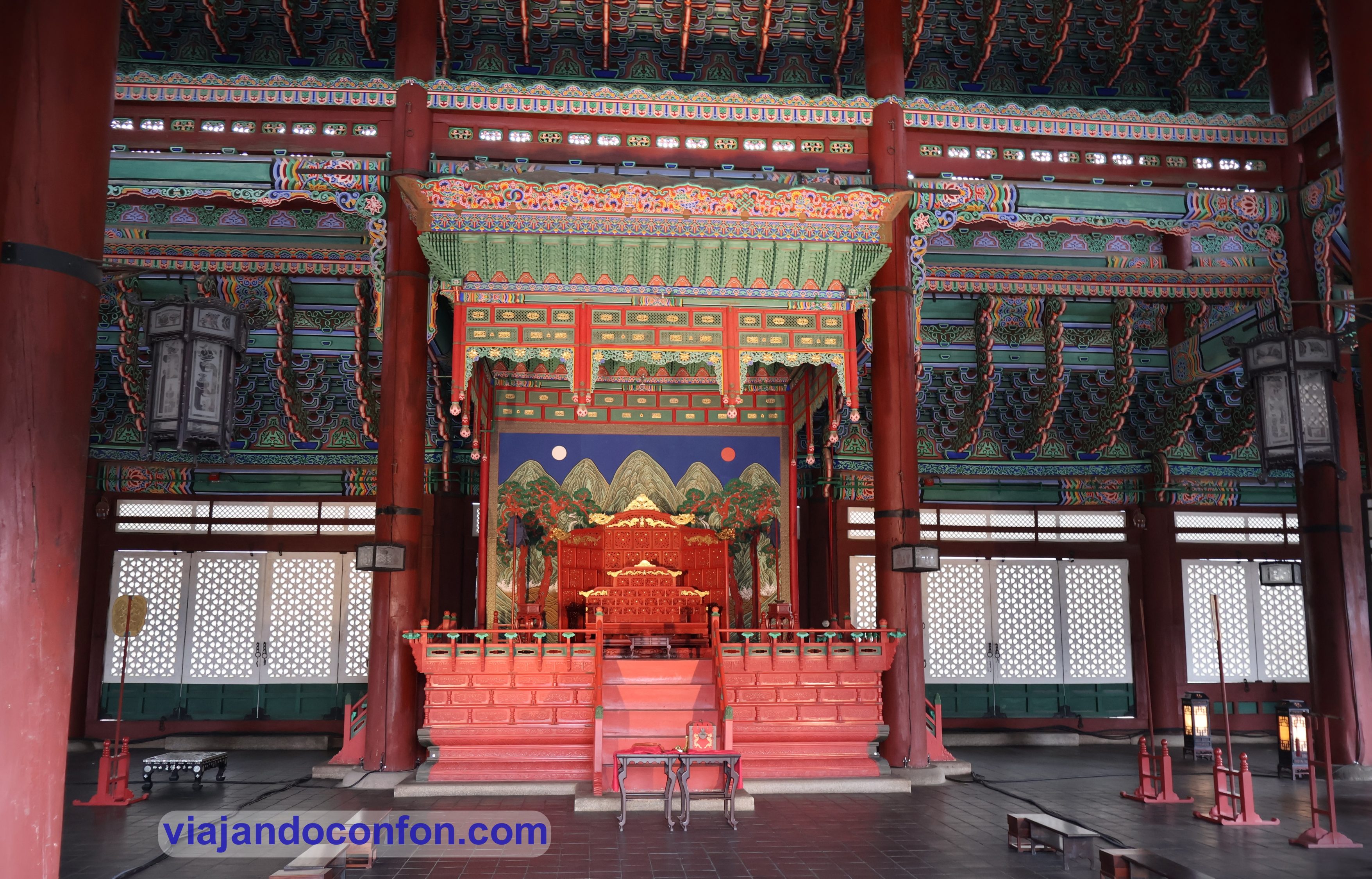
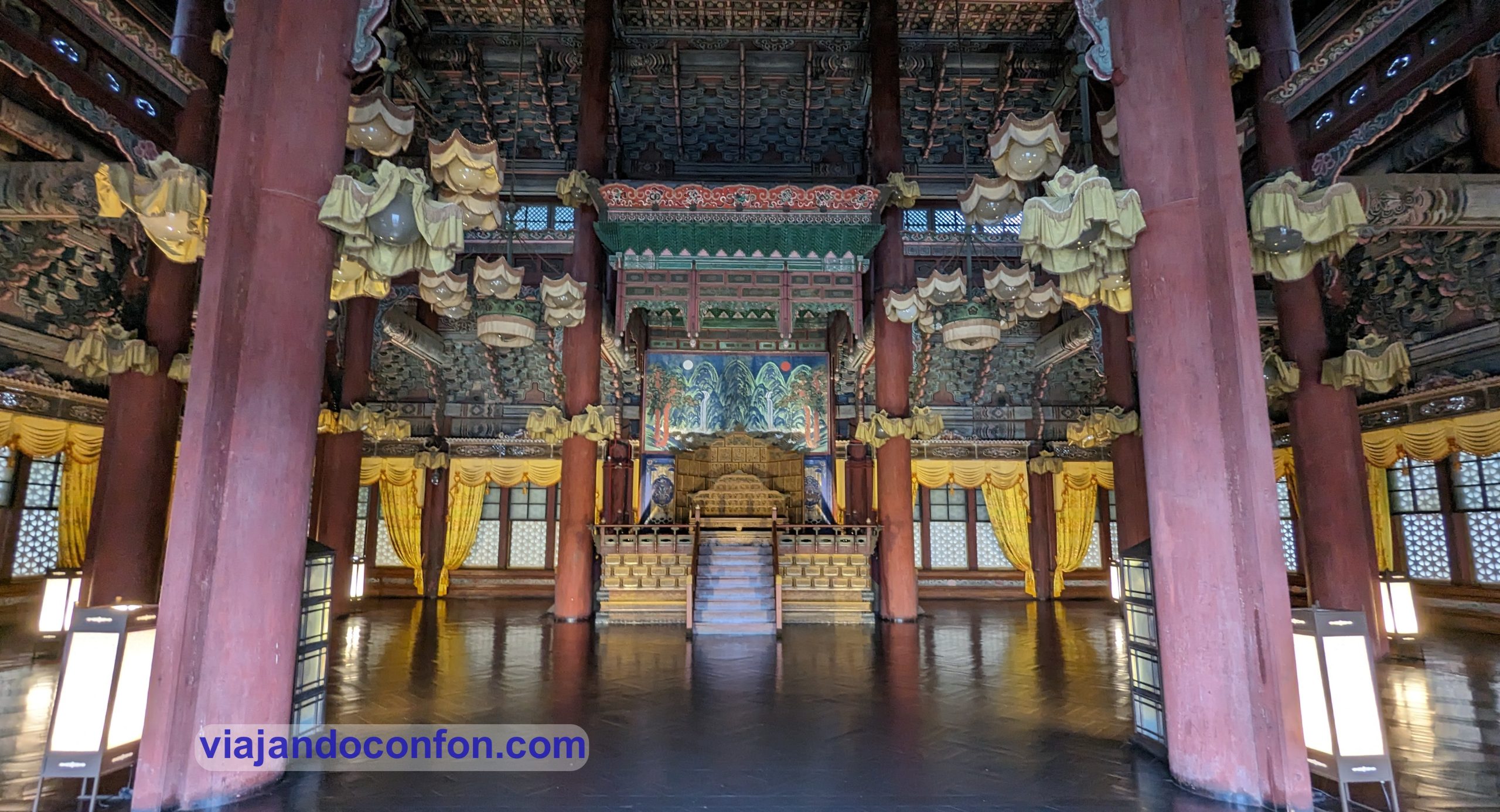
Injeongjeon Hall is the throne room, which was used for more formal state events such as ministerial audiences, coronation ceremonies and receptions for foreign envoys.
Injeongjeon Hall
Injeongjeon Hall
Injeongjeon Hall
Seonjeongjeon Hall is the ruler’s council hall and the only remaining structure in Changdeokgung Palace with a blue-glazed tile roof.
Seonjeongjeon Hall
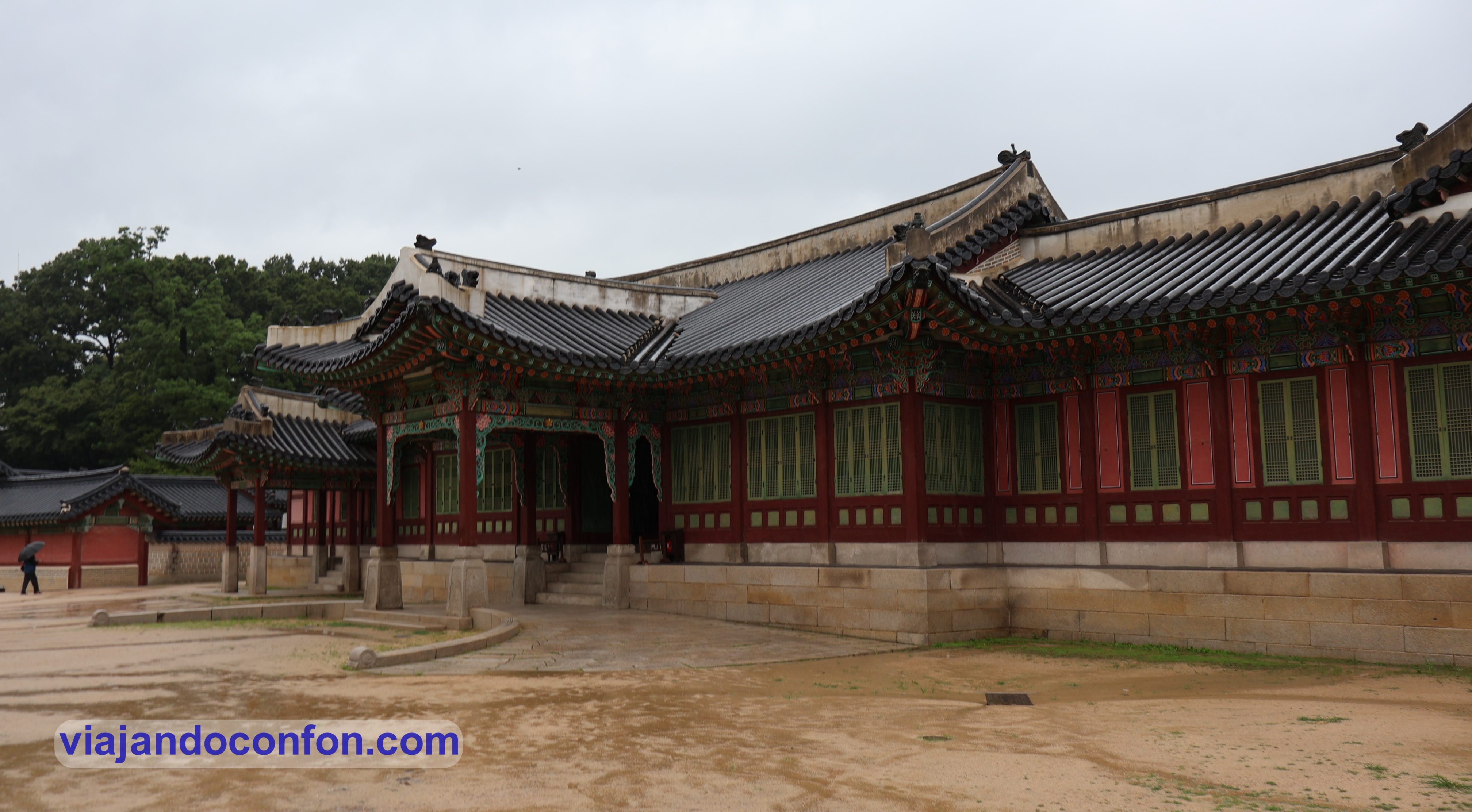
The king’s residence is Huijeongdang Hall, while the queen’s residence is Daejojeon Hall, Huijeongdang Hall was more than a royal bedroom; the king also worked there informally.
Huijeongdang Hall
After visiting this first part of the complex, we went to the meeting point to visit the Secret Garden. Currently the garden can only be visited by guided tours. We had an appointment at 10 o’clock.
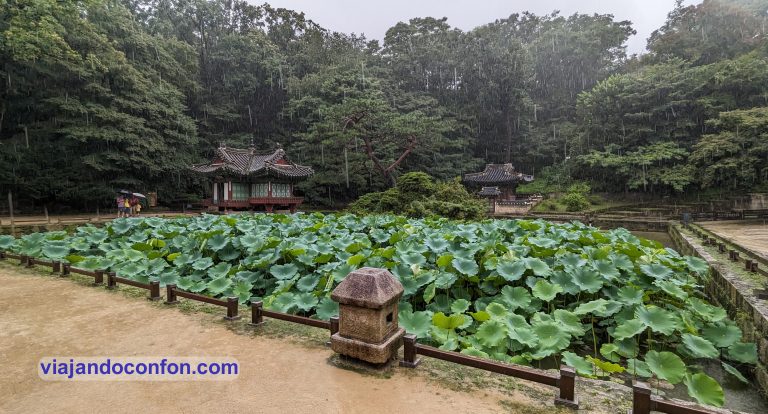
The Secret Garden was intended as a place for kings and members of the royal family to relax. But it was also a place for various outdoor activities.
The early Joseon kings participated in military exercises here, and archery competitions were held here. There were also banquets for the queen dowager, prominent relatives of the king and high-ranking ministers.
The Secret Garden occupies almost 60% of the total area of Changdeokgung Palace, and in the old days even tigers occasionally made an appearance.
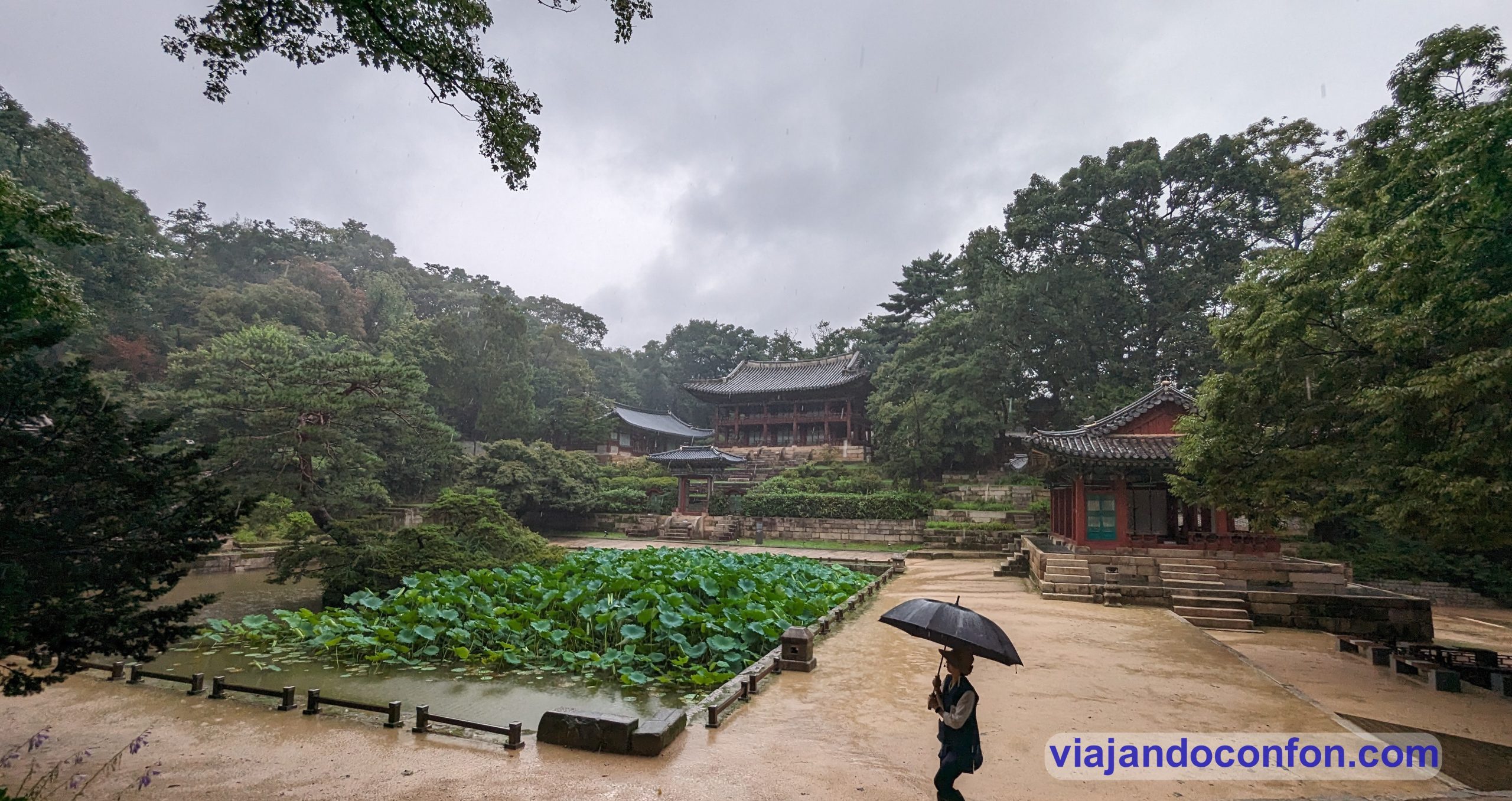
The spectacular scenery of the Buyongji Pond area is striking. This was not there in the early days of the palace. It was built in 1707. It survived the Japanese colonial period and the Korean War without being demolished.
Buyongji
Buyongji
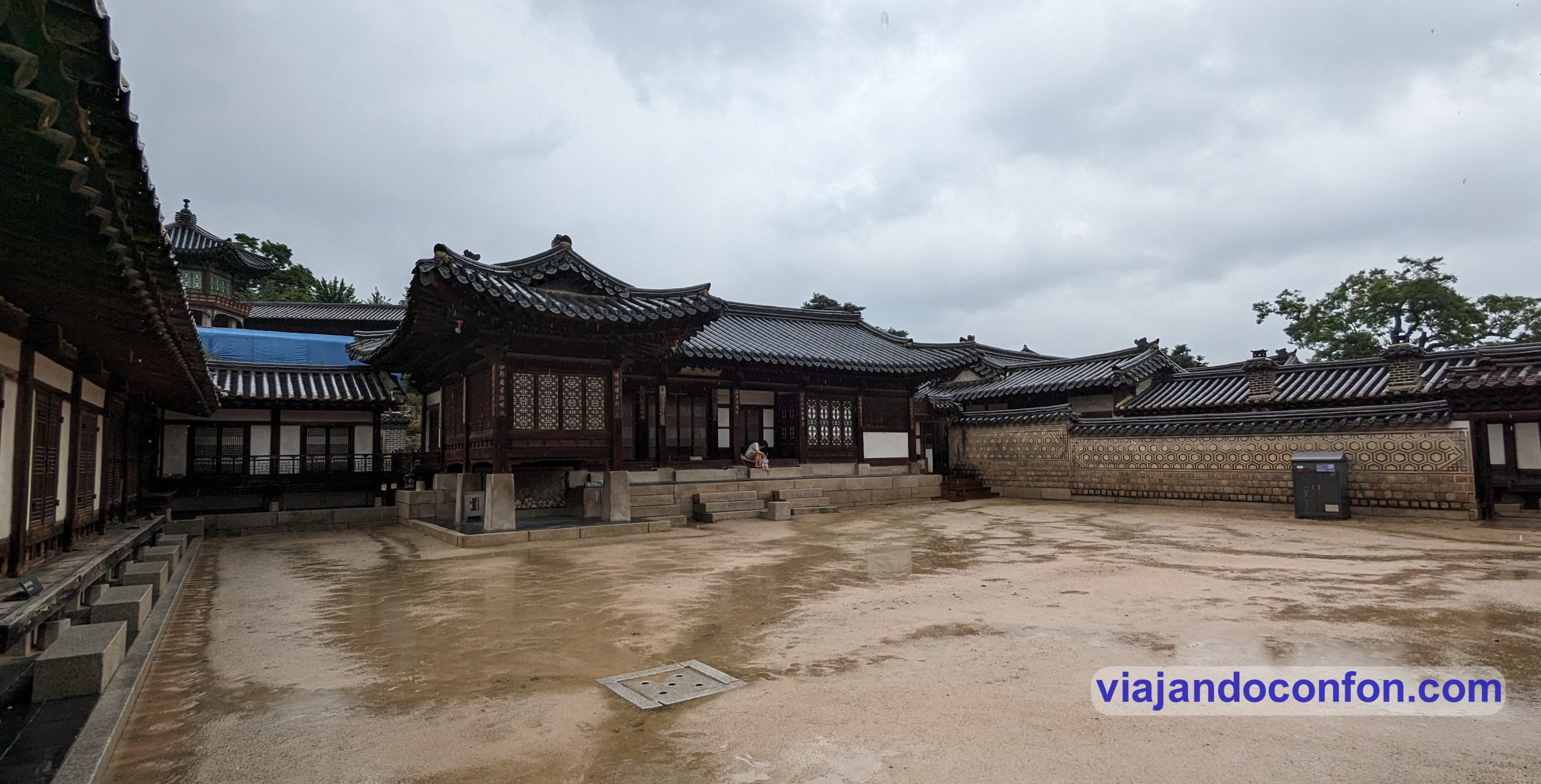
We leave the impressive gardens and head for Nakseonjae Hall.
Nakseonjae Hall is the place where King Heonjong, 24th king of Joseon, built for the concubine he really loved. It was built in 1847.
It is located in the area between Changdeokgung Palace and Changgyeonggung Palace and includes the Seokbokheon and Sugangjae Halls, as well as stone staircases decorated with interestingly shaped stones and flowering trees on the gently sloping hills behind the buildings.
After the 1884 coup, Nakseonjae was used as the king’s office for a time.
The last crown prince of the Joseon dynasty, Yi Eun, lived here from 1963 to 1970. His wife, Yi Bangja, also lived here from 1966 to 1989.
Nakseonjae Hall
Right next door is the entrance to Changgyeonggung Palace. You can enter from Changdeokgung Palace, or from Changgyeonggung-ro Street on the other side of the complex. The entrance fee is 1,000₩ (€0.70) but is included in the Royal Palace Pass.
The palace was built in the mid-15th century by King Sejong for his father, Taejong. It was originally called ‘Suganggung’, but was renovated and enlarged in 1483 by King Seongjong, at which time it received its present name.
Tongmyeongjeon Hall
Many of the buildings were destroyed during the Japanese occupation in 1592. It was rebuilt by successive Joseon kings, but was again largely destroyed by the Japanese in the early 20th century.
Myeongjeongjeon Hall
During the Japanese colonial period, the Japanese built a zoo, botanical garden and museum here.
After independence in 1945 and the destruction of the Korean War of 1950-1953, the zoo was replenished by donations from wealthy Koreans and gifts from foreign zoos. In 1983, the zoo and botanical garden were moved to the present-day Seoul Great Park.
Changgyeonggung Green house
The spectacular Honghwamun Gate, the main gate of the palace, is particularly noteworthy. First built in 1484, it was burned down during the Japanese invasion of 1592. It was rebuilt in 1616.
Honghwamun Gate
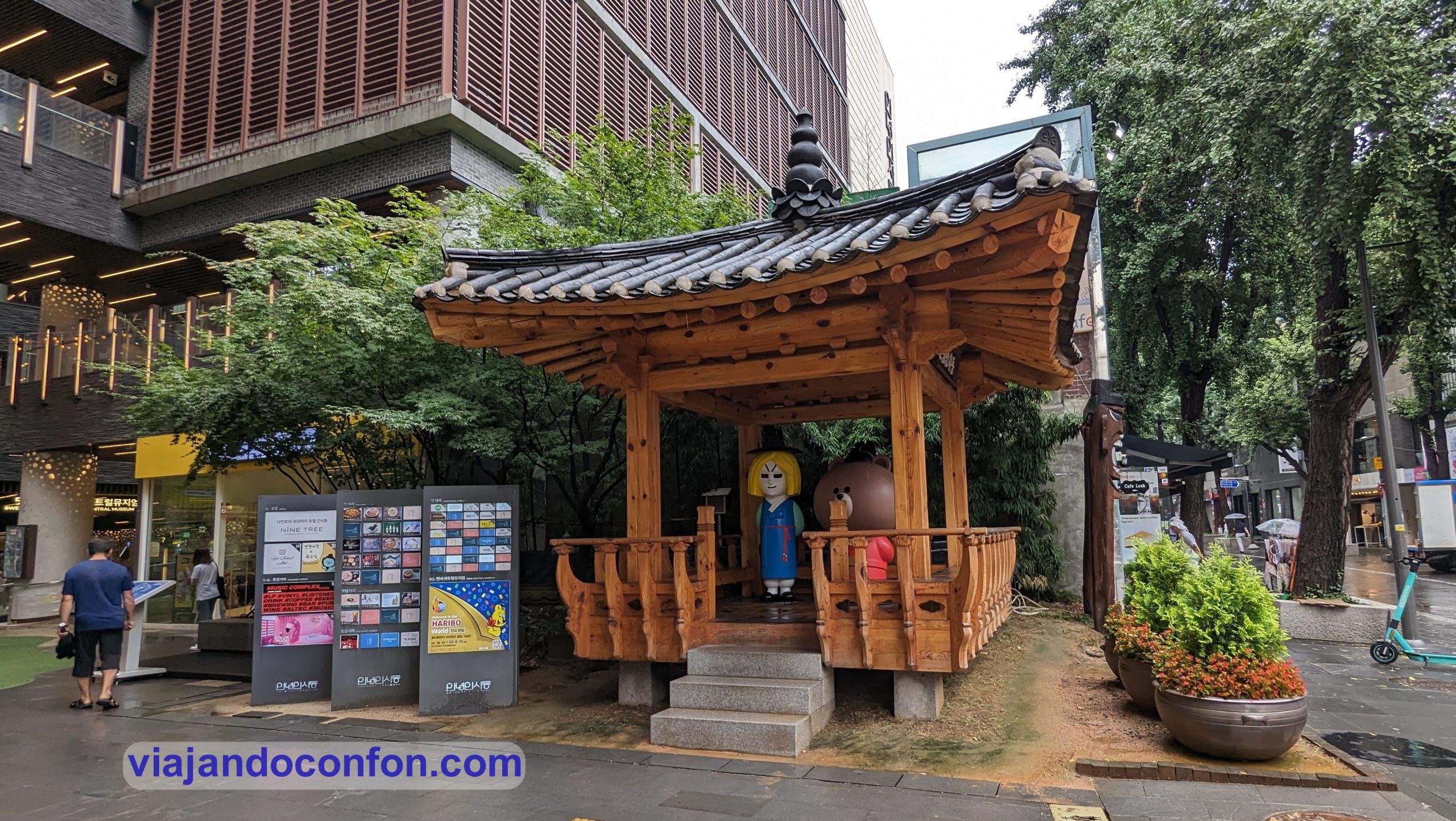
Without wasting a second and taking advantage of the fact that the rain was giving us a little respite, we went for a stroll along the Insadong-ro shopping street.
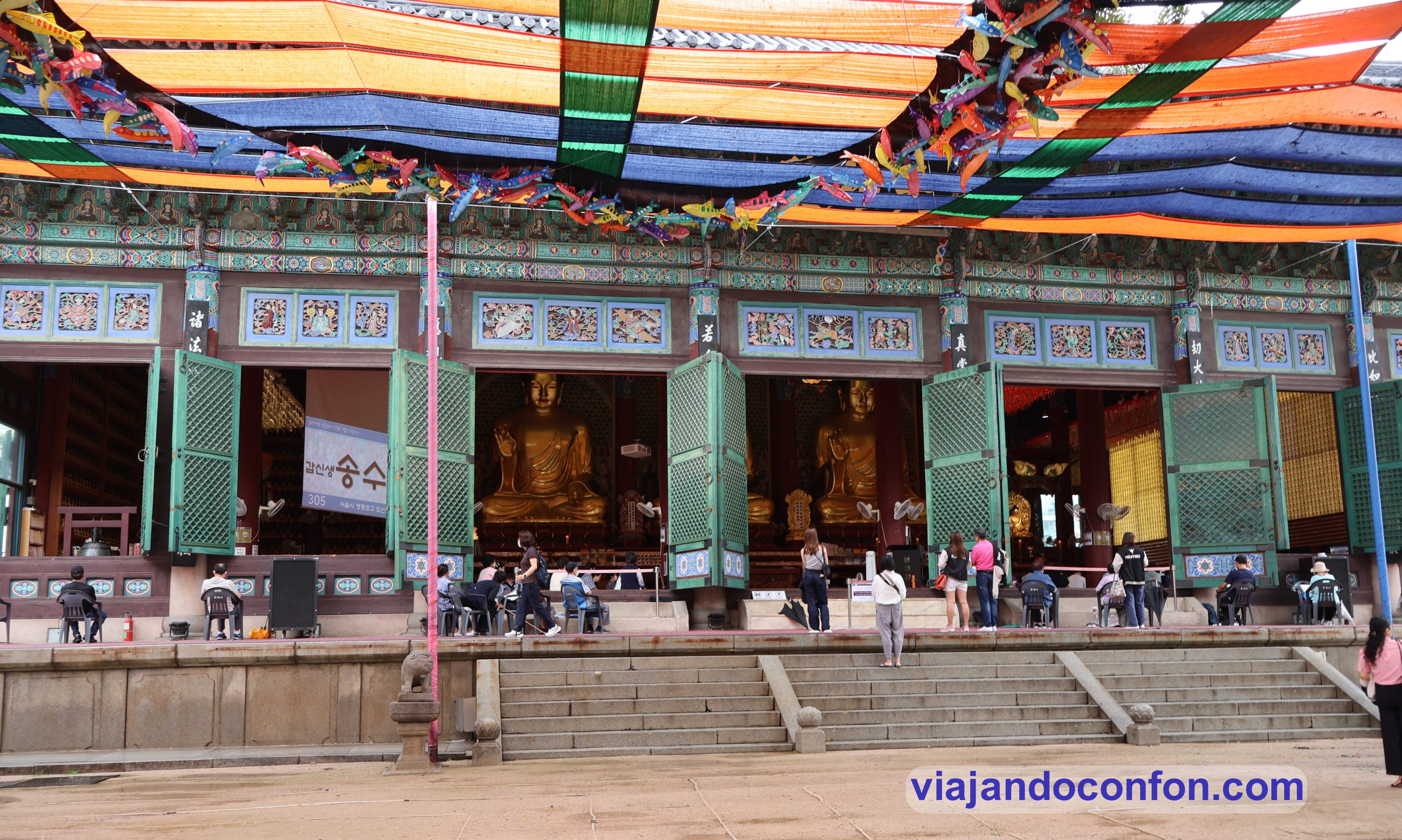
Nearby is Jogyesa Temple, the head temple of the Jogye order.
It was built in 1910 and was named Gakhwangsa Temple, after monks who longed for independence from Korean Buddhism.
The name was changed to “Taegosa” during the period of Japanese rule, and then to the current name in 1954.
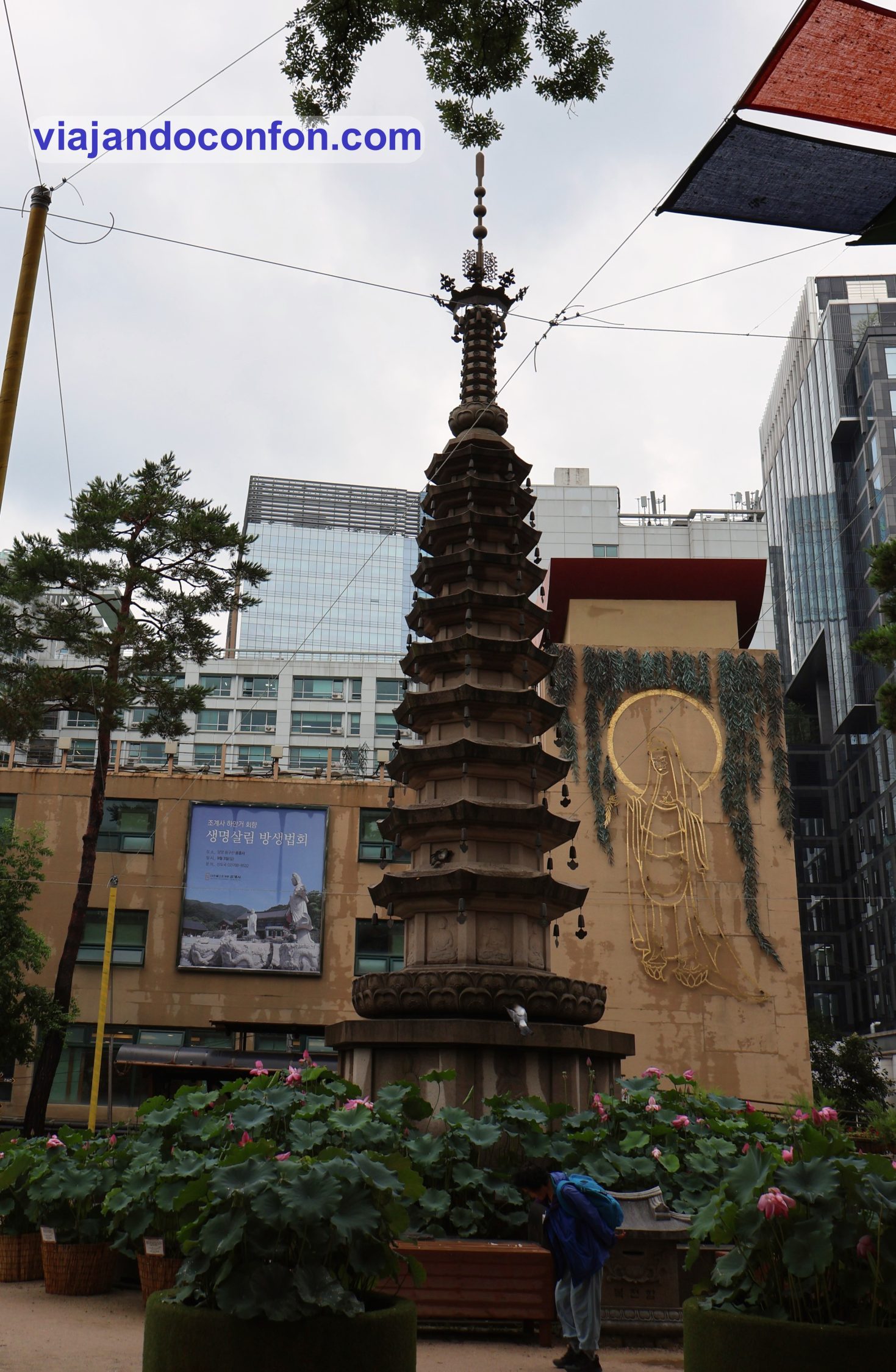
As soon as we entered, we found a spectacular lotus plantation in front of the main pavilion. It was a real marvel.
Practically in the centre of the enclosure there is an ancient white pine tree, listed as Natural Monument no. 9.
In the main courtyard of the temple is the 7-storey stone pagoda, built in 1930. Inside the pagoda are the ashes of Buddha, which were brought here in 1914 by a Sinhalese monk.
After the visit to the temple we went in search of a place to eat. We went to a place called 김 네 대마루... On google maps it is listed as Good Restaurant. Specialising in Korean barbecue.
It is the most expensive meal we had in the whole country but it was so good that we repeated a few days later. The price was 65.000₩ (45€).
After lunch, we continued sightseeing. There was no time to waste.
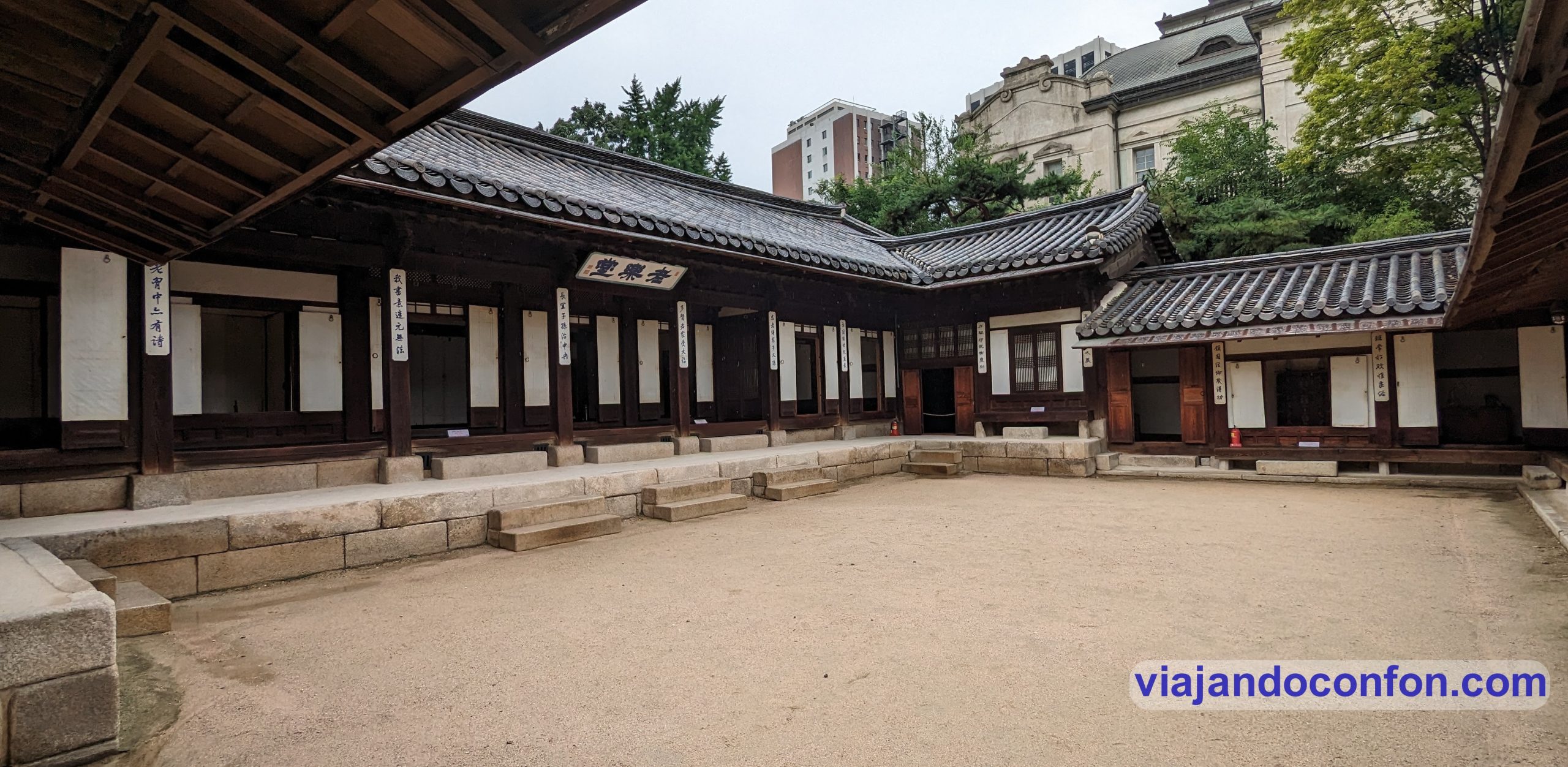
The next visit is the Unhyeongung Palace. It was built as the residence of King Gojong, the 26th king of the Joseon dynasty before he assumed the throne at the age of 12.
During Gojong’s tenure, the regent Heungseon ruled the country for about 10 years, after taking control of state affairs from his son.
Unhyeongung Palace
In 1864, during the first year of King Gojong, the Nokrakdang and Noandang Halls were built. Five years later, in 1869, the Irodang and Yeongnodang Halls were built.
To facilitate entry and exit from Changdeokgung Palace, Gyeonggeunmun and Gonggeunmun gates were built exclusively for Gojong and the regent Heungseon. However, they are no longer standing.
The palace was purchased in 1993 by the city of Seoul and was reopened in 1996 after extensive restoration.
Unhyeongung Palace
In the various buildings there is an exhibition of how life was lived in the time when the palace was occupied.
By the way, the entrance is free of charge.
After the visit to the palace, we went to the hotel for a rest and a shower. With the heat and the tremendous humidity, we were sweating profusely.
After a very short and well-deserved rest, we went on our way to the Heunginjimun Gate. It was built in 1396 during the reign of King Taejo, the first king of the Joseon dynasty. It is the eastern gate of the city’s defensive wall.
Heunginjimun Gate
The gate has been destroyed and rebuilt several times. The present gate dates from 1869 and has the appearance of the original gate. Its name, Heunginjimun, means “Gate of Increasing Benevolence”. It is also known as Dongdaemun Gate (Great East Gate).
Nearby is the DDP, Dongdaemun Design Plaza. The futuristic building was built in 2009 to a design by the Anglo-Iraqi architect Zaha Hadid.
It was opened in 2014 and is a multi-purpose building that hosts exhibitions, fashion shows and all kinds of cultural events.
When we were there, it was full of old televisions. There was also a room called the Media Art Gallery with giant screens that took up almost the entire room. These share splendid moments drawn by SeouLight, a global festival of media facades.
They were really just showing strange images with a rather soothing music.
There is also a shop and a large space simulating a modern garden with some tables and pouffes where we sat down to rest.
At the back of the room there were some kind of conical stools that, when you sat down, you spun around as if you were going to tip over. It was really fun. We made videos, but they were embarrassing, so we kept them to ourselves…
Outside the building, on the side down a small slope on the north-eastern side of the building, is Igansumun, the water gate.
Igansumun was the water gate of the Namsomundongcheon stream originating from Namsan Mountain, which flowed from Hanyangdoseong, the city wall of Seoul in the Joseon Dynasty.
In addition to releasing the flow of water, it had a defensive function and was guarded by soldiers who guarded the gate.
It was buried during the Japanese occupation and was found and restored in 2009 during the construction of the Dongdaemun Historical and Cultural Park.
In a square below the building, next to the entrance of the underground station are the ruins of the former Dongdaemun Stadium.
This was the site of Hadogam (Lower Military Directorate), one of the outposts of Hullyeondogam (Military Training Command) during the Joseon dynasty.
During the Japanese occupation the area became Hullyeonwon Park and in 1925 the Gyeongseong Baseball Stadium was built. After Korea’s liberation from Japanese rule, the stadium was renamed Seoul Stadium and later Dongdaemun Stadium.
After the demolition of the stadium in 2003, the remains of Hullyeondogam and the water gate were discovered. Some of the remains were moved to other parts of the park and some were preserved here.
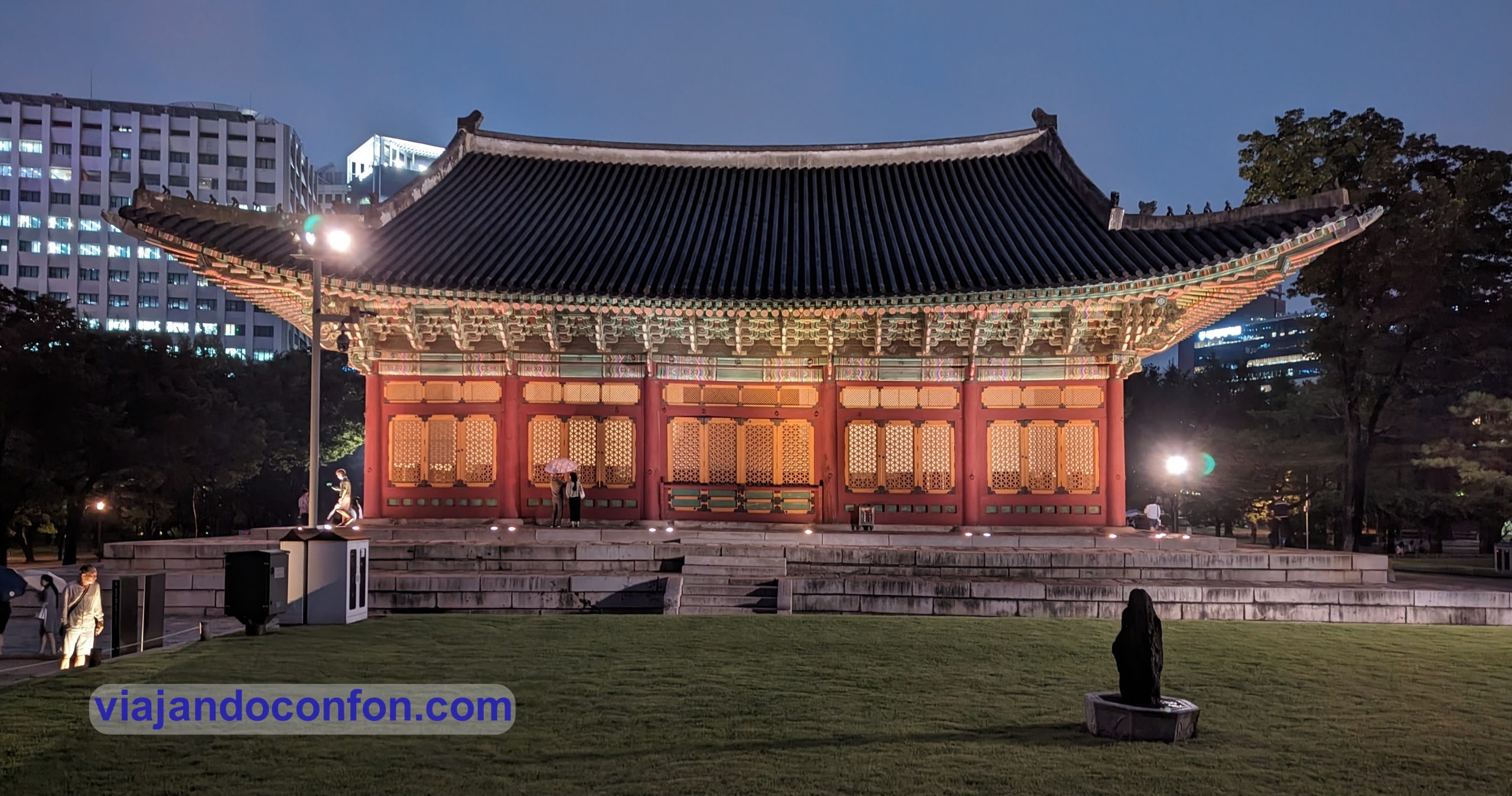
Night is falling so we decided to visit the Deoksugung Palace, which is recommended to visit at night. It is the palace that closes later, at 9 pm.
We left the subway at the City Hall exit and when we arrived at the entrance of the complex a Joseon-era performance was taking place.
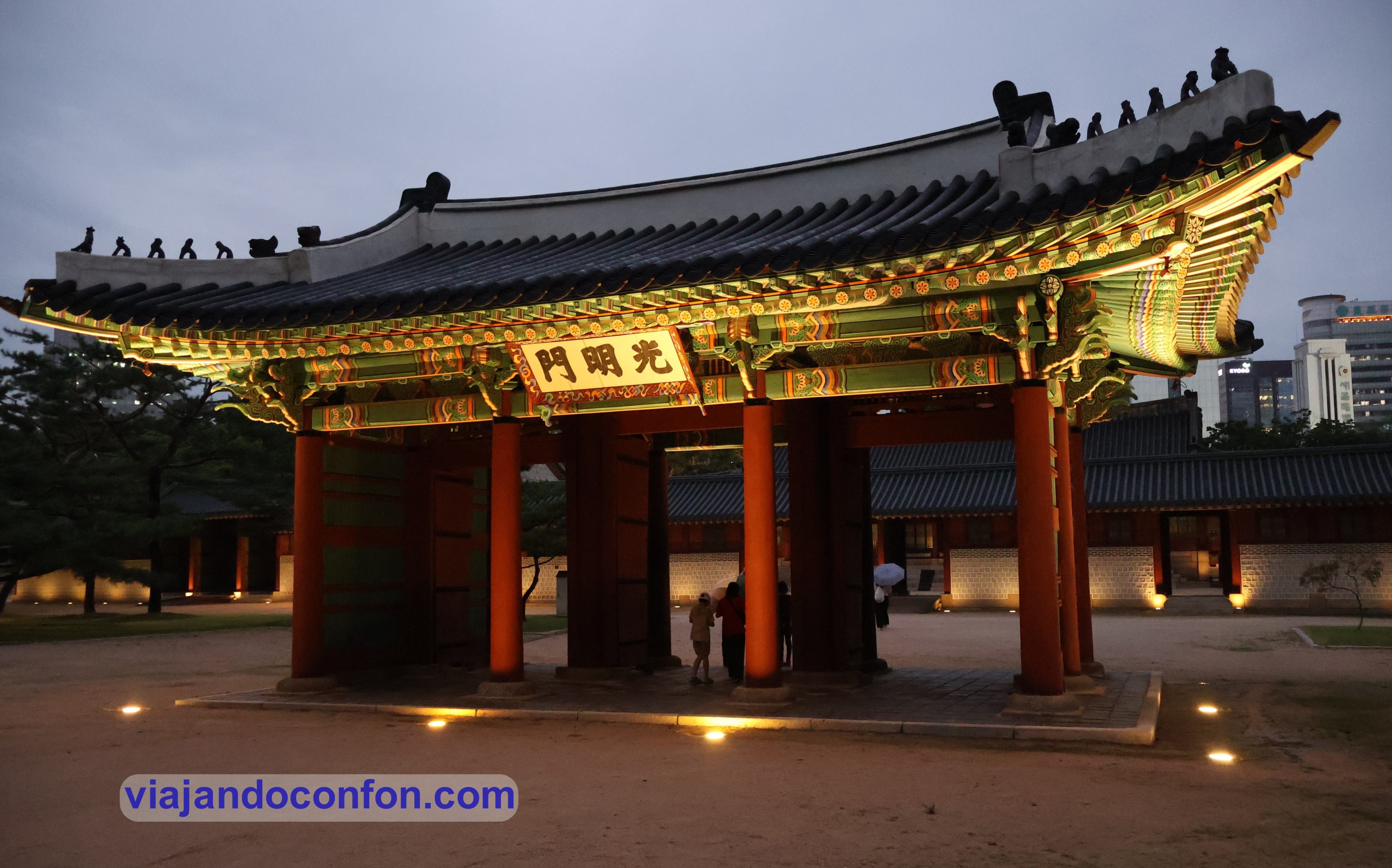
Deoksugung is one of the “Five Great Palaces” built by the kings of the Joseon dynasty. It was inhabited by the Joseon until the beginning of the Japanese occupation in 1910. Today only 1/3 of the original structures remain.
Gwangmyeongmun Gate
It was originally the residence of Grand Prince Wolsan, the elder brother of King Seongjong. Deoksugung became a royal residence when the Japanese burned the remaining palaces during their occupation in 1592.
King Gwanghaegun was crowned in this palace in 1608 and renamed it Gyeongun-gung in 1611. After the reconstruction of Changdeokgung, it was converted back into an auxiliary palace in 1618 and renamed Seogung.
In 1907, the palace was renamed Deoksugung, in reference to the emperor’s wish for longevity. Emperor Gojong died in Hamnyeongjeon.
After the last Japanese occupation in 1910, the complex was converted into a park and many buildings were destroyed. Today only 1/3 of the original elements of the complex remain.
Deoksugung Junghwajeon
At the northwest end of the complex is the National Museum of Art, built in stone in a Western architectural style. It was built in 1910 in the neoclassical style by British architect J. R. Harding.
Entrance to the palace costs 1,000₩ (0.70€) and is included in the Royal Palace Pass.
This is the end of the day (or so we thought). We took the metro to the hotel. On the platform, we noticed that there are emergency kits with water bottles and gas masks in every station. It is a bit disturbing.
We buy some dinner in a combini next to the hotel. The idea is to go to bed early as we have to get up at 5.30 to go to the DMZ.
While we are still having dinner, at about 10 p.m., we get a phone call from reception. We have to change rooms because in the morning work starts on the terrace and we might be disturbed. Really? At 10 o’clock at night you have to collect all the luggage to change rooms. It doesn’t seem halfway normal to me. The work had already been scheduled a week before (they gave it to us in writing). The best thing would have been to let us know when we arrived so that we wouldn’t have to unpack our luggage.
The new room, on the 3rd floor, was much worse. To make matters worse, there was an unpleasant trickle of brown water coming out of the wall of the shower and bathrooms.
We decided to go to bed and complain in the mor12 thning.
12th August
Up at 5.30. Still raining. We had some breakfast that we had bought the night before and went to reception to complain about the various faults in the room. They tell us that maintenance will come and take a look.
We take the metro to the meeting point for the DMZ tour.
The DMZ, the Korean Demilitarised Zone, is a strip of land that runs across the Korean Peninsula near the 38th parallel north, roughly dividing it in half.
It was established to serve as a buffer zone between the countries of North and South Korea under the provisions of the 1953 Korean Armistice Agreement. An agreement between North Korea, China and the United Nations Command.
The DMZ is 250 kilometres long and about 4 kilometres wide and is heavily guarded and mined. For a demilitarised zone, it is the most heavily militarised strip of land in the world.
Somewhat late (we were supposed to be picked up at 6.45) the bus appeared and we got on. It was full of Japanese people, doing a tour in Japanese with a guide. Our group (in English) consisted of the two of us and two couples of kids from Lithuania. One of them was Korean, though. We had another guide, Leo, a very nice young man, although he seemed a bit inexperienced.
After about an hour, we arrived at the first stopping point, Imjingak Park. Leo takes our passports and goes to the main building to check us in.
In this building there is an art exhibition inspired by the conflict, as well as some restaurants.
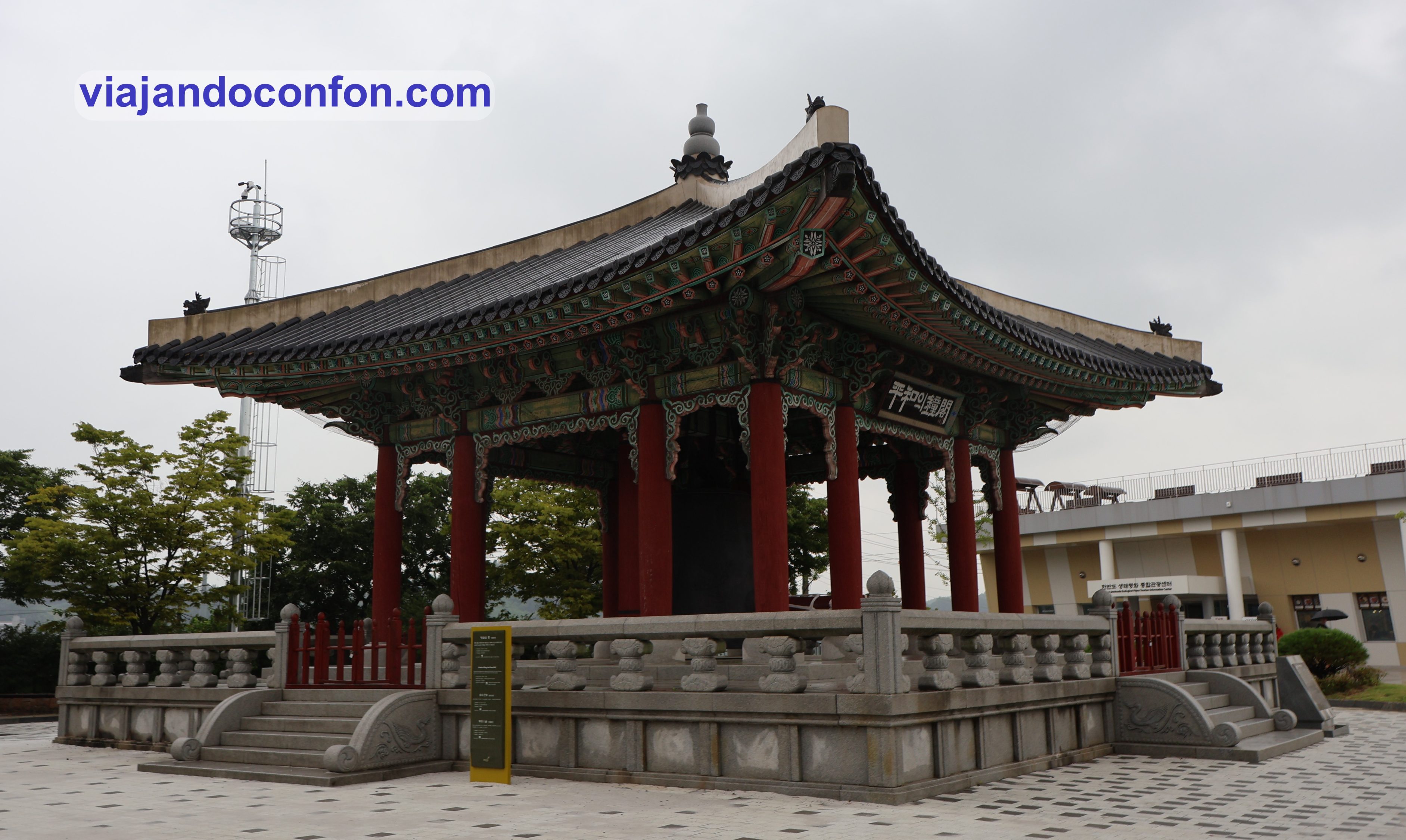
Outside the building there are also several monuments. For example, the Pyeonghwauijong Peace Bell. It was built in 2000 to pray for the peace of the human race and national unification in celebration of the new millennium.
Peace Bell
This is also the site of the Freedom Bridge. It was built to honour the souls of the displaced people who died while missing their families and hometowns they left behind in the North.
It was originally called Dokgae Bridge, but was renamed in 1953. It was when 12,773 South Korean and UN soldiers captured during the war returned across this bridge.
At the end of the bridge are hung many messages from family members separated by the war. It is said that these messages are carried by the wind to the north so that they can reach their intended recipients.
Messages on the Freedom Bridge
Also on display is an old steam locomotive that was attacked in the war and the Imjingang Bridge, a railway bridge that crosses the river to link the two Koreas.
Imjingang Bridge
After the visit and the relevant explanations, Leo leaves us for 20 minutes at our leisure and we return to the bus. Next stop: Dora observatory.
But first we have to go through an exhaustive military checkpoint. Several soldiers get on the bus and check one by one with our passports to make sure that we are on the list.
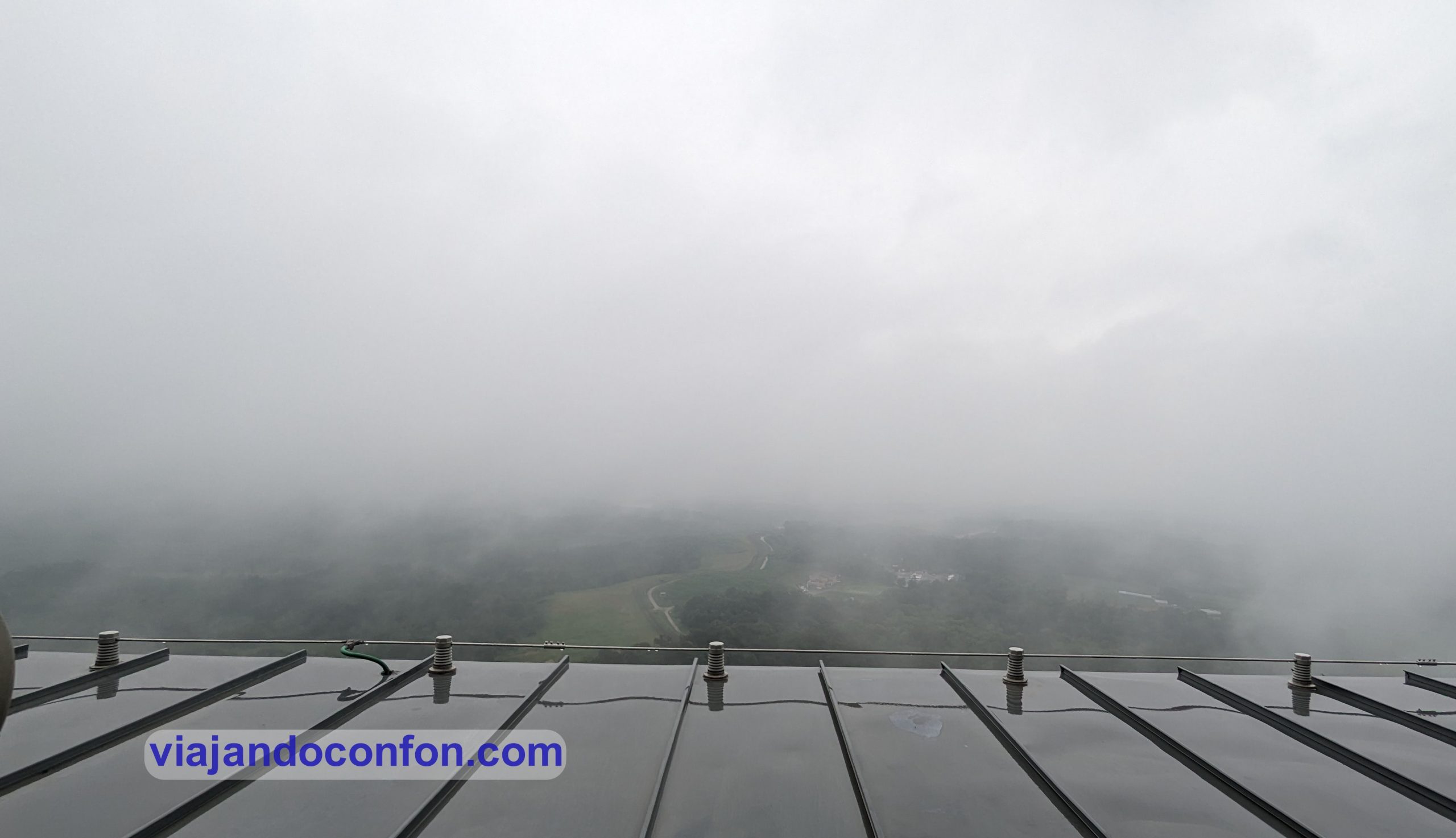
The Dora observatory is located on the top of Mount Dora. From here you can look across the border through binoculars and see into North Korean territory.
This is what we saw:
North Korea is beautiful at this time of the year… and so on.
With a bit of disappointment in our bodies we went to the next point: the Third Tunnel. It is a tunnel dug by the North Koreans for a supposed invasion of the South. Although the North Koreans say it is the other way around.
It was discovered in 1978 after a loud explosion was detected, apparently caused by diggers who had advanced 435 metres under the southern side of the Korean Demilitarised Zone. It took 4 months to locate it and dig the interception tunnel.
It is over 1,600 metres long and 1.95 metres high. It could move up to 30,000 soldiers per hour with light weapons. It is one of four tunnels discovered to date.
Here there is a small museum about the tunnels and a souvenir shop. The highlight is the descent to the tunnel. This is a very long climb of 250 metres with a 10% gradient. Descend into the tunnel and walk through it crouching down and wearing a hard hat, as you will be bumping into the ceiling.
You are not allowed to take photos. In fact, you are forced to leave all your things in lockers before going down. I have to say that you go through it to have the experience because… because in the end there is nothing. An armoured door with a couple of cameras.
The climb is hard, not the next thing. It is not recommended for the elderly, people with heart problems, pregnant women and people in very poor physical condition.
We finish climbing the hill exhausted and with our tongues hanging out. A few cold drinks and back to the bus. Next stop: the cafeteria and local products shop of all the excursions. I eat a black soya ice cream, typical of the area, which was delicious, and then back to the bus.
We go through the exhaustive military checkpoint again and straight to Seoul. I have to say that you can’t visit the DMZ on your own, only by scheduled tours.
You can take this interesting excursion to the DMZ with Civitatis:
We got off at the meeting point where we were picked up and looked for somewhere to eat. We went to a place called Gobong Samgyetang Gwanghwamun. They specialise in Samgyetan, which is like a kind of cream with a WHOLE CHICKEN INSIDE! stuffed with rice. It was really good even though it was an awful lot of food. It cost us 38.000₩ (26.72€).
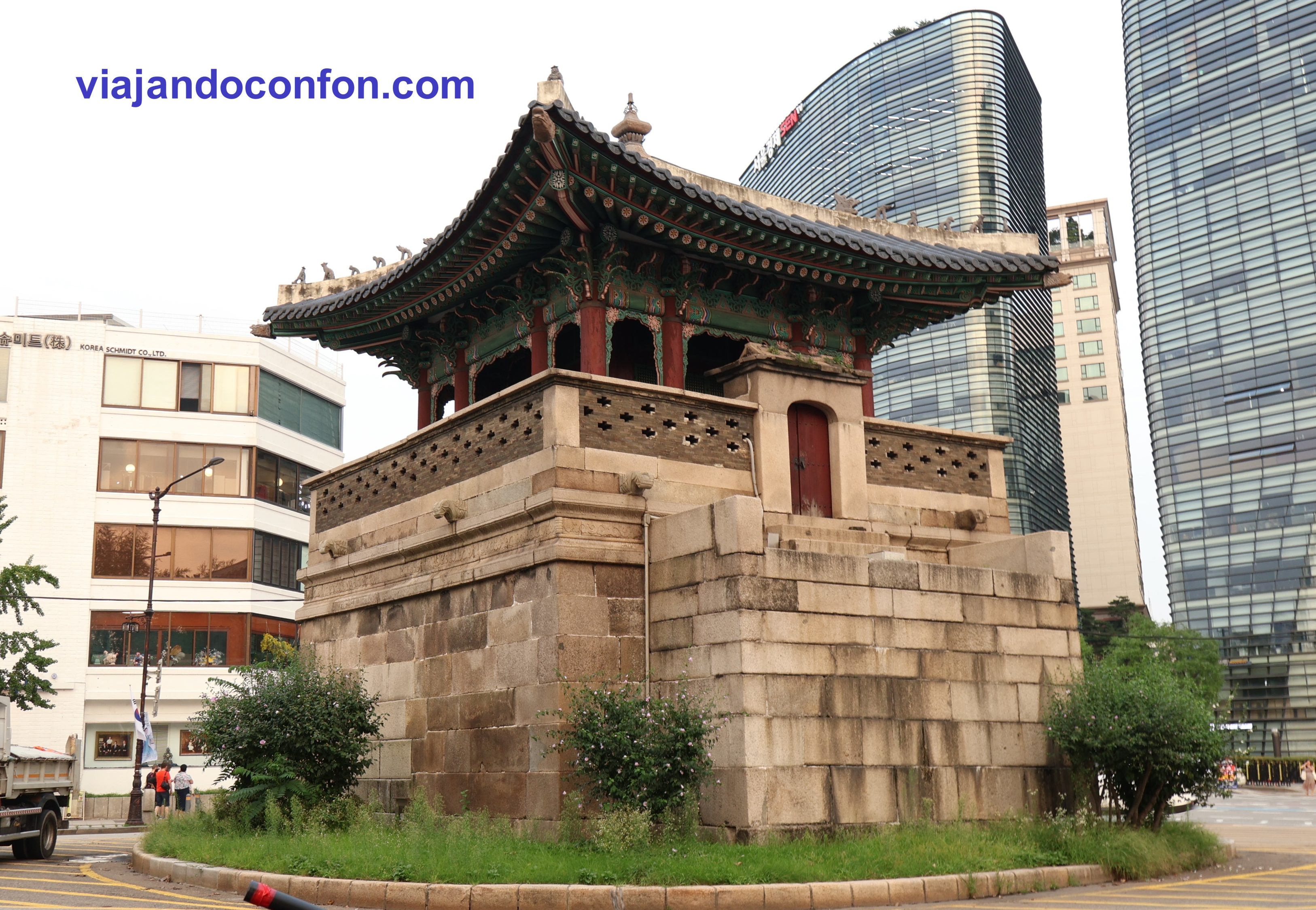
With our stomachs very, very full, we took a rainy walk back to the hotel. On the way we passed Bosingak. It is a huge bell pavilion that gives its name to the avenue where it is located: Jongno. It literally means Bell Street.
It was originally built in 1395 but, after multiple destructions, the current one was built in 1895. The bell was installed in the palace during the Joseon rule and is now only rung at midnight on New Year’s Eve.
Bosingak
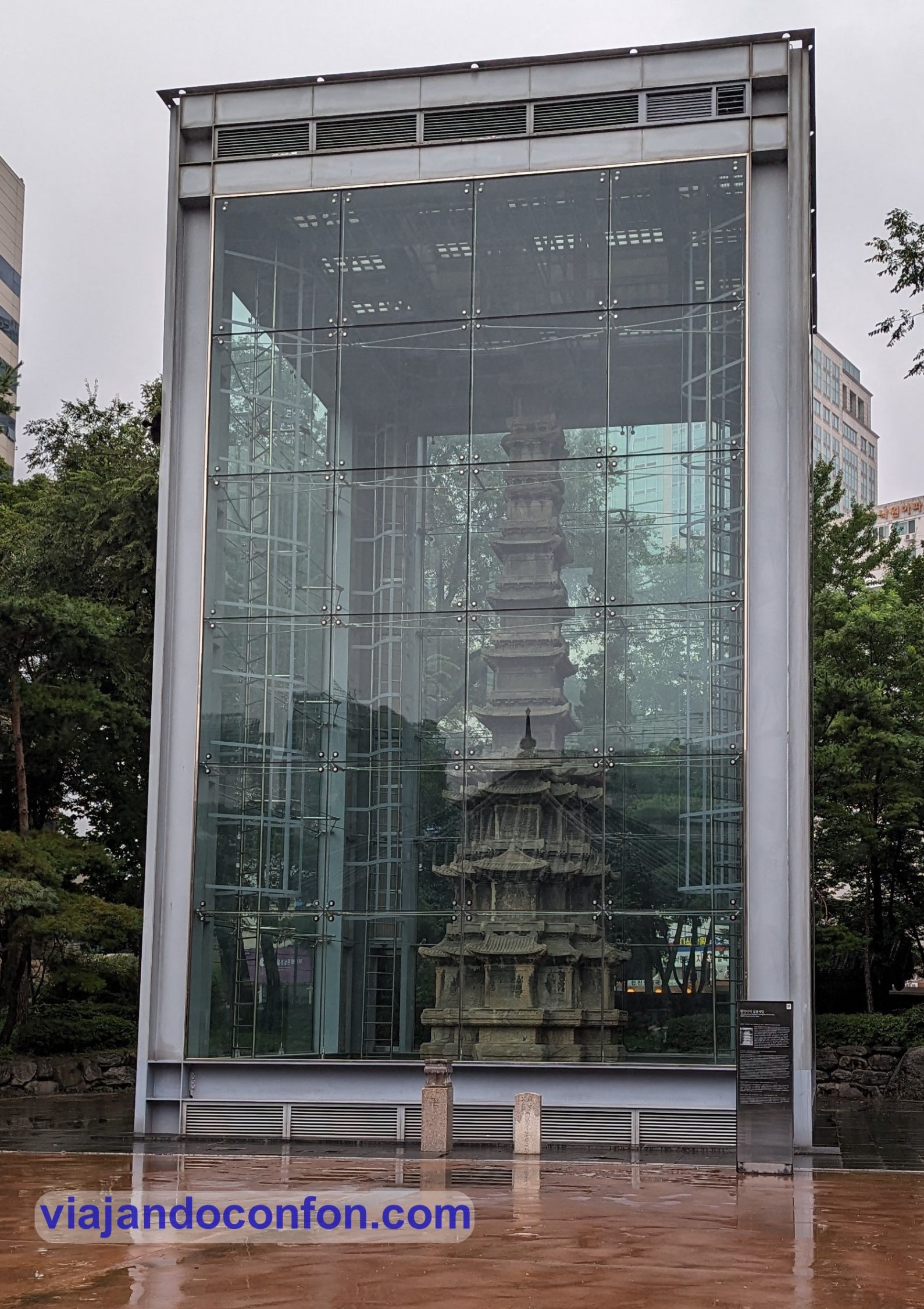
A little further on is Tapgol Park. Here we find several remarkable elements. The most remarkable of all is the Wongaksa Pagoda.
It is a 10-storey, 12-metre-high pagoda built in stone in 1467. It stands on the site of the former Wongaksa Temple. The temple was built in 1465 by King Sejo and was the head temple of the Jogye Order.
Wongaksa Pagoda
Records indicate that the pagoda originally had 13 stories. It was built to house the Sarira and the Wongakgyeong (Wongak Sutras), which had recently been translated at that time.
Another feature of the park, also belonging to the old temple, is the Wongaksa Monument built in 1471. It was erected to record the founding of the Wongaksa Temple.
On the front is an inscription composed by Kim Suon with calligraphy by Seong Im. On the reverse is an inscription composed by Seo Geo Jeong with calligraphy by Jeong Nam Jong.
Wongaksa Monument
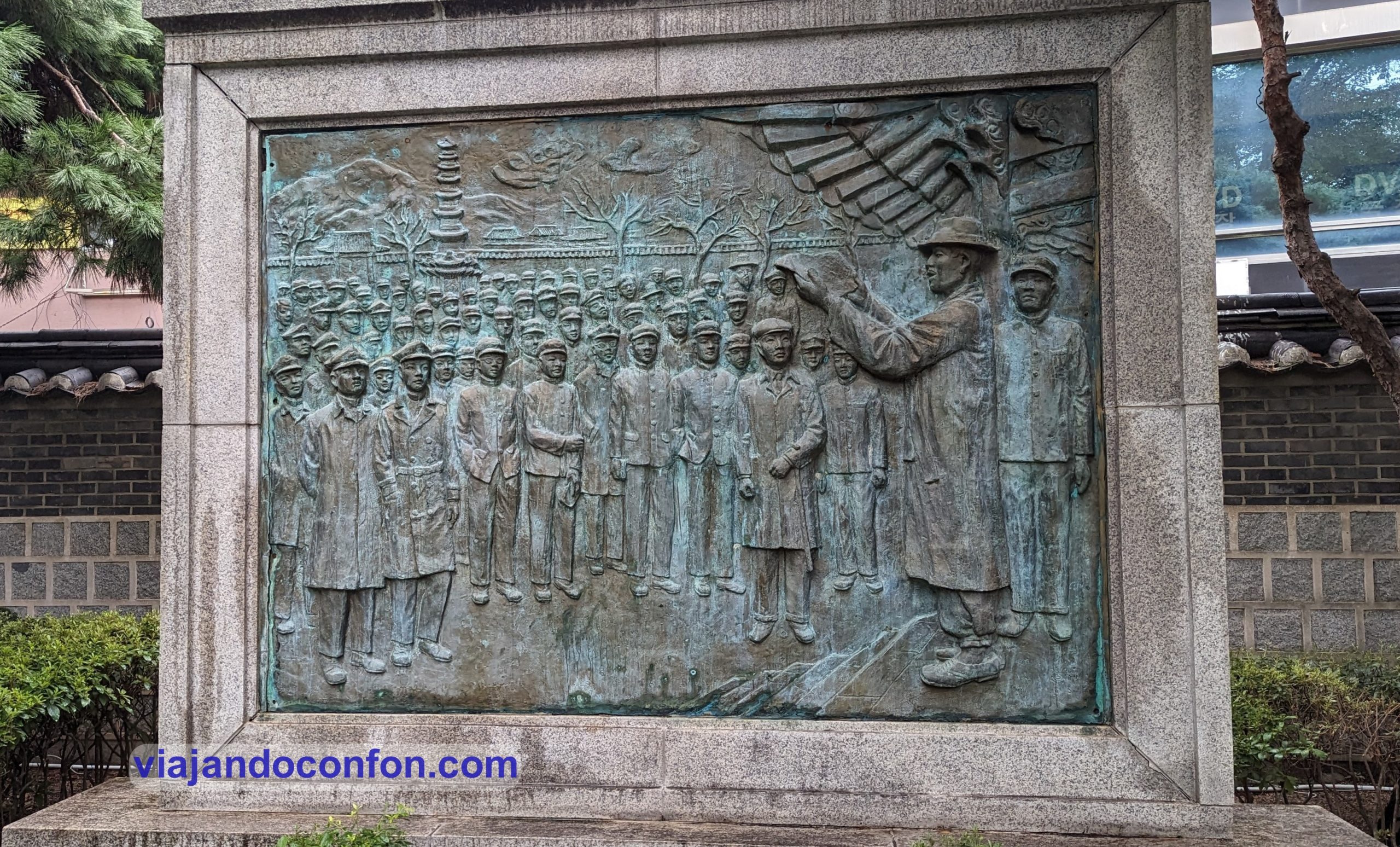
Tapgol Park is historically important as the birthplace of the 1 March 1919 Movement. It was the first place where the Proclamation of Independence was read. There are several statues with bas-reliefs to attest to the fact.
Now we go to the hotel to rest a bit and take a refreshing shower. But first, as soon as we arrived at reception they told us that they had not been able to fix the damage to the room and we had to change AGAIN. Luckily we had not had time to unpack.
This time, before changing, the receptionist went to make sure that everything was in order. While we were waiting we were invited for refreshments.
A while later the guy arrived and said that everything was in order. Floor 8 and much better than the previous room.
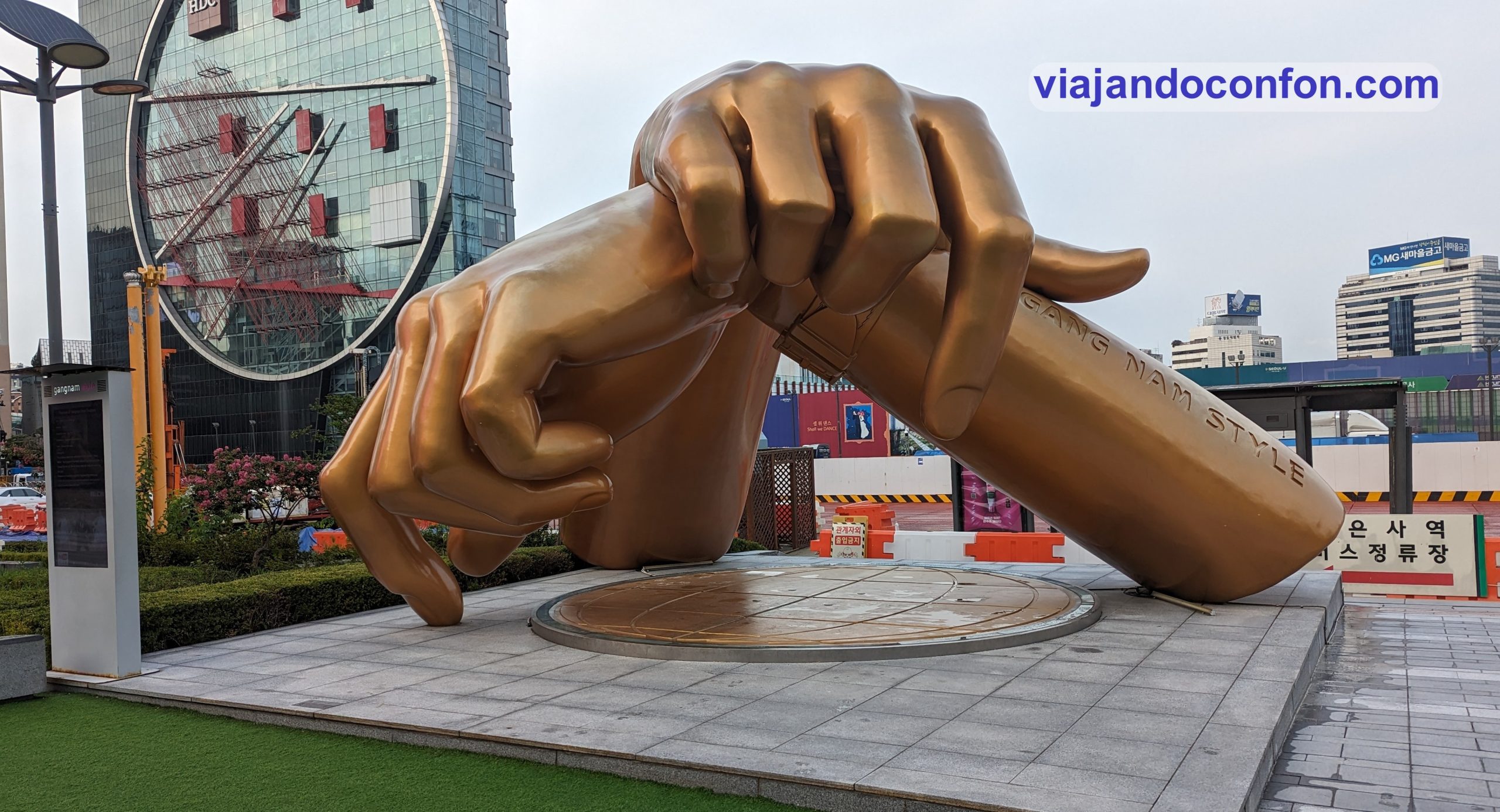
After the break, we took the underground to visit the Gangnam district, one of the most exclusive in Seoul. Yes, where the hit song Gangnam Style by Psy was released.
As we got off the underground and exited the station we came across the monument to the song. Two giant hands representing the song’s dance, with the song playing on a screen and always someone underneath making a fool of themselves.
Ridiculous which, of course, we also did, but I’ll keep the photos and videos to myself. But if you want to see some, you can check out my instagram.
From here we can see the Lotte World Tower. The tallest skyscraper in South Korea with 555 meters and 123 floors. On its top floor is the 2nd highest observation deck in the world at 512 metres.
We are not going to go up for the moment, as it costs a lot of money and with the bad weather we are not going to see much of it.
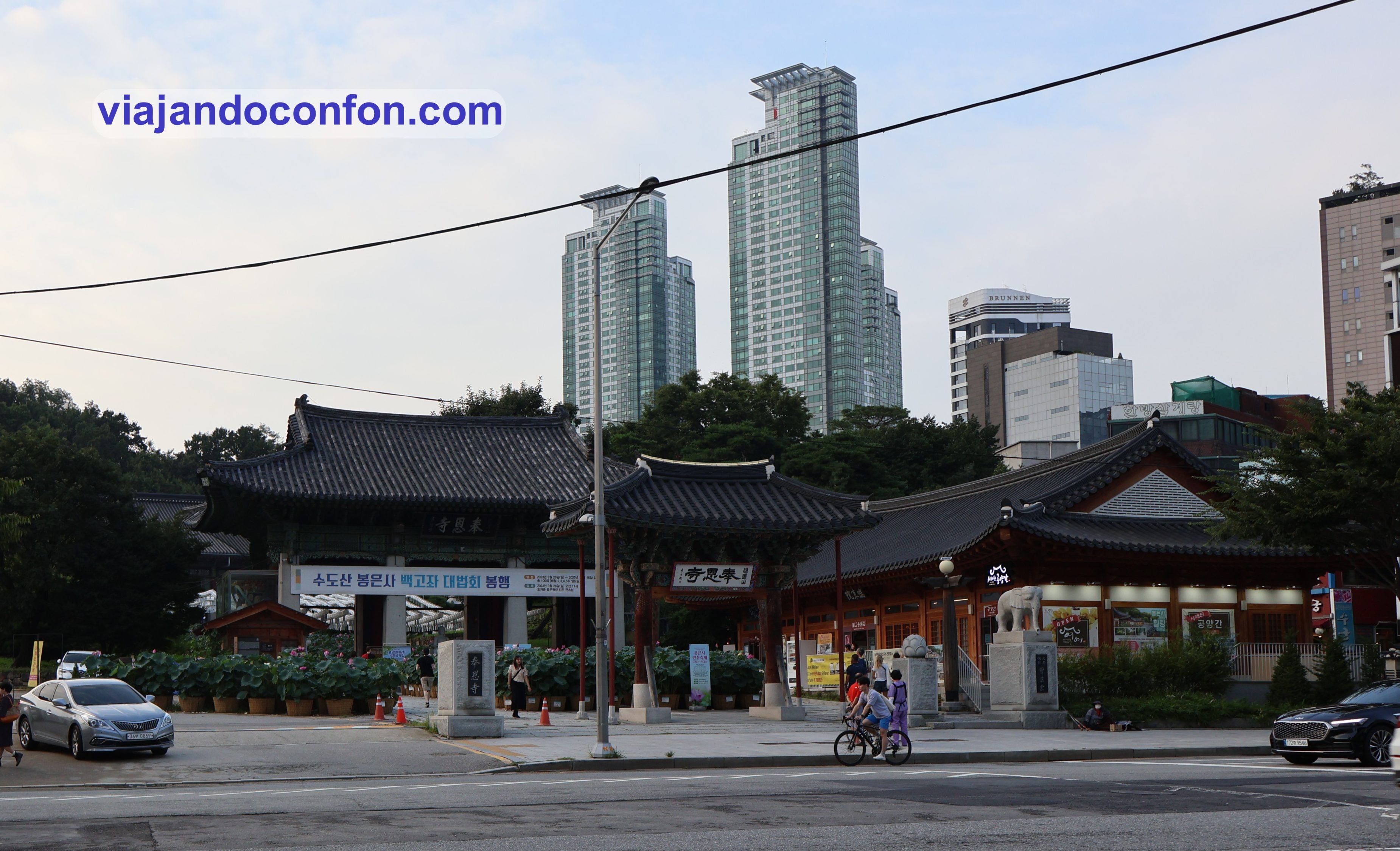
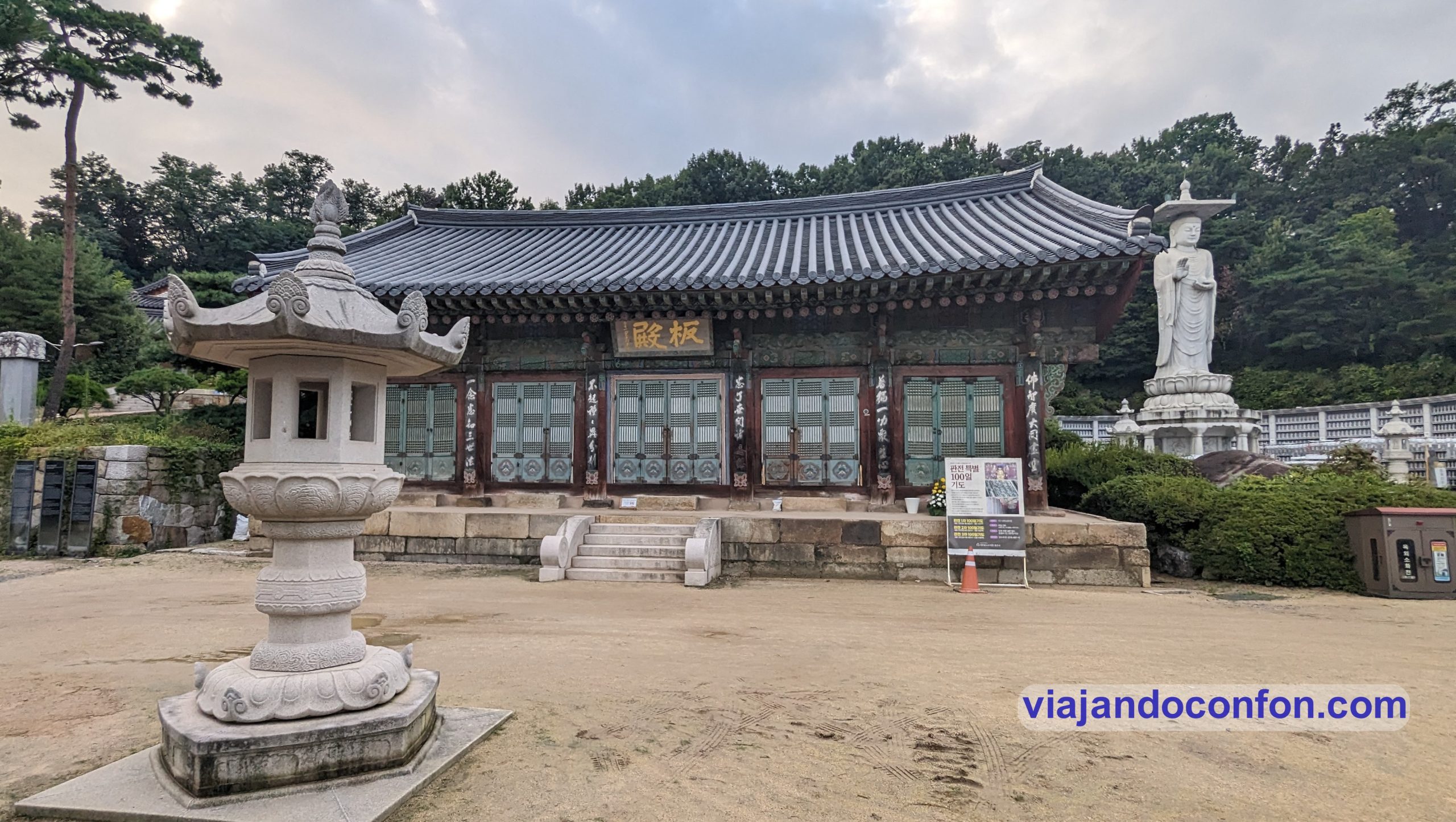
Very close to the Gangnam Style statue is the Bongeunsa Temple. It was founded in 794 by the state preceptor Yeonhoe, then the highest ranking monk of Silla. Its name at that time was Gyeonseongsa.
During the Joseon dynasty, Buddhism in Korea was severely suppressed and the temple was destroyed.
The temple became known as Bongeunsa when it was rebuilt in 1498 under the patronage of Queen Jeonghyeon, a Joseon queen.
The term Bongeunsa means the act of honouring the king, which can be understood here as a prayer for the eternal life of King Seongjong.
With the support of Queen Munjeong, who revived Buddhism in Korea in the mid-16th century, it became the head temple of the Korean Seon (Chan) Buddhist sect from 1551 to 1936.
The monk Bou was appointed head of the temple in 1548 by Queen Munjeong. He was assassinated soon after when anti-Buddhist factions regained dominance in Korea towards the end of Queen Munjeong’s rule.
During the Japanese occupation in the 20th century, the temple became the seat of 80 smaller Buddhist temples around Seoul. After colonial rule, Bongeunsa became subordinate to the Jogye Order, the largest Buddhist sect in Korea.
A fire in 1939 destroyed most of the buildings and other parts of the temple were destroyed during the Korean War.
The temple houses the Bongeunsa Maytreya Buddha, the largest Buddha in Korea at 23 metres tall.
The truth is that the temple is a real haven of peace in the middle of bustling Seoul. What’s more, admission is free.
Overwhelmed by the tremendous humid heat, we decided to look for somewhere with air conditioning where we could have a cool drink. In the COEX shopping centre we found a natural juice place and there we sat down. It’s called Jamba and it’s not cheap, but it was really good. The two large juices cost us 12,800₩ (9€).
As we sat there, we were amazed by the staff. They arrived at the place, left their bags and mobile phones guarding the place and went to order at the cash desk. You do that in Spain and when you come back they’ve even taken the table with them.
In the course of the trip we discovered that South Korea is an extremely safe country, as was the case in Japan. We will give more examples of what struck us in due course.
Refreshed and with renewed strength we went to the Banpo Bridge. It is one of the most famous bridges crossing the Han River. Above all for the spectacle of lights and water by means of its 10,000 LED bulbs, with which it entered the Guinness Book of Records.
As it happened to us in Japan the two times we tried to see the lights of the Rainbow Bridge… they cheated us. No lights, no fountains, no nothing. A cow turd.
What there was was some kind of festival under the bridge. That night there was a guy juggling fire.
Tired of waiting, we went to the hotel. We bought some dinner on the way and went to bed early. It had been a long day and tomorrow we had to get up early again.
Discover the best activities and tours in Seoul with Civitatis:
Construida en 1794 Paldalmun es la puerta sur de la Fortaleza Hwaseong en Suwon. El área alrededor de la Puerta Paldalmun era una carretera que conducía a la región de Samnam. Por lo que la gente la frecuentaba incluso antes de la construcción de la Fortaleza Hwaseong.
El edificio actual es el original, que fue restaurado en 2013.
Puerta Padalmun
Cómo llegar: parada Paldalmun Gate (팔달문), bus 11 o 13.
02. “Escalar” el Monte Paldalsan
Paldalsan es una montaña situada en el centro de Suwon. En 1974 fue designada como parque. El parque roda la muralla de la fortaleza Hwaseong.
Además de la muralla y algunos edificios defensivos, encontramos varios senderos para recorrer admirando las impresionantes vistas de la ciudad.
Señalar que la subida puede hacerse realmente dura. Una combinación de cuestones y empinadas escaleras.
03. Hacer sonar la Campana Hyowon
En lo alto del Monte Paldalsan encontramos la Campana Hyowon. Fue creada para honrar la devoción filial del rey Jeongjo hacia su padre, el príncipe heredero Sado.
Hay que hacer sonar la campana tres veces. El primer toque es en agradecimiento por el amor de los padres. El segundo para esperar la felicidad en la familia. Y el tercero como oración por la superación personal.
Es la joya de la corona de Paldalsan. Se trata del puesto de Comando Occidental y era el centro de mando general de la Fortaleza Hwaseong.
En 1795, cuando el rey Jeongjo visitó la fortaleza, tomó el mando del entrenamiento militar desde este puesto.
Desde aquí podemos contemplar unas maravillosas vistas de la ciudad de Suwon. Cuesta mucho subir pero, francamente, merece la pena.
05. Templo Paldalsan Daeseungwon
Este pequeño templo perteneciente al Monasterio Mahayana, fue fundado en 1954 con el nombre de “Mahasa”
Este templo no pertenece a ninguna secta en concreto. Se trata de un lugar de investigación y educación sobre el pensamiento budista. Su estatua de Buda dorada de 19 metros de altura es visible desde muchos puntos de la ciudad.
El sitio es un auténtico remanso de paz y tranquilidad
Encuentra tu hotel ideal al mejor precio en Corea del Sur con Agoda:
*Nos ayuda a mantener el blog
06. Campana Yeomingag
Esta campana se instaló frente al palacio Huwaseong en 1796 por órden del rey Jeongjo. Ésta se perdió durante la invasión japonesa y fue restaurada en 2008.
La noche del 31 de diciembre se tocan las campanadas de fin de año aquí.
07. Palacio Hwaseong Haenggung, visita imprescindible desde Seúl
Es la joya de la corona de la ciudad de Suwon y visita imprescindible en todo viaje a Seúl.
Fue construido en 1789, año 13 del reinado del rey Jeongjo, de la dinastía Joseon.
Su función original era la de oficina gubernamental. También se utilizó como palacio temporal donde se alojaba el rey cuando viajaba a Suwon.
El rey Jeongjo elevó el estatus de Suwon promoviéndolo a Hwaseong Yusubu, construía uno nuevo en 1795 para celebrar el 60º cumpleaños de su madre, Lady Hyegyeonggung Hong. Fue terminado en 1796 con un total de 600 habitaciones.
Encontrarás una guía detallada en el diario de nuestro viaje a Corea del Sur.
Cómo llegar: parada Paldalmun Gate (팔달문), bus 11 o 13.
Precio: 3.000₩ (2€).
08. Puerta Hwaseomun
Hwaseomun es la puerta oeste de la Fortaleza Hwaseong y ese es el significado de su nombre. Aunque realmente la puerta está situada al noroeste de la fortaleza. Es una de las cuatro puertas de la fortaleza de Hwaseong, fue construida en 1796.
Junto con la adyacente Atalaya del Noroeste, se considera una de las escenas más emblemáticas de la Fortaleza de Hwaseong.
09. Mercado Motgol
El mercado Motgol está ubicado en el centro antiguo de la ciudad. Principalmente está dedicado a la alimentación, pero también tiene un importante componente cultural.
No sólo podrás comprar comida sino, también se realizan numerosos actos culturales en su escenario y centro de capacitación.
10. Hartarte de comer pollo frito
Muy cerca del palacio Hwaseong Haenggung encontramos un pequeño y sencillo local que sirve pollo frito al estilo de Suwon. Su nombre es 매향통닭, Maehyang Whole Chicken.
Pedimos una ración de pollo, para una persona y dos refrescos. Cuando llegó el pollo ¡¡ERA UN POLLO ENTERO!! Teníamos nuestras dudas de si nos habían puesto para dos hasta que llegó la cuenta. Pues no, era una sola ración. que barbaridad.
Estaba realmente rico y todo nos costó 19.000₩… 13€… ¡LOS DOS!. Exagerado de barato. Nos hizo mucha gracia que para comer, además, te dan unos guantes de plástico para no mancharte las manos.
Pues esto es lo más reseñable para visitar en la ciudad de Suwon. Con un día es más que suficiente y, para nosotros, es una visita obligatoria para hacer desde la ciudad de Seúl.
Encuentra las mejores actividades y tours en Corea del Sur con Civitatis:
Dormir en Japón, es tan grande la oferta que puede ser un quebradero de cabeza. En esta entrada te recomendaremos algunos basados en nuestras experiencias y la de amigos y conocidos que han estado por allí.
Lo más importante que debes saber es que, lo normal, es que las habitaciones sean muy, muy pequeñas. También hay que tener cuidado si viajas en pareja y son grandes como nosotros. Te ofrecen habitaciones semidobles, que es una habitación “doble” con cama pequeña (muy pequeña).
Esperamos que te sirva de ayuda.
Encuentra tu hotel ideal al mejor precio en Japón con Agoda:
Shinjuku es el más importante centro comercial y administrativo de Tokio. Su nombre significa “nueva posada”.
Su estación de trenes es la más transitada del mundo. Por ella pasan más de 3 millones de viajeros al día.
APA Hotel Higashi Shinjuku Kabukicho Tower: Se encuentra en Kabukichō a 4 minutos andando de la estación Higashi-Shinjuku Station de Metro Tokyo y Toei subway / 10 minutos andando de la estación de JR Shin-Ōkubo (línea Yamanote).
Nippon Seinenkan Hotel Tokyo: Se encuentra a 15 minutos de Takeshita y Omotesando. A 5 minutos de la estación Gaiemmae de Tokyo Metro y a 20 de la estación de JR Harajuku (línea Yamanote).
JR Kyushu Hotel Blossom Shinjuku (€€€): Situación excepcional junto a la estación de Shinjuku. Perfecto para moverte por todo Tokio y tomar trenes a otras ciudades como Kioto u Osaka.
Shibuya
Shibuya es un barrio dedicado principalmente al comercio y entretenimiento. Es muy popular sobre todo en la juventud tokiota.
Por desgracia es una zona relativamente cara para alojarse.
Taitō fue creado el 15 de marzo de 1947 y es el distrito en el que sencuentra el espectacular parque Ueno y el barrio de Asakusa. En el distrito de Ueno tuvo lugar la batalla donde las fuerzas imperiales derrotaron al último apoyo del shogunado Tokugawa en 1868.
Ueno Touganeya Hotel: situado a 2 minutos de la estación de Ueno y a 5 minutos del parque Ueno.
TenTen Guesthouse: modesto guesthouse con baño compartido pero muy económico y bien puesto. Lo mejor es que está justo enfrente del templo Senso-ji.
APA Hotel Asakusa Kaminarimon Minami: muy buen hotel bastante económico. Situado a 4 minutos de la puerta Kaminarimon y a 5 minutos de la estación Asakusa de Metro Tokyo y Toei Subway.
Akihabara
Akihabara está integrado dentro del Barrio Especial de Chiyoda y es conocida como Akihabara Electric Town.
Hotel MONday AKIHABARA ASAKUSABASHI: con una magnífica relación calidad-precio, es un hotel bastante económico. Está situado a 15 minutos de la estación de JR Akihabara y a 2 minutos de la estación Asakusabashi de Toei Subway.
Hotel Route Inn Grand Tokyo Asakusabashi: muy buena relación calidad-precio. Está situado a 15 minutos de la estación de JR Akihabara y a 2 minutos de la estación Asakusabashi de Toei Subway.
Super Hotel Premier Akihabara: hotel magníficamente situado y con muy buen precio. Situado a 2 minutos de la estación de JR Akihabara.
Laon Inn Gion Nawate: hotel con increible relación calidad-precio. Muy económico. Está situado a 8 minutos del santuario Yasaka.
HOTEL UNIZO Kyoto Karasuma Oike: muy buena relación calidad-precio. Muy económico. Está situado a 10 minutos de la estación de metro Kyoto Shiyakusho-mae. A 10 minutos de Kyoto Gyoen National Garden y a 20 del castillo Nijo.
Como siempre, recomendamos viajar con un buen seguro de viajes. IATI es especialista en seguros de viaje y, por ser nuestro lector, tienes un 5% de descuento.
APA Hotel Higashi Umeda Minami Morimachi Ekimae: otro hotel de la cadena APA, también con un precio magnífico y buena calidad. Bien situado a 5 minutos de la estación JR Ōsakatemmangū y a 2 minutos andando de la estación de metro Minami-Morimachi (Líneas K y T).
Daiwa Roynet Hotel Osaka-Kitahama: Relación calidad-precio muy buena. Situado a 5 minutos de la estación de metro Kitahama (Línea K).
Hotel Noum Osaka: hotel un poco más caro pero muy bueno y situado magníficamente. A 5 minutos andando del Santuario Osaka Tenmangu y a 10 de la estación de metro Minami-Morimachi (Líneas K y T). También se encuentra a 10 minutos de la estación JR Ōsakatemmangū.
Aquí dejamos un mapa con la situación de estos hoteles:
Descubre las mejores actividades y tours al mejor precio en Japón con Civitatis:
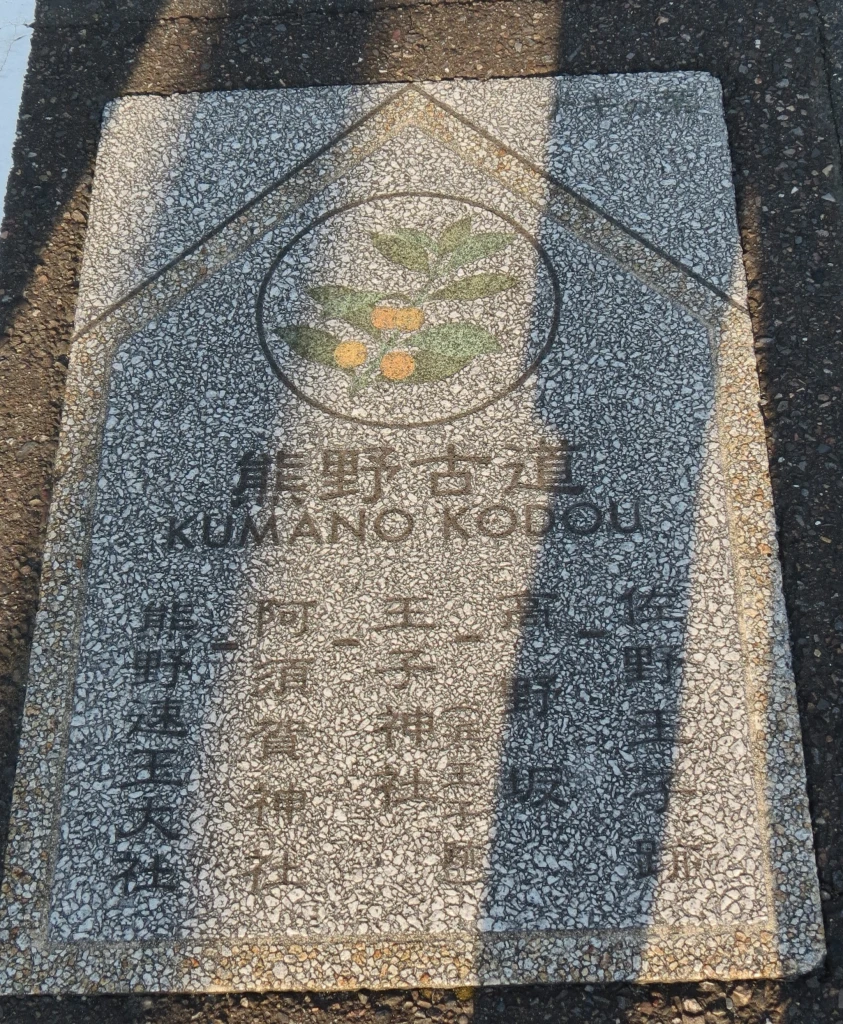
We continue our second trip to Japan. On this occasion we visited Kumano Kodo – Gifu – Nagoya – Nakasendo and Tokyo.
July 24th
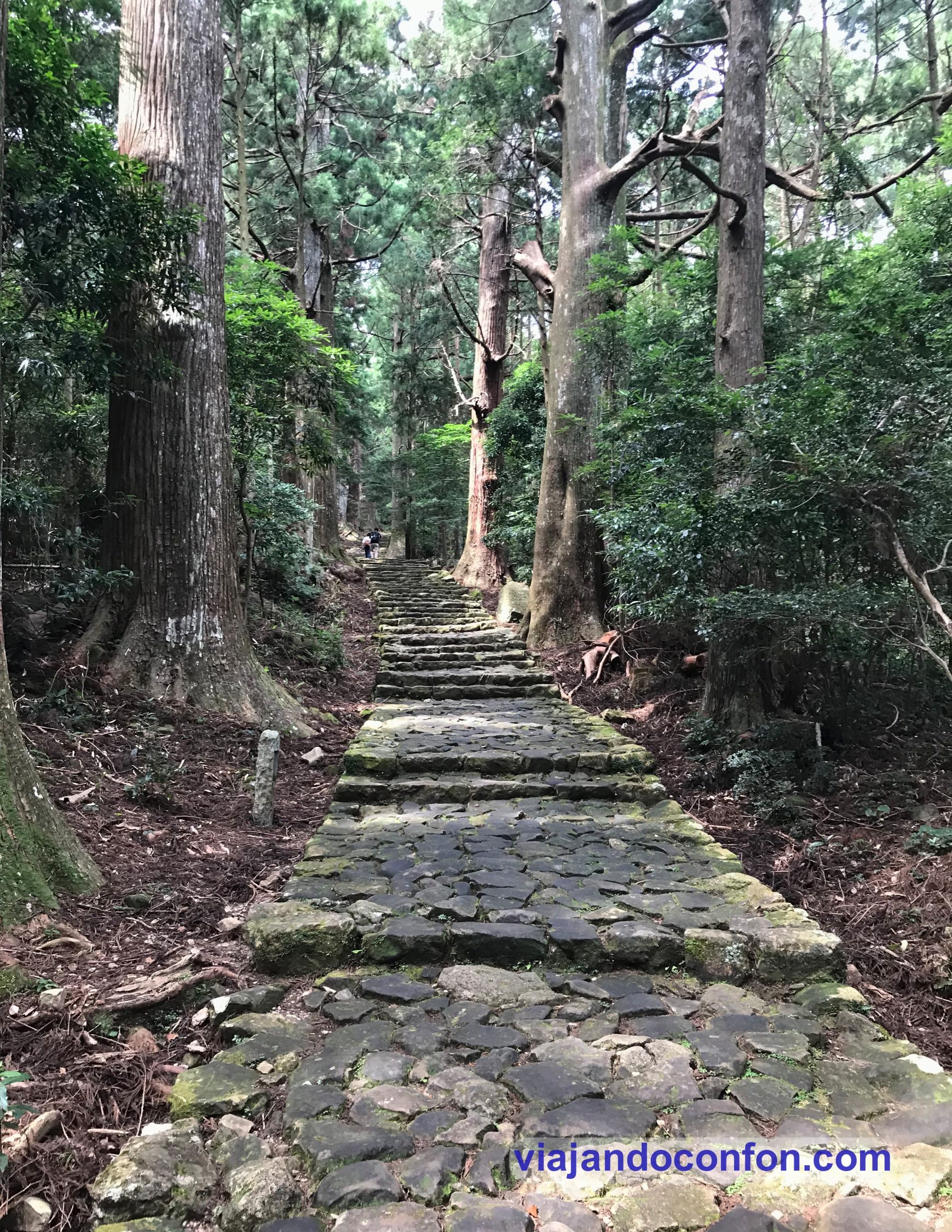
We got up early and at 8 in the morning we were already on the bus on the way to Daimonzaka. In front of the train station, take the 31 bus that goes to the Kumano Nachi Taisa Grand Shrine (熊野那智大社). The return ticket costs 1,000 yen (€7.50). About half an hour later we arrived at the stop on the Daimonzaka slope. There we began the path of ascension towards the temples.
The Daimonzaka slope (大門坂), is a beautiful path of just under 1km long and 267 steps that goes between gigantic cedars.
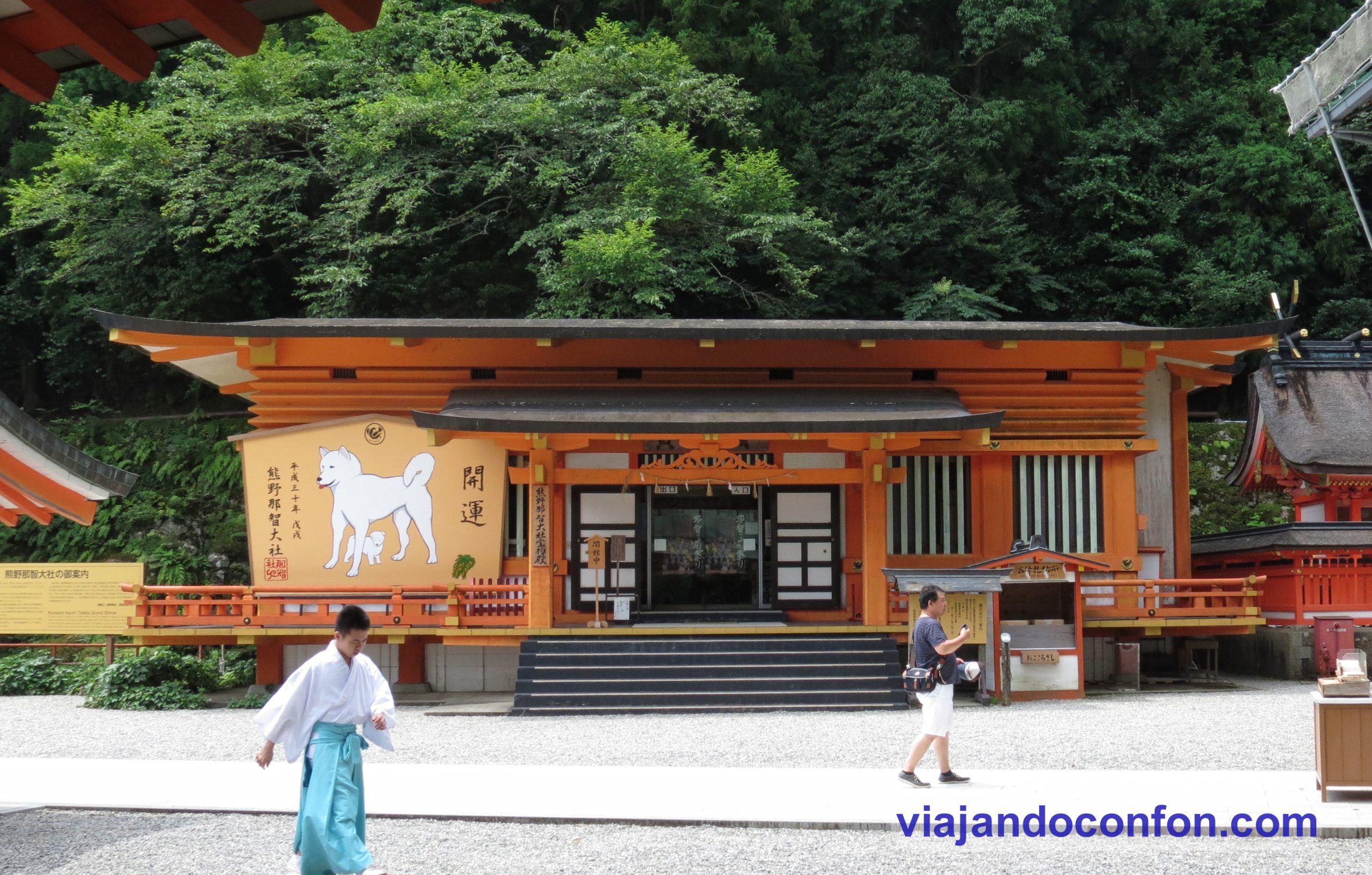
After the ascent in the humid heat of the area, we arrived at the Kumano Nachi Taisa Grand Shrine (熊野那智大社). It is the main sanctuary of the more than 4,000 Kumano Kodo. Unfortunately, we caught the temple under construction and it was completely covered, but it was possible to access it.
Treasure Hall (熊野那智大社宝物殿)
Here we find a viewpoint where we can observe spectacular views of the entire valley.
Right next door is Seiganto-ji Temple (青岸渡寺), a Buddhist temple of the Tendai school dating back to the 5th century. It is the oldest building in the Kumano Kodo.
As soon as we leave, we find the best-known image of the Kumano Kodo and one of the best-known in Japan: the Nachi waterfall behind a three-story red pagoda.
Kumano Nachi Taisa Grand Shrine (熊野那智大社)
The pagoda of the Seiganto-ji temple (青岸渡寺) is a very recent construction dating from 1972. You can go up paying but we did not.
At the exit of the temple, we find some stairs that, between huge cedars and camphor trees, go down to the Hirō sanctuary (飛瀧神社), at the foot of the impressive 133-meter-high Nachi waterfall.
Altogether the view is truly impressive.
The only bad thing is that then you have to go up the stairs again.
Just after the stairs is the bus stop where we take the bus back to Kii-Katsuura, after having an ice cream to mitigate the heat.
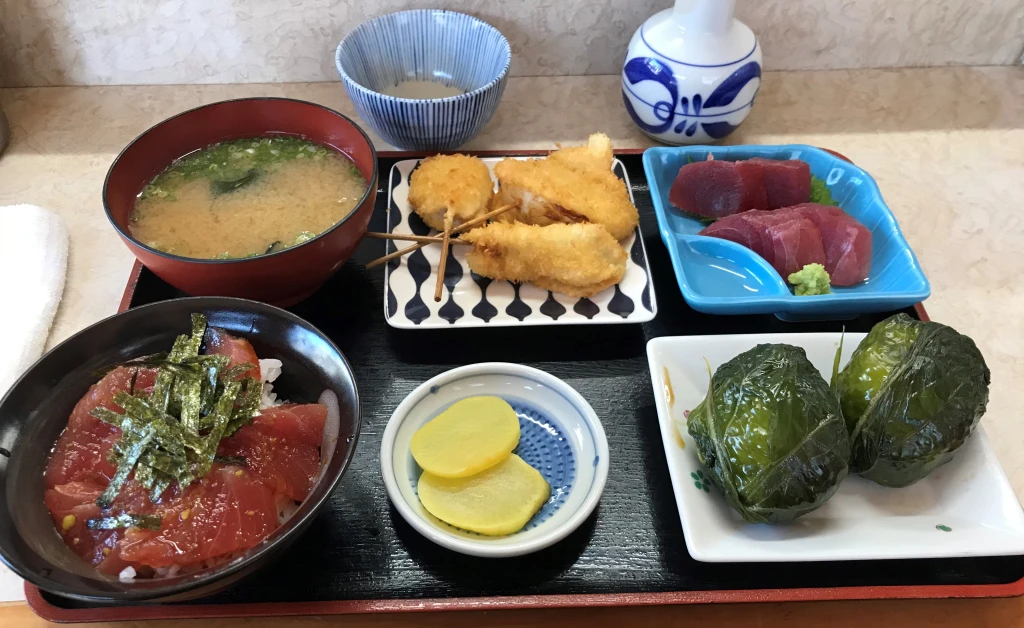
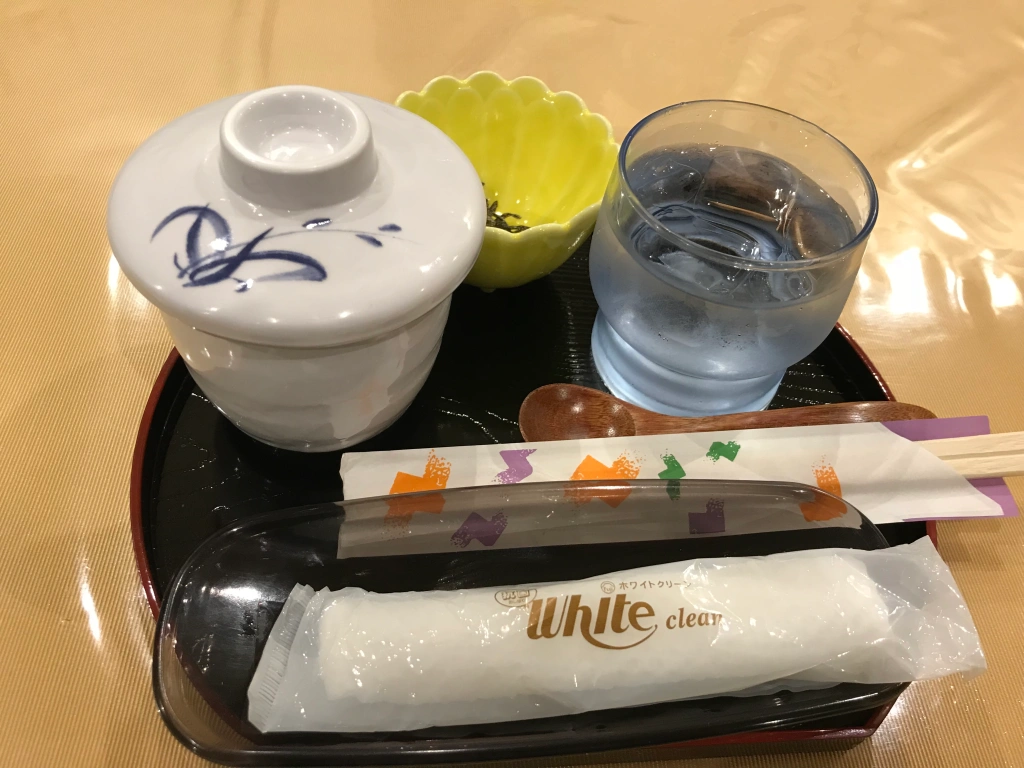
Back in the city, we ate at a small restaurant that the hotel owner recommended to us called めはり寿司二代目 (Mehari zushi nidaime). She is run by a very serious man, who only speaks Japanese, but has a menu in English. For 1,400 yen (€10) he gave us a varied menu with a tuna sashimi from the area that was delicious.
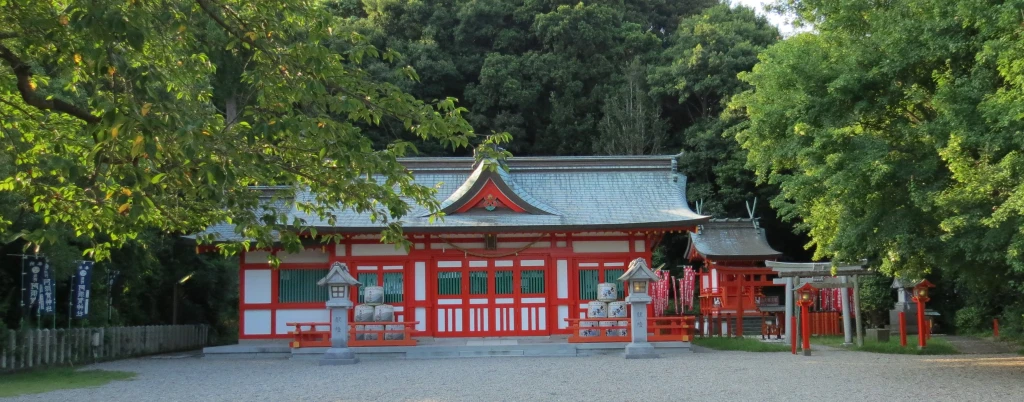
As soon as we finished eating, we ran to the train station and there we took the Limited Express Kuroshio at 4:15 p.m. and at 4:38 p.m. we got off at Shingu to visit the great shrine of Kumano Hayatama Taisha (熊野速玉大社). Unfortunately it closed at 5:00 p.m. and we caught it closing. Even so, we were able to walk around the enclosure and the truth is that the race we gave ourselves was worth it.
Taking advantage of the fact that we had gone to Shingu, we took a walk through the city to the castle ruins, from which there are beautiful views of the city on one side and the Kumano river on the other.
Shinkumanoo Bridge from the castle ruins
Descending from the castle we approached the small temple of Asuka, one of the auxiliary temples of the great sanctuary of Kumano Hayatama Taisha (熊野速玉大社).
Already exhausted we went to the station to return to Kii-Katsuura. But along the way we came across a building that seemed to be Chinese in style, which turned out to be Jofuku Park. It is a small park dedicated to Jofuku, a character sent to Shingu more than 2,000 years ago in search of the elixir of life.
Jofuku Park
At 19.02 we got on the train back. At the hotel, the owner offered us the sweet soup that she had told us about when we arrived the day before. It was a very, very sweet bean soup, but it tasted great and it went well as a snack.
After the exquisite snack we went to relax a bit at a nearby onsen. We chose the one from a luxury hotel called Katsuura Gyoen. It is a beach hotel but by paying 2,000 Yen (€16) per person you can use the onsen. This is amazing, it has a huge indoor and outdoor hot water pool with decoration as if you were in the countryside, it has a large hot pool and a smaller warm water pool. They want to stay there to live.
With the mountains in the background it was night and, to add more magic, there was a moment of the night when fireworks were set off. It was spectacular.
Already very relaxed after a hard day we went back to the hotel, after going through the familymart to catch dinner and sleep because the next day we had to get up super early.
July 25th
Today, around 6.30 we got up. We were going to see the tuna auction at the nearby KII-Katsuura fish market. At 7 we were already in the ship, from where we could admire all the bustle of the auction.
At the end of the auction, we sit for a while in one of the many onsen for feet that are scattered around the town, which are also free. There we relaxed our feet for a while before taking the train to Nagoya.
At 8.55 we took the direct train to Nagoya where we arrived at 12.41 noon. We left our things at the hotel (the same as a week before) and ran to the nearby city of Gifu.
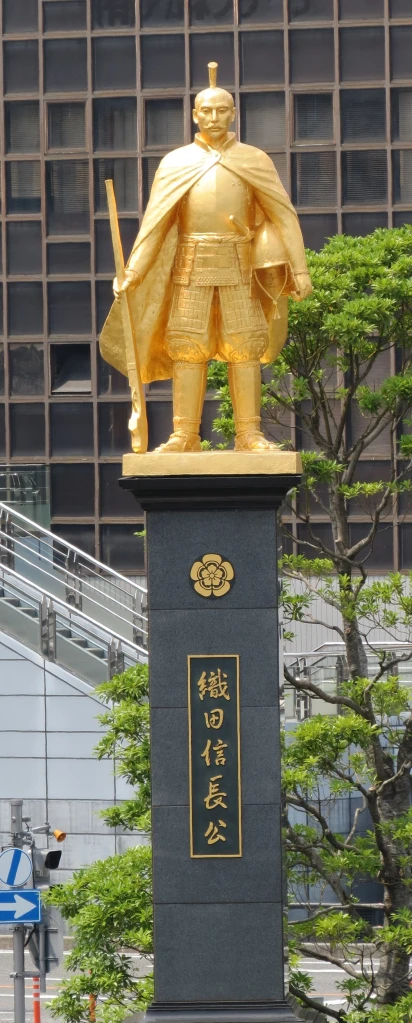
In Gifu, just outside the station we have a golden statue of the famous daimyō Oda Nobunaga (織田 信 長), who lived for 9 years in Gifu and was the base where he began to unify the country. This historical character is present throughout the city.
Oda Nobunaga
Right there we got on bus no. 80 to visit Mount Kinka (金華山), which is where Gifu Castle (岐阜城) is located. But before going up, we pass the Shōbō temple at the base of the mount.
In this temple is the Great Buddha of Gifu (岐阜大仏). A seated image of Shaka Nyorai. The image, which measures more than 13 meters, was completed in 1832.
After visiting the small temple we went to a familymart to hydrate ourselves a bit and cool off in the air conditioning and we continued on.
We took a walk in Gifu Park while going in search of the castle cable car. The cable car costs 620 yen one way (€5) and 1,080 return (€8.70). This time we took a round trip since after so many days we were starting to get tired and it was very hot.
The trip lasts about 5 minutes and a girl will explain things to you in Japanese, I suppose about the views and the castle. We were the only westerners there.
The views from the top are truly spectacular. For 200 yen (€1.60) you can enter the castle and look at the views but we didn’t. The views were already spectacular enough from the base of the tower. We settle for seeing them from there.
We went back down by cable car as we were quite tired. We took another short walk through Gifu Park and returned to Nagoya for dinner.
As we were about to leave the hotel, one of the heaviest downpours we have ever experienced fell. In no time, rivers formed in the streets.
We had dinner at the Sekai no Yamachan Ikeshita-ten restaurant, a chain specializing in typical Nagoya wings. The truth is that it was an ode to frying. It was good but too expensive for a fry up. It cost us 3,369 yen (€27).
After dinner we took a short walk through the Sakae area, going up to the terrace of the Oasis 21 building, which is a bus station and shopping center, from where you can see the Nagoya tower in all its splendor.
July 26th
We get up super early again. Today is a new hiking route: The Nakasendo route. It is an old route that linked Kyoto with Edo (present-day Tokyo). We did the most famous route, which is the one that joins the towns of Magome and Tsumago.
At 8 in the morning we took the Shinano Limited Express train line to Nakatsugawa, where we arrived at 8:49.
While we were waiting for the bus, we went around the tourist office, which is also a huge souvenir shop next to the train and bus station. There I bought a fish-shaped pastry that was like a kind of dorayaki filled with watermelon paste. It was very tasty by the way.
At 9.10 the bus left for Magome. The ticket costs 560 yen (€4.60) and takes, in principle, about 25 minutes. I say in principle because before leaving Nakatsugawa we had an accident against a car that left us standing for ten minutes until another bus was sent to pick us up.
Around 9:45 we arrive at Magome, rest station number 43 on the old Nakasendo route.
View from the bus stop.
In the town there are some museums but we started directly. Things start off well since the town is uphill. As soon as we start, we gather strength by buying a kind of dorayaki stuffed with roasted chestnuts at a stall. Exquisite.
In the middle of the town we find the tourist office. They offer you various services. You can take a map, you can buy or rent bells to scare off the bears and they also have a left-luggage service (for a fee) to leave your suitcases. They also give you all kinds of information about the route.
The town is well cared for and beautiful, although it seems that it is only because it is oriented towards tourism as if it were a theme park.
We continue going up to the end of the town where there is a viewpoint where we take a break to admire the impressive views of the valley. The views in winter have to be spectacular with the snowy valley.
We follow the road, from here, 7.6 km separate us from Tsumago.
Along the way we find bells to ring and scare the bears away. The truth is that I don’t know if they really work because we didn’t see a single one on the entire route.
About two kilometers away we find the Kumano-jinja sanctuary (熊野神社), a good place to take a short break in the shade.
We continue in the spectacular wooded environment scaring bears. The truth is that the route is really impressive.
After about 3 km we find a tea house in the middle of the forest. There they offer us rest in the fresh air and a tea in exchange for a tip.
A little further on we sat in the shade to eat some sandwiches that we had brought for lunch.
The tranquility of the environment infects you and you take it very calmly. A tranquility that is only broken when a tourist passes by doing the route. Especially if he’s wearing a scary bell.
After gaining strength we continue the path. Several kilometers later we leave the forest and the path continues through an area of orchards until it reaches Tsumago, rest station number 42 on the old Nakasendo route.
Tsumago gives the impression of being less artificial than Magome, but it is still noticeable that it is very well cared for thanks to tourism.
It has several points of interest such as the Kotokuji temple or the Nagiso museum, passing through craft shops.
It also has a tourist information office where they give you all kinds of information and where there is Wi-Fi and you can rest in the cool air.
We took a short walk through the town and got on the bus to the nearby town of Nagiso. There we take the train back to Nagoya at 16:55.
At 18.05 we were already in Nagoya. We went straight to the hotel to take a shower and immediately went to the street to take a walk around Nagoya.
We were walking around the commercial area of Sakae. At the sunshine mall there was a little concert by some kind of boy idol group and it was all pretty funny.
From how organized the followers were to the dances they did.
We went to freak out for a while at the pokemon center. It is located inside the luxurious Matsuzakaya shopping center (I don’t know how they let us in with the pints we were wearing).
Since we hadn’t walked enough that day, we went in search of Nagoya Castle.
At that time it was already closed but we went around the moat hoping to see it but we only managed to see the highest part and several defense towers.
After the huge tour we did, we went back to the Sakae area to eat a delicious tonkotsu ramen in one of the Ichirán chain stores. And with a warm belly to the hotel to rest the 28 kilometers that we had walked that day.
July 27th
This is starting to end, it’s time to return to Tokyo. We took the shinkansen early to make the most of the day.
Around 10 in the morning we were already in Tokyo. We left our things at the hotel, which was the same as the first few days, and we went to Asakusa.
Due to personal circumstances, in 2017 I promised to return to Senso-ji Temple one day to make an offering. Promised is debt.
There were so many people that instead of going down Nakamise street, we went down one of the parallel streets. Wonderful idea because there we discovered a place where you can get melonpan filled with ice cream, what a delight!
Before entering the temple we purify ourselves with incense. We make our queue, and make the promised offering.
Then we take out an omikuji through the stick system with the number in Japanese (thank goodness there is always someone to help you).
As this time the omikuji predicted “the best” of luck, instead of leaving it at the temple, I brought it home.
There were so many people that it was uncomfortable to walk around the temple grounds. We went out the back door in search of an ice cream shop specializing in matcha tea ice cream. They have different intensities of flavor, which I had seen on a blog.
It’s called Suzukien Asakusa (壽々喜園). We did our queue and I ordered with intensity 5. It was delicious. While we were at it I bought a jar of matcha tea to bring home.
From there we went to Shinbashi to eat karaage (Japanese fried chicken) at a place we knew in 2016 and loved it is called Karayama Shinbashi (からやま 新橋店).
On that day the traffic in the area was cut off and in the station square there was a kind of festival where there were food stalls and a stage where traditional dance performances were being staged.
From there we went for a walk in Shinjuku. We visited a few shopping malls and happened upon the official store of the 2020 Olympics that had opened two days earlier.
Near sunset, we went up to the observation deck of the Metropolitan Government Building.
The observation deck has breathtaking 360º views and it is said that on clear days you can see Mount Fuji. Three attempts in two years and we still can’t see it.
The views as the sun goes down and the city lights up are amazing. There is also air conditioning, vending machines, gift store, wifi and a restaurant, and admission is free.
Find the best activities at the best price in Tokyo with Civitatis:
On the way back from the viewpoint, already at night, we went for a walk in Kabukicho. It is the adult entertainment area par excellence in Tokyo.
There are numerous gigantic karaokes, bars, nightclubs and love hotels. Both for men and women. Although most of them are run by the yakuza or Japanese mafia.
I have read in some blogs that the PR people are very aggressive. I don’t know if it was because I went with my partner but they didn’t say anything to us.
Kabukicho
The truth is that it is a very curious walk with buildings full of neon and local geeks like the robot restaurant or the giant godzilla in a multiplex.
From here we went back to Kamata, the neighborhood where we have the hotel. There, next to the JR station, there is a ribbon sushi restaurant that we discovered in 2016 that is delicious and relatively cheap. The Sushi Matsu Kamata 2 gōten (すし松 蒲田2号店). We ate a total of 12 dishes and it cost us 2,980 yen (22€).
That night we go to bed with uncertainty as a typhoon is expected to pass through Tokyo the next day.
Buy your Japan Rail Pass
Buy with Japan Experience your Japan Rail Pass at the best price. You can travel around Japan for 7, 14 or 21 days.
It is raining in Tokyo at dawn. It seems that the expected typhoon is deflected and will only catch us by a glancing blow, so we go outside.
Today is a new excursion. We go to Kamakura to tour the area on the Enoden electric railway.
For this we take the Keihin-Tōhoku line to Yokohama and there we change to the Yokosuka line to Kamakura station, where the rain seemed to give a little respite.
Enoden electric railway
You can visit Kamakura with the beautiful Civitatis tour:
There we stamped our stamp booklet with the corresponding station stamp and made our way to the Buddhist temple Kōtoku-in (高徳院). This is where the great Buddha of Kamakura is located.
In 2016 we also visited him and bought a lucky charm, which I don’t know if it’s because of him or it’s coincidence, but from here I had a couple of very good years and with very, very good luck, so it was time to make a new offering of thanks, just in case. I am tremendously grateful to him.
We return to the Enoden in search of the next and main destination of the day: Enoshima island.
We get off at Enoshima station. We put the corresponding stamp and we go for a walk to cross the 600-meter bridge that connects Honshu with Enoshima and reach the island.
As we finish crossing the bridge, we arrive at Benten-Nakamise Street. The street is filled with small souvenir shops and tourist restaurants.
On this same street we cross a large bronze Torii that indicates that we are entering a street that leads to a Buddhist temple.
The torii was originally made of wood but was rebuilt in bronze in 1821.
At the end of the street we find a large red Torii that indicates the entrance to the Enoshima Shrine. Next, a few steps after the Zuishinmon gate.
Just before the gate, on the left hand side we can get a ticket for about 400 yen (3.22 €) to go up the escalators, but we decided to walk up which was more charming. By the way, the escalators are only for going up. To go down, you have to walk.
We continued climbing and arrived at the Enoshima Shrine complex.
Enoshima Shrine
It is a complex of three pavilions: the Hetsunomiya shrine, founded in 1206 and dedicated to the deity of the three sisters.
The Hoanden Hall where the statues of Happi Benzaiten from 1182 and Hadaka Benzaiten, from the Edo period, are located.
It is dedicated to the three goddesses of Munakata. Until the Edo period, it was dedicated to Benzaiten and was called Eshima Benten or Eshima Myojin.
The current enshrined deity was changed when Shinto and Buddhism separated in the Meiji period.
From here we have a nice view of Benten-Nakamise Street and the city and its beaches.
We continued climbing and reached another impressive viewpoint with even better views than the other one.
There was a post with a small platform that turned out to be a place to rest the camera on the cell phone to take a selfie. Later on we would see more of these very well placed posts.
A little further on from the viewpoint, without going any higher… we arrive at the second shrine of Enoshima: the Nakatsunomiya shrine.
Built in 853 and rebuilt in 1689 by order of the Tokugawa Tsunayoshi Shogun. It is dedicated to Ichikishima Hime no Mikoto.
A little further up we find the Samuel Cocking Gardens. It is an extensive garden of tropical plants created in 1880 by the British merchant Samuel Cocking.
As we did not have much time and there was an entrance fee, we passed on going in and continued on our way.
We took a walk around the upper part of the island and went on our way to the modern Buddhist temple Enoshima Daishi.
Built in 1993 and known for its huge 6 meter statue of Fudomyo. Inside they were performing some very curious chanting ceremonies in front of the fire that could be accessed without problems.
We continued our walk leaving behind small souvenir shops and restaurants. One of the locals that had caught our attention, since the door indicated that only locals, i.e. Japanese, were allowed.
We had read on some websites and blogs that this happened in Japan, but this is the first and only place where we have seen it. Although I do not justify it, I imagine that they have had some bad experience with foreigners, but the U.S. flag was well placed on the door ¿?¿?¿?
selfie post
After passing these small streets, we arrived at the last and oldest of the three shrines of Enoshima: the Okutsunomiya Shrine.
It was destroyed by fire in 1841 and was rebuilt the following year.
One of the pavilions that caught my attention at the shrine was the Ejima Ryugu Shrine. It is a small shrine built in 1993 in a cave with a dragon at the top of the entrance.
The pity is that it was closed that day and we could not go in to see it. Just in front of it we found another post to take selfies.
Ejima Ryugu
Nearby we find the lovers’ bell, which couples ring together and where they leave padlocks with their names on one of the fences near the bell. It also has its corresponding selfie pole and this gives a very good service, we can attest.
From here comes the good part, we start going down stairs… and down… and down… and down… and then we have to go up… and up… and up… until we reach the sea level.
There after a short walk along the rocky shore we arrived at the Enoshima Iwaya caves, which are caves that were created by tidal erosion.
We climbed back up the stairs and went all the way across the island on our way to Enoden again.
We got on the train and stopped at Gokurakuji station, which is basically a halt. By this time it was starting to pour rain but we still got out to see Shinsho Gokuraku-ji Temple (極楽寺). It is a temple of the Shingon Risshu sect built in the year 1,259.
Between the heavy rain and the time it was, it didn’t take us long to visit. In a while we were back at the Enoden station to take the next train.
Shortly after we got off again at the final station Kamakura to look for a place to eat under the rain of the typhoon.
The rain seemed to give a little respite and wandering around, we found a ramen place run by a rather old lady. There were only 3 or 4 tables.
We ordered a fried rice that was delicious and a ramen that was to lick the bowl. One of the best we have ever had.
The bad thing is that the name was in Japanese and does not appear in the street view. A pity to be able to recommend it.
While I was in the restaurant, the downpour started again. On top of that, on the way to the station my umbrella broke.
Back in Tokyo, we went to the Sunshine city mall in Ikebukuro, looking for some manga comics that I was looking for in a book off.
I found it and since it was closing time, my partner went to pay while I went to the bathroom. There something curious happened to him. The cashier came to talk to her in Japanese, and she was thinking that she was a westerner and that she didn’t understand a word. Until she realized that, of course, she was supposed to be speaking Japanese when she was getting 4 comics in her own language… Anyway… tourists.
After the experience and taking advantage of our last night in Japan and that it had stopped raining, we went to Akihabara for dinner and a last stroll through the freaky electronic town.
And to sleep.
July 29th
Last day in Japan and we have to take advantage of it. Today it’s time for a good geeky day.
We went to the neighborhood of Katsushika to see the statues of the anime series Captain Tsubasa. The only regret I have is that months later they renovated the station and made it even more themed.
To get there we took the private Keikyū Main Line, for 580¥ (4.40€), from Shinagawa station to the small station Yotsugi station.
As soon as we got out of the station we found the map of where the statues are. We started with the Bruce Harper statue next to the entrance to the station and from there, a walk through the neighborhood to find the 7 statues related to the series.
These statues are located there because the creator was from this neighborhood and they were placed there as a tribute and, by the way, to attract some tourism to the neighborhood.
The whole neighborhood is dedicated to soccer in every corner. We went looking for each and every statue until we arrived at Keisei Tateishi station where we took the train back to the south of Tokyo.
We got off at the Kabuki Theater stop. We were going in search of the Totobe restaurant. A simple sushi restaurant near Tsukiji that we discovered in 2016 where only Japanese workers had been eating. No tourists so it was great and cheap. But we were very unlucky and it turned out that they are not open on Sundays. Cachis la mar. It was time to look for a place to eat.
We decided to take the subway to Tokyo station to eat an exquisite ramen in Tokyo ramen street in a place that we also discovered in 2016. It is the Rokurinsha restaurant. To enter you have to queue for quite a while but it is worth the wait.
To end the visit in the country, we went to Harajuku for a last walk along the most geeky street: TakeshitaDori. We bought some gifts at the Daiso and strolled along the luxurious Omotesando street.
Already exhausted, we picked up our bags from the hotel and went to the airport. The flight was leaving Haneda at 21:55.
As soon as we arrived, we were told that there was a delay. We went to the counters to ask, and they told us that the baggage belts were not working. In an hour they would give the news over the loudspeaker again. We were given a voucher for 1,500 yen (12€) per head for dinner at the airport.
We left our bags there and went in search of a place to have dinner.
Haneda airport is inspired by the Edo period and the truth is that it is very cool. We decided to have dinner at a ribbon sushi place that was exquisite.
Finally, two hours later than planned, we took off for Paris and with this we said goodbye to Japan until next time. We will be back to Japan (hopefully in 202120222024 2026).
Discover the best activities and tours at the best price in Japan with Civitatis:
El JR Pass (Japan Rail Pass) es un pase de tren específico para extranjeros. Con el que puedes hacer viajes ilimitados en todos los trenes de la empresa Japan Rail salvo los Shinkansen NOZOMI, MIZUHO y HAYABUSA, que son los más rápidos.
El JR Pass se puede adquirir para 7, 14 ó 21 dias y tiene 2 clases: la Green Class, que viene a ser primera; y la clase estándar.
Los precios en esta tabla son los oficiales de JR pero al comprarlo, cualquier agencia te va a cobrar una comisión.
Comprar JR Pass
Compra con Japan Experience tu JR Pass al mejor precio. Podrás viajar por Japón durante 7, 14 o 21 días.
Como recomendación te diría que estudiaras bien los trayectos que vas a hacer a ver si te compensa. Pero por ejemplo, solamente Tokio-Kioto ida y vuelta ya son ¥27.700.
Se puede adquirir en online y hay que comprarlo dentro de los 90 días antes de activarlo.
Es accesible sólo a los visitantes con pasaporte extranjero con un visado “temporary visitor”. Es decir, que no exceda los 90 días de estancia en el país.
Condiciones:
Es válido para todas las líneas de la empresa Japan Rail de Japón excepto los Shinkansen Nozomi y Mizuho.
También es válido para el JR Miyajima.
También se puede usar en el Monorraíl de Tokio, así como en algunos autobuses locales de Japan Rail.
Están incluidas tambien algunas líneas de tren de Aormori.
El pase debe comprarse dentro de los 90 días anteriores a su validación.
El JR Pass es personal e intransferible. Para activarlo es necesario el pasaporte y debe llevarlo siempre consigo. El personal de la estación puede comprobarlo.
Para resrvar asiento hay que dirigirse a una oficina de JR. Es gratuito.
La fecha de activación del pase, una vez canjeado, no puede modificarse.
Alquila un Pocket Wifi
La mejor manera de tener conexión ilimitada a internet al mejor precio.
On this page you can find general information about the beautiful city of Kyoto, from its history to learning how to get around.
Find your ideal hotel at the best price in Kyoto with Agoda:
*It helps us to maintain the blog
Kyoto (京都市) is the 7th most populous city in Japan with almost 1.5 million inhabitants. It was the capital of Japan between 794 and 1868 and was home to the Imperial Court.
During World War II it was the only major Japanese city to escape the Allied bombing raids. For this reason, its rich historical, artistic and architectural heritage remains intact.
Para ofrecer las mejores experiencias, utilizamos tecnologías como las cookies para almacenar y/o acceder a la información del dispositivo. El consentimiento de estas tecnologías nos permitirá procesar datos como el comportamiento de navegación o las identificaciones únicas en este sitio. No consentir o retirar el consentimiento, puede afectar negativamente a ciertas características y funciones.
Funcional
Siempre activo
El almacenamiento o acceso técnico es estrictamente necesario para el propósito legítimo de permitir el uso de un servicio específico explícitamente solicitado por el abonado o usuario, o con el único propósito de llevar a cabo la transmisión de una comunicación a través de una red de comunicaciones electrónicas.
Preferencias
El almacenamiento o acceso técnico es necesario para la finalidad legítima de almacenar preferencias no solicitadas por el abonado o usuario.
Estadísticas
El almacenamiento o acceso técnico que es utilizado exclusivamente con fines estadísticos.El almacenamiento o acceso técnico que se utiliza exclusivamente con fines estadísticos anónimos. Sin un requerimiento, el cumplimiento voluntario por parte de tu Proveedor de servicios de Internet, o los registros adicionales de un tercero, la información almacenada o recuperada sólo para este propósito no se puede utilizar para identificarte.
Marketing
El almacenamiento o acceso técnico es necesario para crear perfiles de usuario para enviar publicidad, o para rastrear al usuario en una web o en varias web con fines de marketing similares.